A 2026 Typeform report found that 68% of teams use four or more platforms between lead capture and first response, while 87% hand leads off at least twice before anyone replies. Only 51% automatically send a follow-up email after a form submission, and 69% still take more than 24 hours to respond to at least a quarter of their leads. (Typeform's data report)
That's the core lead follow up automation problem for consulting firms. Speed matters, but speed without ownership just moves a lead faster into the wrong queue. A reliable system must capture the inquiry, enrich the record, assign responsibility, coordinate communication, track the proposal, and keep the next action visible until the prospect reaches a decision.
Table of Contents
- Why Speed Alone Does Not Solve Follow-Up
- Core Components of Lead Follow Up Automation
- Automated Sequences That Move Consulting Prospects Forward
- Purpose-Built Automation Versus Generic CRM Workflows
- KPIs That Reveal Follow-Up Health
- Implementation Considerations for Small Consulting Teams
- Building Follow-Up as Core Revenue Infrastructure
Why Speed Alone Does Not Solve Follow-Up
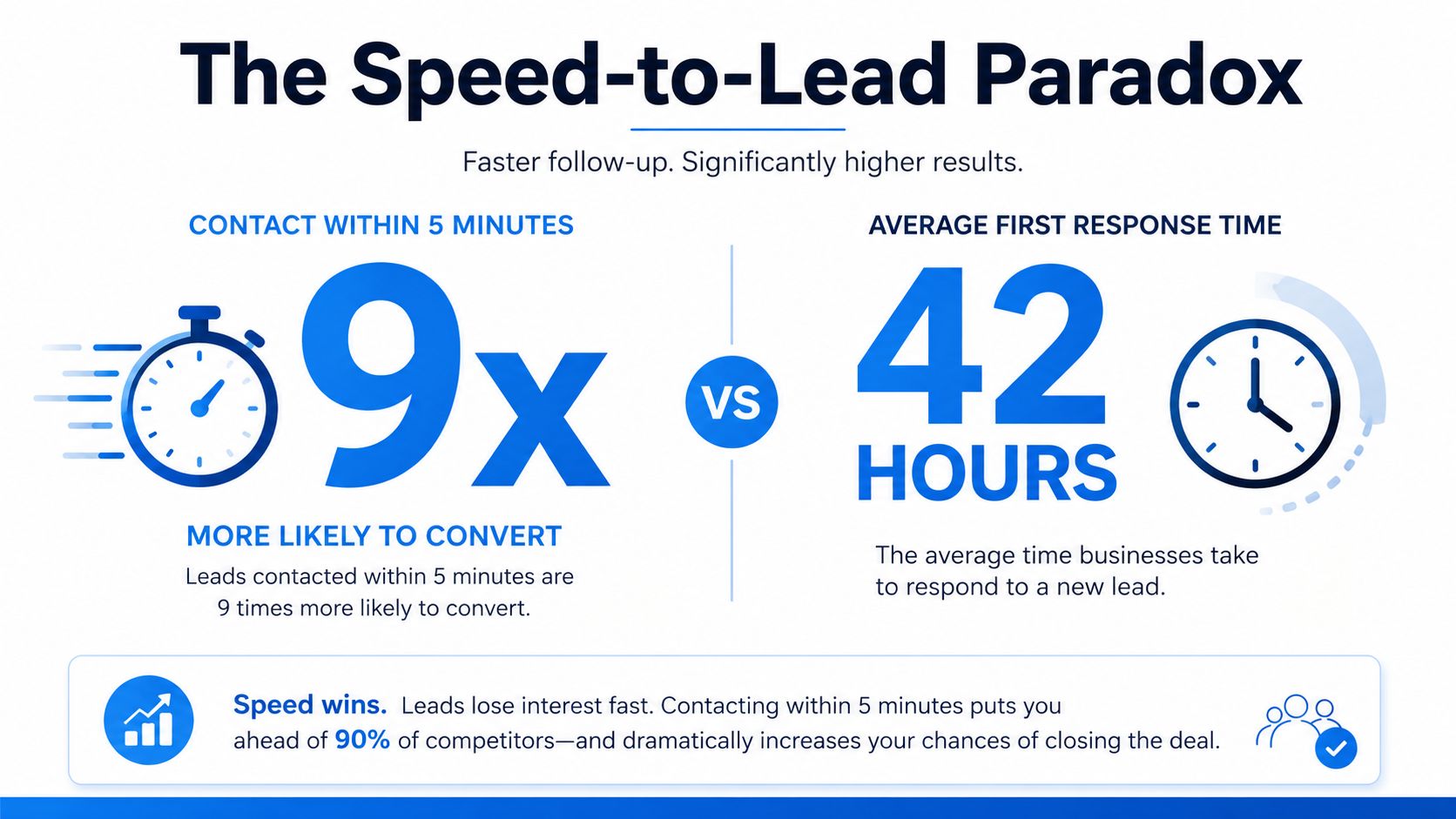
Research associated with MIT and InsideSales.com found that contacting a lead within 5 minutes made a company 21 times more likely to qualify the lead than contacting the lead after 30 minutes, and 100 times more likely to connect than waiting longer. The same research line found that after 24 hours, leads could be 60 times less likely to qualify than when contacted in the first hour. (MIT and InsideSales.com research)
The finding is useful, but it can produce the wrong operational response. A partner may demand that someone replies immediately, while the form sits in a shared inbox, the CRM record lacks an owner, and the calendar link routes to an unavailable consultant. The firm technically responds quickly, yet the prospect still experiences confusion, repetition, or silence after the first exchange.
The hidden failure happens after capture
Consulting opportunities move through several human roles. Marketing may generate the inquiry, an operations coordinator may review it, a partner may qualify it, and a delivery lead may shape the recommendation. Each handoff creates a chance for missing context, duplicate outreach, or an assumption that someone else will act.
Historical benchmarks show the scale of the gap. Average B2B response time has been reported at about 29 hours, while broader benchmarks cite 42 to 47 hours for a first response. A 2017 sales effectiveness report found that only 13% of companies responded within 5 minutes. (Lead response time benchmarks)
Automation should therefore enforce ownership, not merely send an acknowledgment. When a high-intent inquiry arrives, the system should assign a named owner, record the source, create the response task, and escalate if the task remains incomplete. The partner should see the reason for the alert and the conversation history, not just a generic notification.
Practical rule: Automate the gap between one person's responsibility ending and the next person's responsibility beginning.
Follow-up is a journey, not an email
A consulting firm needs a connected path from form submission to discovery call, proposal, negotiation, decision, and onboarding. If the system only automates the first email, the firm may improve response time while leaving the most valuable stage, the proposal-to-decision gap, untouched.
Lead follow up automation works when every stage has a trigger, an owner, a time expectation, and an exit condition. That structure protects the prospect's experience while allowing partners to reserve their attention for judgment, trust-building, and complex commercial conversations.
Core Components of Lead Follow Up Automation
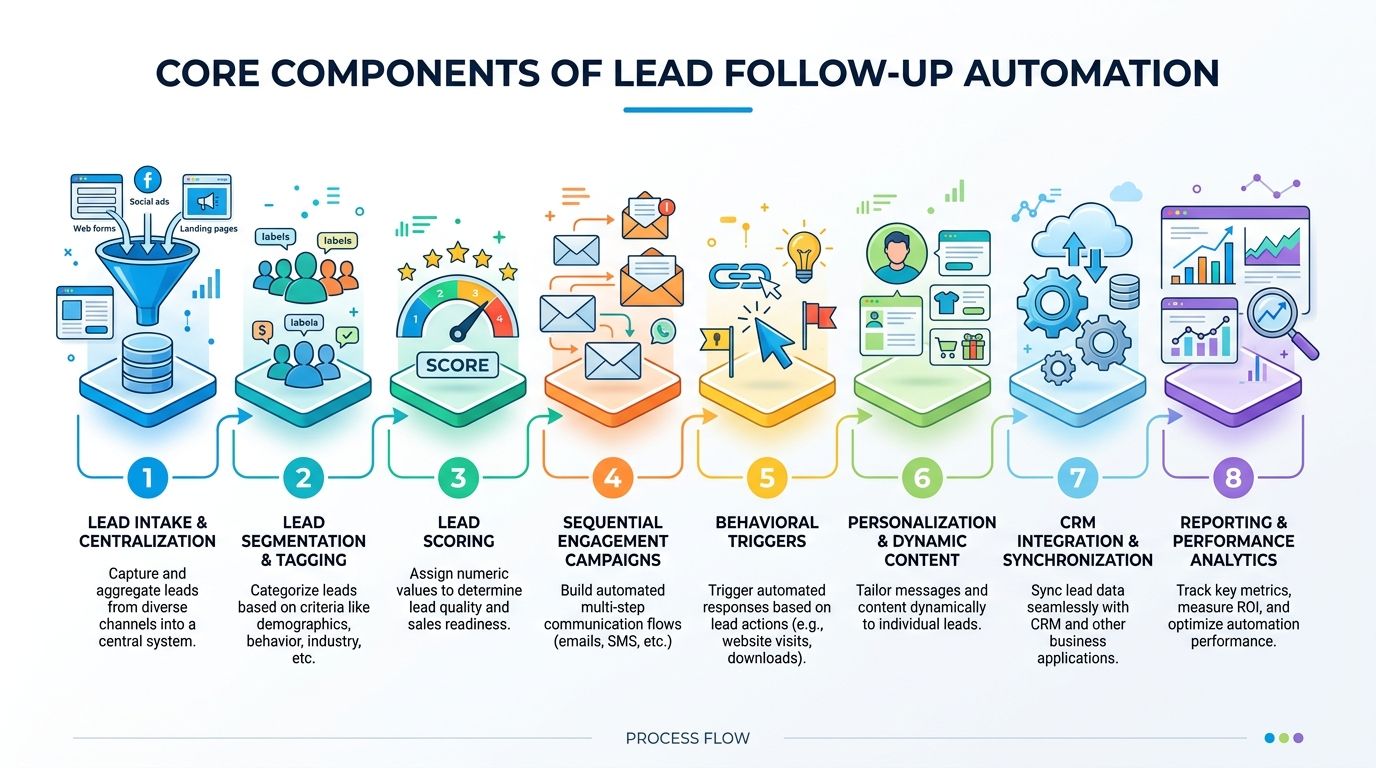
A consulting-grade system is a connected operating model, not a collection of isolated recipes. The essential components are capture and enrichment, scoring and routing, coordinated outreach, proposal-stage tracking, and feedback into marketing.
Capture and enrich the record
Every website form, inbox inquiry, LinkedIn conversation, event contact, and referral should create or update one contact record. Capture the original source, inquiry type, company, role, service interest, and any stated urgency. Enrichment can add firmographic context, but it shouldn't replace the prospect's own words.
For example, a transformation consultancy might route a form mentioning a multi-business-unit initiative differently from a form requesting an individual advisory session. The record should preserve both the structured fields and the original message so the partner can respond with relevance.
Score and route according to buying context
Scoring should reflect fit and intent, not just activity. A pricing request from an organization in the firm's target market may deserve a partner alert, while a general newsletter subscription can enter a nurture path. Routing rules can use service line, geography, account type, availability, or relationship history.
A useful system assigns one owner and defines what happens when that owner is unavailable. Shared queues create ambiguity. Round-robin assignment can distribute volume, but it may be a poor choice for complex advisory work where expertise or an existing relationship matters more than equal allocation.
Consulting firms evaluating lead management capabilities should look for a single timeline that connects assignment, communication, meetings, and stage changes.
Execute coordinated sequences
Email, calendar actions, phone tasks, and internal alerts should operate from the same stage logic. If a prospect books a discovery call, the system must stop the booking sequence and start appointment reminders. If the prospect replies with a substantive question, automation should pause and create a human handoff.
Track proposal movement
Proposal tracking bridges the gap that many CRM workflows leave blank. The system should record whether the prospect opened, shared, or commented on the proposal document, then create an appropriate next step. A viewed proposal may need a clarification call. An unopened proposal may need a concise reminder that confirms receipt. A proposal with multiple stakeholders may require a review meeting rather than another automated email.
Feed outcomes back to marketing
Marketing needs more than form volume. It needs to know which sources create qualified conversations, which messages lead to discovery calls, and where prospects stop progressing. Closed-lost reasons, proposal objections, and referral outcomes should inform content, qualification, and future routing.
These components must share stage definitions and ownership rules. Otherwise, one automation sends a message while another assigns a task, leaving the team with duplicate outreach and no reliable record of the next decision.
Automated Sequences That Move Consulting Prospects Forward
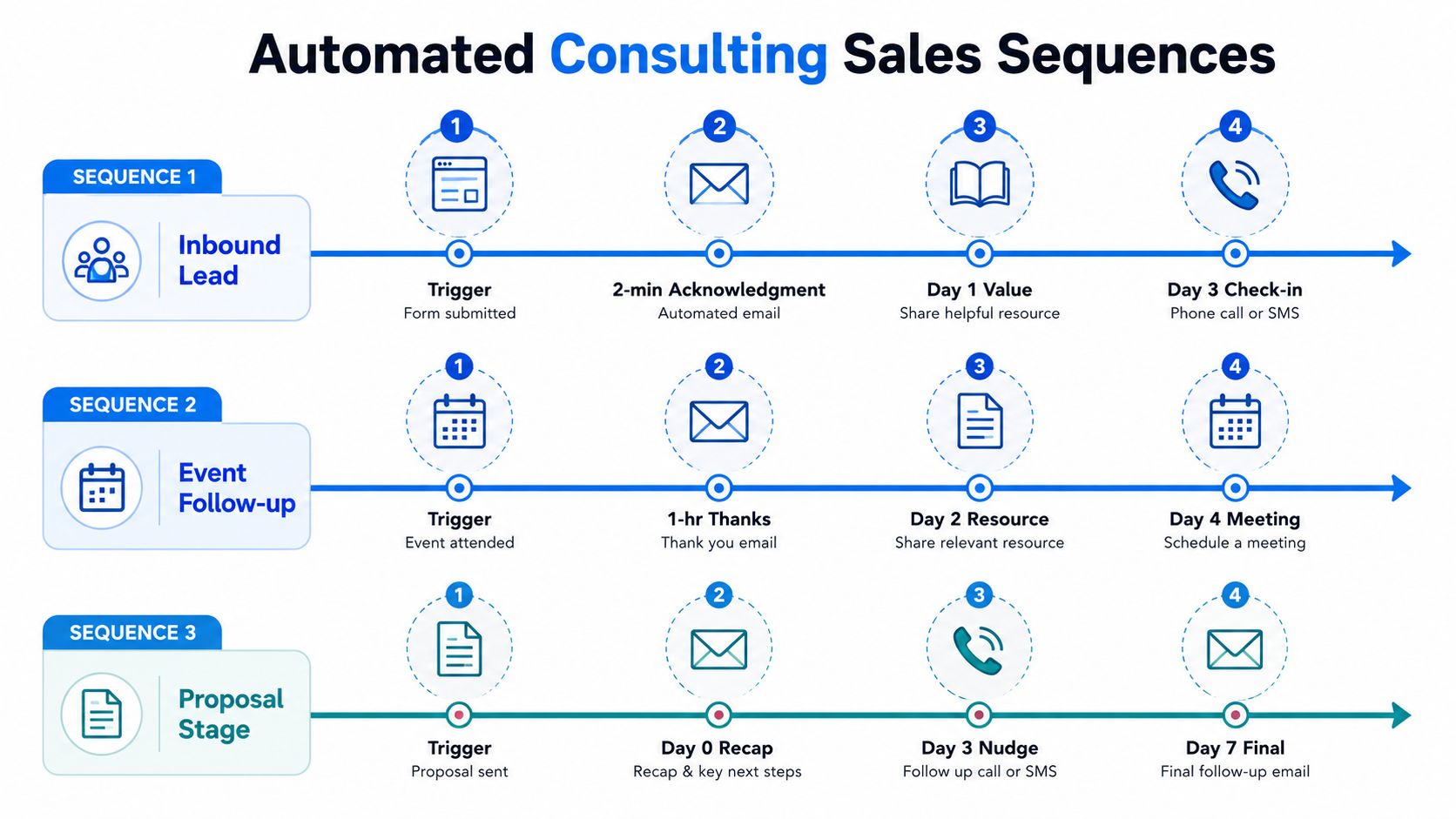
The strongest sequences are triggered by a meaningful event and end with a human decision. They don't attempt to imitate a partner indefinitely. They create momentum, collect context, and escalate when the prospect's situation requires judgment.
New inbound inquiry
Trigger: A prospect submits a high-intent form requesting a consultation, pricing information, or a callback.
Sequence: Send a personalized acknowledgment within two minutes, confirm what happens next, and offer a calendar link matched to the correct partner or service line. Create an internal task with the form details and the source channel. If no meeting is booked within 48 hours, alert the partner or business development owner for a personal follow-up.
The acknowledgment should confirm receipt without pretending that a consultant has reviewed the inquiry. It can mention the requested service and ask one useful preparation question, but it shouldn't deliver a long qualification survey before the first conversation.
Human handoff: The owner takes over when the prospect replies, books a meeting, asks about scope or pricing, or signals a strategic concern. The automation then pauses so the prospect doesn't receive a sequence message immediately after a personal exchange.
For firms building demand through content, email marketing lead generation should connect directly to this same capture and routing logic instead of creating a separate contact database.
Stalled proposal
Trigger: A proposal remains unopened for five days, or it has been viewed but remains unsigned for ten days.
Sequence: First confirm that the document reached the right person and offer to answer questions. Then send a value-reinforcement message tied to the prospect's stated objective, such as decision criteria, implementation considerations, or a relevant case study. If engagement remains absent, queue a personal call task for the engagement manager.
The system should account for proposal versioning. If the team issues a revised scope, the old proposal should no longer generate reminders. A prospect shouldn't receive a message referring to an earlier document after the commercial terms have changed.
Human handoff: The engagement manager decides whether to call, revise scope, involve another stakeholder, or close the opportunity as inactive. Automation can identify silence, but it can't reliably interpret whether silence means budget pressure, internal disagreement, lost urgency, or a competing priority.
Referral introduction
Trigger: A mutual contact introduces the prospect by email or a referral record is created.
Sequence: Send a warm context-setting response that acknowledges the connection and references the shared relationship. Offer a low-commitment diagnostic conversation rather than forcing a proposal discussion. If the prospect has no immediate need, move them into a relationship nurture track with useful, occasional updates.
Referral sequences require restraint. Frequent automated messages can make a trusted introduction feel transactional. The system should also notify the referrer when appropriate, especially after a conversation is booked or the opportunity reaches a meaningful stage.
Human handoff: A partner should own the first substantive reply. Automation can coordinate scheduling and reminders, but the relationship context belongs to a person.
Across all three sequences, define the stop conditions before launch. A reply, booked meeting, disqualification, opt-out, or change in stage should remove the prospect from irrelevant automation immediately.
Purpose-Built Automation Versus Generic CRM Workflows
Generic CRMs such as HubSpot and Salesforce can support complex sequences, but they often begin with a blank framework. That flexibility suits organizations with dedicated administrators. Small advisory firms may need fewer options and more reliable defaults, especially around proposal review, partner ownership, and delivery handoff.
The trade-off isn't just software capability. It's the operating burden required to keep every integration working as the pipeline changes.
| Capability | Generic CRM Workflows | Purpose-Built Consulting Automation |
|---|---|---|
| Lead routing logic | Highly configurable, but routing often requires custom fields, workflows, or external connectors | Usually organized around service lines, owners, referral sources, and advisory stages |
| Proposal tracking | Often needs document-tracking integrations and custom stage rules | Designed to connect proposal activity with follow-up tasks and decision stages |
| Stakeholder mapping | Can store contacts and relationships, but multi-threaded buying groups may require customization | Treats stakeholder roles and decision involvement as part of the opportunity workflow |
| Sales-to-delivery handoff | Possible through custom automation, but teams must maintain the rules | Built around defined ownership changes, delivery kickoff, and internal notifications |
| Reporting granularity | Broad reporting with extensive customization | Narrower reporting focused on response, meetings, proposals, decisions, and referrals |
Generic CRM workflows offer a major advantage when a firm has unusual processes or expects frequent changes. Administrators can model almost any path, connect specialized tools, and tailor dashboards to different teams. The cost is maintenance. A document tracker, calendar integration, inbox connection, and custom proposal stages can each fail independently, and the team may not notice until a prospect is already waiting.
Purpose-built automation imposes more structure. That can feel restrictive to a partner who wants every opportunity handled differently, but consistent structure makes exceptions visible. A partner can override a sequence deliberately. They shouldn't have to discover that a sequence never started because a custom field was left blank.
Reliability usually beats theoretical flexibility when a small team has no full-time revenue-operations owner.
The practical decision is to map the firm's actual bottlenecks. If the primary issue is complex account customization, a generic CRM may be appropriate. If qualified prospects disappear between inquiry, proposal, and decision, a purpose-built system can reduce the number of fragile handoffs.
KPIs That Reveal Follow-Up Health
Open rates and click activity can help diagnose messaging, but they don't prove that a consulting pipeline is healthy. A managing partner needs measures tied to ownership and stage progression.
Start with time to first touch, measured from lead creation to the first meaningful response. Then separate it from time to discovery call, because a fast acknowledgment that never produces a conversation may hide a scheduling or routing problem.
Measure movement, not activity
Proposal-to-decision velocity shows how long opportunities remain in commercial uncertainty. Review it by service line, owner, source, and proposal type. A long cycle may be commercially justified, but unexplained variation often points to unclear next steps, missing stakeholders, or weak follow-up ownership.
Follow-up completion rate measures whether scheduled actions happen on time. This is more useful than counting tasks created. A firm can have a full task queue and still fail prospects if partners regularly postpone calls or close reminders without recording an outcome.
Stakeholder engagement depth identifies whether the process reaches the economic buyer, the operational sponsor, and the people who will influence implementation. A sequence that keeps one champion engaged may still fail if the decision group never enters the conversation.
Use the dashboard to find broken handoffs
Pipeline decay rate shows how quickly stalled opportunities lose momentum after an expected action is missed. Segment the result by stage. If decay concentrates after discovery, improve qualification and meeting follow-up. If it appears after proposals, inspect document delivery, stakeholder mapping, and decision scheduling.
The available benchmarks reinforce why response time belongs on the operating dashboard. Teams responding within five minutes have been benchmarked at roughly 21% conversion, compared with about 2.3% for teams waiting 24 hours or longer. (Speed-to-lead benchmark data)
| KPI | What It Measures | Benchmark Range | Red Flag Threshold |
|---|---|---|---|
| Time to first touch | Initial responsiveness after capture | Under the five-minute operating window for high-intent inquiries | Any recurring delay beyond the agreed SLA |
| Time to discovery call | Speed from inquiry to a scheduled conversation | Defined internally by service complexity and availability | Qualified leads with no booking path |
| Proposal-to-decision velocity | Movement from proposal delivery to a commercial decision | Established from the firm's own historical pipeline | Opportunities with no dated next step |
| Follow-up completion rate | Execution of assigned actions | High and consistent across owners | Repeated overdue tasks or closed reminders without outcomes |
| Stakeholder engagement depth | Breadth and seniority of buying-group participation | Enough coverage to support a decision | One contact engaged while decision authority remains unknown |
| Pipeline decay rate | Loss of momentum after missed actions | Stable by stage and source | Concentrated decay after handoffs or proposal delivery |
These ranges should be treated as operating references, not universal promises. The important practice is to define the expected behavior, inspect exceptions, and assign someone to fix the workflow rather than blaming individual partners.
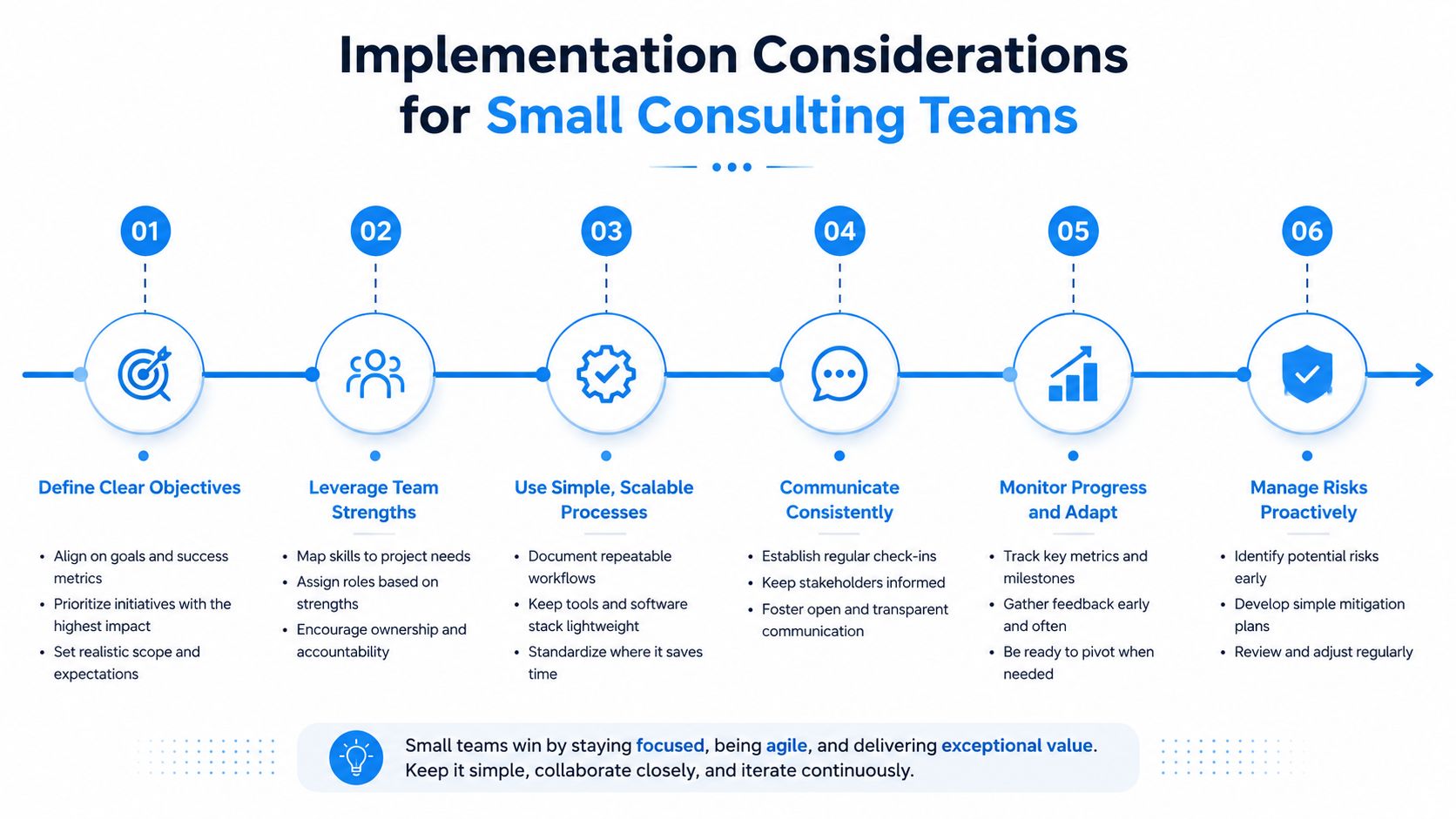
Implementation Considerations for Small Consulting Teams
Small firms shouldn't automate the entire commercial journey on the first day. Partner-led sales depend on trust and nuance, so implementation should begin with the repetitive coordination work that creates the most avoidable delay.
Phase one should protect capture and ownership
Connect every inbound source to one lead record. Define the required fields, assign a named owner, create an immediate acknowledgment, and set an escalation alert when the owner hasn't acted. Test the workflow with real submissions, including incomplete forms, duplicate contacts, referrals, and inquiries sent outside working hours.
Don't begin with elaborate scoring. A small team usually benefits more from dependable routing rules than from a complex model nobody trusts.
Add the commercial milestones next
Once capture and routing work, add discovery-call scheduling, confirmations, reminders, and post-call tasks. Then implement proposal tracking with explicit stages such as draft, sent, viewed, revision requested, decision pending, won, and lost.
The proposal stage needs a clear owner and a next-action date. Without those fields, automation can send reminders but can't create accountability.
Introduce nurture only after the basics are stable
Stalled opportunities and referral relationships need carefully calibrated language. Test messages with partners before enabling them broadly. An automated referral note should sound like a considerate extension of the introduction, not a campaign blast.
Common rollout failures include:
- Over-automating partner conversations: Let automation schedule, remind, summarize, and alert. Keep strategic diagnosis, negotiation, and sensitive relationship work with the partner.
- Ignoring data hygiene: Outdated service tags, duplicate contacts, and missing ownership fields cause routing failures that look like software problems.
- Skipping team training: Partners create workarounds when they don't know what a status means or when alerts feel irrelevant. Show the team how the system reduces administrative effort and define when they must update the record.
- Launching without exception rules: Decide what happens when a lead replies, opts out, books a meeting, changes scope, or becomes unavailable.
Adoption improves when leadership reviews a small set of pipeline exceptions in regular meetings. Ask who owns the next step, what blocked movement, and whether the workflow needs adjustment. That turns CRM use into revenue management rather than administrative policing.
Building Follow-Up as Core Revenue Infrastructure
Lead follow up automation belongs beside proposal management, resource planning, partner dashboards, and client onboarding workflows. A message sent quickly has limited value if the proposal has no owner, the delivery team receives no context, or the referral relationship disappears after a lost opportunity.
The firms that build dependable follow-up treat every stage as part of one operating system. They assign operational ownership, maintain integrations, define escalation rules, and review follow-up health alongside utilization and pipeline quality. Partners then spend less time reconstructing what happened and more time applying judgment where it matters.
Starward Navigators provides client acquisition infrastructure for small consulting and advisory firms, including prebuilt pipelines, automated lead and proposal follow-up, appointment reminders, routing, and client handoffs. If fragmented tools or unclear ownership are slowing your pipeline, visit Starward Navigators to review how the system can connect capture through proposal decision and onboarding.