Proposal management is the end-to-end system that qualifies, drafts, tracks, and follows up on proposals from discovery through decision, not just the act of writing and sending a document. In a 2021 benchmark, only 43% of respondents were using RFP-specific technology, which explains why so many firms still treat proposals like a document scramble instead of a managed revenue workflow. Responsive's proposal manager benchmark overview shows how much volume this work handles at scale, with published 2026 summaries reporting 153 proposals per year on average and 266 for enterprise teams, so a loose process gets expensive fast.
You've probably seen the pattern already. A strong discovery call, a custom proposal sent within 48 hours, then silence. The team starts debating price, but the core issue is usually simpler, the proposal was never managed as a live stage in the deal.
Table of Contents
- The Real Reason Proposals Go Quiet
- Core Components of Proposal Management
- Stages From Discovery to Decision
- Why the Proposal-to-Decision Gap Costs You Deals
- Generic CRM Versus a Proposal Operating System
- How to Systematize Proposal Management
- What to Measure and When to Iterate
The Real Reason Proposals Go Quiet
A boutique consultancy can do almost everything right and still lose the deal after sending the proposal. The scope is tight, the language is custom-fit, the turnaround is fast, then the buyer goes dark because no one owned the next move. That's the proposal-to-decision gap, the space between submission and commitment where winnable opportunities slip away.
Why the document isn't the finish line
Proposal management is the operating system that owns that gap. It starts with qualification, moves through drafting and review, and keeps control after delivery with follow-up, status tracking, and decision triggers. That's a very different job from “send the deck and hope.”
A lot of firms still act like the proposal itself closes the sale. Competitors who stay present, schedule the walkthrough, and press for a clear next step often win even when their solution is only marginally better. The difference is not always the document quality, it's the discipline around the process.
Practical rule: if the proposal has been sent but the next buyer action isn't assigned, timed, and owned, the deal is already drifting.
That's why I treat proposal management as a revenue workflow, not a writing task. The proposal is one artifact inside a larger system that coordinates people, keeps momentum visible, and forces accountability on both sides of the table. If you want a practical example of how that follow-up layer gets structured, the workflow used in proposal follow-up is the right mental model, because the send date is never the end of the work.
When firms manage proposals this way, they stop asking, “Did we send it?” and start asking, “What decision are we driving next?” That shift is usually where the win-rate lift comes from, not from prettier formatting.
Core Components of Proposal Management
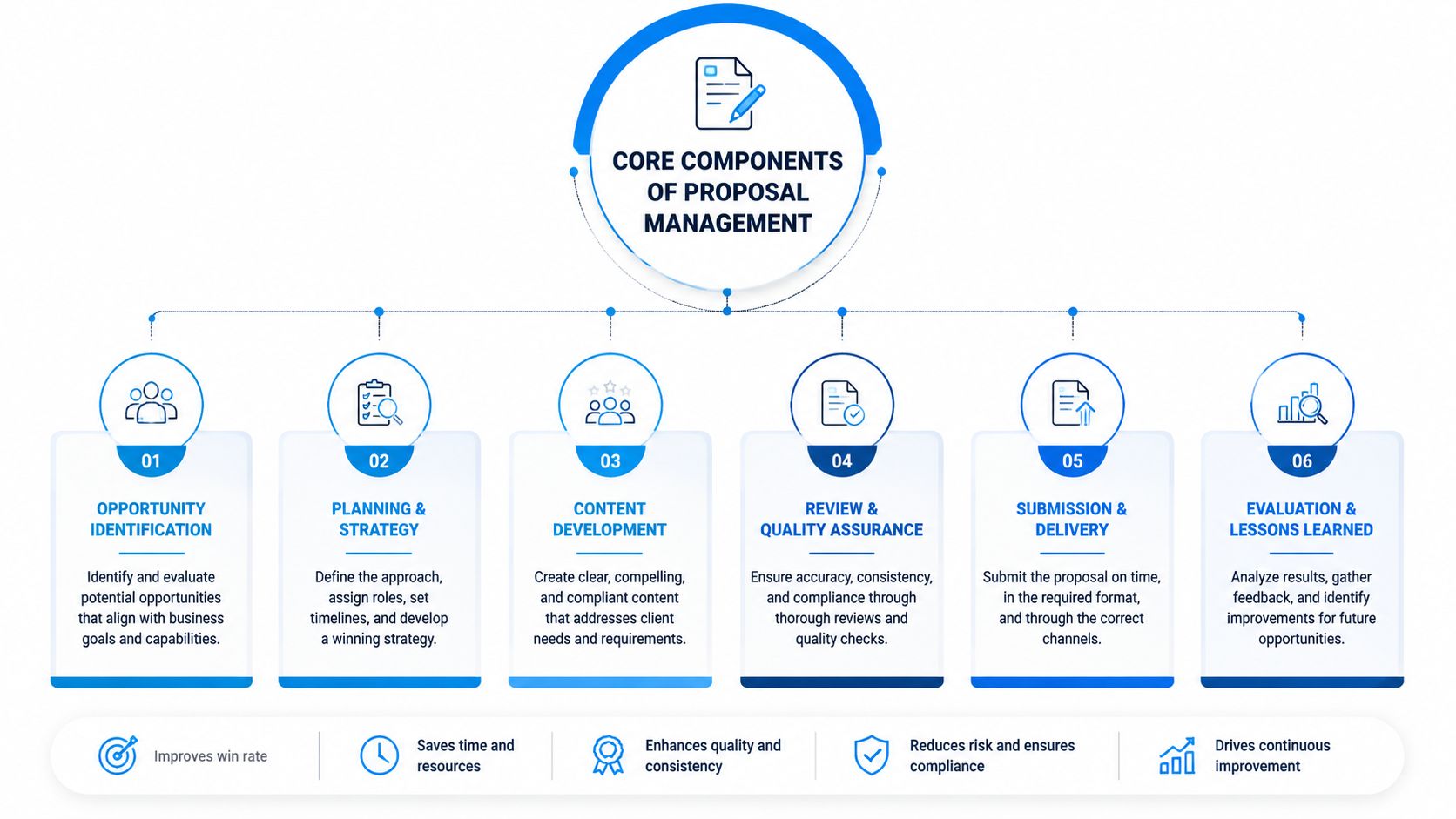
A proposal process breaks down fast when one person is improvising every step. The work holds together only when the team has clear gates, reusable content, and review rules that prevent a good opportunity from slipping into a slow, messy handoff.
Qualification before drafting
The first pillar is qualification. Keep it specific. Score the opportunity against criteria that affect win probability, such as budget authority, decision access, problem urgency, delivery fit, and internal capacity. A simple pass or fail is rarely enough. Many firms use a weighted checklist or red-yellow-green scoring so the team can see whether the deal deserves a full proposal, a lighter response, or no pursuit at all.
Templates and content libraries
The second pillar is a modular content system. Teams need reusable blocks for company background, case studies, team bios, methods, and compliance language, so they are not rebuilding the same proposal from scratch each time. A good library also keeps source material current. It reduces the risk of old bios, mismatched project examples, and language that no longer matches how the firm sells.
Review workflows with ownership
The third pillar is internal review. Named reviewers are only part of the job. The process needs version control, redline discipline, and a clear approval path, so pricing, legal, and subject matter experts know what to review and what good looks like. Shared comments in a document, tracked changes, and a final sign-off checklist prevent circular edits and protect the proposal from becoming a parking lot for feedback.
Tracking that informs follow-up
The fourth pillar is engagement tracking. You need to know whether the buyer opened it, who forwarded it, and which sections drew attention. That lets the team adjust the next conversation around what the buyer spent time on, not around guesswork. Proposal tracking also helps buyer-facing accountability, because it shows whether the conversation has moved from delivery to decision or stalled in between.
The structure matters because each part feeds the next. Qualification determines what gets drafted, drafting determines what gets reviewed, review determines what gets delivered, and tracking determines what the buyer sees next.
A proposal system breaks most often at the handoff, not the writing desk.
Stages From Discovery to Decision
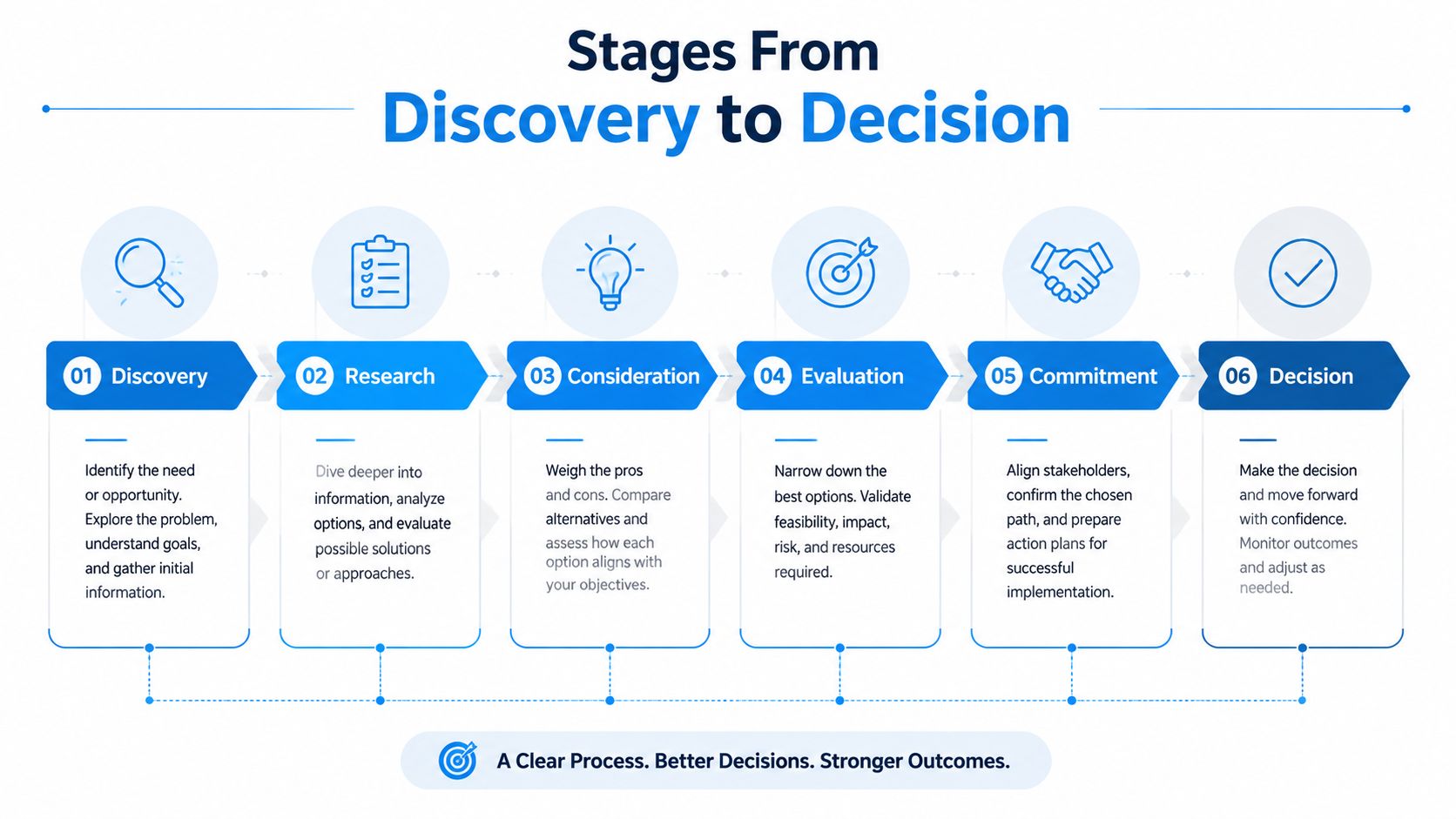
The cleanest proposal process starts before anyone types a sentence. If the team doesn't know who the buyer is, what problem matters most, and how the decision will be made, the document becomes an expensive guess. Proposal management works when every stage has a real owner and a real exit condition.
Discovery and scoping
The first stage is discovery and qualification. Confirm budget authority, timeline, and fit before the team commits drafting time, because otherwise you're chasing an opportunity that can't move. This is also where a firm should decide whether the deal deserves full pursuit or a lighter-touch response.
The next stage is scoping and drafting. Use approved templates, assign an internal deadline, and convert discovery notes into a proposal that matches the buyer's language and evaluation priorities. If the draft starts as a blank page, teams waste time reinventing structure that should already exist.
Review, delivery, and buyer movement
Internal review comes next, and it needs hard ownership. Technical, pricing, and partner approval should be routed with a 24-hour expectation, because stalled review cycles are often the reason a proposal misses the buyer's decision window. After that, delivery should be more than emailing a PDF. Schedule a live walkthrough so value can be explained, objections can be handled, and the buyer doesn't have to interpret everything alone.
For teams that still manage sales in a CRM, lead management only works when the proposal stage is treated as a distinct handoff, not a generic task. That handoff is where accountability either gets clearer or disappears.
The final stages are active follow-up and decision capture. Follow-up shouldn't be random. It should be triggered by engagement signals and mapped to a cadence, then end with a forced outcome, yes, no, or revised scope. If a buyer keeps the proposal in limbo, the sales team is usually letting ambiguity do the work for them.
| Stage | Owner | Exit criterion | Escalation if stalled |
|---|---|---|---|
| Discovery and qualification | Business development | Fit confirmed | Re-qualify or drop |
| Scoping and drafting | Proposal lead | Draft ready for review | Reset deadline |
| Internal review | Pricing, technical, partner reviewers | Approved version | Escalate to decision-maker |
| Delivery and presentation | Account lead | Buyer walkthrough completed | Schedule live follow-up |
| Active follow-up | Sales owner | Buyer responds or redirects | Increase touchpoint intensity |
| Decision capture | Proposal owner | Yes, no, or revised scope | Close the loop |
Why the Proposal-to-Decision Gap Costs You Deals
The proposal-to-decision gap is where many consultancies lose deals they thought were already in hand. The buyer isn't rejecting the solution outright. They're hesitating because the next step is vague, internal alignment is messy, or the proposal didn't make the decision easy.
What the benchmarks are really saying
Industry benchmarks make the timing issue hard to ignore. A 2026 summary reported an average proposal win rate of 45%, with top performers above 75% and small businesses averaging 42%. The same source said proposals sent within 24 hours were about 2x more likely to close, while those left for more than 7 days fell to an 18% win rate. Sendprop's 2026 proposal statistics summary captures the point clearly, speed and follow-up discipline are part of the win, not a clerical afterthought.
The practical problem is that many teams stop managing once the proposal leaves the inbox. That's when buyers start comparing you with internal alternatives, asking procurement questions, or postponing the decision because nobody forced the timeline.
Why buyers stall
Buyers stall for ordinary reasons. They're not always rejecting you, they're juggling internal politics, budget uncertainty, and competing priorities. If your team doesn't create a next-step checkpoint, silence becomes the default.
A managed follow-up cadence changes that. The team owns the follow-up window, the decision trigger, and the escalation path. That's why firms that treat the proposal as a live stage usually convert more pipeline than firms that treat it as a final deliverable.
| Follow-Up Timing | Win Rate | Deal Velocity | Common Outcome |
|---|---|---|---|
| Within 24 hours | About 2x more likely to close | Fastest | Live discussion, faster decision |
| More than 7 days | 18% | Slow | Buyer drift, internal delay |
| No structured follow-up | Qualitatively weaker | Unpredictable | Silence, stalled deal |
The difference isn't subtle. Hope-based selling waits for the buyer to come back. Managed proposal work makes the buyer's next step visible, scheduled, and harder to ignore.
Generic CRM Versus a Proposal Operating System
A generic CRM can tell you where a deal sits. It usually can't tell you whether the proposal was reviewed, who approved the pricing, or which section got the buyer's attention. That's the operational gap small consultancies run into when they try to manage proposals inside a pipeline tool that was never built for this job.
Where the CRM falls short
Generic CRMs are good at contact records, pipeline stages, and basic reminders. They're weak at stage-gated approvals, version control, and proposal-specific accountability. Once the proposal is sent, follow-up often becomes a manual note attached to the deal record, which means discipline depends on memory instead of process.
That matters because proposal management needs more than visibility. It needs control over the handoff between drafting, review, delivery, and post-send follow-up. A CRM can show the pipe, but it doesn't naturally enforce the work.
Where a proposal system is stronger
A purpose-built operating system handles the proposal as a workflow object. It can trigger review tasks, set decision-stage reminders, and keep follow-up aligned with buyer behavior. It's built around the actual way consultancies win work, not around generic sales stages.
For firms that want a closer fit without adding a lot of complexity, the decision is often between configuring an existing CRM or adopting dedicated proposal workflow tooling. CRM for consulting firms is relevant here because consulting teams need stage specificity, not just a cleaner contact list.
Practical rule: if your team still needs Slack messages or calendar nudges to remember proposal follow-up, the system isn't doing enough of the work.
| Capability | Generic CRM | Proposal Operating System |
|---|---|---|
| Stage-gated approvals | Limited | Built in |
| Version control | Basic or manual | Structured |
| Section-level engagement tracking | Rare | Common |
| Automated follow-up triggers | Generic reminders | Proposal-specific cadences |
| Decision-stage analytics | High-level only | Workflow-focused |
One option in this category is Starward Navigators, which includes proposal tracking and automated follow-up sequences for consulting workflows. It's not a substitute for good qualification or good writing, but it does address the part most CRMs leave loose, the gap between sent and decided.
How to Systematize Proposal Management
A small firm doesn't need a huge operations stack to manage proposals well. It needs a connected workflow that turns sales motion into a repeatable sequence, then makes the handoffs impossible to miss. The goal is not more software. The goal is fewer lost deals caused by avoidable process drift.
Map the pipeline to proposal triggers
Start by linking pipeline stages to proposal actions. When a deal moves to proposal requested, the drafting workflow should open automatically, reviewers should be assigned, and follow-up cadences should be queued. That prevents the common problem where everyone assumes someone else is handling the next step.
Build the library and gate the output
Organize the template library by engagement type, not by random file name. A strategy proposal, a retainer renewal, and a fractional executive engagement all need different structures, so the library should support that reality instead of forcing one generic format.
Approval gates matter just as much. No unreviewed proposal should leave the firm, and no version should be sent unless ownership is clear. If the process allows people to skip a gate, the system will eventually reward the fastest person, not the best response.
Automate follow-up and handoffs
A good follow-up engine uses escalating touchpoints tied to buyer engagement signals. If someone opens the proposal, forwards it, or revisits it, the sales owner should know. If nobody responds, the cadence should still keep the deal active instead of letting it decay.
This is also where accountability needs to be explicit. Sales owns the relationship, operations owns the workflow, and delivery owns anything that affects scoping or fulfillment. Leadership should be looking at throughput, stalled proposals, and review delays, not just total sends.
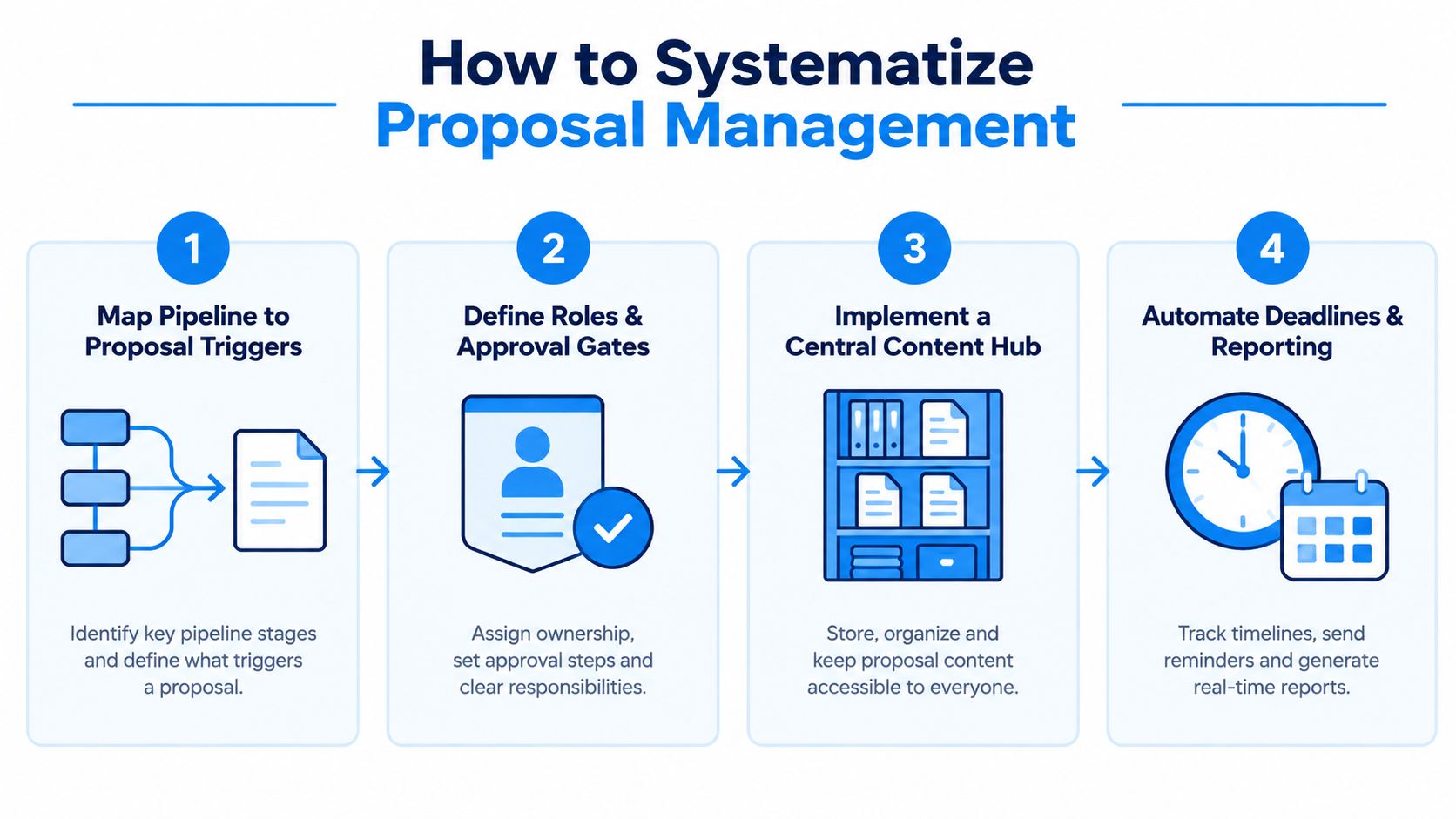
The rollout doesn't need to happen all at once. In week one, lock down the tracking workflow and the follow-up trigger rules. By month three, you should have cleaner template libraries, fewer approval bottlenecks, and enough data to see where the process still leaks.
What to Measure and When to Iterate
The wrong metric makes teams busy instead of effective. Proposal volume feels productive, but it doesn't tell you whether the process is moving buyers toward a decision. What matters is how quickly proposals convert, how reliably follow-up happens, and where the workflow stalls.
The three metrics that matter
Start with proposal-to-close cycle time. If deals take too long to move from sent to decided, the process has a bottleneck. Next, measure follow-up completion within 48 hours of delivery, because the first touch often determines whether momentum holds. Third, track stage conversion from sent to verbal agreement, since that shows whether the proposal itself is creating movement.
Set a baseline in the first 30 days, then review monthly. The operations lead should look for patterns, not just averages, because one stalled approval or one weak template can distort the whole pipeline. If fewer than 60% of proposals receive a follow-up touch within two business days, the accountability layer is broken.
What to fix first
The order matters. Fix tracking before templates, because if you can't see what's happening, you'll rewrite content that may not be the actual problem. Then automate follow-up triggers, since that's the easiest way to reduce drift without adding headcount.
After that, refine templates using actual win-loss data. If one engagement type consistently underperforms, don't assume the issue is just pricing. Check whether the proposal is too long, too vague, or too weak on decision guidance.
Measure velocity, not just output.
A firm that sends more proposals but takes longer to get decisions is usually losing on process, not demand. The system is working only when it shortens the path from qualified opportunity to yes, no, or revised scope.
If you want to turn proposal management into a real revenue workflow instead of a loose set of reminders, Starward Navigators can help you structure the tracking, follow-up, and handoff layers that most firms leave to chance. Visit Starward Navigators to see how a consulting-focused operating system can support proposal follow-up, client handoffs, and pipeline accountability in one place.