Most advice about client communication skills starts with personality: listen actively, show empathy, be polite, and respond quickly. Those habits matter, but they don't explain why capable consulting firms still lose opportunities, miss handoffs, and leave clients wondering what happens next.
The harder problem is usually operational. A lead arrives in an inbox, a proposal gets sent without a follow-up owner, or a signed engagement sits in sales while delivery assumes someone else has started onboarding. No individual conversation is necessarily rude or incompetent. The firm lacks a reliable system that makes the right communication happen at the right stage.
That distinction matters because clients increasingly judge communication by visibility, follow-through, and accountability, not warmth alone. The firms that communicate well at scale treat every interaction as part of a workflow, from lead capture and discovery scheduling to proposal decisions, delivery updates, and referrals.
Table of Contents
- Redefining Client Communication Skills in Consulting
- The Commercial Impact of Communication Quality
- Designing the Right Cadence and Channel Strategy
- Navigating the Quiet Gap in Proposals and Handoffs
- Generic CRMs Versus Purpose-Built Consulting Systems
- Self-Assessment and Process Improvement Strategies
- Building a Repeatable Client Communication Engine
Redefining Client Communication Skills in Consulting
A consultant can be thoughtful, articulate, and highly responsive in direct conversations while still delivering a poor communication experience. The weakness appears between conversations, where nobody owns the next update and no system records what the client is waiting for.
Project.co's 2025 to 2026 communication benchmark found that 98% of respondents consider effective business communication important, while 95% want to see where things stand with a purchase or project. Those findings describe more than a preference for courteous emails. They point to an expectation that firms will make progress visible and explain what happens next.
For a consulting firm, that means communication skills include the ability to:
- Capture context: Record the lead source, business problem, stakeholders, and agreed next action in one accessible place.
- Route responsibility: Assign the next task to a named person rather than leaving ownership implied.
- Maintain stage visibility: Show whether an opportunity is awaiting discovery, proposal review, decision, contract, or kickoff.
- Trigger timely contact: Prompt follow-up when a proposal stalls, a meeting approaches, or an onboarding task remains incomplete.
- Close loops: Confirm decisions, summarize commitments, and document changes before memory becomes the operating system.
Operational rule: If a client has to ask who owns the next step, your communication process has already failed.
Small advisory firms often lose momentum after a strong discovery call. The consultant assumes the proposal is being reviewed. The buyer is comparing options, waiting for an internal approval, or unsure whether questions are welcome. Days pass, and both sides interpret the silence differently. A well-designed workflow removes that ambiguity with a scheduled follow-up, a clear decision path, and a direct invitation to discuss open points.
This approach doesn't eliminate the human side of consulting. It protects it. When routine reminders, appointment confirmations, and stage changes are handled consistently, consultants have more attention for judgment-heavy conversations, difficult trade-offs, and strategic reassurance.
The shift is simple but consequential: client communication isn't a personal trait that some people possess and others lack. It's a firm capability that can be designed, measured, and improved.
The Commercial Impact of Communication Quality
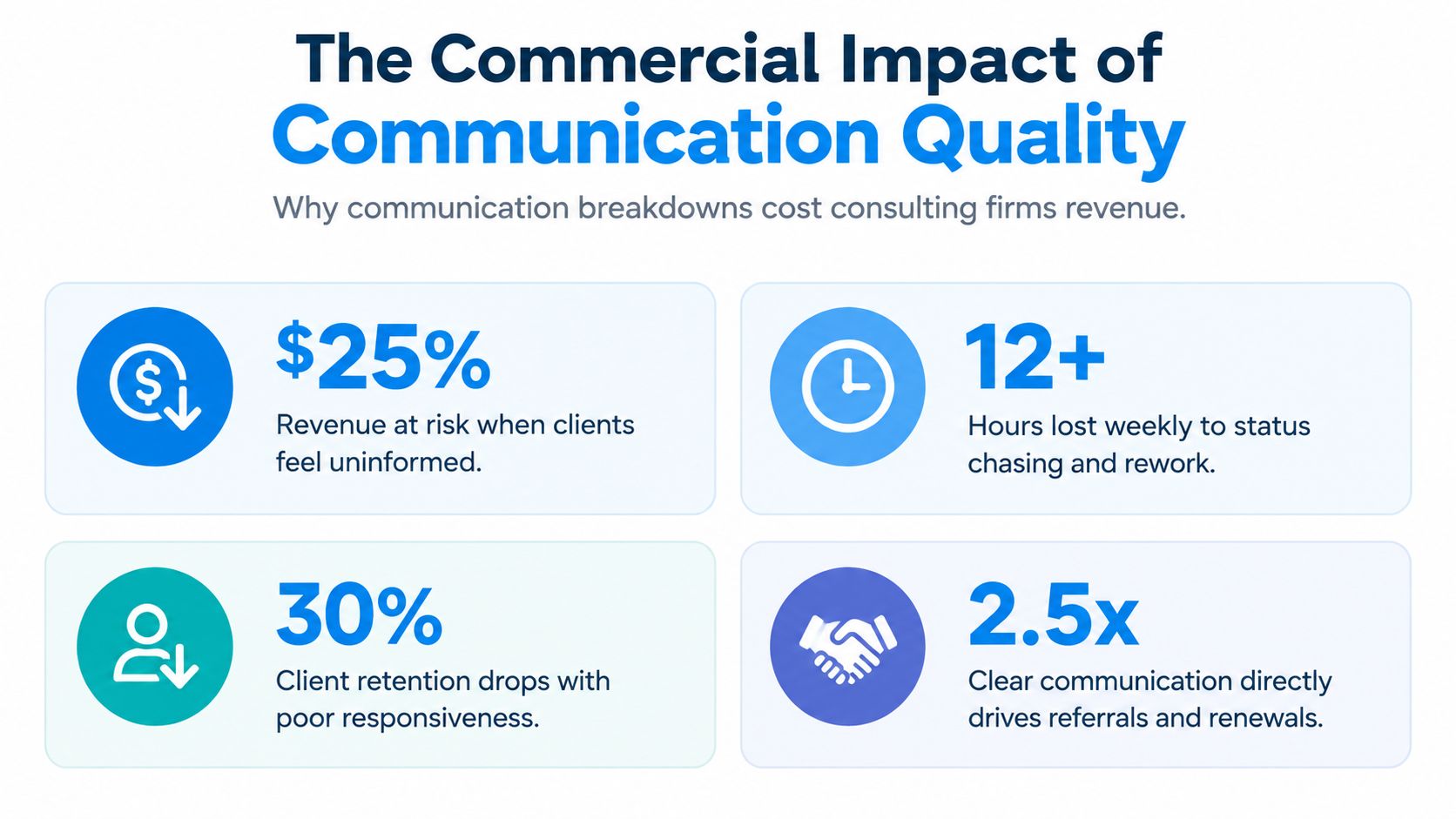
Communication failures become commercial problems when they interrupt a client's confidence in progress. A missed reply can delay a decision. An unclear handoff can create rework. An absent update can make a client question whether the firm is still actively managing the engagement.
The Project.co communication research summary reports that 66% of people said they had stopped dealing with a company because of poor business communication, remaining at 66% in 2024 and rising to 68% in 2025. The same summary says 96% of people believe businesses have room to improve effective communication and project management. These figures don't prove that every silent proposal will be lost, but they do show why firms shouldn't treat communication gaps as harmless administration.
Responsiveness is a process standard
Clients commonly define responsiveness through concrete behavior. Benchmark research from Beaton Global describes prompt returns of calls, emails, and requests as the most frequent meaning of responsiveness, representing 50% of mentions, while meeting deadlines accounts for 19% and fast work turnaround for 17% in its cited benchmark attribute explanations.
The practical lesson is that “we're responsive” shouldn't be a vague cultural statement. A firm needs operating rules:
- Acknowledge a new request promptly, even when the complete answer requires investigation.
- State when the client will receive the substantive response.
- Record the commitment in the task or project system.
- Escalate when the promised date is at risk.
- Close the loop with a decision, deliverable, or revised plan.
That system protects revenue because it reduces the number of opportunities that depend on memory. It also protects delivery capacity by making delays visible before they become client complaints.
Communication quality affects execution
Research examining project communication finds a strong positive relationship between communication quality and project outcomes, including project success and overall performance, as discussed in this project communication study. In consulting, the mechanism is straightforward. Clear information reduces coordination errors, helps stakeholders make decisions sooner, and gives delivery teams a more dependable view of commitments.
The commercial impact extends beyond the current project. Communication influences whether clients renew, expand, and refer. A firm that delivers technically sound work but forces the client to chase status updates creates unnecessary doubt around every future engagement. A firm that makes progress, ownership, and risks visible gives buyers a reason to continue the relationship.
Designing the Right Cadence and Channel Strategy
More communication isn't automatically better communication. Clients need enough contact to understand progress, risks, and decisions, but excessive messages can bury the information they need. A 2025 global customer communication survey from Sinch found that more than 40% of consumers reported frustration with communications that are too frequent or excessive, while 96% said knowing exactly where a purchase or project stands is important.
The answer is a designed cadence, not a blanket promise to “keep clients posted.”
Start with expectations
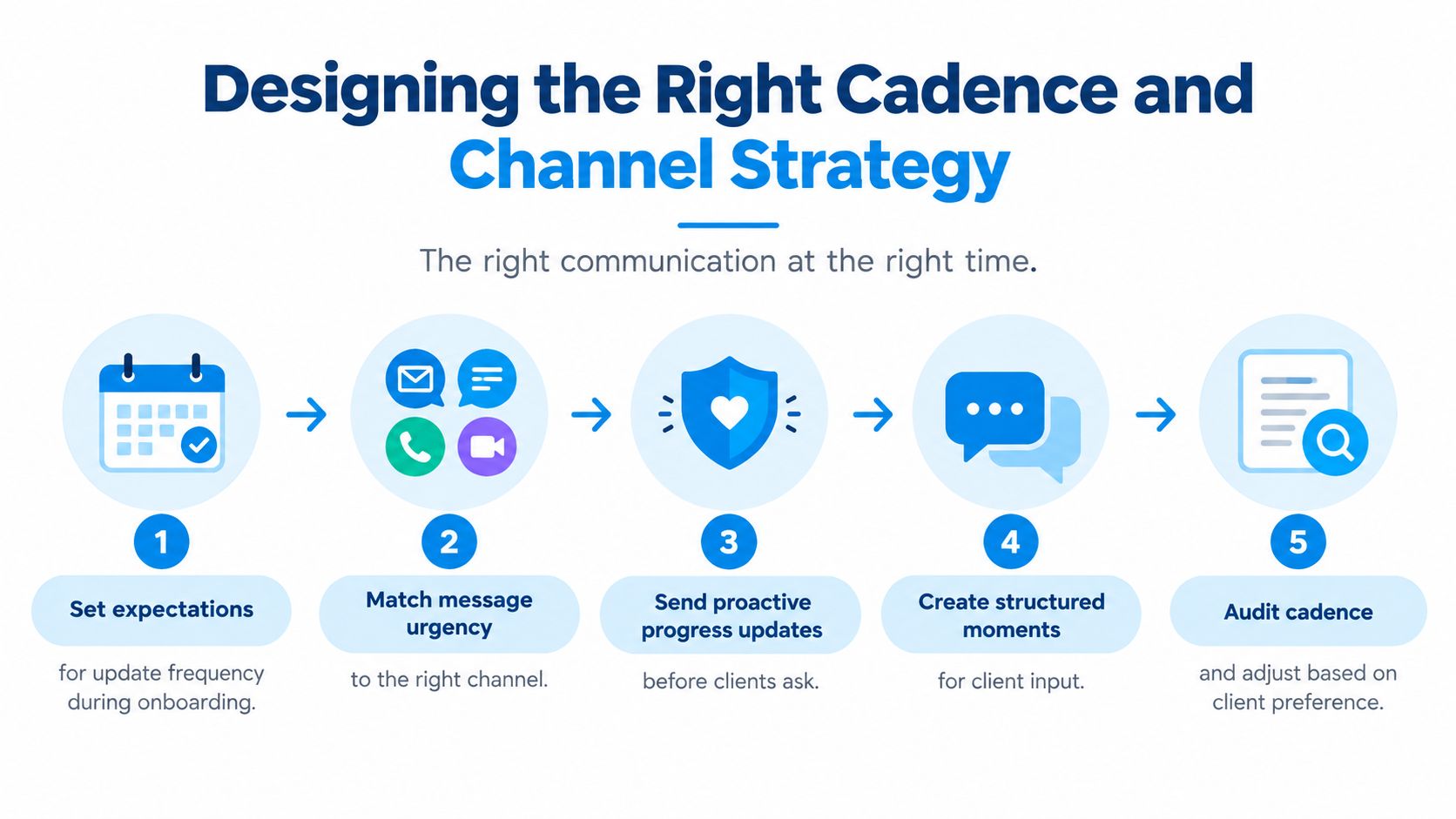
During onboarding, agree on the communication contract. Define the primary channel, the type of information that belongs there, expected response windows, meeting rhythm, escalation route, and the format of progress reporting. Put the agreement in writing, then adjust it when the client's needs change.
A useful cadence separates routine visibility from decision communication:
| Communication need | Suitable format | Owner |
|---|---|---|
| Progress and milestones | Shared project board or written update | Engagement lead |
| Formal decisions | Email summary or meeting record | Decision owner |
| Complex trade-offs | Video meeting or working session | Subject-matter lead |
| Urgent risks | Direct message or phone call, followed by written documentation | Account owner |
| Routine reminders | Automated email or calendar notification | Workflow system |
Automation works well for predictable events, such as appointment confirmations, reminders, status changes, and requests for missing information. It shouldn't carry sensitive feedback, strategic pivots, scope disputes, or messages that require judgment.
Match channel to consequence
Email remains useful for durable records and concise summaries. Project-management tools are better for shared visibility because the client can see current tasks, owners, and dependencies without searching through threads. A call or video session is usually more effective when the issue has competing interpretations or requires rapid alignment.
Personalization matters, but it doesn't mean writing every update from scratch. Research cited by Sinch says 60% of advisors identify personalized communication as the top way to establish trust and credibility. Personalization can be as practical as tailoring the summary to an executive's decision needs, highlighting operational implications for a project lead, or using the client's preferred channel for routine questions.
Review the cadence after a meaningful project milestone. Ask whether updates arrive early enough, whether they contain useful decisions, and whether the channel makes information easy to find. A communication system should create reassurance without producing noise.
Navigating the Quiet Gap in Proposals and Handoffs
The most dangerous communication gap often begins after the consultant has done the visible work. Discovery is complete, the proposal is polished, and the buyer says they'll review it internally. The consultant moves the opportunity into a vague “waiting” state. No follow-up date is recorded, no decision process is confirmed, and no one knows whether the buyer needs clarification.
The buyer may not see it that way. They could be waiting for an answer to an unstated question, expecting the consultant to suggest a decision meeting, or reading the silence as a sign that the firm has other priorities. The consultant interprets the lack of response as normal review time. That mismatch turns a promising opportunity into an ungoverned pipeline item.
Make proposal follow-up explicit
A proposal should leave the firm with four recorded details:
- Decision date: When will the client review or decide?
- Decision participants: Who needs to approve, advise, or validate the purchase?
- Open questions: What might prevent a decision?
- Next contact: Who will reach out, through which channel, and with what purpose?
The first follow-up shouldn't ask only whether the client has “had a chance to review.” It should make progress easier. Summarize the business outcome, identify any decision point that needs clarification, and offer a specific conversation to resolve concerns. If the client doesn't reply, the next message should remain useful rather than becoming a sequence of increasingly urgent nudges.
A structured proposal follow-up workflow can assign these actions to stages, so the opportunity doesn't depend on a consultant remembering what was promised during a busy week.
Treat the handoff as a client-facing moment
The second quiet gap appears after signature. Sales considers the work won. Delivery hasn't received the full context. The client is left wondering when kickoff will happen, who their day-to-day contact is, and whether the details discussed during sales made it into the delivery plan.
A reliable handoff creates the following chain immediately:
- The opportunity changes to a won stage.
- The delivery record opens with the agreed scope and commercial context.
- The delivery owner receives a notification.
- The client receives confirmation of what happens next.
- Kickoff scheduling begins.
- The post-kickoff summary records decisions, responsibilities, and initial milestones.
This isn't about making the client experience feel automated. It's about ensuring that automation handles the administrative trigger while a named consultant handles the relationship. The client should experience continuity, not an internal transfer between disconnected systems.
Generic CRMs Versus Purpose-Built Consulting Systems
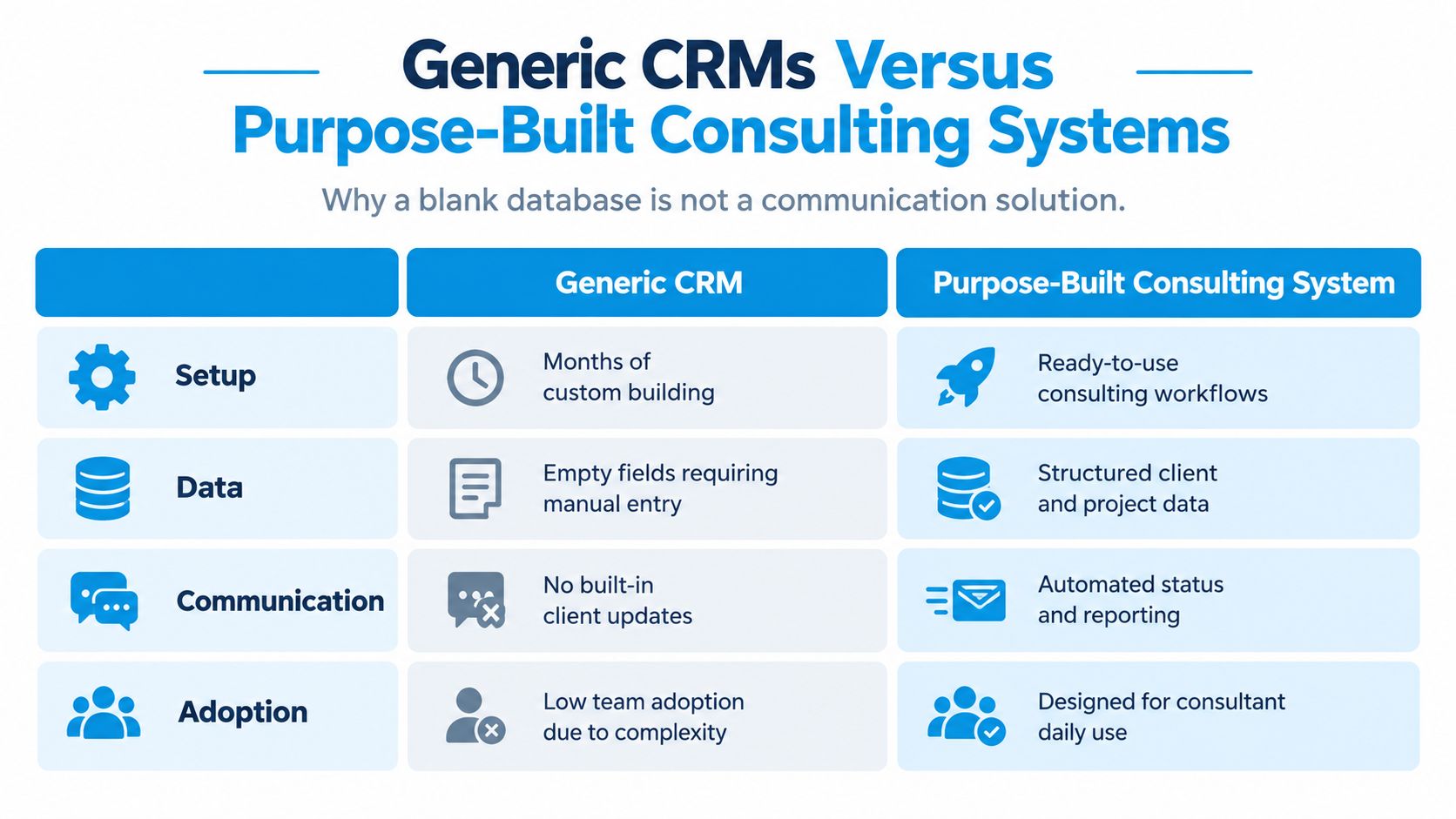
A generic CRM can store contacts, companies, activities, and opportunities. It can also become an expensive blank canvas. The firm buys the platform, imports records, creates fields, debates pipeline names, and eventually asks consultants to update a system that doesn't reflect how advisory work moves.
That approach can work when a firm has dedicated operations capacity and a clear internal design. It struggles when the CRM is expected to solve communication problems without a defined workflow behind it.
Compare the operating models
| Generic CRM approach | Purpose-built consulting approach |
|---|---|
| Starts with records and configurable fields | Starts with advisory stages and repeatable workflows |
| Requires the firm to define proposal follow-up | Includes stage-based follow-up logic |
| Often separates acquisition from delivery | Connects business development, delivery, and relationships |
| Depends heavily on user discipline | Uses reminders, triggers, and ownership rules |
| Can support many industries | Reflects consulting-specific handoffs and decision points |
The key distinction isn't the software category. It's whether the system tells people what should happen next. A contact database won't automatically prevent a proposal from going quiet. A pipeline with defined proposal stages, follow-up tasks, and escalation rules can.
Decide whether to build or adopt
Build a custom system when your firm has unusual delivery models, strong technical resources, and the patience to maintain the workflows. Adoption is often more practical when the recurring problems are familiar: inconsistent lead routing, missed discovery reminders, stalled proposals, messy handoffs, and untracked referrals.
A purpose-built CRM for consulting firms should make the daily action obvious. It should capture opportunities from existing channels, centralize relationship history, provide ready-to-use pipelines, and connect a signed deal to delivery work without requiring a manual rebuild.
Starward Navigators is one example of that model. Its system combines Business Development, Client Delivery, and Relationships and Referrals pipelines with automated follow-up, appointment reminders, proposal tracking, client onboarding triggers, and centralized lead-source capture. The trade-off is less freedom to invent every process from scratch, in exchange for a faster path to a working consulting workflow.
Adoption still depends on leadership. Even a well-configured system fails when consultants don't trust the data, ownership remains ambiguous, or the team keeps important updates in private inboxes.
Self-Assessment and Process Improvement Strategies
You don't need a complex dashboard to identify communication failures. Start by tracing a recent lead and a recent client engagement from first contact through the next decision. Note where information was stored, who owned each action, when the client received an update, and whether the next step was visible to everyone involved.
The review should expose process behavior, not judge individual personalities. If the same type of delay appears repeatedly, the firm has a workflow problem that training alone won't fix.
Audit the client journey
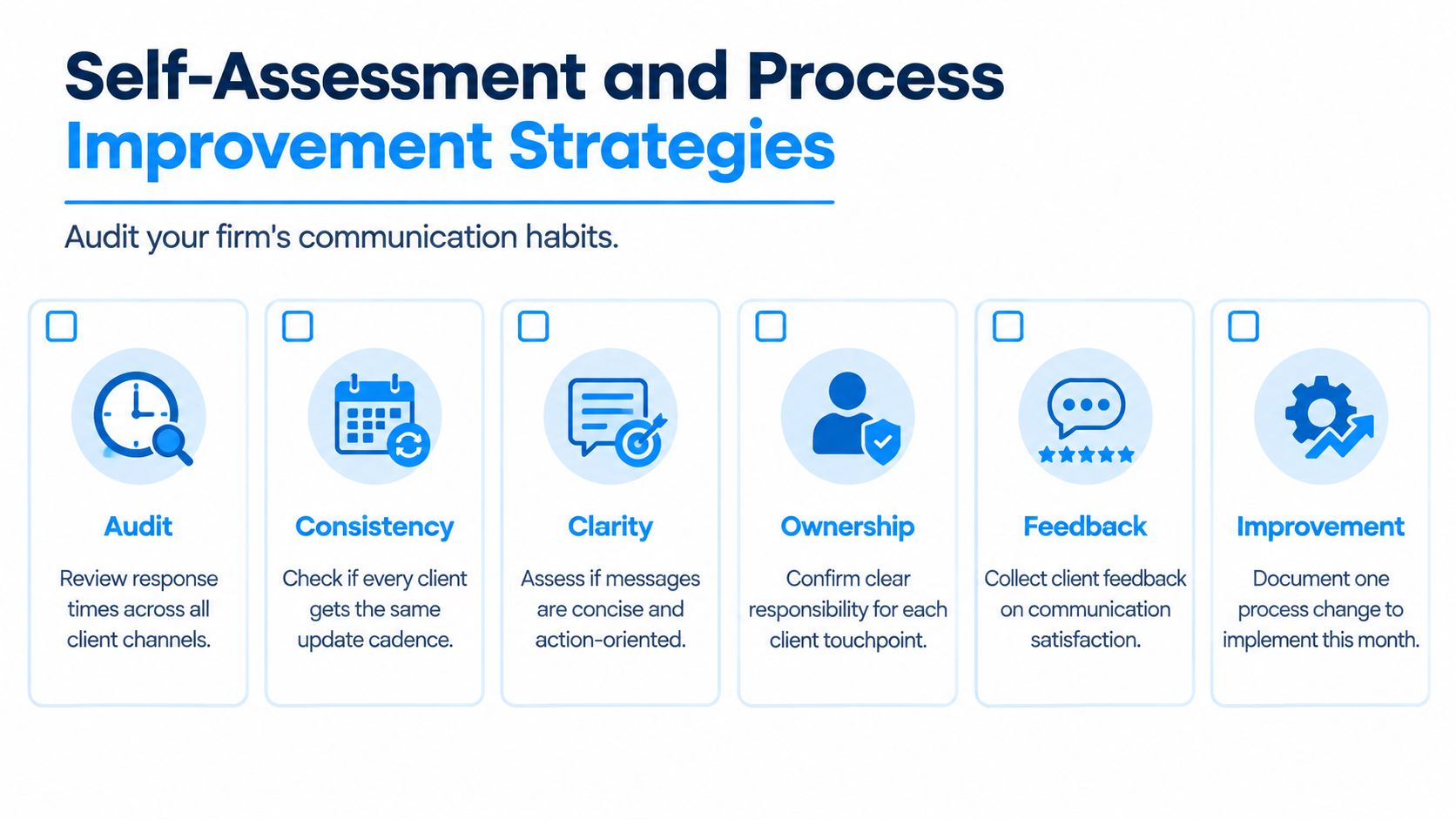
Use these checks during a practical review:
- Response timing: Compare when leads, client requests, and proposal questions arrived with when someone acknowledged them and when a complete response followed.
- Cadence consistency: Check whether clients at the same engagement stage receive a comparable level of visibility, even when different consultants own the work.
- Message clarity: Look for a clear purpose, decision, owner, and date in each important update. Remove jargon that forces clients to interpret the firm's internal language.
- Ownership: Confirm that every touchpoint has one accountable owner. Contributors can help, but shared responsibility often becomes no responsibility.
- Client feedback: Ask directly whether the communication is easy to follow, sufficiently proactive, and appropriate for the client's role.
- Process change: Choose one recurring failure and document the trigger that should prevent it next time.
A small team can run this audit from sample records in its email, calendar, project tool, and CRM. The point isn't to measure everything. It's to find where the firm relies on memory, private notes, or informal handoffs.
Turn findings into controls
If new leads wait for manual assignment, connect the intake form to a routing rule. If consultants forget proposal follow-up, create a required next-contact field before the opportunity can leave the proposal stage. If clients repeatedly ask for status, establish a standard progress update with milestones, risks, decisions, and upcoming actions.
Review the result after the next relevant cycle. Did the trigger fire? Did the owner act? Did the client receive a more useful update? If not, simplify the process before adding more automation.
Useful test: A process is working when a new team member can follow the record and understand what the client knows, what the firm owes, and what happens next.
Building a Repeatable Client Communication Engine
A repeatable communication engine connects four operating layers. Lead capture makes sure inquiries from websites, inboxes, LinkedIn, events, and referrals enter one process. Discovery logistics confirms meetings, reminds participants, and preserves the context needed for a productive conversation.
Proposal control gives every opportunity a visible stage, an owner, a decision path, and a next contact. It turns the proposal-to-decision gap from a period of waiting into a managed workflow. Delivery handoff then transfers the commercial and strategic context into client onboarding, assigns ownership, schedules kickoff, and starts the first delivery tasks.
The final layer is relationship management. Satisfied clients and referral partners shouldn't disappear into an archive after an engagement ends. A practical system records the relationship stage, schedules appropriate nurture, and gives the firm a reason to reconnect that's more useful than a generic check-in.
Use automation for consistency, not impersonation
Automation should handle repetitive coordination:
- Lead routing: Assign new inquiries and trigger an initial acknowledgement.
- Appointment management: Send confirmations, reminders, and internal alerts.
- Proposal movement: Create follow-up tasks when an opportunity enters a review stage.
- Onboarding triggers: Notify delivery owners and launch kickoff actions after signature.
- Referral nurture: Record introductions, thank contributors, and schedule relationship follow-up.
Human judgment remains essential for diagnosis, negotiation, difficult news, strategic recommendations, and feedback conversations. The system should make those moments easier by presenting the right history and next action, not replace them with generic messages.
A documented client onboarding workflow gives the firm a repeatable sequence for expectation setting, kickoff scheduling, delivery ownership, and early engagement follow-up. That sequence protects the client's confidence during the transition from buyer to participant.
The deeper principle is that client communication skills become scalable when the firm turns good judgment into repeatable operating rules. Consultants still need clarity, listening, adaptability, and candor. But the business shouldn't rely on individual memory to make those skills visible at every stage.
Audit your current lead, proposal, and handoff workflows this week, then identify the one silent gap that creates the most risk. Starward Navigators provides prebuilt client acquisition infrastructure for consulting and advisory firms, including follow-up, proposal tracking, onboarding handoffs, and referral workflows. Visit Starward Navigators to assess whether a purpose-built operating system fits the way your firm wins and serves clients.