Companies that contacted an inbound prospect within an hour were more than 60 times as likely to qualify the lead as companies waiting at least a day, according to the Harvard Business Review analysis summarized in Retell AI's speed-to-lead overview. That's a striking association, but it isn't a revenue forecast for a boutique consultancy. The useful question behind lead follow up statistics is whether your firm loses opportunities before the conversation starts or after the buyer has already engaged.
Table of Contents
- Core Lead Follow-Up Numbers and Why Minutes Matter
- How to Measure Response Time Without Fooling Yourself
- How Follow-Up Cadence Should Change by Stage
- Why Small Advisory Firms Should Not Copy the Averages
- Applying the Numbers to a Three-Person Advisory Firm
- Set Your First Response Targets This Week
Core Lead Follow-Up Numbers and Why Minutes Matter
Headline lead follow-up statistics with sources
The Harvard Business Review figures below come from its 2011 study, “The Short Life of Online Sales Leads,” summarized above. The company audit and related lead analysis are separate samples, not interchangeable descriptions of the same exercise.
| Metric | Reported value | Source and sample |
|---|---|---|
| Companies responding to web leads within one hour | 37% | HBR 2011 audit of 2,241 U.S. companies |
| Companies taking longer than 24 hours | 24% | HBR 2011 company audit |
| Companies that never responded | 23% | HBR 2011 company audit |
| Average response time among responders | About 42 hours | HBR 2011 company audit |
| Qualification likelihood, sub-hour response versus 24 hours or later | More than 60 times as likely | HBR related analysis of about 1.25 million leads |
| Conversion, first response within five minutes versus five minutes to 24 hours | About eight times higher | InsideSales 2021 analysis of 5.7 million inbound leads, summarized in Reploom's lead follow-up statistics |
| Odds of reaching a lead, five minutes versus 30 minutes | About 100 times higher | Earlier Lead Response Management research, summarized by Reploom |
| Odds of qualifying a lead, five minutes versus 30 minutes | About 21 times higher | Earlier Lead Response Management research, summarized by Reploom |
| Touches often cited for a sale | An industry-summary range, not a controlled benchmark | Persistence summaries discussed under follow-up cadence |
| B2B leads taking at least three months to decide | A buyer-summary finding, not a response-time measure | Decision-latency summaries discussed under follow-up cadence |
| B2B leads waiting up to a year | A longer-horizon buyer-summary finding | Decision-latency summaries discussed under follow-up cadence |
These figures describe different outcomes. Reaching someone, qualifying an opportunity and converting a lead aren't the same event. The Reploom summary attributes its conversion comparison to the InsideSales analysis, while its contact and qualification odds come from earlier Lead Response Management work.
The Harvard Business Review analysis also needs careful wording: its nearly seven-times comparison concerned the likelihood of a meaningful conversation with a decision-maker for sub-hour responders versus companies waiting an additional hour. That isn't a general close-rate multiplier, and it shouldn't be presented as one.
What the comparisons actually support
The defensible conclusion is operational: don't leave an inbound request waiting for someone to notice it. Give the inquiry an owner, make the requested next step accessible and record whether anyone attempted contact.
Think of a lead like a hot meal. It's best served where it was ordered, while the person is still ready for it. That analogy explains the urgency, but it doesn't establish a universal deadline after which a prospect becomes worthless.
A prospect who has just requested a consultation has made their interest visible. They may be available to clarify the problem, explain their deadline or compare your approach with another provider's. A delayed response leaves room for someone else to begin that conversation first.
However, the evidence doesn't isolate speed from every other possible difference between firms. A well-run sales team may respond quickly while also qualifying more consistently, offering clearer scheduling and maintaining better records. Treating the entire observed difference as the causal effect of response time would go beyond what these summaries establish.
Practical rule: Use speed benchmarks to design ownership and escalation, not to promise a corresponding increase in revenue.
Why the first-contact standard matters
For a small advisory firm, the most actionable row is the first-response-within-five-minutes comparison. It offers a concrete service objective that a team can turn into assignment rules, alerts and backup coverage.
That doesn't mean a partner must deliver a fully researched diagnosis immediately. Separate the acknowledgment from the substantive response: confirm receipt automatically, then have the assigned person make a relevant contact attempt.
The contact should advance the buyer's request. If someone asks about succession planning, acknowledge that subject and offer the appropriate discovery conversation. A generic newsletter enrollment doesn't serve the same purpose.
These findings concern inbound requests, not every relationship in your pipeline. Lead source, offer, market, channel and qualification criteria can change the outcome. The benchmark gives your firm a standard to test, not permission to assume that every inquiry deserves identical treatment.
How to Measure Response Time Without Fooling Yourself
Measure elapsed time from capture to attempted contact, not from assignment to task completion. The InsideSales lead follow-up test supports comparing response-time bands with connection, discovery-booked and qualified-opportunity outcomes rather than assuming the benchmark applies uniformly.
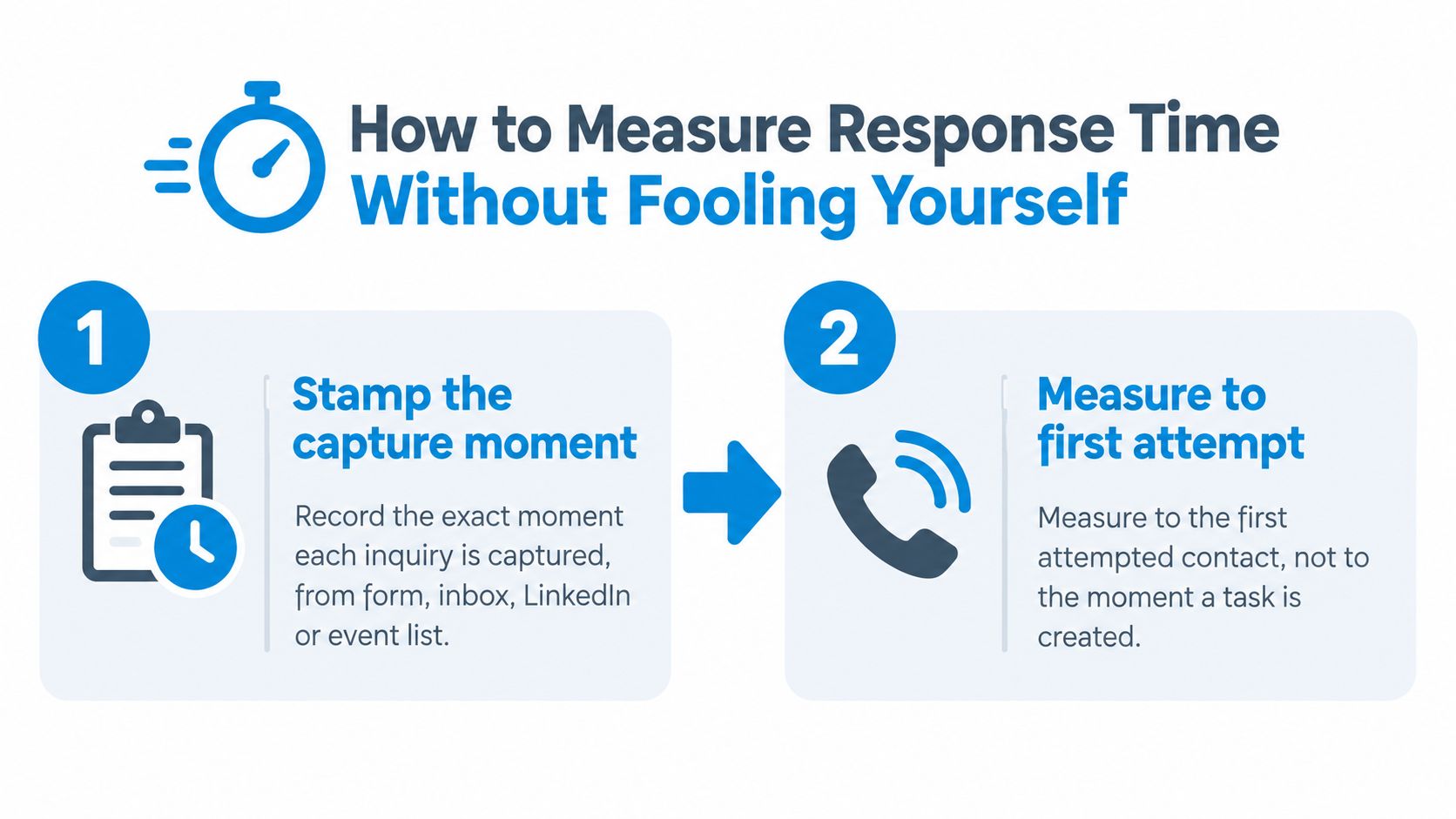
The tracking sequence starts with these distinct events.
Build a timer you can audit
Stamp the capture moment. Store the original form submission, inbox receipt or direct-message timestamp in your CRM. For event imports, distinguish when the conversation happened from when someone uploaded the list.
Measure to the first attempted contact. Keep automated acknowledgment and human outreach in separate fields, so an instant receipt message doesn't conceal an unanswered consultation request.
Assign a response band. Use the intervals below, keeping the categories mutually exclusive. “Same day” should mean after the shorter intervals but before the end of the capture date.
Count outcomes for the same captured-lead cohort. Record connected, discovery booked and qualified separately, and don't classify a sent email as a connection.
Segment before interpreting. Compare website inquiries with website inquiries, then examine geography and engagement model. Otherwise, differences in referral quality or coverage hours can masquerade as speed effects.
Review a rolling window rather than reacting to isolated wins. A rolling quarterly view is a practical starting point, but sparse segments may need longer before their rates are informative.
Make the report usable
Response band report template
| Response band | Leads | Connected | Discovery booked | Qualified |
|---|---|---|---|---|
| 0 to 5 minutes | CRM cohort count | Connected count | Booked count | Qualified count |
| 6 to 30 minutes | CRM cohort count | Connected count | Booked count | Qualified count |
| 31 to 60 minutes | CRM cohort count | Connected count | Booked count | Qualified count |
| Same day | Remaining same-date count | Connected count | Booked count | Qualified count |
| Later | Subsequent-date count | Connected count | Booked count | Qualified count |
Calculate each outcome rate against the leads in its own row. Keep counts visible beside rates, and allow time for newly captured opportunities to progress before comparing qualification outcomes.
Use a consulting sales scorecard to connect these measures with later pipeline stages. A timer that begins at task creation excludes the very queueing delay you need to diagnose.
For an additional walkthrough, use the accompanying video.
How Follow-Up Cadence Should Change by Stage
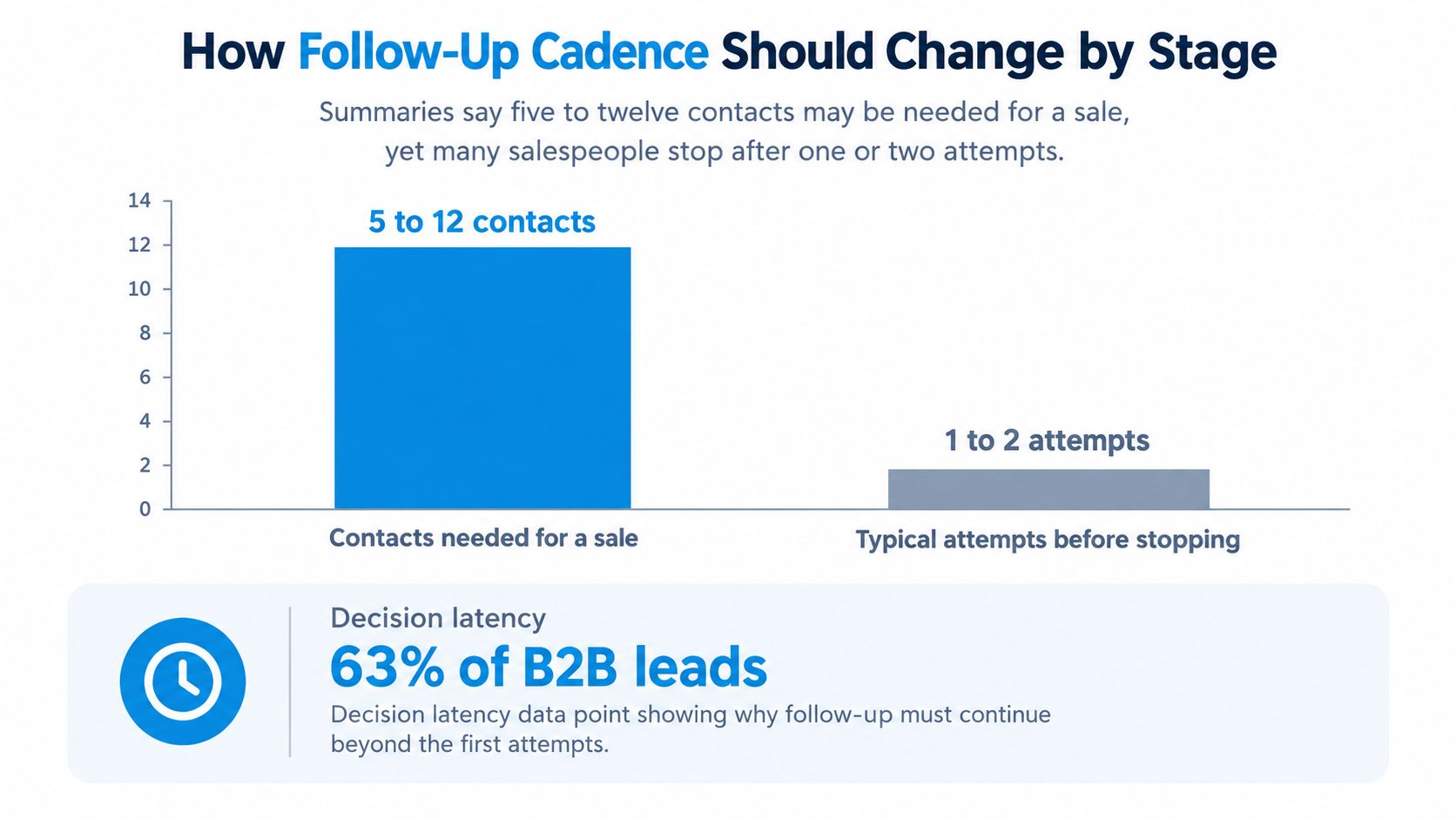
Persistence summaries describe five to twelve contacts as potentially necessary for a sale while reporting that many salespeople stop after one or two attempts; buyer research summarized in VanillaSoft's sales persistency guide also indicates that 63% of B2B leads may take at least three months to decide, while around one-fifth may wait up to a year. These are summary-level findings, not a controlled prescription for consulting engagements.
The apparent contradiction is useful: buyers may need sustained attention, but sustained attention doesn't mean uninterrupted sales pressure. The chart illustrates that distinction in reported persistence.
Match contact purpose to the decision
The horizons below are planning categories, not measured stage-specific averages. Use the buyer's stated decision process to replace them whenever possible.
| Opportunity stage | Typical decision horizon | Purpose of each contact |
|---|---|---|
| New inbound request | Minutes to days as an intake planning horizon | Confirm, qualify and book a call |
| Proposal awaiting approval | Weeks to months as a planning horizon | Remove internal friction and answer questions |
| Discovery complete, no proposal yet | Weeks as a scoping horizon | Confirm next step and scope |
| Dormant opportunity | A longer-term horizon confirmed with the buyer | Provide useful content with low pressure |
| Referral partner | Irregular, relationship-led | Thank, reactivate and share context |
For a fresh inquiry, prioritize the requested interaction. If the buyer doesn't respond, vary the next attempt's purpose rather than sending repeated availability requests. Offer a relevant scheduling option, clarify an unanswered scope question or explain what the discovery conversation will establish.
A proposal awaiting approval needs a different message. Ask whether the sponsor needs an implementation outline, a clearer statement of deliverables or material they can share internally. Don't keep asking whether they've read the document if the obstacle is approval authority.
For dormant opportunities, a permission-based monthly rhythm can be a starting hypothesis, not an evidence-backed optimum. Send something tied to the original business issue and invite the buyer to confirm whether it's still relevant. Referral partners need context and acknowledgment, not prospecting sequences.
The Social Search's follow-up guidance for B2B outbound teams offers a complementary resource for message and timing ideas. Adapt those ideas to an existing advisory conversation rather than treating outbound templates as inbound evidence.
Define when persistence should stop
Persistence should preserve a useful next step, not merely keep a sequence running.
Set a stop or transition rule before activating each workflow. Stop on an explicit refusal or opt-out; pause when the buyer requests a later date; move an unresponsive opportunity into low-pressure nurture when active follow-up no longer has a defined purpose.
Track time to next step, proposal aging, stalled-opportunity recovery, disengagement and referral reactivation. Total attempts tell you how much activity occurred. They don't tell you whether the buyer became more able or willing to proceed.
Why Small Advisory Firms Should Not Copy the Averages
The uncomfortable point is that the popular averages weren't established specifically for firms like yours. The large-database benchmarks summarized in BookYourData's B2B sales statistics coverage don't resolve the economics of expert-led advisory work with limited lead volume, complex engagement fit and multiple stakeholders.
What should a small advisory firm optimize first: response speed, lead quality or informed personalization? The answer requires separating operational failures from commercial ones.
Diagnose the constraint, not just the delay
Consider the difference between an unanswered inquiry and an unsuitable inquiry answered promptly. The former is a routing problem. The latter may be a targeting, positioning or qualification problem, and a faster reply won't make the engagement suitable.
Use a source-level comparison to decide where to investigate:
- Slow response and weak connection: Audit assignment, coverage and contact attempts before changing acquisition channels.
- Prompt response and weak qualification: Review what the source promises, who it attracts and whether the request matches your services.
- Qualified conversations without proposals: Inspect discovery outcomes, scope clarity and the agreed buying process.
- Proposals without decisions: Examine stakeholder access, approval requirements and whether each proposal has an accountable next action.
These are diagnostic hypotheses, not proof of causation. Review the underlying conversations before changing the process.
Small samples require particular restraint. An isolated large engagement can dominate revenue results, while a missed opportunity can noticeably change a segment's apparent performance. Keep counts visible, extend the observation window when needed and resist ranking response bands that contain little evidence.
Test relevance after establishing coverage
For small advisory firms, partner availability, engagement fit and project value belong beside operational metrics. Track response time with qualification rate, booked-meeting rate, proposal rate and eventual revenue, grouped by source.
If qualification remains weak, examine acquisition before increasing follow-up volume. Trefle.ai's overview of agencies helping consultants win new clients is a useful starting point for considering outside acquisition support, not evidence that outsourcing will improve your results.
Once every inquiry receives reliable coverage, test the quality of the first response. Compare a generic scheduling invitation with a response that acknowledges the business issue and explains the proposed next step. Speed should be the service floor; relevance is the next variable to investigate.
Applying the Numbers to a Three-Person Advisory Firm
Consider an illustrative three-person advisory firm, not a benchmark or a reported client result. Its partners initially suspect that missed discovery calls come from slow first contact, so they group inquiries by response band and review what happened afterward.
The quickest-response group appears to book more readily than the same-day group. Before buying additional coverage, however, they inspect the full path from inquiry to decision.
An illustrative diagnostic view
The entries below describe the scenario's pattern, not measured findings.
| Response band | Booking pattern in the scenario | Qualification pattern | Later-stage observation |
|---|---|---|---|
| 0 to 5 minutes | Stronger booking | Similar engagement fit | Proposals still stall |
| 6 to 30 minutes | Mixed booking | Similar engagement fit | Next steps aren't consistently recorded |
| 31 to 60 minutes | Mixed booking | Similar engagement fit | Approval ownership is unclear |
| Same day | Weaker booking | Similar engagement fit | Proposal follow-up lacks a purpose |
| Later | Limited engagement | Too little information | Intake needs review |
The initial interpretation is that speed explains the lost revenue. The second interpretation is more useful: faster contact may help secure conversations, but the firm also has a proposal-to-decision problem.
The partners read the opportunity notes and find discovery conversations ending without a confirmed approval process. They've sent proposals, but they haven't established who reviews them, what questions remain or when the buyer expects to decide.
Decision test: Fix a visible downstream failure before attributing every lost engagement to first-response latency.
To run the same exercise, replace the scenario's descriptions with your CRM counts and row-specific outcome rates. Keep the capture cohort consistent, inspect lead sources separately and let opportunities mature before judging eventual results.
The purpose isn't to declare a winning band from a small sample. It's to identify which operational change deserves a test: better coverage, better qualification or better decision-stage follow-up.
Set Your First Response Targets This Week
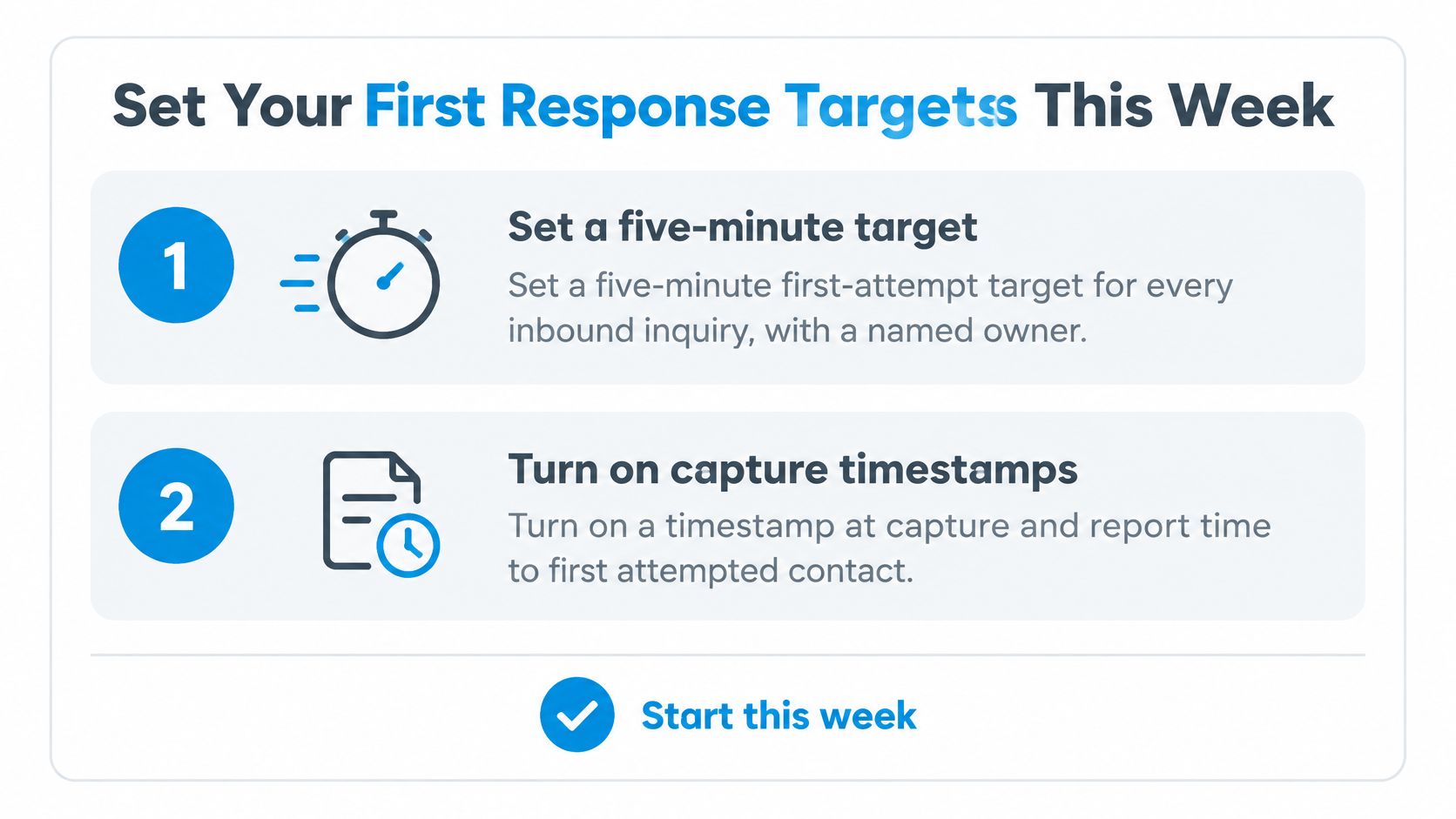
Assign a named owner to every inbound inquiry and set a first-attempt service objective. Add backup ownership so the workflow still functions when the primary person is delivering client work.
Use the target-setting checklist to make responsibility visible.
Install the minimum operating controls
Define coverage and escalation. Specify who handles inquiries, what happens outside staffed hours and when a backup receives an alert. Don't promise immediate human availability if you haven't staffed it.
Turn on capture timestamps and preserve the original inquiry details. Test the workflow by submitting a real form and checking the contact record, owner notification and outreach activity.
Build the response-band report. Keep connection and booking counts visible alongside rates, then review comparable lead cohorts rather than mixing sources indiscriminately.
Add a proposal-aging view with an owner, next action and buyer-agreed decision milestone. Flag missing next steps separately from genuinely delayed decisions.
Review disengagement before adding messages. Check opt-outs, buyer replies and reactivation outcomes during a recurring quarterly review. Increase contact only when you can explain what the additional message contributes.
These controls work in any CRM that preserves timestamps and activity history. If implementation capacity is limited, a done-for-you follow-up automation platform is another option: prebuilt sequences, appointment reminders and stage-based proposal tracking can be installed through a Map, Install, Go Live process.
Choose the implementation route around your team's capacity. Judge the result by whether inquiries receive accountable attention and opportunities retain a meaningful next step.
Starward Navigators provides client-acquisition infrastructure for consulting and advisory firms, including lead routing, automated follow-up, appointment reminders and proposal tracking. Visit Starward Navigators to discuss a setup that connects first-contact activity with the decisions that follow, rather than measuring response speed in isolation.