A lot of small consulting firms have the same blind spot. They run a sharp discovery process, build a thoughtful proposal, send it, and then slip back into delivery work while that proposal sits in someone's inbox and everyone's memory. A week later, one partner asks if the client ever replied. Another assumes someone else followed up. By the time the team realizes nothing has moved, the deal is no longer warm. It's just unresolved.
That's why a proposal tracking system matters. Not because firms need another place to store PDFs, but because they need a way to manage the period between proposal sent and decision made. In a boutique consultancy, that gap is where opportunities stall, ownership gets fuzzy, and revenue forecasts become fiction.
Industry benchmark coverage makes the problem clear. In a proposal management benchmark summary, only 43% of respondents reported using RFP-specific technology, while the rest relied on email, spreadsheets, content storage, and e-signature tools. The same reporting showed how lean these teams usually are: 6% consist of one person, 33% have 2 to 5 people, 24% have 6 to 10 people, 16.5% have 11 to 20 people, 12% have 21 to 50 people, and 8.5% have more than 50 people. Small firms don't have spare capacity for proposal drift. They need a system that makes follow-up visible, assigns ownership, and keeps each live proposal moving.
Table of Contents
- The Proposal That Went Quiet and What It Cost
- What a Proposal Tracking System Actually Does
- Core Features That Matter for Consulting Teams
- Proposal Tracking System vs Generic CRM
- Implementing a Proposal Tracking System Without Disruptive
- Proposal Tracking Mistakes That Create Silent Pipelines
- Turning Proposal Tracking Into Operating Infrastructure
The Proposal That Went Quiet and What It Cost
Tuesday afternoon, the proposal goes out. By Friday, the client has not replied. In the next partner meeting, someone asks whether follow-up is scheduled. No one is sure. The relationship lead thought the proposal writer would send the next note. The proposal writer assumed the partner would handle it. Two weeks later, the opportunity is still labeled active, but no decision process is being managed.
That pattern is expensive because the problem is not the document. The problem is the unmanaged period between proposal sent and decision made.
In small consulting firms, silence after a proposal usually points to an operating gap. The team did the hard work up front. Discovery happened. Scope was framed. Pricing was debated. Then the proposal left the building and ownership got fuzzy. What generic CRM setups often miss is that this stage needs its own discipline. A deal can look healthy in the pipeline while the actual buying conversation is stalled, unclear, or forgotten.
Silence also changes how the firm is perceived. Buyers do not only judge the quality of the proposal. They judge whether the firm can run a process, keep momentum, and help a decision move. A calm, well-timed follow-up often signals stronger execution than a polished PDF followed by three weeks of inactivity.
Practical rule: A sent proposal starts a decision workflow. It does not close a task.
The commercial cost shows up in several places. Revenue gets harder to forecast because partners keep counting unresolved proposals as likely business. Capacity planning gets distorted because delivery leaders hesitate to staff work that may never start. Win rates suffer because objections, procurement questions, and internal sponsor hesitation sit untouched for too long.
The operational cost is just as real. Once a proposal goes quiet, teams start reconstructing context from inboxes, meeting notes, and memory. That recovery work is slow, and it usually happens after momentum is already gone.
Earlier benchmark reporting already established that many proposal teams still rely on email, spreadsheets, storage tools, and e-signature platforms rather than purpose-built proposal systems. For a boutique consultancy, that matters because silence needs a recorded next step, not a vague intention to follow up. Every live proposal needs a clear owner, a defined next action, and a date attached to that action. Without that, the gap between proposal sent and decision made stays unmanaged, and quiet deals stay quiet.
What a Proposal Tracking System Actually Does
Most firms think they already have proposal tracking because they can find a sent file in Google Drive, search the email thread in Outlook, or attach the PDF to a deal in HubSpot or Salesforce. That isn't a proposal tracking system. That's scattered evidence that a proposal exists.
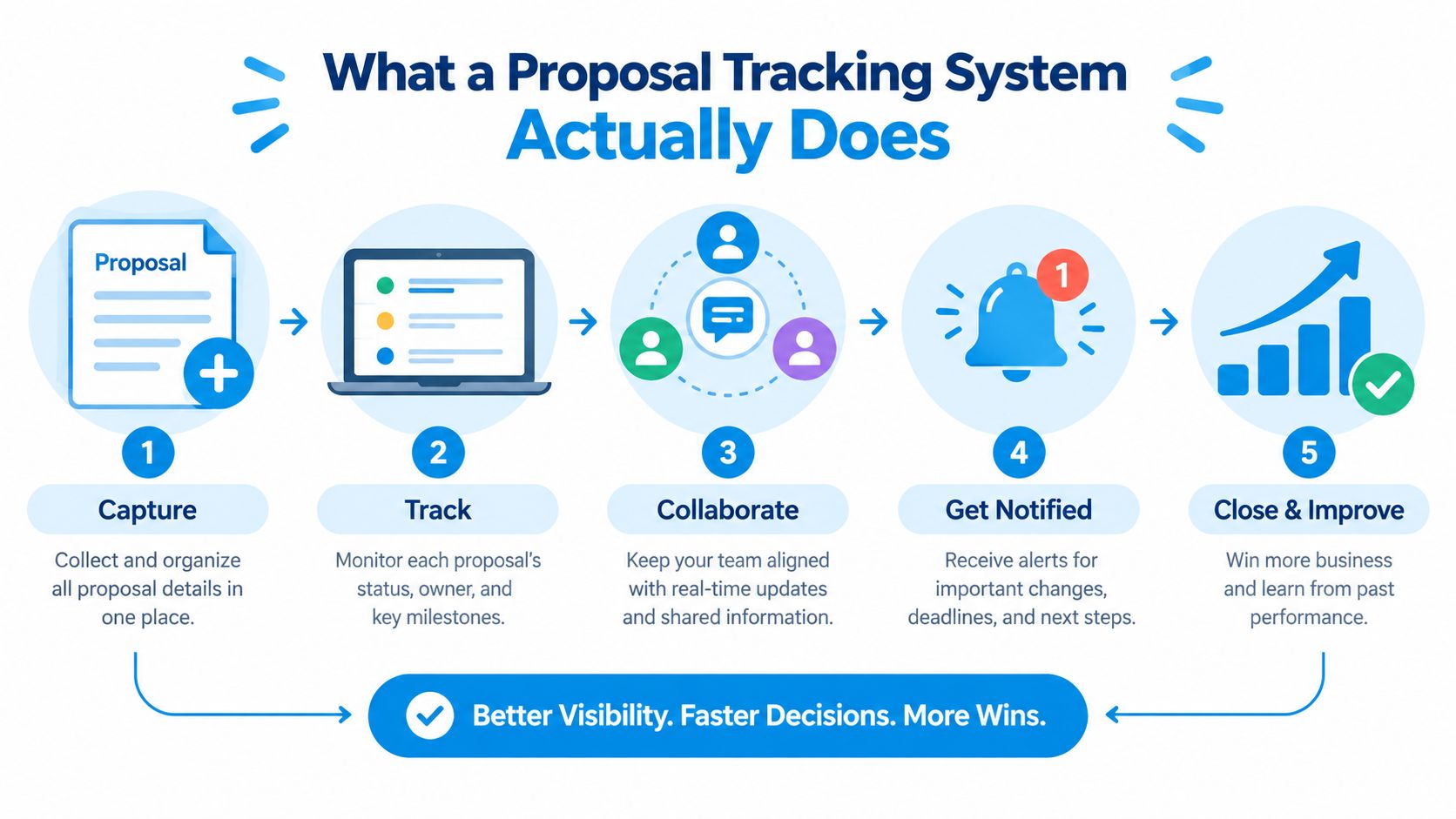
A real proposal tracking system treats the proposal as an operating object with its own lifecycle.
It creates a durable record
The first job is simple but often missing. Each proposal needs its own record linked to the right company, contacts, engagement notes, and commercial context. That record should survive handoffs. If the partner who owns the relationship goes on leave, someone else should be able to open the proposal record and understand what was promised, what was debated, and what the client is deciding.
Without that record, firms waste time reconstructing history from email fragments and half-remembered conversations.
It applies a stage model that means something
The second job is stage discipline. A proposal should move through specific states such as drafted, sent, opened, reviewed, negotiating, decided, won, or lost. The labels can vary, but the principle matters. Vague statuses like “waiting” or “pending” hide too much.
When firms define proposal stages properly, their internal conversations change. Instead of asking, “Where are we on Acme?” they can ask better questions:
- Has the buyer engaged yet
- Do we know who else is reviewing it
- Is the hold-up commercial, political, or procedural
- What's the next action before this goes stale
It drives action from signals and time
The third job is what generic systems usually miss. A proposal tracking system should create follow-up prompts based on elapsed time and buyer behavior. Practical workflow guidance shows that the strongest systems use behavioral triggers, stage changes, and reminder rules together, not just a calendar nudge. One example cadence is Day 0 confirmation, Day 3 clarification, Day 7 decision-timeline check, Day 14 direct status call, and Day 30 close-out or negotiation package, as described in this proposal tracking workflow guide.
Open tracking matters less than what your team does next. Signals are only useful when they produce a clear action.
That's the difference. A shared folder stores documents. A CRM attachment stores evidence. A proposal tracking system manages the live decision process after the proposal is sent.
Core Features That Matter for Consulting Teams
Consulting firms don't need bloated proposal software. They need a small set of capabilities that match how advisory deals move. The right feature set isn't about elegance. It's about preventing avoidable stalls, preserving context, and making handoffs survivable.
The features worth insisting on
Some features solve recurring operational pain. Others just produce nicer screenshots. The table below separates the useful from the decorative.
| Feature | Workflow Problem It Solves |
|---|---|
| Stage-based pipeline view | Stops every proposal from collapsing into a generic “sent” status and shows where decisions are actually stuck |
| Deal-level context storage | Preserves discovery notes, scope assumptions, and commercial background so another team member can step in |
| Time and signal-based follow-up rules | Prevents proposals from aging quietly because no one remembered to chase them |
| Version control | Resolves confusion when clients comment on an older draft or approve a prior scope |
| Stakeholder tracking | Makes it visible when the named recipient is not the only decision-maker |
| Outcome capture and loss reasons | Creates a usable record of why proposals fail, stall, or convert |
Where generic setups break
Stage-based pipeline view matters because consulting proposals don't move in a straight line. Buyers ask for revisions, bring in procurement late, pause decisions, or go dark before resurfacing. Your pipeline needs stages for stalls and re-engagement, not just neat progress from draft to won.
Context storage is equally important. A proposal without discovery notes is hard to follow up on well. The person calling back needs more than the latest PDF. They need the buyer's problem statement, urgency, budget posture, political risks, and any non-obvious buying criteria.
Version control becomes critical the first time a client says, “We're approving the version from last week, not the one you sent on Tuesday.” If the firm can't immediately verify what changed, negotiation gets messy fast.
The overlooked requirement
Most firms underbuild stakeholder tracking. They log the primary contact and assume that's enough. It usually isn't. Coverage of proposal tracking has pointed out that teams often over-focus on opens and page views while stale contact data and wrong recipients can make 15%+ of proposals bounce, according to this discussion of proposal tracking and contact quality. For consulting firms, that matters because proposals are commonly forwarded inside the client organization. A clean open signal from one person may tell you very little about the actual buying group.
That's why proposal tracking should include recipient verification and buying-committee mapping, not just engagement metrics.
One practical example is a system with a structured proposal pipeline and per-deal context, such as Starward's proposal follow-up workflow, which is built around defined next steps rather than passive document storage.
Proposal Tracking System vs Generic CRM
A generic CRM can hold proposal data. That doesn't mean it handles proposal operations well. Most CRMs were built to manage contacts, activities, and broad sales stages. Consulting firms need something narrower and more exact once a proposal is in play.
The question is whether your current setup treats the proposal as a live decision record or just a file attached to an opportunity.
Side-by-side comparison
| Capability | Generic CRM | Proposal Tracking System |
|---|---|---|
| Proposal as its own record | Usually an attachment or note inside a deal | Managed as a first-class record with its own status and history |
| Version and reviewer history | Often manual, inconsistent, or outside the CRM | Built into the proposal workflow and tied to the active draft |
| Task segmentation after send | Depends on manually created tasks | Follow-up, reminders, and escalations can be tied to proposal status |
| Stakeholder map per proposal | Usually contact-centric, not proposal-centric | Tracks who received, reviewed, influenced, or forwarded the proposal |
| Buyer engagement signals | Often limited or added through separate tools | Incorporated into stage changes and next actions |
| Forecasting quality | Based on broad sales stages | Based on proposal-specific movement and decision readiness |
Where firms feel the friction
A generic CRM usually works fine until the proposal has been sent. That's when teams start compensating. They add a spreadsheet to track versions. They create ad hoc reminders in Google Calendar. They build custom fields no one keeps current. They forward internal emails because the CRM record doesn't capture the nuance of the live negotiation.
That patchwork produces bad pipeline visibility. Deals look active because the sales stage hasn't changed, even though no one has heard from the buyer in weeks.
Operator's test: If you need a spreadsheet to understand your proposal status, your CRM isn't actually handling proposals.
What this means for advisory firms
For a small firm managing a modest number of live pursuits, the practical issue isn't software purity. It's whether the team can trust the pipeline. If proposal status is being flattened into generic opportunity stages, your forecast gets distorted and your follow-up gets lazy.
That's where a more structured system earns its keep. A consulting sales pipeline built around operational stages can keep proposal activity visible without forcing the team to maintain parallel trackers.
Implementing a Proposal Tracking System Without Disruptive
On Monday, a partner asks a simple question: which proposals are waiting on a client decision, and what happens next on each one? If the answer lives partly in inboxes, partly in someone's head, and partly in a spreadsheet no one trusts, implementation has already started late.
Small consulting firms usually do not need a heavy system rollout. They need a controlled way to turn proposal follow-up into a managed decision process. The practical risk is not software disruption. It is losing track of who owns the next move after the proposal leaves your hands.
Start small and build around active decisions, not historical records.
A useful rollout has four parts: gather the live proposals, define decision stages, set follow-up rules, and test the process with one team before wider adoption.
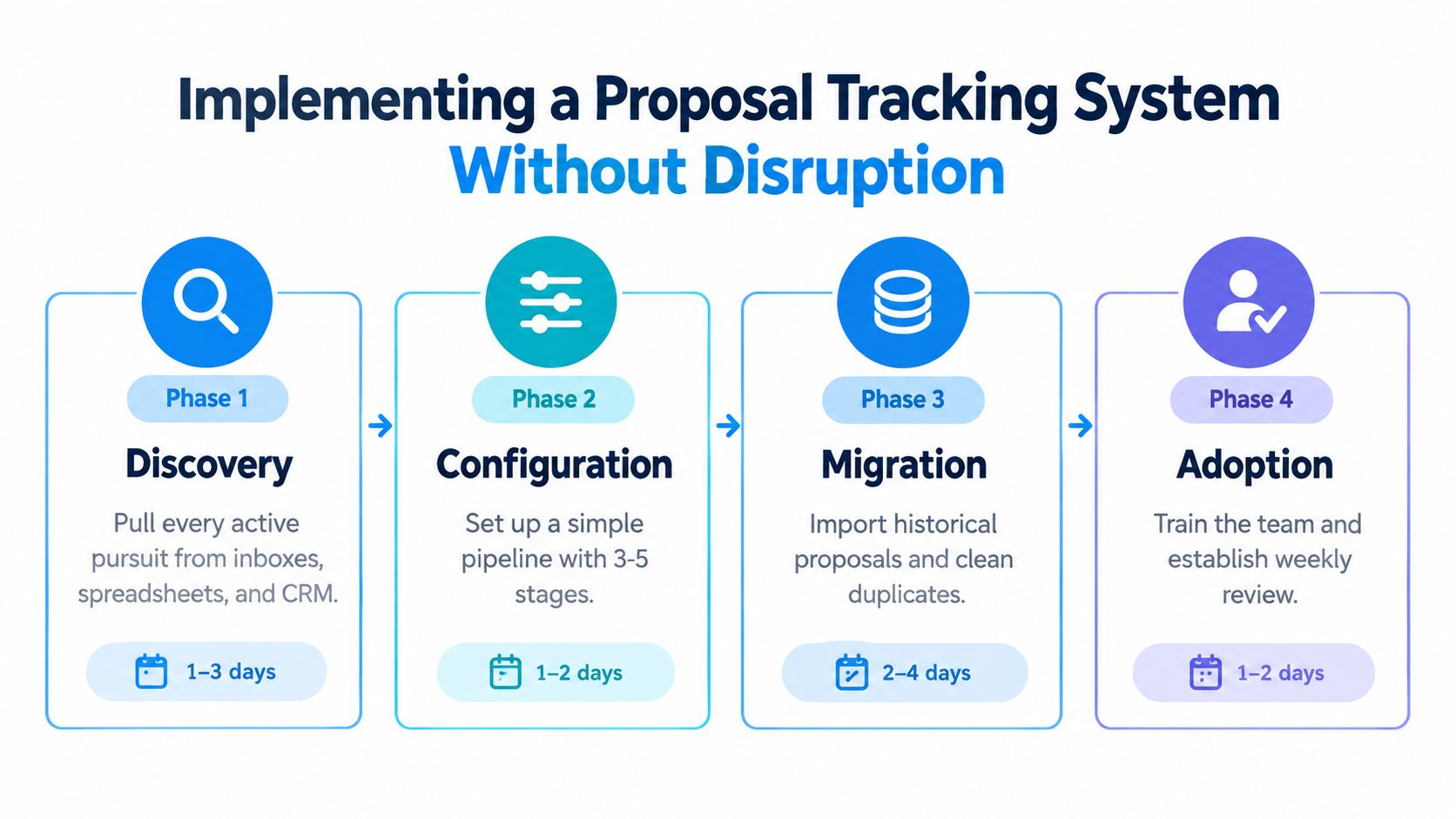
Phase one creates a live decision register
Pull every open proposal into one working list, regardless of where it sits today. That usually means inbox threads, spreadsheet trackers, partner notes, draft folders, and calendar reminders.
Do not start by cleaning every field or rebuilding old records. Start by identifying the proposals that still need a client decision and the next internal action tied to each one. For small firms, that distinction matters. Closed work can wait. Ambiguous live work cannot.
Capture only the fields the team will use in review.
- Client and opportunity name
- Current decision stage
- Named owner
- Date sent
- Last meaningful client contact
- Next action
- Expected decision date, if known
That first register usually exposes a hard truth. Several proposals that looked active are unattended.
Phase two maps stages to decision reality
The stage model should reflect how consulting buyers move from review to decision. Generic templates tend to flatten this into broad sales labels, which hides where a proposal is slowing down.
Useful stages often include internal client review, revision requested, sponsor aligned, procurement review, decision pending, and stalled. The exact labels matter less than the behavioral difference between them. A stage should tell the team what the client is doing, what risk is present, and what action belongs next.
Keep the model tight. Six clear stages will outperform twelve vague ones.
I usually use one test here. If two partners would classify the same proposal differently after a short discussion, the stage definitions are still too loose. Fix that before you configure anything.
A short walkthrough helps teams visualize the change before they configure anything:
Phase three sets the rules that protect follow-through
Once the stages are clear, add the few rules that keep proposals from going quiet. The system starts acting like operating infrastructure instead of a record repository.
Use simple triggers such as:
- When a proposal is marked sent, create the first follow-up task.
- When there has been no client response within the agreed interval, notify the relationship owner.
- When a revision is requested, assign an internal owner and due date.
- When a proposal is approved, create the handoff record for delivery.
The goal is not maximum automation. The goal is consistent intervention before a live decision stalls.
That trade-off matters. Over-automate, and the team ignores the alerts. Under-define the rules, and the system becomes a passive log that still depends on memory.
Phase four tests the operating rhythm in one slice
Roll this out in one practice area, one partner group, or one set of live pursuits first. A pilot shows whether the stage definitions make sense, whether follow-up tasks are realistic, and whether ownership stays clear under real workload.
Keep the parallel period short. If the old spreadsheet, inbox reminders, and side notes remain in place too long, people revert to them under pressure.
The failure points are predictable:
- Migrating stale proposals that no longer need a decision
- Assigning shared ownership instead of one accountable owner
- Letting side trackers survive after the pilot starts
- Skipping weekly review during the first month
Weekly review is the part teams underrate. It is where proposal tracking becomes decision management. Each proposal should have an owner, a current decision stage, and a next action that matches the buyer's situation. If any of those are missing, the record is not current enough to guide action.
Implementation stays manageable when the firm treats this as an operating change with light software support, not a software project with hoped-for behavior change. That is how small teams close the gap between proposal sent and decision made.
Proposal Tracking Mistakes That Create Silent Pipelines
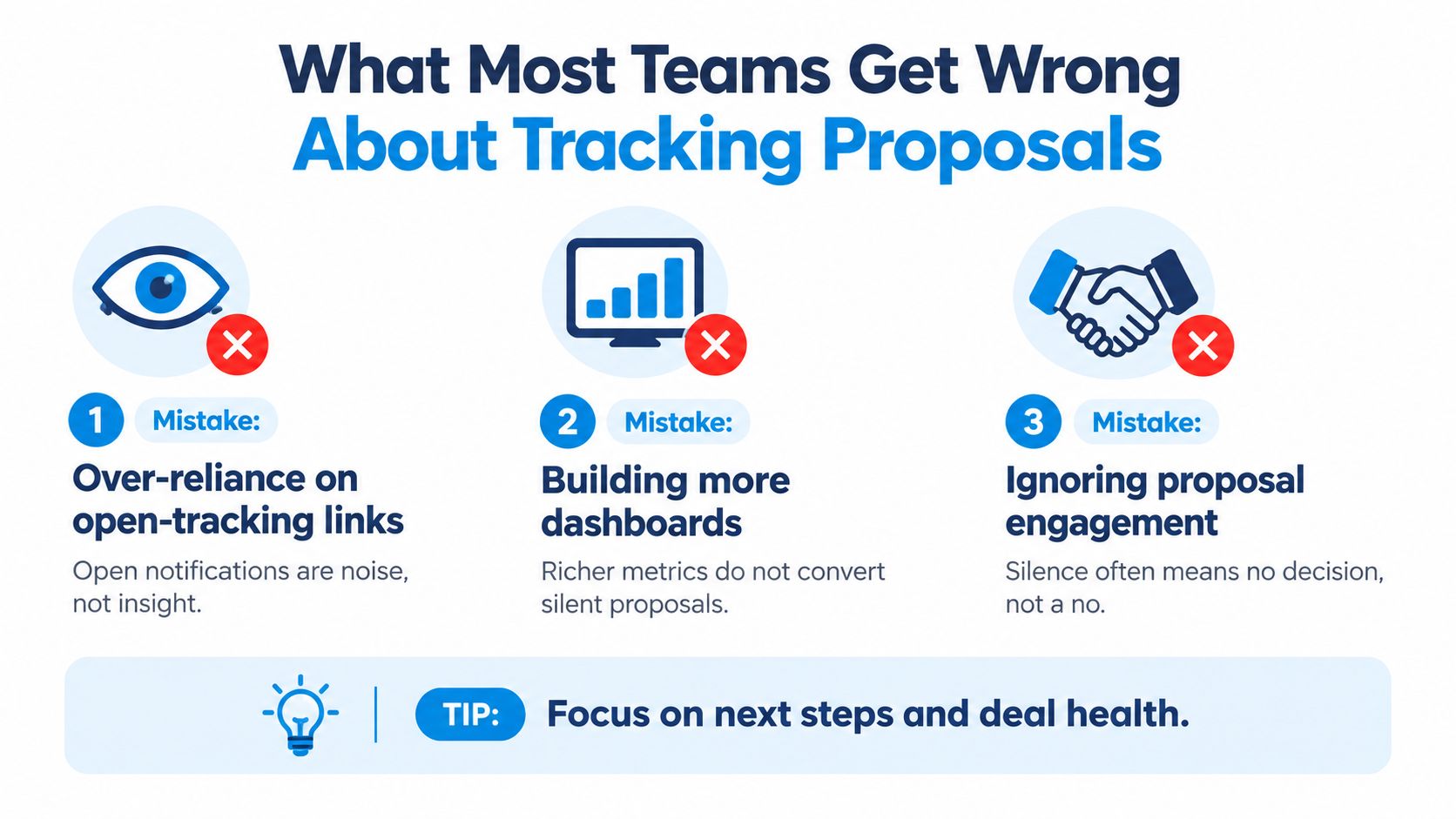
The recurring failure is treating proposal tracking as an activity log instead of a decision-management system. Small consulting firms rarely lose control because a file went missing. They lose control because nobody can answer three basic questions once the proposal is out: who owns the next move, what decision the buyer is making, and when silence becomes a risk that needs intervention.
A page-view alert does not answer any of that. Neither does a dashboard full of opens, forwards, and time-on-document metrics if the team still has to guess what to do next.
Three proposal tracking mistakes that hurt consulting teams
The pattern shows up the same way across boutique firms:
- Recording interest signals without assigning a decision owner. If a proposal is opened and nobody is accountable for the follow-up, the signal changes nothing.
- Measuring document activity instead of decision progress. Buyers can reread a proposal for days while internal approval, budget review, or scope questions remain stuck.
- Treating tracking like client surveillance. Good systems are built for internal coordination. They help the team decide when to follow up, what to ask, and whether the pursuit is still active.
I have seen firms buy proposal software for the alerts, then keep running the process from partner memory and scattered inbox threads. That setup looks modern, but it breaks the minute one person is busy, traveling, or assuming someone else already reached out.
What disciplined tracking looks like in practice
Track the few fields that help the team move a live decision forward:
- One named owner for each proposal
- Current decision stage, not just sent date
- Next action scheduled before the proposal leaves
- Reason for delay if the buyer goes quiet
- Review flag for stalled proposals that need escalation or a close-lost call
This is less about storing proposal history and more about managing judgment. A consulting pipeline improves when the record shows how close the buyer is to a decision and what the firm will do next to reduce drift.
The strongest teams keep the system plain on purpose. Less data, better decisions.
Healthy proposal tracking reduces ambiguity after send. It does not just document that a proposal exists.
Turning Proposal Tracking Into Operating Infrastructure
A proposal record becomes operating infrastructure when it lets the firm make the next decision without chasing the last conversation. That is the standard. Small consulting teams do not need another place to store PDFs. They need a shared system that shows what decision is pending, who owns progress, and what happens if the buyer does not respond on time.
Once teams work that way, proposal tracking starts changing day-to-day execution.
Weekly pipeline reviews get shorter and more useful because the conversation shifts from recollection to action. The team can see which proposals are waiting on legal review, which ones need a scope revision, and which ones have gone quiet long enough to justify a close-lost call. That matters more than knowing whether a prospect opened the file three times. Decision progress is what keeps revenue moving.
The same discipline improves coverage across partners and project leads. If one person is out, someone else can step in and see the current state, the last meaningful contact, the buyer-side blocker, and the agreed next move. Generic CRM notes rarely capture that level of decision context unless a firm forces the habit. A proposal tracking system should make that context easy to maintain because small firms do not have extra management layers to clean it up later.
The handoff after a win is part of the same system.
Teams that treat "won" as the finish line create friction for delivery. Scope assumptions get lost, kickoff timing slips, and the client repeats information the firm already had during the sales process. A better setup carries the final proposal context into staffing, kickoff prep, and client onboarding. That closes the gap between decision made and work started, which is where many boutique firms still lose time.
A simple test usually settles whether the system is real.
Could another team member open the record today and run the next two weeks of follow-up without a long internal briefing? If not, the firm is still relying on personal memory, inbox search, and informal status updates. That can work for a while. It usually breaks during travel, busy delivery periods, or partner handoffs.
Starward Navigators builds client acquisition infrastructure for small consulting firms, including proposal tracking, follow-up automation, stage-based pipelines, and handoffs into delivery so proposals do not go quiet after they are sent. If you want a system that treats proposals as active decisions instead of static documents, visit Starward Navigators and see how the workflow is structured end to end.