You've had the call. The prospect was engaged, asked thoughtful questions, and agreed that your approach fits. You send the proposal that evening, receive a polite “we'll review it,” and then watch the opportunity disappear into an inbox.
The document may have been clear, accurate, and professionally designed. That still doesn't mean the buyer knows how to approve it, who else needs to review it, or what happens next. For a small advisory firm, a sales proposal format must do more than describe the work. It must help a buyer reach a decision and give you a practical system for moving that decision forward.
Table of Contents
- The Proposal That Disappeared and Why
- Required Sections in the Right Order
- Pricing and Options That Make the Decision Easy
- The Next-Step CTA and the Internal Alignment Layer
- A Follow-Up Cadence That Prevents Proposal Ghosting
- Tracking Engagement and Letting Signals Drive the Next Move
- Putting It All Together and What to Do This Week
The Proposal That Disappeared and Why
The usual failure begins with a mistaken milestone. The advisor treats proposal sent as progress. The buyer treats it as a new task that competes with budget reviews, internal meetings, procurement questions, and other priorities.
A strong discovery call doesn't protect you from that outcome. In fact, it can make the silence more frustrating because the opportunity felt real. You understood the problem, the prospect liked the proposed direction, and the commercial conversation seemed manageable. Yet the proposal arrived as a standalone file with no agreed decision date, no confirmed approval path, and no scheduled review.
That isn't a writing problem. It's an operating problem.
Sales proposals evolved from relationship-based agreements into structured procurement documents as buyers and sellers became separated by distance and unfamiliarity. Industrialization expanded markets in the mid-19th century, businesses used newspapers and trade publications to publish vendor notices, and suppliers responded by mail. Later, telephone, fax, faster postal services, formal government RFPs, computers, email, spreadsheets, word-processing documents, and PDFs moved proposals into increasingly standardized workflows. The history and structure of the modern RFP explain why today's proposal normally connects requirements, scope, evaluation criteria, pricing, timing, terms, and response instructions.
The important point for an advisory firm is practical: a proposal is a decision document, not a company brochure. It should reduce ambiguity between the client's stated problem and the work you'll deliver.
Operating rule: Sending the proposal is an administrative event. Getting the decision is the sales milestone.
That distinction changes how you write every page. You're not asking, “How can we describe our firm impressively?” You're asking:
- Can the buyer explain the recommendation to another stakeholder?
- Can finance understand the commercial commitment?
- Can the operational evaluator see what happens first?
- Can the champion identify the exact approval action?
- Do you know when and how you'll follow up?
The rest of the format should answer those questions. The document and the post-send workflow belong together.
Required Sections in the Right Order
Buyers don't read a proposal as a portfolio. They scan it for answers to a sequence of risks: Do you understand our situation? What exactly will happen? What will it require from us? What will it cost? How do we approve it?
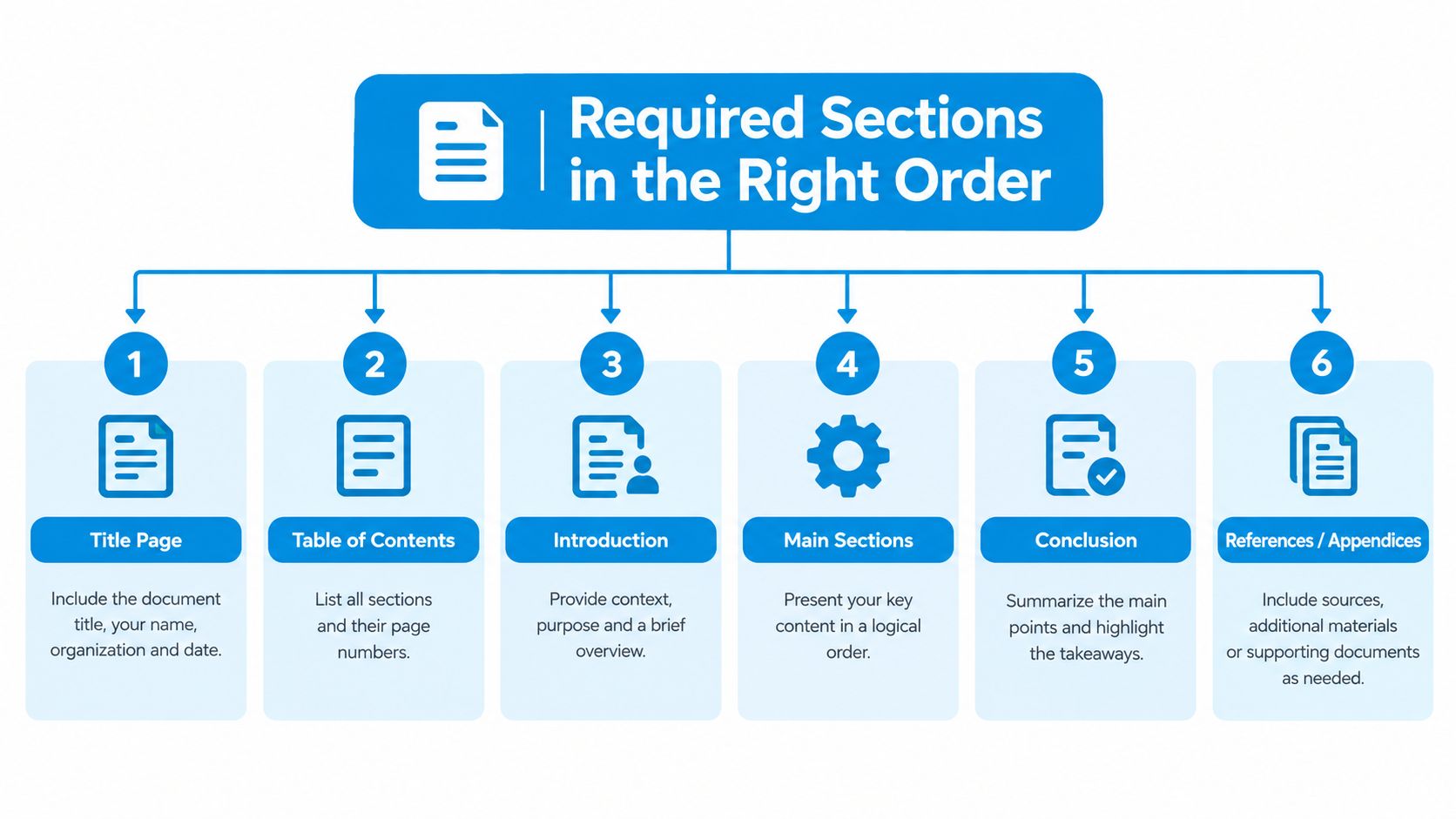
Use this order:
- Cover page: Name the client, engagement, date, proposal validity, and your firm. Keep it functional. The cover should establish ownership and context, not consume space with branding.
- Executive summary: Lead with the buyer's situation, desired outcome, recommended approach, relevant evidence, and one action. Don't begin with your history. Senior buyers may read this page closely and skim the rest.
- Problem impact: Describe the operational or commercial consequence of leaving the problem unresolved. Use client-specific facts from discovery. If the impact hasn't been quantified, state the consequence precisely without inventing a number.
- Solution and delivery method: Explain how your approach addresses the stated problem. Include only the methods, services, or capabilities that support the recommendation.
- Scope and deliverables: Define what you'll produce, what meetings or inputs are required, what's excluded, and how completion will be recognized.
- Timeline and milestones: Show phases, decision points, owners, dependencies, and client responsibilities. A timeline should help the buyer visualize implementation.
- Pricing and packaging: Present the commercial choices in a way that allows comparison. Don't bury assumptions in small print.
- Proof: Include relevant evidence, such as a directly comparable engagement, validated experience, or client-approved example. Generic credentials belong in the background, not at the center.
- Terms and assumptions: State payment terms, validity period, dependencies, confidentiality expectations, cancellation conditions, and required client resources.
- Next step: Give one action, such as approving the proposal, signing an agreement, or booking a decision meeting.
The sequence matters because each section resolves a question created by the previous one. A methodology section before the problem statement asks the reader to care about your process before they understand why it matters. A price without scope makes comparison impossible. Multiple closing requests create uncertainty about which action counts.
Match length to decision complexity
The right document is concise enough to review and complete enough to approve. A 2024 analysis cited by proposal length and close-rate guidance reported that proposals under eight pages had a 2.6-times higher close rate than proposals over 20 pages. A separate observational benchmark reported five-page proposals closing at approximately 50%, compared with roughly 35% for 30-page proposals. These are observational benchmarks, not proof that cutting pages causes more wins, but they reinforce a sound operating principle: remove material that doesn't help the buyer decide.
For most advisory engagements, aim for a concise core document with appendices available when the buyer needs deeper technical, legal, or implementation detail. Use a proposal template library for advisory firms as a controlled starting point, then replace every generic section with language from discovery.
| Proposal section | What the buyer is checking | Failure mode if weak |
|---|---|---|
| Executive summary | “Did you understand our situation?” | The proposal feels generic |
| Problem impact | “Why act now?” | The cost of inaction stays unclear |
| Solution and method | “How will this work?” | The recommendation sounds theoretical |
| Scope and timeline | “What are we buying?” | Delivery risk increases |
| Pricing and terms | “Can we approve this?” | Finance or procurement slows the deal |
| Next step | “What do we do now?” | The file enters an unresolved queue |
Pricing and Options That Make the Decision Easy
A single price creates a binary reaction. The buyer either accepts it or decides it's too expensive, often without a useful conversation about scope. Advisory work rarely fits a simple commodity comparison, so pricing should help the client choose the right level of commitment.
Present three differentiated packages:
- Focused option: Solves the immediate problem with a deliberately limited scope. Label what it excludes.
- Recommended option: Covers the outcome you believe the client needs. Make this the clearest choice, not a disguised compromise.
- Complete option: Adds breadth, speed, governance, or ongoing support. Explain the additional business reason, not merely the extra tasks.
Each option should show scope, expected outcome, client responsibilities, investment, timing, and exclusions. Avoid a menu of line items that forces the buyer to assemble your recommendation themselves. A package should be repeatable in an internal meeting: “The recommended option gives us the diagnostic, implementation support, and reporting needed to reach the agreed objective.”
An analysis of 50,000 proposals reported that presenting multiple packages increased win rates by 36%. The same source reported an average proposal-stage win rate of 47%, with rates of 22% in software and 19% in finance, showing that outcomes vary by market. The proposal-format analysis supports a clear commercial lesson: give the buyer visible choices, but make the differences meaningful.

Make commercial terms easy to repeat
Your pricing page should answer practical questions without requiring a call:
- What's included in each package?
- What isn't included?
- When is payment due?
- How long is the proposal valid?
- What assumptions affect delivery?
- Which services are optional?
- What triggers a change in scope?
Don't hide one-time setup fees, retainers, travel, third-party costs, or renewal conditions in an appendix. If an add-on matters, describe the decision it supports. “Optional stakeholder workshop” is more useful than “Workshop module.”
The recommended package should feel like a professional judgment. Explain why it fits the stated outcome and constraints. The lower tier should be viable, not punitive. The higher tier should remove a real bottleneck, reduce a meaningful risk, or extend the result. If every tier contains the same work with different labels, the buyer will treat the structure as a pricing trick.
The Next-Step CTA and the Internal Alignment Layer
Most proposal templates end with a call to action aimed at the person who attended discovery. That's incomplete. In B2B advisory work, the champion often needs to persuade a finance partner, procurement lead, operational owner, or executive sponsor before anyone can sign.
Recent B2B research reports that 90% of buyers research before speaking with a vendor, while separate research found that 86% of B2B purchases stall because a stakeholder's concerns weren't addressed early. The buyer-decision research makes the implication clear: the proposal must travel internally, not just land well with one reader.
Build a two-layer close.
The external action
Give the champion one specific next step:
- Approve the proposal and return the acceptance form.
- Confirm the recommended package and book the kickoff.
- Schedule a decision meeting with the required stakeholders.
- Authorize a defined diagnostic phase.
Don't end with “Let us know what you think.” That phrasing transfers the burden back to the buyer and creates no event to manage.
The internal decision brief
Add a short, forwardable summary that a non-author can use without you present. It should contain:
- Business outcome: What changes if the engagement succeeds?
- Current problem: Which operational or commercial issue is being addressed?
- Recommendation: Why this package fits the stated need.
- Stakeholder outcomes: What finance, operations, leadership, and end users each gain.
- Implementation risks: What could delay or weaken delivery, and how you'll mitigate it.
- Client requirements: People, data, access, decisions, and meeting participation.
- Commercial summary: Package, investment, payment terms, validity, and exclusions.
- Approval path: Procurement, legal, budget owner, and decision date.
- Forwardable language: A short paragraph the champion can paste into an internal message.
This layer is more valuable than another page of credentials. Your qualifications matter, but they rarely resolve the internal question, “Why should our organization approve this now?”
A champion doesn't need more material to read. They need language and evidence they can reuse.
The post-send process should reflect that reality. Confirm the economic buyer, operational evaluator, approval path, decision date, and next meeting before sending. Then monitor whether other stakeholders engage with the document and adapt the follow-up to their concerns.
Use one external CTA, supported by internal artifacts. The proposal should include the decision brief, stakeholder outcomes, assumptions, risks, required resources, and approval mechanics. The champion should be able to defend the recommendation without reconstructing your discovery call from memory.
A Follow-Up Cadence That Prevents Proposal Ghosting
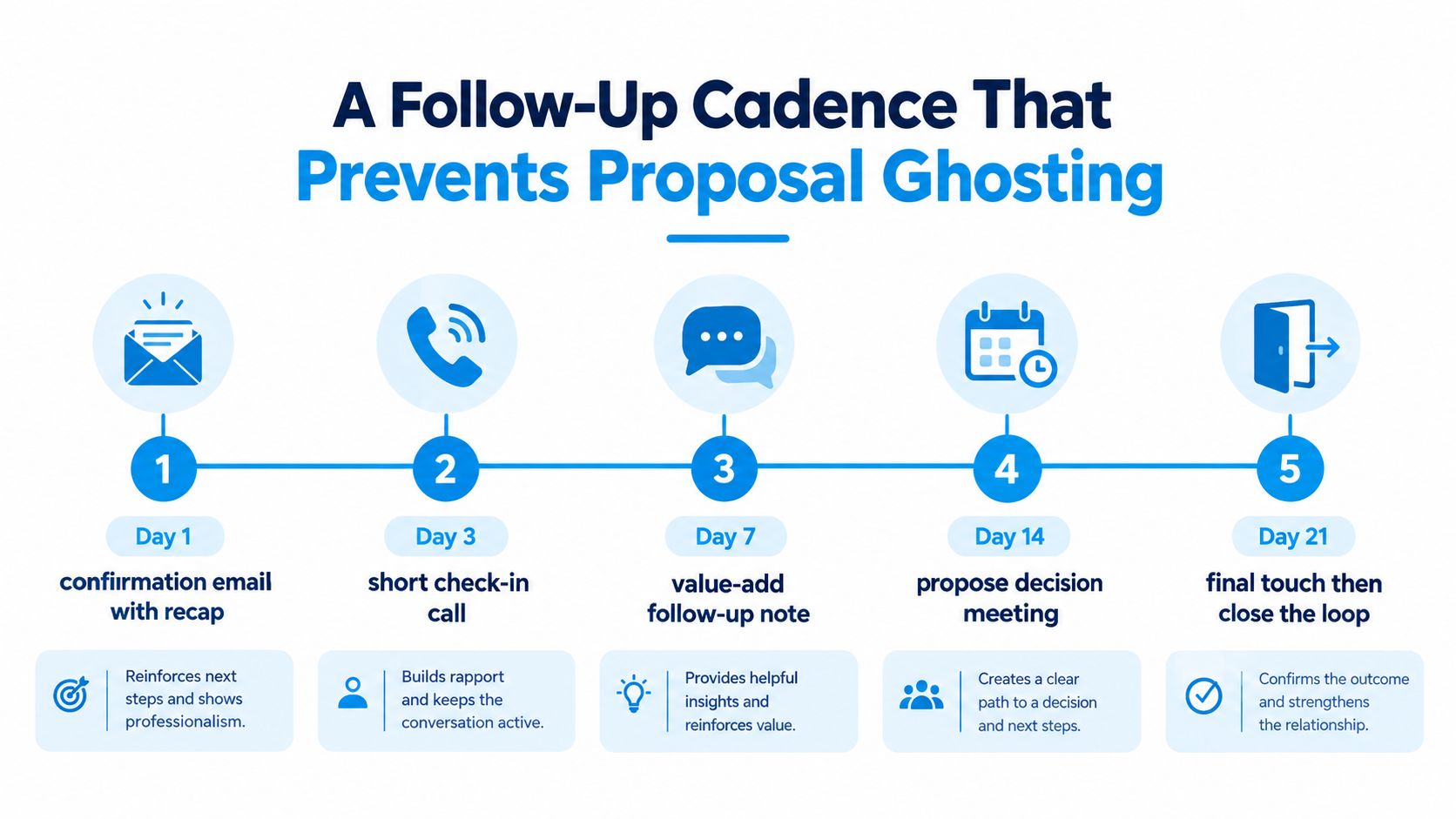
A proposal needs a scheduled operating sequence before it's sent. If you're deciding what to write after silence arrives, you're already reacting too late.
Proposal engagement analyses indicate that 82% of readers open a proposal within one hour, falling to 48% after 24 hours and 8% after one week. Other research reports that the first follow-up within 24 to 48 hours can materially improve reply rates. Proposal follow-up timing guidance supports a simple rule: follow up while the proposal is still connected to the buyer's recent conversation.
Use each touch to answer a different question
Same day, delivery confirmation. Confirm that the proposal arrived, recap the agreed problem and recommended package, and restate the scheduled decision event. Don't add a new sales pitch.
Within 24 hours, remove friction. Ask whether the buyer or any stakeholder needs clarification on scope, terms, assumptions, or required resources. This is the right time to catch a missing attachment, an unclear acceptance mechanism, or a mistaken stakeholder.
After two or three days, reconnect to value. Tie the message to the buyer's stated outcome. If the concern was inconsistent reporting, clarify how the proposed work changes reporting ownership and decision flow. If the concern was implementation risk, point to the milestone or dependency that controls it.
After five to seven days, review stakeholders and objections. Ask who else needs to evaluate the recommendation and offer a focused review with those people. Don't ask for a vague status update. Ask whether the current package, assumptions, and timing still reflect the buying group's needs.
At the final checkpoint, close the loop. Hold the decision meeting or request a clear disposition. If the buyer isn't ready, agree whether to revise scope, move the opportunity to nurture, or close it as inactive. “No decision” is a pipeline state, not a reason to keep sending unstructured reminders.
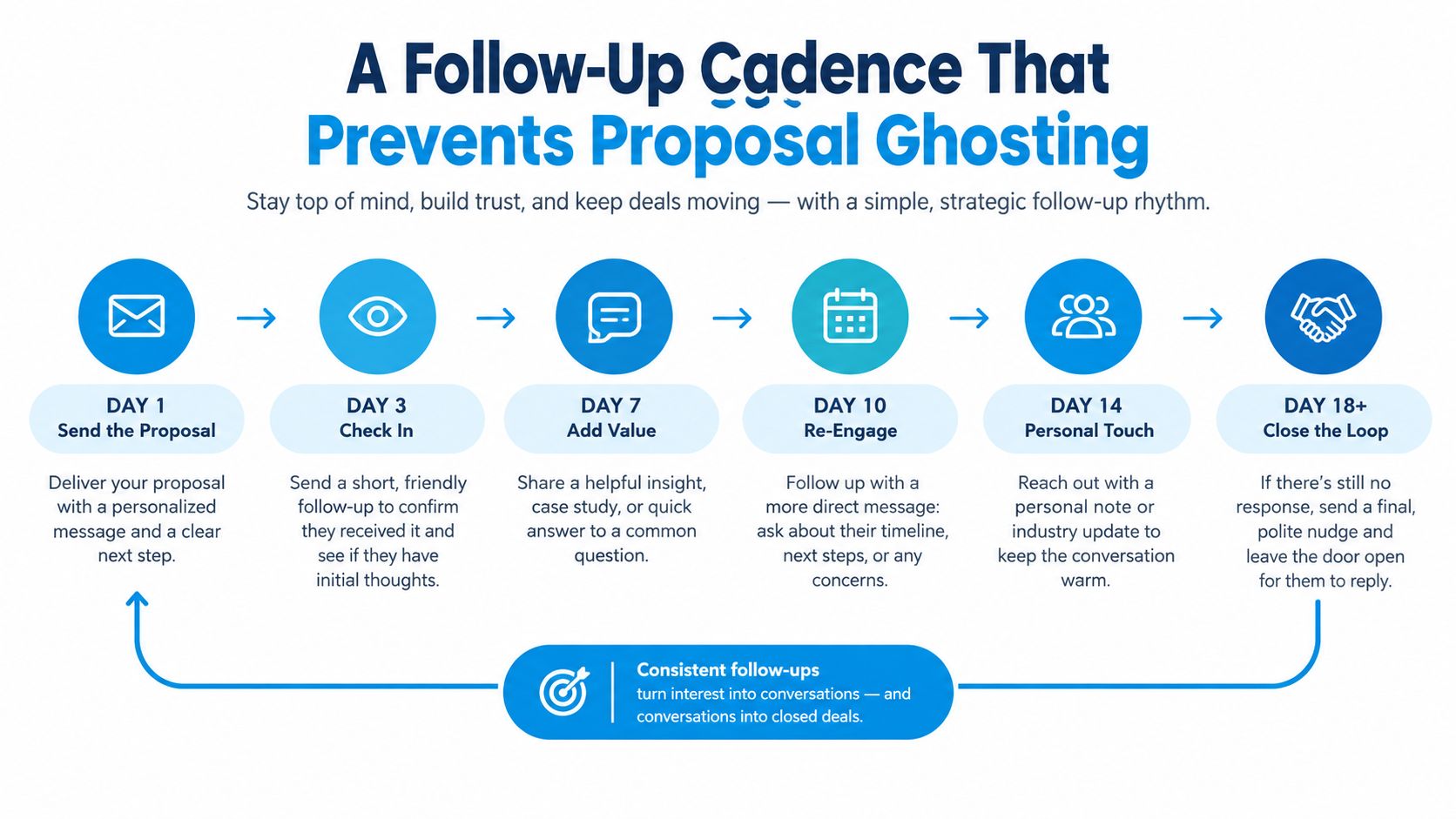
Every touch should reference something the buyer already said. Replace “just checking in” with a useful action: clarify an assumption, answer a stakeholder question, offer a decision meeting, or confirm that priorities have changed.
A practical proposal follow-up workflow should assign an owner, a due date, a message purpose, and an exit condition. If the buyer doesn't respond after the final checkpoint, move the opportunity to nurture with a defined reactivation condition. That protects your time and keeps the pipeline honest.
Tracking Engagement and Letting Signals Drive the Next Move
A proposal tracking system shouldn't exist merely to tell you that someone opened a document. Its job is to help you choose the next useful action.
Track engagement alongside the opportunity record, not in a separate spreadsheet. A practical stage sequence is:
Sent → Opened → Reviewed → Pricing viewed → Decision pending → Stalled → Won or lost
Every stage needs an owner, a next step, and a due date. Without those fields, tracking becomes observation rather than management. A sales pipeline built around explicit next steps keeps proposal activity connected to discovery notes, stakeholders, commercial terms, and handoff requirements.
Let behavior change the response
The pricing section is viewed repeatedly, but nobody replies. Don't immediately discount. Send a concise note that clarifies the package differences, payment terms, validity period, and the business reason behind the recommended option. Then propose a short commercial review with the economic buyer.
An unknown stakeholder opens the proposal. Ask the champion who the person is and what they need to evaluate. If the stakeholder is in finance, provide a commercial summary. If they're operational, provide the implementation plan and client responsibilities. The signal tells you that the buying group is broader than the discovery contact.
There are no opens after 72 hours. First confirm delivery and the recipient address. Then call or send a direct message tied to the agreed decision process. The problem may be timing, a blocked email, or a change in priority. Don't rewrite the proposal before you know which problem you're solving.
The buyer views the solution repeatedly but not the terms. The recommendation may be interesting but commercially unready. Ask whether the concern is scope, authority, budget, or risk, then send only the material that addresses that barrier.
The proposal is opened by several people and the decision date passes. Stop treating the champion as the only contact. Request a stakeholder review or mutual action plan that names decisions, owners, dependencies, and dates.
Engagement signals are clues, not conclusions. A view doesn't equal intent, and a lack of activity doesn't prove rejection. Use the signal to select the next question, then record the answer in the opportunity.
Starward Navigators is one example of a system that combines proposal tracking, scheduled follow-up, pipeline stages, appointment reminders, and client handoffs for consulting and advisory firms. The important design principle is broader than any single tool: the document, engagement data, follow-up task, and decision event should live in one operating flow.
Putting It All Together and What to Do This Week
A workable sales proposal format has four connected parts. The document explains the problem, recommendation, scope, timeline, pricing, proof, terms, and one approval action. The internal alignment layer gives the champion material to reuse with stakeholders. The follow-up cadence creates deliberate contact after delivery. Tracking turns buyer behavior into a reasoned next move.
Most weak proposals fail in predictable ways:
- Feature-heavy narrative: Replace a catalogue of capabilities with a buyer-specific delivery method.
- Generic credentials: Move broad experience to the background and foreground relevant proof.
- Multiple competing CTAs: Choose one approval action and support it with a scheduled decision event.
- Unquantified promises: Use client-provided facts where available, and describe outcomes precisely when they can't be quantified.
- Undefined next step: Name the meeting, owner, date, and acceptance mechanism before sending.
- Single-reader assumption: Add stakeholder outcomes, risks, assumptions, client requirements, and a forwardable summary.
If you only change three things this week, make them operational:
- Rebuild the template around the buyer's decision sequence. Put the executive summary, problem impact, solution, scope, timeline, pricing, proof, terms, and next step in that order.
- Create the internal decision brief. Give your champion a concise document they can forward to finance, procurement, operations, and the executive sponsor.
- Schedule the post-send workflow before delivery. Turn on tracking, assign each follow-up, define the decision date, and record the exit condition for a stalled opportunity.
Your Monday-morning checklist should be simple:
- Required sections are present.
- The executive summary leads with the client's outcome.
- Three pricing packages are clearly labeled.
- Assumptions and exclusions are visible.
- The internal alignment layer is attached.
- The acceptance mechanism is explicit.
- Follow-up tasks are scheduled.
- Engagement tracking is active.
- The decision event is on the calendar.
- The post-win handoff has an owner.
A proposal that meets this checklist won't guarantee approval. It will do something more useful: make the buyer's decision easier, expose the underlying obstacle sooner, and prevent a promising engagement from becoming another silent file in an inbox.
Starward Navigators provides client acquisition infrastructure for small consulting and advisory firms, including proposal tracking, automated follow-up, defined pipeline next steps, and client handoff workflows. Visit Starward Navigators to see how you can connect proposal delivery to the decision and delivery process.