
74% of businesses use online forms to generate leads, and 49.7% say those forms are their best-performing lead generation tool (PrimeView benchmark). That should change how you think about leads from website. The form itself is not the win, the operating system behind the form is.
Most small consulting firms already have enough demand. What they lack is a clean path from submit to signed proposal. Leads get stuck in a shared inbox, routed to the wrong partner, or left waiting while someone is in a workshop, on a client call, or traveling.
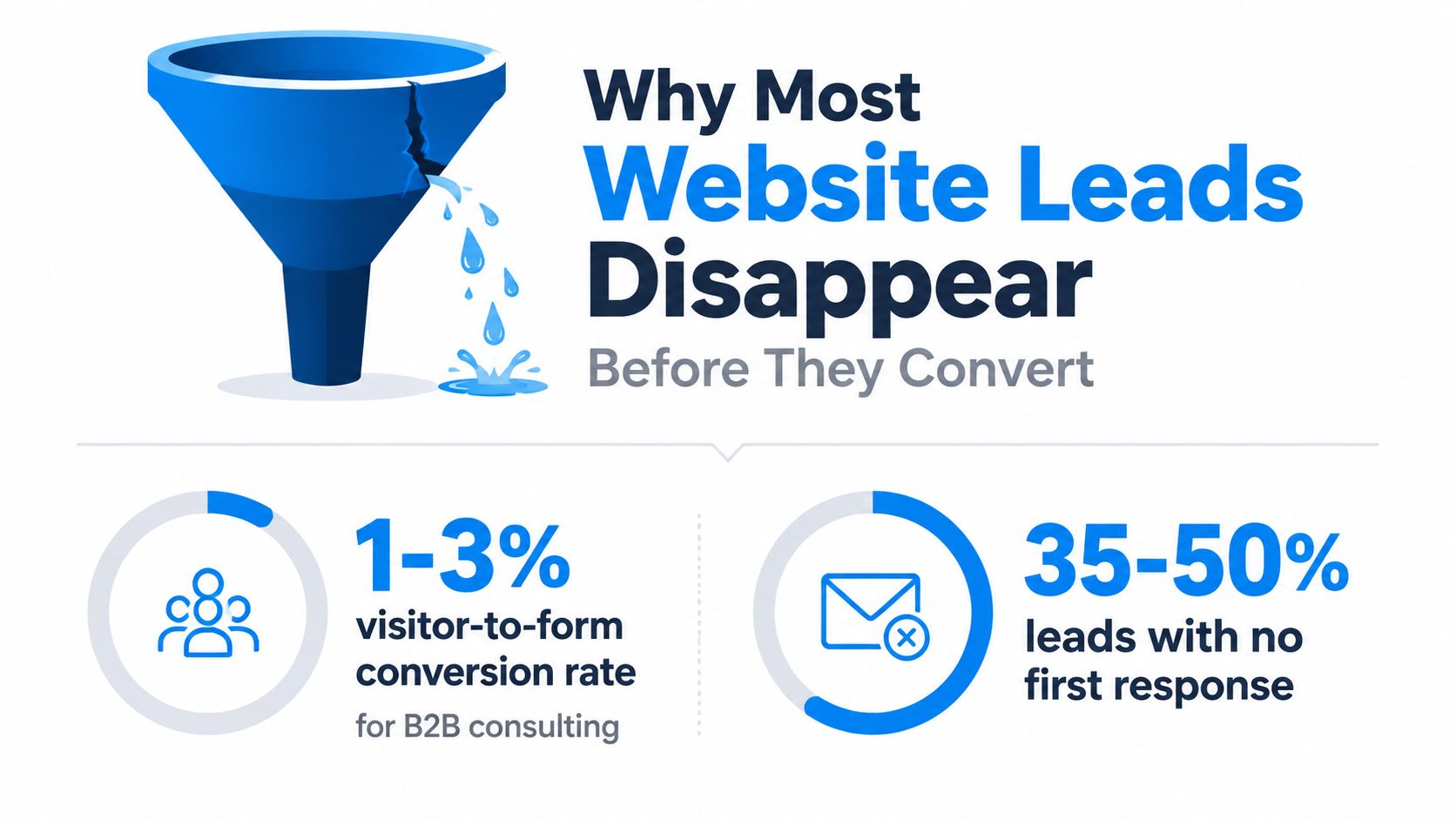
Table of Contents
- Why Most Website Leads Disappear Before They Convert
- The Four Parts of a Working Lead System
- Designing CTAs, Forms, and Content Offers That Get Filled Out
- Routing and First-Response Automation Within Five Minutes
- Building a Follow-Up Sequence That Actually Closes
- Lead Quality Over Lead Volume in 2026
- A Prebuilt Pipeline Checklist for Consulting Firms
Why Most Website Leads Disappear Before They Convert
Website leads do not usually vanish because the offer was terrible. They disappear because the firm treats intake as a marketing event instead of an operational handoff. In practice, the problem is not just conversion at the page level, it's what happens after the lead is captured.
The benchmark data is blunt. Lead response time averages more than 29 hours, 63% of companies never respond at all, and one dataset found the average personalized email response to web forms was 11 hours 54 minutes (lead response benchmark). Another benchmark says leads contacted within 5 minutes are about 21 times more likely to qualify than leads contacted after 30 minutes, and qualification success falls from 85% for sub-1-minute contact to just 7% after 24+ hours (speed-to-lead benchmark). That is the decay curve you need to manage, not the vanity metric of form fills.
Practical rule: if a lead is still sitting in a shared inbox after the first few minutes, you are already spending money to lose it.
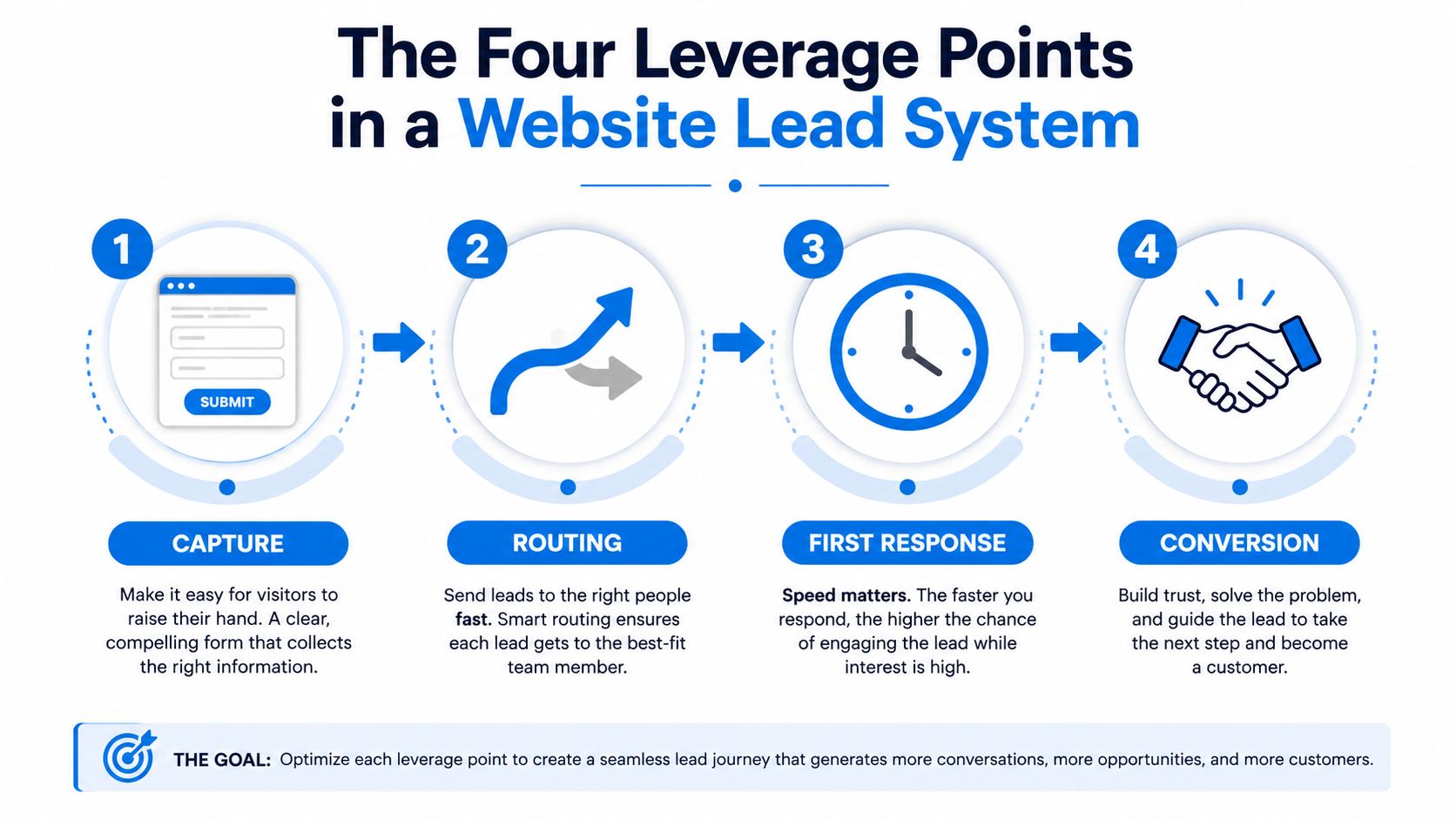
The consulting firms that win do three things well. They capture the right visitor, route the lead to the right owner, and force an immediate first touch. Then they keep going with follow-up, because first response alone does not close most deals.
The Four Parts of a Working Lead System
A website lead has four checkpoints before it becomes revenue. It must be captured cleanly, routed to the right owner, answered quickly, and followed up until the prospect either books or drops out. Miss one checkpoint, and the pipeline leaks.
Capture works when the offer, CTA, page, and fields fit together
Capture depends on four elements working together: the offer, the CTA, the page, and the fields. A vague offer attracts weak intent. A bloated form drives away decent intent. Strong capture starts with a specific reason to raise a hand, then removes friction from the page.
Routing works when ownership is defined before the lead arrives
Routing is where many firms lose good leads. A lead can be qualified and urgent, then sit with the wrong person for hours because no one assigned service-line matches, geography mismatches, or enterprise inquiries in advance.
First response keeps the conversation alive
The first reply has one job, preserve momentum while interest is still high. An automatic confirmation, a human note, and a clear next step do more than a polished brochure. They tell the buyer someone is already handling it.
Follow-up recovers the leads who hesitate
Most prospects do not answer the first message. That is normal. Stop after one touch, and you give up leads you already paid to acquire.
A healthy system assigns one owner to each stage. Marketing owns capture quality. Ops owns routing. A partner owns the first response. Someone owns the sequence.
Designing CTAs, Forms, and Content Offers That Get Filled Out
The fastest way to improve leads from website is to stop asking for a call too early. Consulting buyers respond better to a specific problem than a generic sales pitch. A CTA like “Get our 2026 IT cost benchmark for mid-market manufacturers” earns attention. “Contact us” mostly gets ignored.
Forms should match intent. For top-of-funnel offers, keep the field count low. For high-intent requests like a diagnostic or scoping call, you can ask for a little more because the buyer already raised their hand. The wrong move is asking for everything up front and then wondering why nobody submits.
| Offer Type | CTA Example | Recommended Fields | Conversion Expectation |
|---|---|---|---|
| Awareness | Get the one-page diagnostic | Four fields | Highest completion, lowest friction |
| Consideration | Download the benchmarking PDF | Four to six fields | Balanced lead quality and volume |
| Decision | Book a 30-minute working session | Six to eight fields | Fewer submissions, stronger intent |
The content offer has to match the decision stage. A one-page diagnostic works for awareness. A benchmarking PDF works for consideration. A working session works when the buyer is close to action. If you mismatch the offer, you get either junk leads or a dead page.
Leave out the junk that kills mobile completion. Skip long job-title dropdowns, don't make “How did you hear about us” required, and don't add captchas that break autofill. Put field labels above inputs, use a single-column layout, and add a short privacy line under the submit button.
For a compact lead-gen pattern you can compare against, the structure used in this lead-capture approach is a useful reference point for how clear offers and simple forms reduce friction.
Test on a phone first. If the form feels annoying on mobile, it will underperform even when the copy is strong.
Routing and First-Response Automation Within Five Minutes
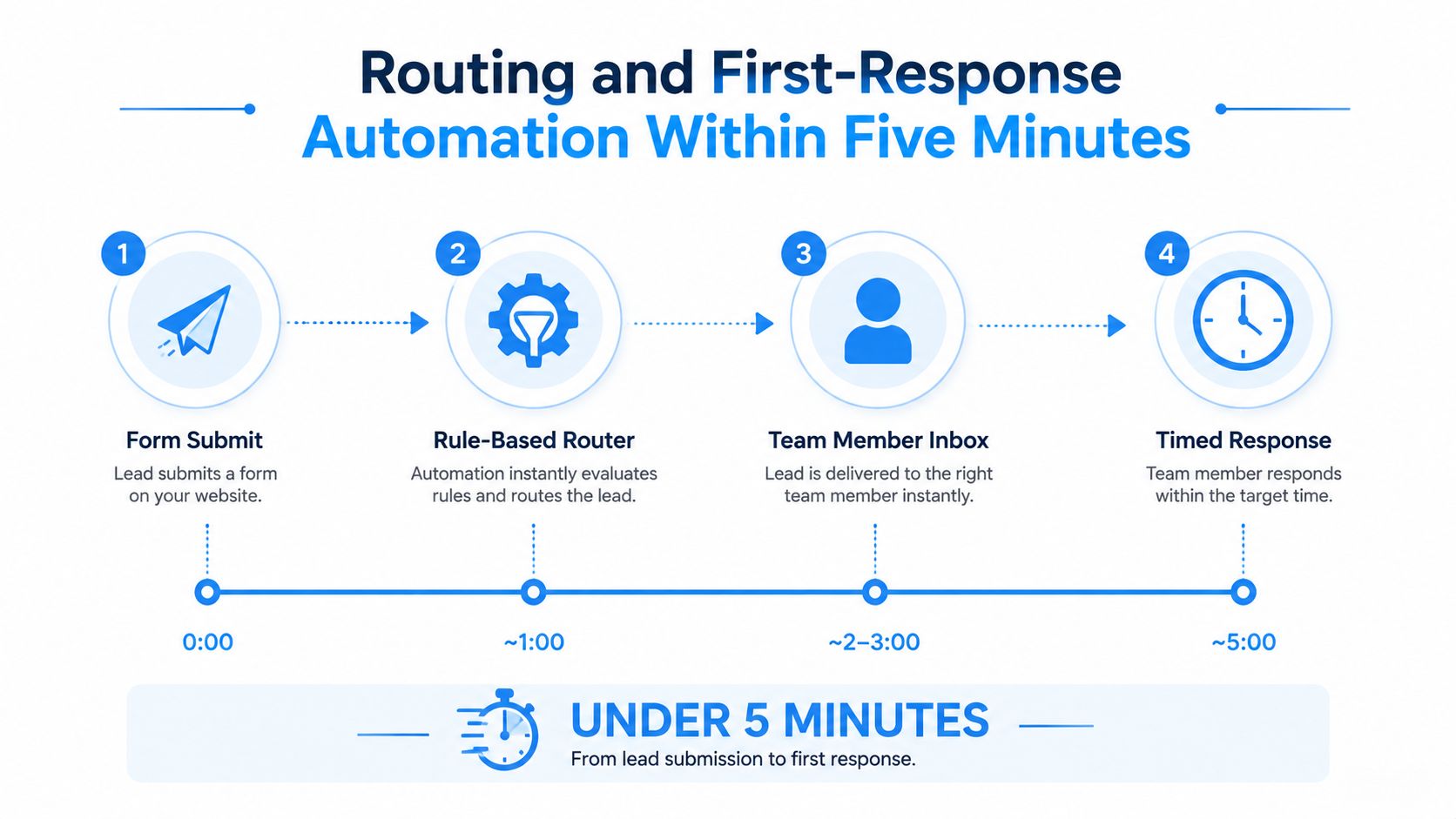
Routing is where a good lead becomes a live opportunity. For a small consulting firm, the rule set should be boring and strict. If the submission matches your core service line, it goes straight to the right partner. If it's enterprise-scope, out of region, or outside your ideal fit, it goes through a triage step before anyone spends selling time on it.
Use the fields that matter in the decision. Service line, company size, urgency keyword, and UTM source are enough for most firms to start. Then set a round-robin or weighted assignment in the CRM so the lead lands with a clear owner instead of a shared pile.
The goal is not automation for its own sake. It is sub-minute assignment. The moment the form submits, the system should send the lead a confirmation email, alert the assigned owner in Slack or the CRM, create the task, and attach a calendar link. The first-touch note should mention the exact offer they requested so the message feels continuous, not robotic.
A simple fallback rule matters. If the assigned owner is offline, the backup owner gets the task immediately. No one should wait for the primary rep to come back from a meeting before a fresh lead gets touched.
For teams that want a ready-made workflow layer, this automation setup is a practical model for connecting routing, reminders, and handoffs in one place.
Building a Follow-Up Sequence That Actually Closes
Single outreach is weak because most buyers need multiple nudges before they reply. Industry summaries say new leads often require 6–8 follow-ups to convert, 55% respond to follow-ups sent within 24 hours, and roughly 40% of B2B leads convert after a follow-up within 3 days (follow-up benchmark). That's why one email and a prayer is not a strategy.
For a 2 to 10 person firm, the sequence has to be simple enough for a partner to live with. Email stays primary. LinkedIn is secondary. Retargeting supports the leads who visited but didn't submit. The copy should be short, direct, and tied to the exact pain point they named in the form.
| Day | Channel | Send | Personalization Source | Exit Criteria |
|---|---|---|---|---|
| 0 | Confirmation plus next step | Form field, offer name | Books meeting or replies | |
| 1 | Short note or Loom link | Pain point or service line | Engages or asks for timing | |
| 3 | Case study matched to industry | Industry, company size | Opens and clicks with intent | |
| 5 | Breakup email with direct question | Previous thread context | Replies or declines | |
| 8 | Connection with relevant insight | Role, company, source | Accepts or responds | |
| 12 | Final value-add message | Offer and source page | Converts to nurture |
Keep the language tight. A partner can copy this pattern and still sound human. A confirmation on day 0 sets the tone. Day 1 carries the personal note. Day 3 proves relevance. Day 5 asks a direct question. Day 8 adds a social touch. Day 12 closes the loop.
The exit criteria should be explicit. If the lead books, replies, or clearly declines, it leaves the active sequence. If not, it drops into slower nurture so the inbox doesn't become a graveyard of old opportunities.
Lead Quality Over Lead Volume in 2026
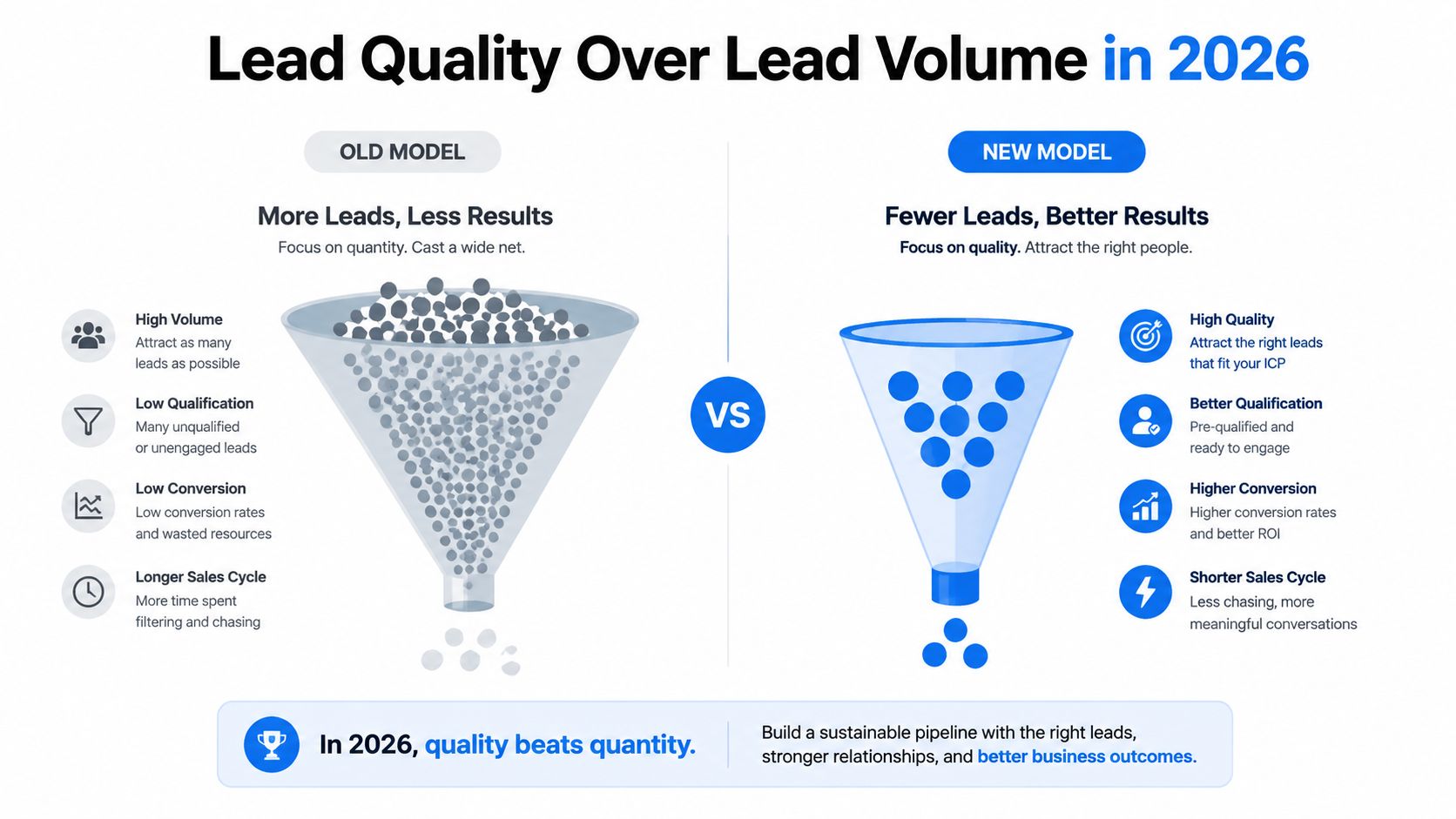
Chasing more form fills is the old habit. It creates noise, fills the CRM with bad names, and burns the partner who has to call them. The better question is which website leads are worth immediate attention.
Recent B2B trend coverage says the market is moving from spray-and-pray outreach toward signal-based selling, omnichannel coordination, and owned audience data, while paid search still produces the largest single share of B2B lead volume at 22% but has declined 3 points since 2024 as ABM and partner-sourced channels gained share (B2B lead-generation trends). That shift matters because speed alone doesn't fix low-intent traffic. Quality now outranks raw volume in most small-firm pipelines.
Score leads on observable signals, not gut feel. Company size, role seniority, service-line fit, page depth, and whether the visitor consumed a case study are far more useful than vanity volume. Source tracking also matters. UTM data, referrers, and landing page paths tell you whether a lead came from a buying channel or just wandered in.
If your firm has any kind of logged-in resource hub, treat those records as first-party data, not decoration. That data tells you who keeps coming back and which content pulls buyers forward. Leads that hit your threshold get same-day human response. Everything else goes into slower nurture.
A Prebuilt Pipeline Checklist for Consulting Firms
A consulting firm needs a working pipeline, not another pile of disconnected tools. Start with the capture layer. You need a form platform, a CRM, and calendar booking that all talk to each other. Then add routing rules that separate service lines, deal size, and geography so every lead lands in a sensible place.
After that, build the response layer. A 5-minute email, a task creation rule, and an SMS fallback for urgent leads cover the basics. Then build the follow-up cadence around the buyer stage, not the rep's mood. Day 1, 3, 7, and 14 touchpoints are enough to start, as long as each one has a purpose.
Use this lead management framework as a reference point if you want a system that keeps source, owner, and next step attached to each opportunity. The operational idea is simple, every lead should arrive with a home, a clock, and a next action.
A founder should hand this to an ops contractor in week one:
- Capture infrastructure: form, CRM, calendar link, and source tracking.
- Routing rules: service line, geography, and deal-size segmentation.
- First-response automation: immediate confirmation, task creation, and fallback ownership.
- Follow-up cadence: stage-based emails with a human review point.
- Accountability artifacts: weekly lead-to-meeting review, monthly source attribution snapshot, quarterly pipeline velocity audit.
Build the system in order. Install capture first. Then routing. Then the first-response sequence. Then refine follow-up and reporting. If you do those four things well, booked discovery calls from organic traffic should trend upward over time, and that's the KPI that tells you the pipeline is healthy.
If you want this turned into a working client-acquisition system instead of another strategy document, Starward Navigators builds the routing, follow-up, and proposal handoff structure for small consulting firms. Visit Starward Navigators to see how the operating system fits your website leads, your sales process, and your team's day-to-day workflow.