The best sales email starts before the pitch. A generic message can't serve a cold prospect, a buyer preparing for discovery, a stakeholder reviewing a proposal, and a past client who hasn't heard from you in years. Each stage has a different job. Prospecting should earn a conversation, discovery follow-up should improve understanding, proposal follow-up should remove uncertainty, and referral nurture should protect a valuable relationship.
That distinction matters because email performance varies sharply by targeting and sequence design. A 2026 benchmark found a 7.4% median reply rate across 500 B2B cold emails, compared with a 3.4% baseline across more than 100 million cold emails, while 58% of replies came from the first message in the sequence. The benchmark details point to a practical conclusion: the first email deserves careful thought, but it should sit inside a documented workflow rather than operate alone.
The eight template sales email examples below follow a consulting and advisory buyer journey. Adapt each one with specific context, one clear CTA, and a recorded next step. Starward Navigators is a relevant example of how structured pipelines, automated follow-up, proposal tracking, and relationship workflows can help firms execute that discipline consistently.
Table of Contents
- 1. The Discovery-First Prospecting Email
- 2. The Social Proof and Proof Point Email
- 3. The Value-First Follow-Up Email
- 4. The Referral Nurture Email
- 5. The Problem Reframe Email
- 6. The Time-Sensitive Window Email
- 7. The Collaborative Problem-Solving Email
- 8. The Win-Back and Re-Engagement Email
- 8 Sales Email Templates Comparison
- Turn Individual Emails Into a Repeatable Sales System
1. The Discovery-First Prospecting Email
A prospecting email should create room for diagnosis, not rush into a solution. That's especially important for consulting firms, where the buyer often knows something is wrong but hasn't defined the scope, priority, or internal owner of the problem.
Subject: A question about [specific business priority]
Hi [First Name],
I noticed [specific company development, role change, market move, or hiring pattern]. Firms at a similar point often start asking whether [relevant operational challenge] can support the next stage of growth.
How are you currently handling [diagnostic question tied to the recipient's role]?
I work with [type of company or leader] on [relevant advisory area]. If this is an active issue, would a brief conversation next week be useful?
Best,
[Name]
The strongest personalization isn't a compliment about the company. It's a credible observation connected to the recipient's responsibilities. A fractional CFO might ask a growing company how it projects its cash runway. A strategy consultant might ask a founder how the team is choosing between competing market opportunities.
Research two or three concrete details before writing, then choose only one for the email. Too many observations make the message feel researched for its own sake.
- Match the question to the role: Founders may care about priorities and trade-offs, while finance leaders may care about forecasting, controls, or reporting.
- Keep the CTA narrow: Ask for a short conversation or a simple reply, not a complete assessment.
- Log the outcome: Record the diagnostic question, response, qualification, and agreed next step in the pipeline.
Practical rule: A prospecting template should make the buyer feel understood before it makes the firm sound capable.
For firms building a more consistent acquisition process, this guide to generating leads for email marketing can sit alongside a discovery-focused pipeline. Once a question earns replies, save the tested version in Starward Campaigns, then use automated reminders for scheduling, confirmations, and unanswered follow-up.
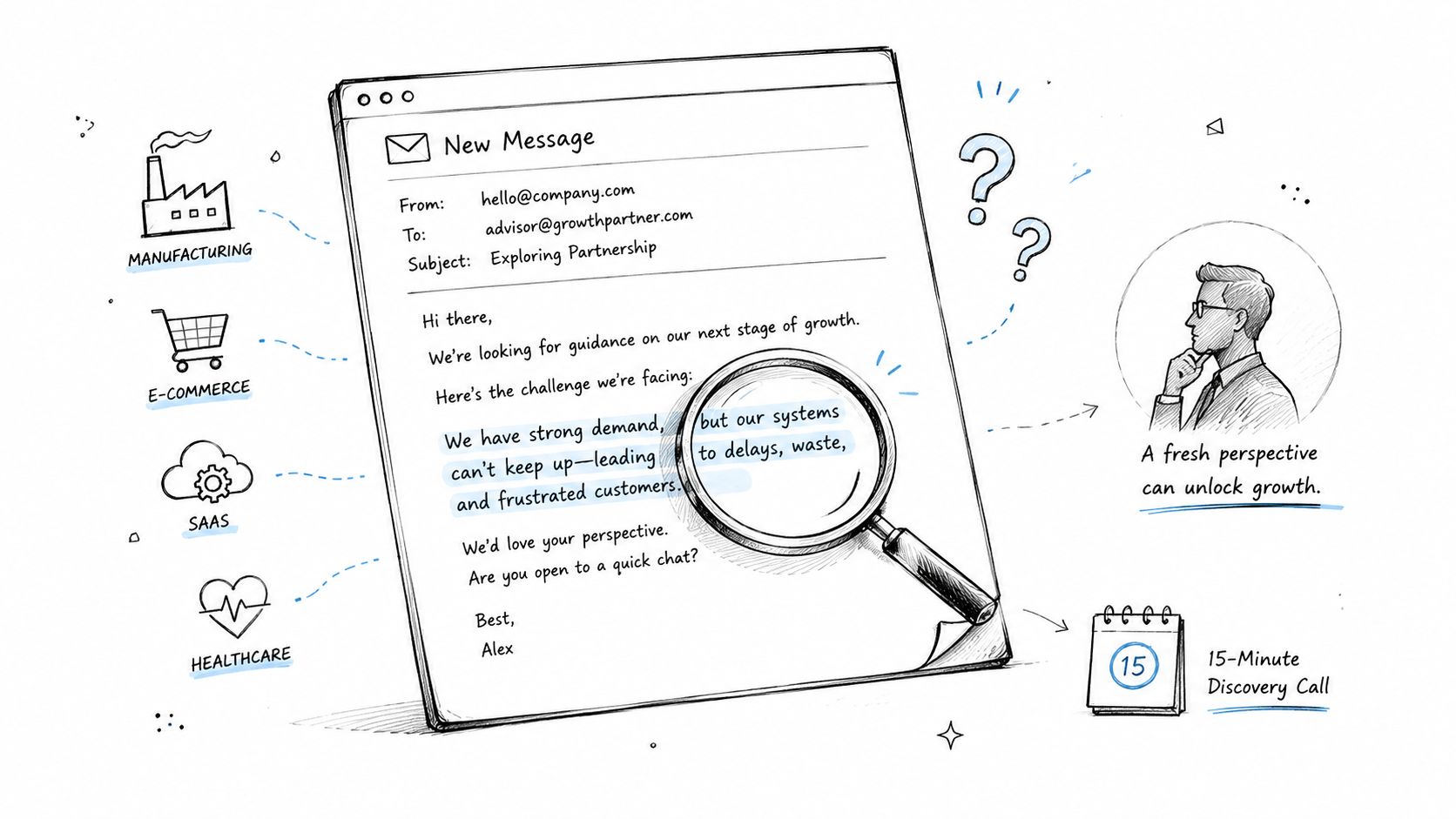
2. The Social Proof and Proof Point Email
Buyers don't need a catalogue of every client you've served. They need evidence that your firm understands a problem resembling theirs and can work within a comparable context.
Subject: A relevant example for [Company]
Hi [First Name],
We recently helped [anonymized company description] address [specific challenge]. The work focused on [engagement scope], and it gave the leadership team a clearer way to [relevant business decision or operating improvement].
Your situation may be different, but you mentioned [specific challenge or priority]. Is that still affecting [business area]?
If useful, I can send a short summary of the approach or talk through what might translate to [Company].
Best,
[Name]
Use this email after an initial exchange, following a discovery call, or when a promising opportunity has stalled. The proof point should resemble the prospect in a meaningful way, such as industry, company stage, stakeholder complexity, or problem type. A vague statement like “we help companies grow” adds little. A specific, permission-safe description of the work gives the buyer something to evaluate.
Never disclose a client name, result, or internal detail without explicit permission. Anonymized proof can still be useful when it preserves the relevant context.
Make the proof point do one job
Choose between a measurable business outcome and a qualitative change in decision quality, operating clarity, or stakeholder alignment. Don't crowd both into a short email. The proof point should support the buyer's question, not replace it.
Starward's centralized contact records can hold approved descriptions of recent wins, engagement scopes, and relevant client characteristics. That makes it easier to personalize responsibly without searching through old documents each time. If an opportunity goes quiet, a trigger-based workflow can prompt a proof-point message tied to the actual concern raised in discovery.
The trade-off is obvious. Social proof can reduce perceived risk, but it can also sound boastful when the example isn't relevant. Lead with the buyer's situation, then use the proof as context.
3. The Value-First Follow-Up Email
A quiet proposal doesn't always mean rejection. The buyer may be comparing options, waiting for another stakeholder, questioning the scope, or unsure how to translate the document into a decision. A “just checking in” message gives them no reason to reopen the conversation.
Subject: A question about the [Project Name] proposal
Hi [First Name],
I wanted to follow up on the proposal for [engagement]. I know decisions like this can involve several people, so I wanted to ask whether any part of the approach, timing, or scope needs clarification.
You mentioned [specific challenge or concern from discovery]. Would it be more useful to:
- review the proposal together,
- clarify a question by email, or
- revise one part of the scope?
If the priority has changed, that's useful to know too.
Best,
[Name]
This template treats the proposal as a working document rather than a take-it-or-leave-it offer. It also gives the buyer several low-friction ways to respond. That matters in advisory sales because the proposal-to-decision stage often requires alignment, not another pitch.
A practical cadence might start with a value-first note after the firm's normal review window, followed by additional messages spaced far enough apart to avoid pressure. The exact timing should reflect the buying process, the stated decision date, and the number of stakeholders involved. Don't automate a sequence that ignores those signals.
- Reference the discovery call: Use the buyer's language and the issue they said mattered.
- Offer a useful adjustment: Clarify an assumption, revise a deliverable, or explain the decision path.
- Define the next stage: Keep the opportunity open only when there's a documented action or date.
Starward's proposal follow-up workflow is designed for this operational gap. Proposal tracking can trigger follow-up, preserve the next step, and help a team distinguish an active decision from an opportunity that should be marked lost or moved into nurture.
4. The Referral Nurture Email
Referral relationships weaken when firms contact partners only when they need introductions. A better nurture email gives the recipient something useful and keeps the relationship active without turning every interaction into a referral request.
Subject: Thought of you after seeing [specific update]
Hi [First Name],
I saw that [specific company development, hire, event, or achievement]. Congratulations. It reminded me of the work you've done around [relevant expertise or shared area].
I've been seeing [qualitative pattern or recurring client question] among [relevant audience]. I'm putting together a short resource on it and would value your perspective. Would you like me to send it over when it's ready?
Also, I'd be glad to introduce you to [relevant person or opportunity] if that would be useful.
Best,
[Name]
The message works because it starts with the partner's world. A previous client might receive a relevant industry insight or event invitation. An accountant, banker, or attorney might receive a useful reference guide for the founders they advise. A strategic partner might receive an introduction that has nothing to do with an immediate sale.
Segment contacts by relationship type and current value, then tailor the cadence and content. Top referral sources may warrant direct, personal notes. Broader partner groups may receive a lighter nurture sequence, provided every message still contains a genuine reason to exist.
Protect the relationship
Avoid vague requests such as “keep us in mind.” If you eventually ask for an introduction, name the type of company, situation, or decision-maker who would benefit. Make the request easy to assess and easy to decline.
- Share real value: Send an article, introduction, event invitation, or useful observation.
- Use recent context: Mention a hire, expansion, published idea, or detail from a previous conversation.
- Track attribution: Record which relationship produced the opportunity and whether the lead was qualified.
A practical referral tracking process helps firms move this work out of personal memory. Starward's relationship pipeline can stage partners, record source attribution, and support nurture and thank-you workflows without treating trusted contacts like a bulk email list.
5. The Problem Reframe Email
A strong consultant doesn't merely repeat the problem the buyer stated. After discovery, the consultant can offer a sharper interpretation that helps the buyer decide what deserves attention first.
Subject: A thought about [stated challenge]
Hi [First Name],
I've been reflecting on our conversation about [stated problem]. One possibility is that the visible issue, [surface problem], may be connected to [related constraint or underlying factor].
For example, teams often focus on [common response] when the harder constraint is [reframed issue]. I'm not assuming that's true for [Company], but it may be worth testing.
Would it be useful to spend a short call exploring whether [reframed issue] belongs in the scope?
Best,
[Name]
This email belongs in the middle of the sales cycle, after the consultant has enough context to make a relevant observation. It shouldn't arrive as a correction. Phrases such as “I wonder if” and “one possibility is” preserve the buyer's authority while inviting examination.
A business development advisor might reframe rapid hiring as an onboarding and management-capacity problem. A consulting firm might suggest that weak proposal win rates originate in shallow discovery rather than proposal design. A fractional CFO might connect cash-forecasting anxiety to a broader question about financial decision rights after fundraising.
The reframe earns its place only when it changes the next conversation.
Tie the new angle to the service you can provide. Don't introduce an unrelated problem to sound strategic. Then track which observations generate useful replies, not just positive reactions. Those patterns can improve future discovery questions and help consultants recognize recurring constraints earlier.
The trade-off is precision versus disruption. A thoughtful reframe can revive a lukewarm opportunity, but an unsupported one can make the buyer feel misunderstood. Anchor the observation in something they said, describe it as a hypothesis, and offer a practical way to test it.
6. The Time-Sensitive Window Email
Urgency helps only when the deadline is real. Consulting firms can legitimately limit capacity for a cohort, reserve a start date, or offer a seasonal engagement, but inventing scarcity damages trust and creates a poor fit for advisory work.
Subject: Capacity for [specific engagement window]
Hi [First Name],
I'm opening a small number of places for [program or engagement] during [specific period]. The timing matters because [real reason, such as a planning cycle, launch window, or cohort start].
Based on our conversation about [buyer's priority], this could be relevant if you want to address [specific outcome or decision] before [legitimate deadline].
If you'd like to explore it, we'd need to confirm scope by [date]. If that timing doesn't work, I can suggest a later start or keep you informed about the next available window.
Would a brief conversation be useful?
Best,
[Name]
Explain why the deadline exists. “We have limited availability” is weaker than a clear operational reason tied to delivery quality, a fixed program start, or the buyer's own planning cycle. Offer a fallback when possible, such as a later start, waitlist, or planning conversation without commitment.
A boutique strategy firm might reserve capacity for a planning sprint before a known operating cycle. A fractional executive might have one opening before a client-heavy period. A peer program may have a defined group size because participation depends on discussion and shared attention.
Keep urgency honest
- State the constraint: Name the actual capacity, start date, or seasonal window.
- Connect it to relevance: Explain why the timing matters for this buyer, not just for your calendar.
- Give an alternative: Offer a later window when one exists.
- Close the loop: Follow up before the deadline only if the prospect expressed interest or asked for a decision reminder.
Appointment scheduling and reminders can convert a legitimate window into a clear next action. A workflow should never pressure a non-responsive contact repeatedly just because a date is approaching. Urgency is a decision aid, not a substitute for fit.
7. The Collaborative Problem-Solving Email
Some buyers aren't ready for a full proposal because the stakeholders disagree about the problem. A tightly scoped workshop can create shared understanding before either side commits to a larger advisory engagement.
Subject: A working session before a formal proposal
Hi [First Name],
Rather than jump straight to a proposal, I'd suggest a focused working session with [specific participants].
In [duration], we'd [activity one], [activity two], and [activity three]. You'd leave with [specific deliverable or decision]. We'd also learn whether a deeper engagement makes sense.
To make the session useful, I'd need [decision-maker or stakeholder roles] in the room. Would [two proposed dates] work for the team?
Best,
[Name]
The workshop must have boundaries. State the duration, attendees, preparation required, outputs, and what happens afterward. A free or low-priced session can reduce perceived risk, but price isn't the main safeguard against scope creep. Written terms and a defined deliverable are.
For a go-to-market advisory firm, the session might map target customers, positioning gaps, and decision points. For a fractional CFO, it might examine the current financial model and the decisions the leadership team needs to make. For a firm serving multiple stakeholders, interviews followed by a facilitated alignment session may expose whether the proposed work addresses a shared priority.
Require the relevant decision-makers to attend. If the person sending the email can't secure that commitment, the workshop may produce interesting discussion without moving the opportunity forward. Afterward, document findings promptly and send a proposal only when the evidence supports one.
A short explainer can help a prospect understand why collaborative diagnosis is different from a sales presentation.
The trade-off is delivery effort. Workshops consume consultant time before a larger engagement is certain, but they can expose poor fit earlier and give several stakeholders a shared basis for a decision. Track the workshop outcome, follow-on proposal, and client handoff in the same pipeline so the activity is evaluated as part of the sales process, not as an isolated event.
8. The Win-Back and Re-Engagement Email
Dormant contacts deserve context, not a generic “just checking in.” The reason the relationship went quiet should shape the message. A stalled prospect, a former client, and someone met at an event each need a different opening.
Subject: Reconnecting about [specific past priority]
Hi [First Name],
I realized it's been a while since we spoke about [specific challenge or project]. I've been thinking about [detail from the earlier conversation], and my view has changed as I've worked through similar situations.
I'm not sure whether this is still relevant for [Company], so I wanted to ask directly. Has [priority or challenge] moved forward, changed, or remained unresolved?
If it's useful, I'd be glad to reconnect for a short conversation and share what I'm seeing now.
Best,
[Name]
Acknowledging the gap can make the message more credible. If the firm failed to follow through, say so plainly and avoid pretending the relationship is active. If the recipient was a past client, begin with the work completed and a genuine question about what happened next. If the contact came from an event, mention the event and the original topic.
Personalize the reason to return
Review the contact history before sending. Identify the original priority, who was involved, why the opportunity stalled, and what has changed since then. A new service, a relevant insight, an introduction, or a sharper approach gives the recipient a reason to respond.
- Segment the audience: Separate stalled qualified opportunities, closed-lost prospects, former clients, and low-fit contacts.
- Respect the current situation: Ask whether the issue is still active instead of assuming it is.
- Offer a useful next step: Suggest a short conversation, a relevant resource, or an introduction.
- Record the result: Update the relationship stage whether the answer is yes, not now, or no longer relevant.
Don't confuse persistence with repetition. Reusing the same untouched pitch adds pressure without adding value. A re-engagement sequence should change the context, acknowledge what happened, and stop when the contact has clearly declined.
8 Sales Email Templates Comparison
| Template | Implementation Complexity 🔄 | Resource Requirements ⚡ | Expected Outcomes 📊 | Key Advantages ⭐ | Ideal Use Cases 💡 |
|---|---|---|---|---|---|
| The Discovery-First Prospecting Email | Moderate, custom research and tailored diagnostic questions | Medium, time per prospect, LinkedIn/CRM research | High reply & qualification rates; longer sales cycle ⭐⭐⭐⭐ | Positions sender as advisor; uncovers fit early | Boutique advisory targeting C-suite; early-stage discovery outreach |
| The Social Proof + Proof Point Email | Low–Moderate, assemble relevant, comparable case snippets | Low, maintain a library of proof points in CRM | Increases opens and credibility; strong for re-engagement ⭐⭐⭐⭐ | Boosts trust quickly; reduces perceived risk | Re-engaging stalled opportunities; mid-market/enterprise prospects |
| The Value-First Follow-Up Email (Quiet Proposal Rescue) | Low, templated but needs accurate proposal context | Low, automated workflows tied to proposal tracking | Improves proposal conversion and shortens decision time ⭐⭐⭐⭐ | Breaks silence without re-pitching; preserves momentum | Firms with silent proposals or long proposal-to-decision gaps |
| The Referral Nurture Email (Partner Relationship Builder) | Moderate, segmentation and sustained cadence required | Medium, curated content, relationship management automation | Long-term referral growth; high LTV but slow ROI ⭐⭐⭐ | Builds advocacy and recurring referral pipeline cost‑effectively | Firms with professional networks wanting systematic referrals |
| The Problem Reframe Email (Shifting Perspective) | High, requires credible domain expertise and proper timing | Low–Medium, expert time to craft a credible insight | Repositions advisor as strategic thinker; reignites deals ⭐⭐⭐⭐ | Differentiates via thought leadership; creates new conversation paths | Mid‑sales cycle after discovery with knowledgeable prospects |
| The Time-Sensitive Window Email (Urgency + Opportunity) | Low, craft authentic, time-bound message | Low, clear deadline and scheduling support | Accelerates decisions and segments readiness; risk of pushback ⭐⭐⭐ | Speeds closes; helps manage capacity and cohorts | Time-bound programs, seasonal windows, limited-capacity offers |
| The Collaborative Problem-Solving Email (Joint Workshop Offer) | High, design, facilitation, and stakeholder coordination | High, advisor time, multi-stakeholder commitment | High buy-in and clarity; strong workshop→engagement conversion ⭐⭐⭐⭐ | Demonstrates methodology; engages decision-makers early | High-ticket engagements needing alignment across stakeholders |
| The Win-Back / Re-engagement Email (Dormant Lead Revival) | Moderate, requires accurate history review and honest outreach | Medium, CRM data cleanup, tailored messaging | Cost-effective reactivation; shorter cycle if re-engaged ⭐⭐⭐ | Leverages existing familiarity; lower acquisition cost | Dormant leads, past clients, and previously stalled prospects |
Turn Individual Emails Into a Repeatable Sales System
Eight templates are useful only when each one has a defined job. Start with the discovery-first email when the buyer's situation is still unclear. Use proof points after engagement when the buyer needs evidence that your firm has handled a similar problem. Use a reframe when discovery reveals a potentially more important constraint. Choose a workshop when risk, complexity, or stakeholder misalignment blocks a conventional proposal.
Use value-first follow-up for quiet proposals because silence usually needs clarification, not another feature list. Reserve urgency for genuine deadlines, real capacity limits, or fixed program windows. Use referral nurture to protect relationships before you need an introduction, and use win-back messages when an earlier relationship contains enough context to justify a fresh reason for contact.
A practical implementation process starts small:
- Choose one stage: Begin with the point where opportunities most often lose momentum.
- Personalize the context: Replace generic claims with the buyer's role, stated challenge, recent event, or prior conversation.
- Define one CTA: Ask for one reply, one call, one clarification, or one decision.
- Record the next stage: Every response should move to discovery, proposal review, nurture, workshop, closed lost, or another named state.
- Review the evidence: Compare replies, booked conversations, proposal movement, and conversions before scaling a template across the team.
Email measurement needs careful interpretation. Apple Mail Privacy Protection has made raw open rates less dependable because pixels can load automatically. A 2026 analysis estimated 4.5 percentage points of inflation from MPP and reported an engagement-adjusted open rate of 16.8%, while also reporting 34.2% opens for fully authenticated domains using DMARC, SPF, and DKIM. The analysis of email benchmarks and measurement changes supports a better operating rule: assess authenticated delivery, clicks, conversions, replies, and stage movement rather than treating opens as the final measure.
Email still operates at meaningful business scale. A 2026 benchmark summary reported a 30.41% average open rate, while automated campaigns averaged 30.21% opens, a 4.66% click rate, and a 1.49% conversion rate. The benchmark summary also reported a 31% average open rate across industries and 45.1% among the top 10% of performers, which reinforces the value of segmentation and structured automation. Those figures don't guarantee consulting results, but they show why firms should test a workflow rather than abandon email after a few manual sends.
Starward Navigators can support that operating rhythm with prebuilt Business Development, Client Delivery, and Relationships and Referrals pipelines, automated follow-up, appointment reminders, proposal tracking, client handoffs, and referral workflows. Its purpose-built structure is relevant to small consulting firms that need to keep lead capture, discovery, proposals, onboarding, and relationship management connected rather than scattered across separate tools.
A template should make good execution easier. It shouldn't replace judgment, listening, or a documented decision process.
Starward Navigators provides prebuilt pipelines, automated email follow-up, appointment reminders, proposal tracking, client handoffs, and referral workflows for consulting and advisory firms. Visit Starward Navigators to connect your template sales emails to a repeatable client acquisition process.