
A senior partner forwards a warm introduction to a shared inbox. Three people reply with a thumbs-up, someone promises to “get this into the CRM,” and the prospect receives a friendly note. A week later, nobody can say who owns the opportunity, which partner made the introduction, or whether the prospect ever reached discovery.
That's how referral tracking usually fails in a small advisory firm. The problem isn't a lack of software. It's the absence of a reliable chain connecting the first introduction to qualification, proposal, delivery, renewal, and the next referral. How to track referrals effectively means preserving that chain through every handoff, not merely counting links clicked or names entered in a spreadsheet.
For a consulting firm, the record must answer practical questions: Who introduced this buyer? When did the introduction happen? What stage did the prospect enter? Who owns the next action? Did the relationship produce revenue, and did the referring partner remain engaged afterward? Referral-driven buying deserves this discipline because one independent roundup reports that 84% of B2B decision-makers start the buying process with a referral or recommendation, while 65% of new B2B business comes from referrals. The same B2B referral statistics roundup reports that referred leads convert 30–70% better than leads from other channels.
The operating principle is simple: a referral is an event that must survive contact with your process. Every person who touches the opportunity should see the source, the referrer, the current stage, and the next required action.
Table of Contents
- The Introduction That Disappeared From Your Pipeline
- The Referral Fields Your CRM Cannot Skip
- Building the Referral Pipeline From Introduction to Closed Won
- Choosing Link, Code, and Server-Side Attribution
- Four Nurture Workflows That Keep Partners Warm
- Metrics That Tell You Which Referrals Are Worth Pursuing
- Your 30-Day Referral Tracking Rollout
The Introduction That Disappeared From Your Pipeline
The missing introduction creates more damage than an inaccurate report. When a partner takes the risk of recommending your firm, the prospect expects a coordinated response. If the introduction disappears into an inbox, the firm loses context, the partner loses confidence, and the buyer may experience a disjointed first conversation.
Spreadsheets make this worse because they separate the referral from the work. One sheet holds partner names, another lists leads, and a third tracks proposals. An email thread may contain the only explanation of why the partner made the introduction. When a colleague updates a company name, changes an owner, or copies a contact into a new tab, the relationship becomes difficult to reconstruct.
Treat the referral as a relationship record
A referral should enter the CRM with enough information to support both pipeline execution and relationship care. That means recording the source, introducer, date, stage, owner, and context at the moment the opportunity is created. The information shouldn't depend on a partner remembering the details during a later review.
A tracked referral should also remain visible after the first meeting. Discovery notes, proposal activity, decision status, client handoff, and repeat business all belong to the same attribution chain. Otherwise, the firm may credit “inbound” for revenue that began with a partner's recommendation, or fail to recognize the partner when a later engagement comes from the same account.
Practical rule: If a new team member can't identify the referrer and next action from the opportunity record, the referral hasn't been tracked properly.
Referral measurement has evolved alongside relationship-based selling and CRM systems. Firms moved from simple contact databases toward source fields, referral ownership, pipeline stages, and automated attribution because informal memory couldn't support reliable reporting. Word of mouth remains a major buying influence, with one independent summary reporting that 91% of B2B buyers are influenced by word of mouth and 88% seek word-of-mouth assurance before financial decisions in its cited research overview at ThinkImpact's B2B referral statistics resource.
The useful mindset is operational rather than promotional. Don't ask only how many introductions arrived. Ask which relationships create qualified opportunities, which ones progress, which partners deserve a faster response, and where attribution breaks during proposal or delivery.
The Referral Fields Your CRM Cannot Skip
A referral pipeline becomes dependable only when the underlying record is explicit. Before building automations, create the fields that let the team identify the relationship without opening old emails.
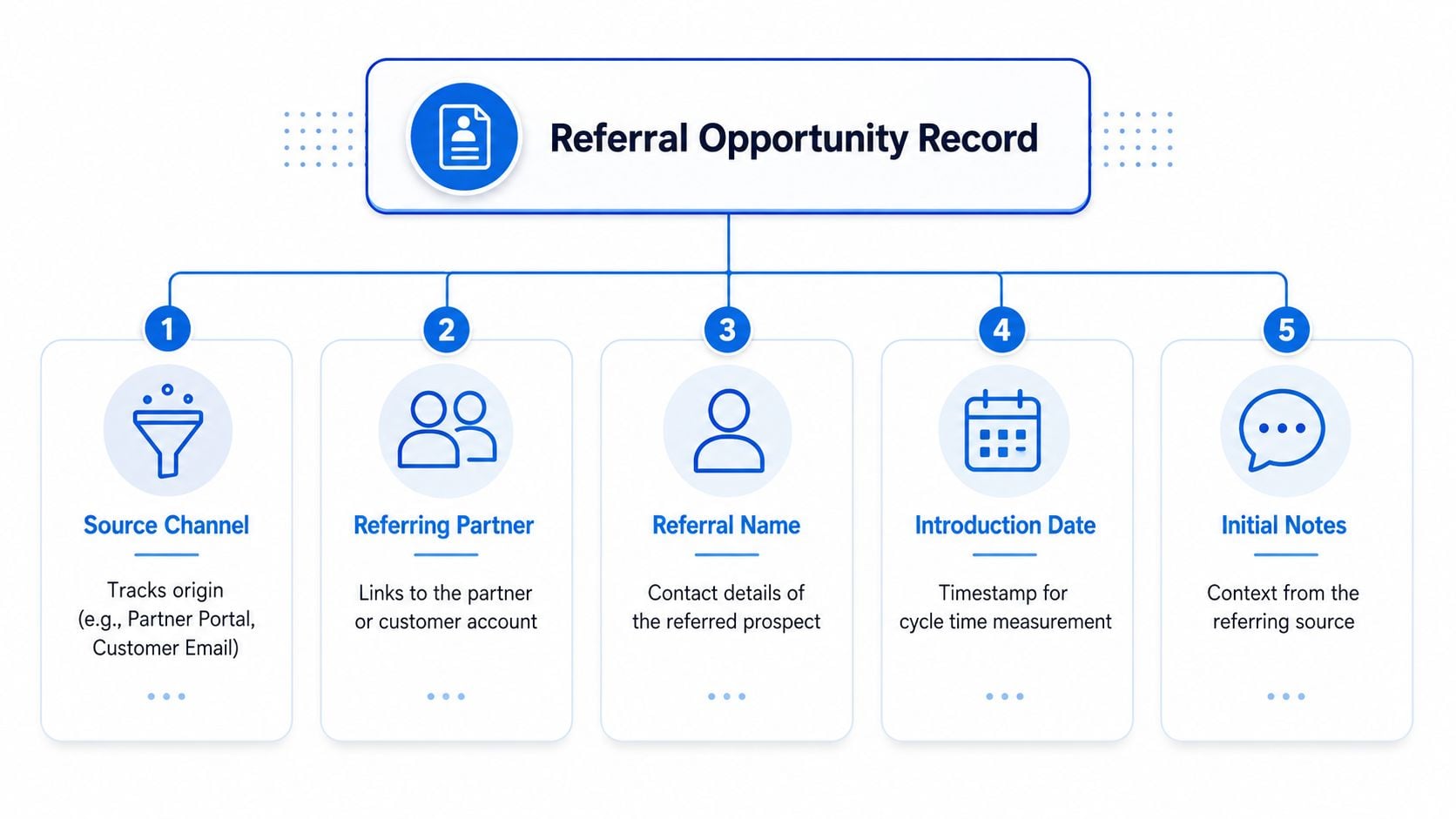
Start with five record-level fields
Source Channel
Use a controlled value such asReferral, while preserving the specific origin in a companion label such asReferral, Acme Partner. Add a URL parameter or campaign identifier when the introduction arrives through a form or portal. This field feeds source-level pipeline and win-rate reporting.Referring Partner or Customer
Link the opportunity to the existing person or account record, rather than typing a name into a notes box. The relationship link keeps thank-you messages, previous introductions, and partner activity attached to the right record.Referral Name
Store the referred prospect as a distinct contact with their email, company, role, and consent status. Don't overwrite an existing contact just because a second partner introduced the same person.Introduction Date
Capture the date the introduction was made, not the date someone finally entered it. This supports response-time and cycle-time reporting and exposes delays that the creation date hides.Initial Notes
Preserve the introducer's context, including the business problem, urgency, relevant service, and any expectations already set. Keep this field concise enough to scan during the first call.
A practical lead management workflow should enforce these fields before the opportunity can move forward. The record label can remain human-readable, while the linked referrer and machine-readable identifier provide the structure needed for attribution.
Prevent data drift before it starts
Use dropdowns for source channels and linked records for people and companies. Review duplicate contacts before creating a new opportunity, and decide whether multiple introductions should be stored as separate referral events or as additional referrer relationships on one opportunity.
Run these checks during setup:
- Source consistency: Confirm every referral carries both the general channel and specific referrer label.
- Relationship integrity: Verify that the referrer links to the correct person and originating account.
- Date accuracy: Compare the CRM introduction date with the email, form submission, or portal event.
- Duplicate control: Search existing contacts before creating a new referred prospect.
- Ownership clarity: Assign one opportunity owner and one relationship owner where those responsibilities differ.
The field model should make the correct action easier than the shortcut. If staff must remember where to record a partner, they'll eventually record the referral nowhere.
Building the Referral Pipeline From Introduction to Closed Won
A referral pipeline works when each stage represents an observable event, not a vague feeling that “sales is in progress.” Define the stage, owner, required data, and trigger before the opportunity moves.
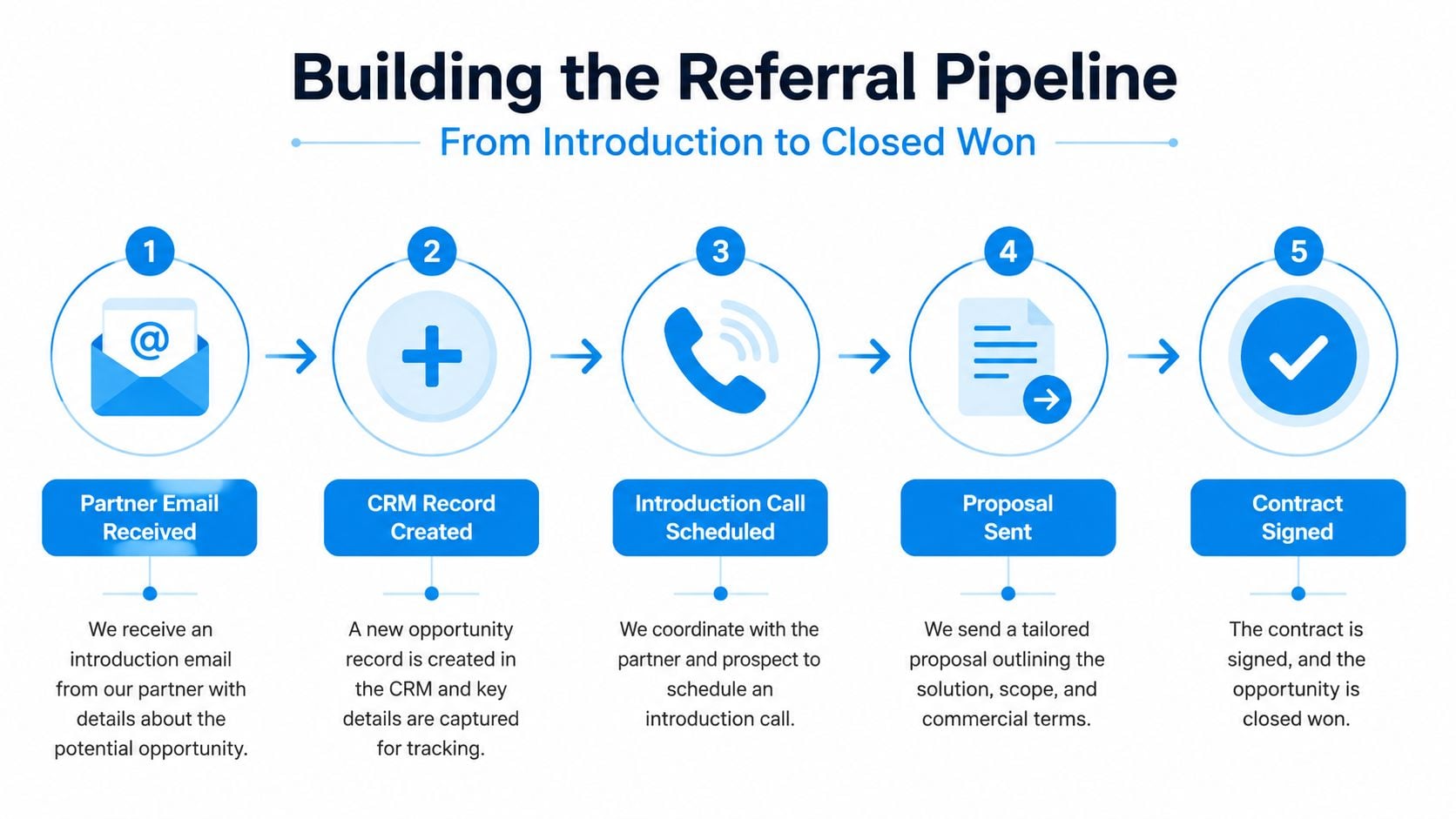
Give every stage a job
Introduced begins when the partner email, form submission, message, or verbal introduction is received. The trigger creates or updates the prospect, links the referrer, records the introduction date, assigns an owner, and sends an internal alert. The opportunity shouldn't enter a generic inbound queue, because that strips away the relationship context.
Qualified means the team has confirmed a plausible fit, relevant need, and a next step. The owner records qualification notes and either advances the opportunity or marks it unqualified with a reason. That reason matters later when you compare referral quality by partner.
Discovery Booked requires a calendar event, confirmed attendees, and a reminder sequence. If the meeting is cancelled, the workflow should create a rescheduling task rather than returning the opportunity to a broad holding stage.
Proposal Sent should include the proposal date, recipient, scope, decision process, and next action. A proposal without a scheduled follow-up is an orphaned document, not a managed opportunity.
Decision Pending identifies a live commercial decision where the buyer hasn't accepted or declined. Create task dates based on the agreed next step, and keep the referring partner visible to the owner without exposing confidential proposal details.
Closed Won should trigger client onboarding, delivery-pipeline creation, owner notifications, and any agreed partner thank-you action. Closed Lost should require a reason such as timing, fit, budget, incumbent provider, or no decision, so the firm can distinguish poor referral quality from weak follow-up.
The referral relationship must remain visible on every internal handoff. A delivery lead shouldn't have to search email history to learn who opened the door, and a partner manager shouldn't discover the win months later through a finance report.
The source field is not a label you set once. It's an attribution thread that follows the opportunity through sales and delivery.
Use a purpose-built referral management workflow when the firm needs partner stages, ownership, thank-you tasks, and pipeline reporting in the same operating environment. The tool matters less than the trigger design. A CRM with no enforced transitions will reproduce the same spreadsheet failure in a more polished interface.
Choosing Link, Code, and Server-Side Attribution
Links and codes solve the capture problem, but neither should become the system of record. Referral attribution needs a layered design because a buyer may click on one device, register on another, reply by email, and enter the sales pipeline weeks later.
Compare the three methods
| Method | Best For | Strength | Main Failure Mode |
|---|---|---|---|
| Unique referral link | Partner portals, campaign pages, digital introductions | Captures source automatically at first touch | Lost cookies, device changes, and direct replies can break the chain |
| Referral code | Email, events, conversations, and offline introductions | Gives the prospect or partner a memorable fallback | Codes can be mistyped, omitted, or shared without context |
| Server-side attribution | CRM-led consulting and advisory pipelines | Preserves the relationship after form submission and handoff | Requires deliberate integration and deduplication rules |
A unique link should assign an identifier and capture the first touch. A code should provide a cross-channel fallback when a partner can't use the link or introduces someone verbally. Store the resulting relationship on the server after registration or lead creation, rather than trusting a browser cookie to survive every later interaction.
The implementation sequence is straightforward:
- Assign a unique referral identifier to the partner or referral event.
- Capture the first touch from the link or code.
- Check the CRM for an existing contact or account.
- Link the referral event to the existing record when appropriate.
- Persist the referrer and originating account server-side.
- Write each status transition with a timestamp.
One expert implementation pattern uses a 30-day click attribution window and unlimited duration for code-based entries, while its source also associates automated tracking with 45% more referrals than manual tracking. Those figures and the technical pattern are documented in Track360's referral attribution guide. Treat that window as a design choice, not a universal rule. Consulting sales cycles often outlast a click window, so the CRM event should preserve the relationship even when the browser no longer can.
Four Nurture Workflows That Keep Partners Warm
A partner who makes an introduction and hears nothing won't know whether the prospect was contacted, qualified, or lost. The answer isn't a stream of promotional updates. It's a small set of useful, triggered communications that respect confidentiality and keep the relationship active.
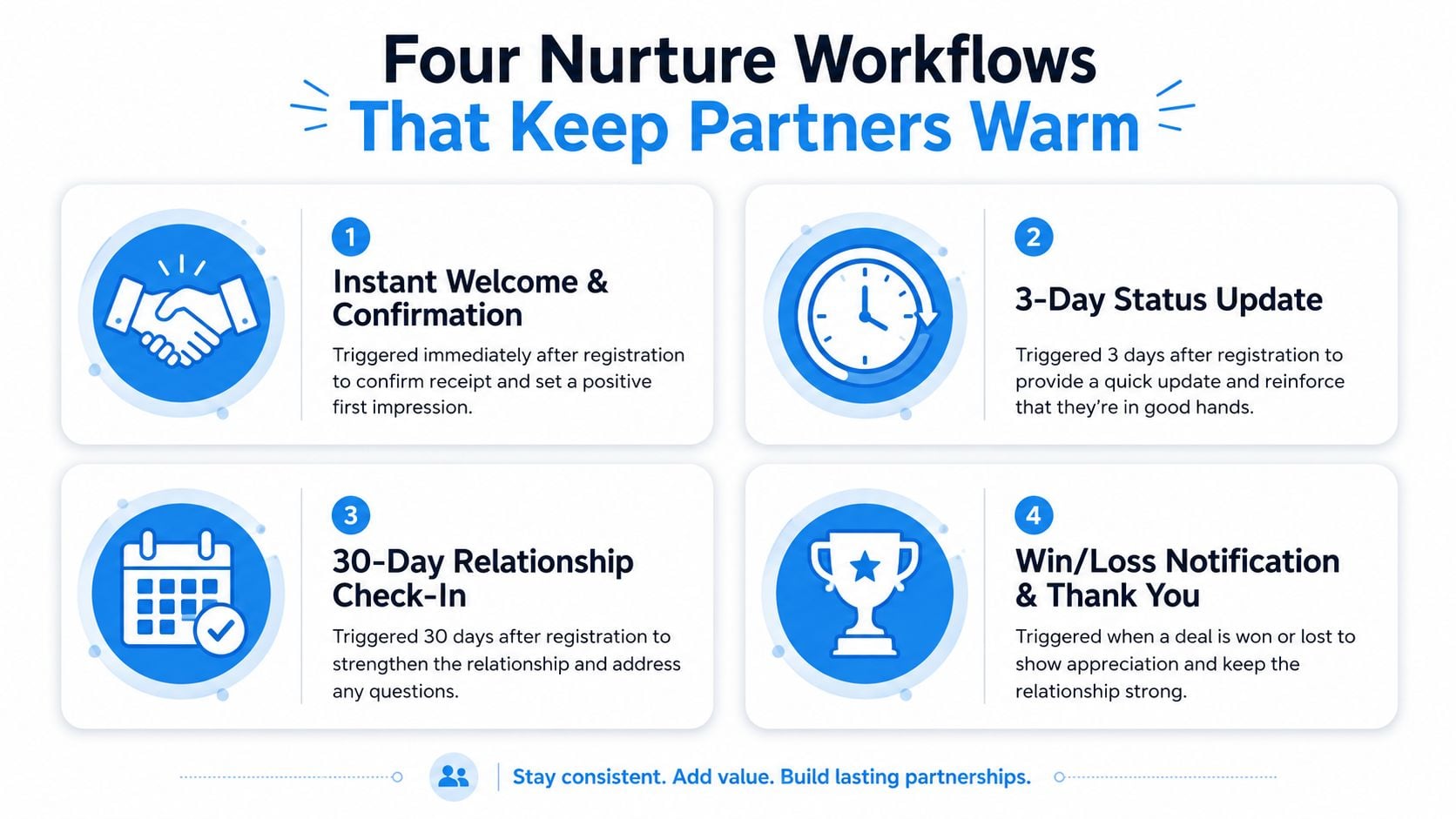
Use four controlled touchpoints
- Immediate acknowledgement: Send an internal alert as soon as the referral enters the CRM, then acknowledge the partner promptly through the agreed channel. Confirm receipt, name the opportunity owner, and state when the partner should expect the next update. Don't disclose sensitive buyer information.
- Three-day status update: If the opportunity hasn't reached a meaningful stage, send a short update that confirms contact activity or explains what remains outstanding. The message should reassure the partner that the introduction didn't vanish into a queue.
- Thirty-day relationship check-in: If the referral remains open or has gone quiet, ask the partner whether the context has changed. This is a relationship conversation, not a demand for another introduction. A follow-up automation workflow can create the task while leaving the message personalized.
- Win, loss, and thank-you notification: When the opportunity closes, notify the partner according to the permissions and expectations established earlier. For a win, coordinate a genuine thank-you, such as a personal note or a joint client acknowledgement. For a loss, thank the partner and share only an appropriate high-level outcome.
The timing should be measured from referral events, not from arbitrary campaign calendars. A partner update after the proposal is sent may be more valuable than a weekly newsletter, while a high-frequency sequence can make the relationship feel transactional.
Partner nurture should answer one question before the partner asks it: “Did my introduction receive proper attention?”
Pause automation when the partner is already in an active conversation with the opportunity owner. Also exclude partners who've asked not to receive updates, and route sensitive accounts to a person rather than an automated message. The purpose is confidence, not volume.
Metrics That Tell You Which Referrals Are Worth Pursuing
A referral count tells you that introductions happened. It doesn't tell you whether the channel deserves more attention. Source-level reporting should connect partner activity to pipeline movement, revenue, relationship quality, and future introductions.
Build the dashboard around outcomes
Win rate by source is closed-won referral opportunities divided by qualified referral opportunities for the same source and period. View it beside inbound and outbound win rates. A falling rate is a yellow flag when the source is producing introductions but qualification is weakening.
Average cycle time by source measures the elapsed time from introduction date to closed-won or closed-lost. Put it on a pipeline trend view. A longer cycle can reflect complex advisory work, but it deserves investigation when one partner's referrals repeatedly stall at the same stage.
Partner-level revenue contribution sums closed-won revenue attributed to each partner, with incentive and service costs deducted when those costs apply. This is more useful than lead volume because it shows which relationships create commercial value.
Partner-level referral quality can use the share of a partner's introductions that reach qualification, discovery, proposal, and closed won. Review the stage progression, not just the final outcome. A partner may send fewer referrals but provide stronger context and better-fit buyers.
Repeat referral rate measures the proportion of active referring partners who make another introduction after their first tracked referral. A program without this metric is a one-shot channel disguised as a relationship.
The broader evidence supports looking beyond volume. An independent 2025 guide cited by Extole's referral tracking overview reports a 4.75% referral share of purchases and 8–12% referral success rates in high-growth startups, while referred customers showed 37% higher retention and 18% lower churn in the cited material. Those benchmarks are context, not targets for every advisory firm.
Use a dashboard that lets an operator filter by source, partner, stage, owner, and outcome. If a report can't explain why a referral was accepted, delayed, won, or lost, it's an activity report wearing a performance label.
Your 30-Day Referral Tracking Rollout
A reliable rollout doesn't start with a referral platform. It starts with the records your team already creates and the handoffs that currently fail.
Week one sets the data model
Create the source channel, referrer link, originating account, referral name, introduction date, initial notes, owner, and referral identifier fields. Define controlled values and duplicate rules. Backfill only the active partner and opportunity records needed for testing, rather than importing an unverified spreadsheet wholesale.
Week two makes movement visible
Create the stages from Introduced through Closed Won and Closed Lost. Add required fields and triggers at each transition, including owner assignment, internal alerts, discovery reminders, proposal follow-up, and client handoff. Test the workflow with a partner email, a form submission, an existing contact, and a duplicate introduction.
Week three protects the relationship
Launch the acknowledgement, status update, relationship check-in, and win or loss notification workflows. Keep the first messages internal where privacy or tone requires human review. Ask the operations owner to inspect every automated message before it reaches a real partner.
Week four measures commercial value
Build source-level views for win rate, cycle time, partner revenue, referral quality, and repeat referrals. Hold the first review with sales and delivery together. Fix missing fields and broken ownership before debating incentive design.
Avoid three rollout mistakes: launching nurture before attribution works, allowing referrals to re-enter generic inbound, and optimizing introduction volume before understanding partner quality. Start with the three referral partners whose revenue and relationship value you most need to protect, then expand after the workflow survives real handoffs.
Starward Navigators provides prebuilt pipelines, referral relationship tracking, automated follow-up, proposal tracking, appointment reminders, and client handoff workflows for consulting and advisory firms. Visit Starward Navigators to see how its acquisition infrastructure can preserve referral attribution from first introduction through repeat business.