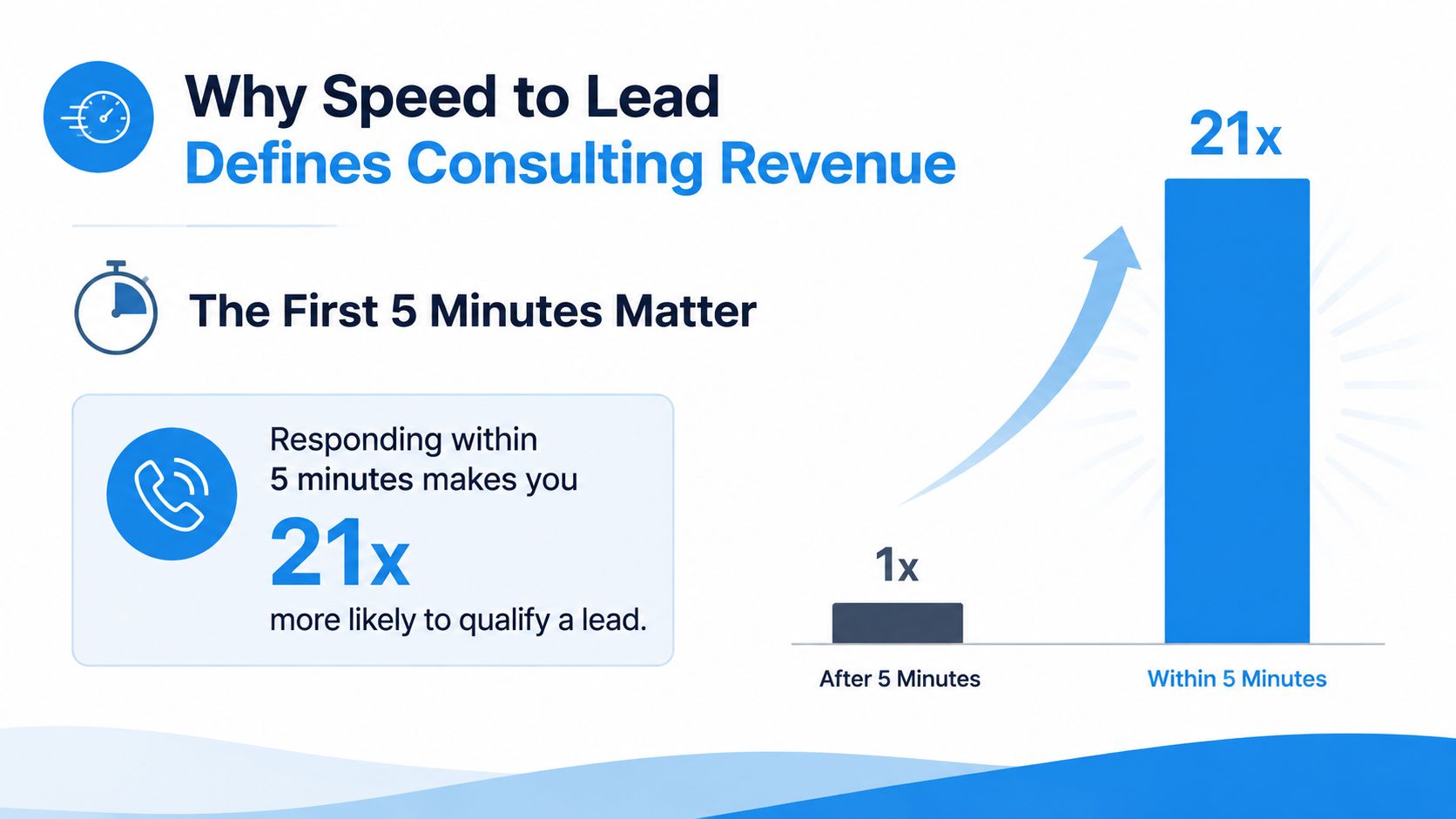
A lead contacted within 5 minutes is 21 times more likely to qualify than one contacted after 30 minutes, and the odds fall again as the delay stretches past an hour (lead response time benchmarks). For a small consulting firm, that isn't a motivational poster. It's a warning that your revenue process starts the moment someone raises a hand, whether that hand came through a form, an inbox, a LinkedIn message, an event badge scan, or a referral intro.
That's why lead follow up strategy can't live in a rep's memory or in a half-used inbox tab. Boutique consultancies lose deals in the cracks between people, tools, and channels. One owner sees the inquiry. Another person schedules discovery. A third person sends the proposal. If the handoff is sloppy, the buyer feels it immediately, and the opportunity goes cold before anyone notices.
Table of Contents
- Why Speed to Lead Defines Consulting Revenue
- Building a Complete Follow Up Operating System
- Channel Mix and Response Prioritization
- Proposal Stage Follow Up as a Decision Workflow
- Measuring What Actually Predicts Pipeline Health
- A Real World Consulting Follow Up Scenario
- Implementing Your Follow Up Infrastructure
Why Speed to Lead Defines Consulting Revenue
The fastest teams don't treat first response as a courtesy. They treat it as the first commercial action in the engagement. The clearest speed-to-lead research shows that firms attempting contact within 1 hour were nearly 7 times as likely to qualify a lead as those waiting longer than 60 minutes, and leads contacted after 24 hours or more were 60 times less likely to qualify than those contacted within the first hour (Harvard Business Review and MIT summary). That's not a small edge. It's the difference between a live opportunity and a dead record.
For consulting and advisory firms, the consequence is sharper because the ticket size is often high and the sales cycle is relationship-driven. A missed response doesn't just cost a single meeting. It can push a buyer to another advisor who responded first, routed the inquiry cleanly, and made it easy to continue the conversation. The response window is part of how buyers judge competence.
The first hour is an operating requirement
Small firms usually lose speed in ordinary ways. The lead lands in a shared inbox, someone thinks someone else replied, and the follow-up starts the next morning. Or the contact arrives through LinkedIn, but nobody enters it into the CRM because the “real” lead management happens later. That delay is where money leaks out.
Practical rule: if a lead is worth selling to, it's worth routing immediately.
The more fragmented the intake, the more important it is to standardize the response path. A boutique firm can't afford different rules for website forms, referrals, and event conversations. Each source may deserve a different message, but not a different level of attention.
Recent benchmark reporting also shows the broader problem isn't rare. One 2025 to 2026 study found only 33% of firms respond in 10 minutes or less, while 39% take more than 2 hours or never respond at all (speed-to-lead benchmarks). That gap explains why so many small teams feel busy but still underperform. They're working leads, but not as a system.
Building a Complete Follow Up Operating System
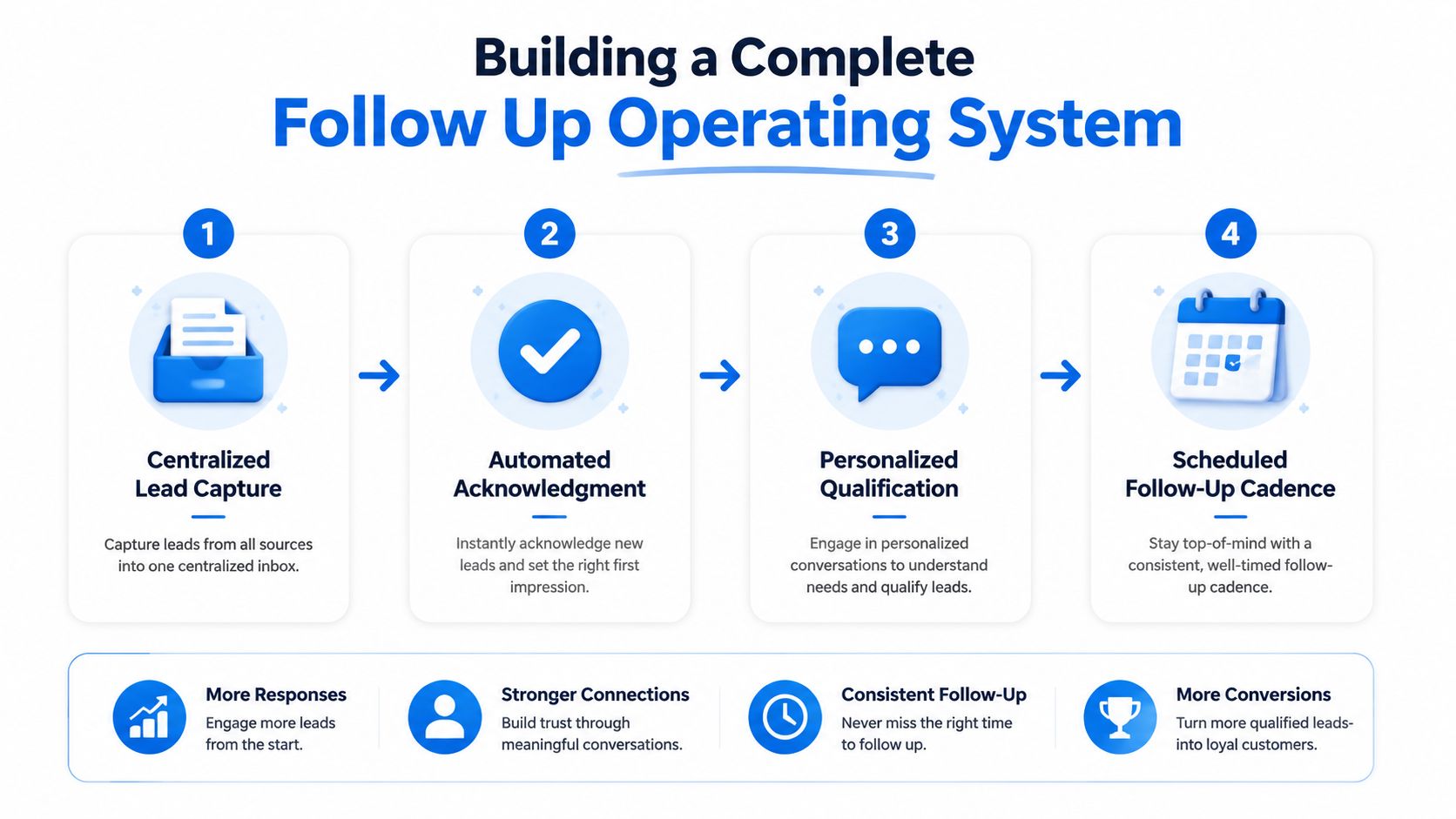
A real lead follow up strategy for a consulting firm has four parts, and all four have to work together. First, every inquiry has to land in one place. Second, the right person has to be assigned without delay. Third, the buyer needs an immediate acknowledgment so they know the message was received. Fourth, there has to be a repeatable sequence that keeps the conversation alive if the buyer doesn't answer right away.
Capture once, route once, follow up once
The first failure point is capture. If a lead can arrive through email, a website form, a LinkedIn DM, an event exchange, or a referral note, it still needs to become one record with one owner. Otherwise, the firm ends up with partial visibility and duplicate work. A clean intake path also gives the team one place to see status, next step, and last touch.
The second failure point is routing. Advisory buyers expect human judgment, but they don't need humans to manually sort every request. The operating system should assign the right advisor or business development lead based on service line, geography, or account type. That keeps the first response fast without making a senior consultant babysit an inbox.
The third layer is the SLA. A first-response standard only matters if someone owns it. Small firms often set a vague expectation like “same day,” then never inspect whether it's happening. A better approach is to define the response standard by channel and stage, then let automation remind the owner when something stalls.
The last piece is sequencing. Not every inquiry converts on first contact, and repeated follow-up is part of the job. Sales research summarized in 2026 reports says 80% of sales require 5 or more follow-ups, yet many reps stop after 1 or 2 attempts (sales follow-up research summary). That's why the system needs a cadence, not a heroic memory.
This follow-up automation platform is one example of how a consulting firm can centralize capture, route leads, and start a defined sequence without building the workflow from scratch.
Channel Mix and Response Prioritization
Speed to lead only works if the firm sorts channels by intent. A website form usually signals active interest, even if the buyer is still comparing options. A LinkedIn note can carry more context because it often comes with a mutual connection or a specific ask. Event contacts sit in the middle. Referrals need speed and tact because the introducer is part of the trust transfer.
Small consulting firms lose deals when they treat every touchpoint like generic inbound. That creates wasted effort on low-signal leads and slow replies on the ones that are ready to talk. The fix is a channel-specific response plan that keeps the tone human and keeps the team from bouncing between inboxes, DMs, and handoffs all day.
Channel Response Priority Matrix
| Channel | Target Response Time | First Touch Method | Escalation Trigger |
|---|---|---|---|
| Website form | Immediate acknowledgment, same-day human follow-up when qualified | Auto-reply plus routed owner message | No human reply after the first touch |
| Shared inbox | Same-day triage | Short reply, then assign owner | Message sits unassigned |
| LinkedIn inquiry | Fast personal response | Direct message from the right advisor | Thread goes quiet after initial exchange |
| Event contact | Same day or next business day | Reference the meeting context | No booked discovery after first reply |
| Referral introduction | Immediate acknowledgment to the introducer and prospect | Thank-you note plus tailored next step | No movement after intro is made |
The practical trade-off is simple. A lean team cannot give every channel the same treatment and still stay fast. High-intent sources should move into a tighter response loop. Lower-intent contacts should move into a structured nurture path, including email sequences built for lead generation for email marketing.
A second trap is over-automating the first touch until it sounds like a mass-market funnel. Consulting buyers spot that right away. The first reply should sound like a person who understands the source and knows what the firm does. Automation should handle speed and consistency, not flatten the firm's voice.
The right matrix keeps the team calm. The wrong one creates false urgency for weak leads and slow response for the ones that matter.
Proposal Stage Follow Up as a Decision Workflow
The quietest losses happen after the proposal goes out. The firm thinks the deal is alive because nobody said no. The buyer thinks the vendor is waiting. Days pass, no one owns the next step, and momentum disappears inside a polite silence.
That's why proposal follow-up should behave like a decision workflow, not a nurture sequence. Research summaries continue to show that delayed response windows hurt qualification odds, including the sharp drop between contact inside the first hour and contact after 24 hours or longer (lead response time research). The same timing logic applies after discovery. Once the proposal is delivered, uncertainty rises, and the firm has to keep the decision process visible.
What healthy proposal follow-up actually looks like
A proposal should not be an attachment that floats in the inbox. It should come with a receipt confirmation, a review call on the calendar, and an explicit next step. If the buyer needs time, the consultant should know what they're reviewing, who else is involved, and when the next checkpoint happens.
Use stage-based triggers instead of vague check-ins:
- Confirm receipt: make sure the buyer received and opened the proposal.
- Lock a review date: don't let “I'll take a look” sit undefined.
- Send decision aids: include the materials the buyer needs to compare options or brief stakeholders.
- Set a next action: ask for a yes, a revision, or a scheduled decision discussion.
That approach removes silent stalls without sounding pushy. It also gives the internal owner a reason to act when a proposal sits untouched. Most firms lose deals here because nobody wants to feel aggressive, so nobody drives the process at all.
Proposal follow-up automation helps when the team needs a defined sequence from discovery complete to decision, especially if multiple consultants are involved in the sale. The point isn't more pressure. It's clearer ownership.
Measuring What Actually Predicts Pipeline Health
Teams often track activity because it's easy to count. Number of emails sent. Number of calls made. Number of proposals issued. Those numbers can matter, but they don't tell you whether the pipeline is healthy. A lean consulting firm needs a smaller dashboard that shows where the process is slowing down.
The useful measures are the ones tied to decisions. Time-to-first-response tells you whether the intake system works. SLA compliance shows whether the team is honoring the standard it agreed to. Proposal-stage velocity shows whether opportunities are moving or sitting. Stalled-opportunity detection shows whether a human needs to intervene. Referral-to-engagement timing shows whether relationship work is turning into business.
Keep the dashboard narrow
A practical dashboard usually stays under ten metrics because the goal is action, not surveillance. If the dashboard is too large, the team stops looking at it. If it's too small, you miss the places where opportunities die without notice. The best setup points to a concrete fix, like a routing issue, an unowned proposal, or a scheduling bottleneck.
A useful reporting rhythm looks like this:
- First response by channel: spot where the team is slow.
- Open proposals with no next step: find decision drift.
- Discovery booked versus inquiry received: see whether qualification is working.
- Follow-up completion by owner: identify accountability gaps.
- Referral status: confirm partner relationships aren't being neglected.
The point is not to punish people for being busy. It's to reveal where the system needs support. If one advisor always responds fast but never logs the next step, the firm has a process problem, not a personality problem. If referrals get warm attention at first and then disappear, the relationship workflow is broken.
That distinction matters because small firms often confuse good intentions with operational control. Data gives you the difference.
A Real World Consulting Follow Up Scenario
A 7-person advisory firm gets a website inquiry from a founder looking for help with revenue process design. The form submission lands in a single system, the lead is assigned immediately, and the prospect receives a short acknowledgment that names the owner and promises a timely reply. Nothing fancy, just fast and clear.
The owner reviews the inquiry, sees that it matches the firm's core work, and sends a same-day message with two discovery times. The calendar invite includes confirmation and reminders, so nobody has to manually chase attendance. After the discovery call, the opportunity moves into proposal stage with a defined owner and a visible next checkpoint.

When the proposal is sent, the record doesn't go dark. A follow-up sequence confirms receipt, schedules the review conversation, and logs the buyer's questions for the next touch. If the buyer asks for time, the system sets the next reminder instead of relying on memory. That matters because the buyer's decision may involve another partner, a finance lead, or a board member, and each delay creates another chance for the deal to stall.
After the deal closes, the record moves into onboarding and then into relationships and referrals. The firm doesn't treat the client handoff as an admin task. It becomes part of the same operating system, so the team can ask for introductions later without starting from zero.
That kind of workflow doesn't eliminate human judgment. It makes sure human judgment shows up in the right places. The firm spends less time wondering what happened to the lead and more time moving the engagement forward.
Implementing Your Follow Up Infrastructure
A consulting firm can build this on a generic CRM, but only if someone has time to configure the workflows, reminders, and stage logic correctly. Most small teams don't. They buy the software, import contacts, and stop there because the system still feels blank. That's why a purpose-built operating system with ready-made pipelines and follow-up sequences is often the more realistic choice for a 2 to 20 person firm.
The implementation checklist should be simple and essential. Import contacts. Configure the pipeline. Connect forms and inboxes. Set up appointment scheduling. Build proposal tracking. Activate onboarding automation. Turn on referral workflows. If those pieces aren't live, the team will fall back to spreadsheets, side emails, and memory.
Practical rule: don't go live with a system that still depends on one person remembering every handoff.
The strongest implementations also define the transition from build to use. That means the firm knows who owns the setup, when the system goes live, and what has to be tested before clients touch it. If the vendor or internal admin can't show the full path from first inquiry to referral follow-up, the rollout isn't ready.
For firms that want structure without custom-building everything, Starward Navigators provides an operating system built around consulting pipelines, proposal follow-up, onboarding handoffs, and referral management. Used well, that kind of infrastructure turns follow-up from a personality test into a repeatable revenue process.
If your firm is still juggling leads across inboxes, DMs, and half-finished CRM records, Starward Navigators can help you turn that chaos into a follow-up system that holds up under load. Visit Starward Navigators to see how a consulting-focused operating system can standardize intake, proposals, onboarding, and referrals without asking your team to remember everything manually.