Most advice about quality vs quantity is too shallow for a boutique consultancy. “Choose quality” sounds sensible, but it doesn't tell a partner whether to answer an inbound lead immediately, make another follow-up attempt, accept a marginal discovery call, or spend an afternoon writing a proposal. “Choose quantity” is no better when it becomes an excuse to fill the pipeline with poor-fit prospects.
Small firms don't lose because they pick the wrong side of a philosophical debate. They lose because they never define the behavior they're funding, so acquisition drifts toward whatever feels urgent. The useful question is narrower and harder: which operating behavior should produce revenue this quarter, and what metric will prove it worked?
Table of Contents
- Why Quality vs Quantity Is the Wrong Question for Boutique Firms
- Two Meanings of Quality vs Quantity Every Consultant Should Separate
- Where Quality and Quantity Actually Compete in Acquisition
- Comparing Quality-Led and Quantity-Led Boutique Pipelines
- Three Boutique Scenarios and the Right Answer for Each
- How a Prebuilt Operating System Resolves the Tradeoff
- A Decision Framework for Choosing Quality or Quantity
- Your 30-Day Plan to Get the Balance Right
Why Quality vs Quantity Is the Wrong Question for Boutique Firms
The classic quality-versus-quantity framework comes from economics, not productivity slogans. Gary Becker formalized the child quantity-quality model in 1960 and expanded it in 1991. Its central logic is straightforward: when resources are limited, allocating more time and investment to each unit can reduce the number of units a household or institution can support. The historical demographic research associated with the framework linked declining fertility in Europe and North America to rising investment in each child, establishing a durable principle about scarce capacity and per-unit investment. The historical overview of the quantity-quality framework explains why the tradeoff has influenced thinking far beyond demography.
That principle maps cleanly onto consulting. A partner can pursue fewer, researched opportunities, or create a larger flow supported by qualification, automation, and delegation. But the firm can't make that decision by repeating “quality matters” in a planning meeting. It has to decide where partner attention goes and which activities the system will handle without partner involvement.
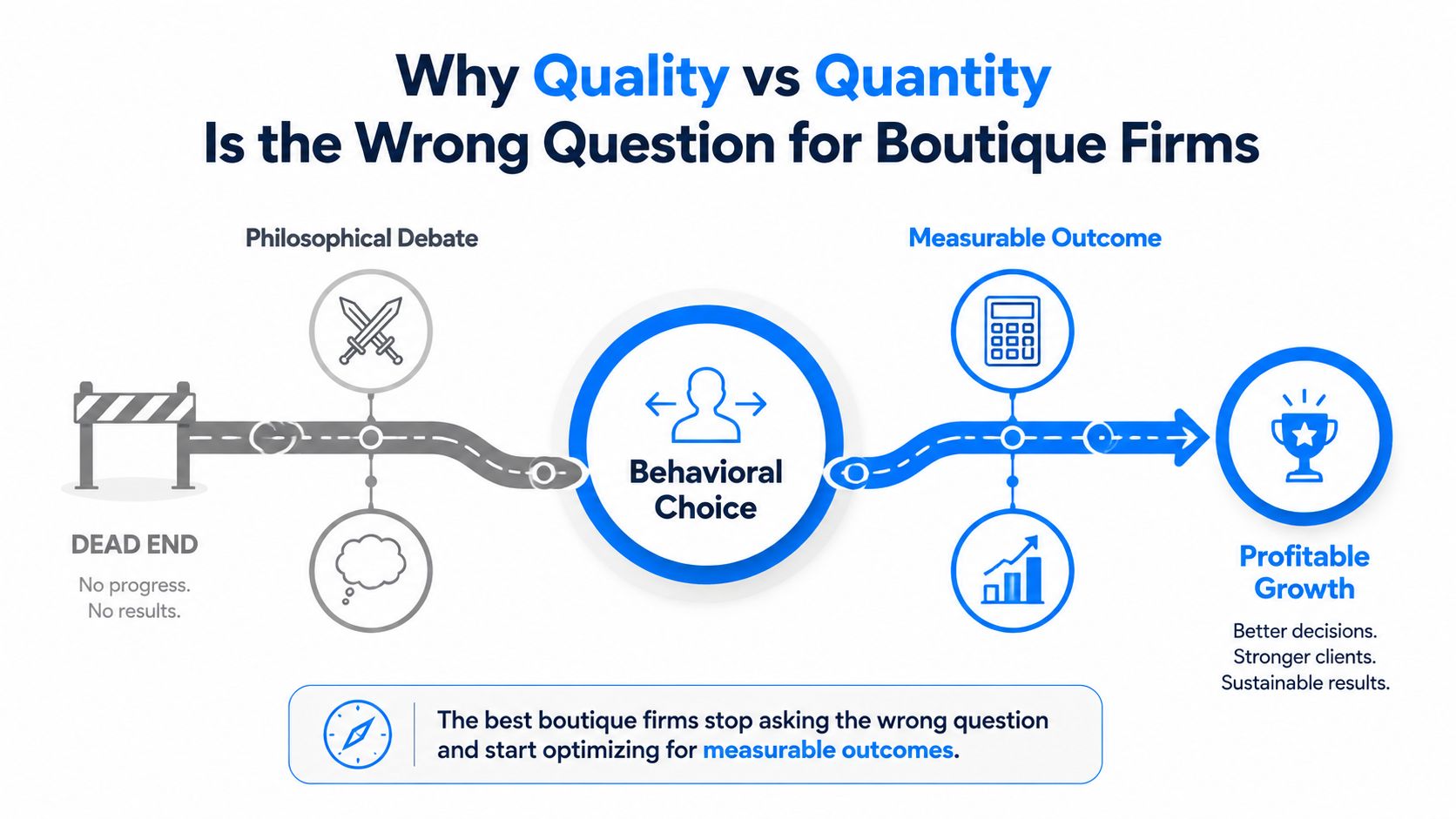
Define the behavior you're buying
A quality-led acquisition motion funds fit, trust, and conversion depth. It narrows the audience, uses stronger qualification, invests in personalized conversations, and accepts a longer path when the resulting engagement justifies the effort. A quantity-led motion funds coverage, speed, and repeatability. It uses broader prospecting, structured qualification, and automated follow-up to create enough opportunities for the conversion system to work.
Neither mode is automatically superior. A specialist advisor selling complex transformation work may destroy margin by accepting every inquiry. A fractional executive with a defined offer and available delivery capacity may lose revenue by relying only on introductions.
Operating rule: Don't call yourself quality-led until your calendar, qualification rules, and follow-up behavior enforce that choice.
The practical test is simple. Name the target segment, define the minimum acceptable fit, specify the response and follow-up standards, then select a weekly metric. If you can't do that, “quality” is a preference, not an operating model. Your CRM will default to quantity through unattended leads, inconsistent outreach, and a growing list of opportunities nobody owns.
Two Meanings of Quality vs Quantity Every Consultant Should Separate
Consultants often use the same words to describe two different decisions. The first is a preference, usually held by the founder. The second is an operating behavior, visible in the pipeline. Separate them before changing your acquisition plan.
A preference-based definition describes what the firm wants to be known for. The partner may prefer fewer clients, premium retainers, senior-level relationships, or engagements where the team can influence the outcome. That preference is legitimate, but it doesn't tell the business how many prospects to contact or how fast to respond.
An operational definition describes what the firm does. It covers lead routing, qualification, outreach volume, response time, follow-up sequence, meeting acceptance, proposal production, and referral management. A firm can prefer premium clients while running a high-volume outbound motion. It can also claim to value volume while leaving every lead waiting for a partner to respond.
| Dimension | Preference-Based Definition | Operational Definition |
|---|---|---|
| Meaning | What the founder values in a client or relationship | What the pipeline does repeatedly |
| Quality focus | Strong fit, trust, strategic importance, premium scope | Qualification rigor, relevant messaging, proposal depth |
| Quantity focus | Broader market coverage or more opportunities | Contact volume, meeting flow, routing speed, cadence execution |
| Proof | Ideal-client profile and commercial priorities | Weekly pipeline metrics and stage behavior |
| Main risk | Over-polishing a pipeline that produces too little demand | Filling calendars with opportunities delivery can't support |
| Management question | Which clients should we want? | Which actions create and convert them? |
Run the diagnostic
Ask four questions in a leadership meeting:
- Which prospects are we deliberately excluding?
- What must happen before a prospect reaches a partner's calendar?
- How quickly does an assigned lead receive a meaningful response?
- Which metric would tell us the current motion is degrading?
If the answers are vague, the firm hasn't chosen a quality or quantity mode. It has chosen improvisation. That is expensive because partners spend time making the same judgment repeatedly, often after the lead has already gone cold.
The behavioral distinction also matters because research increasingly treats quality and quantity as distinct consumer preferences, not merely opposite ends of one scale. A 2025 Journal of Consumer Research study analyzed 32 studies involving 24,404 participants and reported that people can systematically prefer quality or quantity, with those preferences predicting financial outcomes. The study on quality and quantity preferences gives boutique firms a useful lens: the buyer's preference and the seller's operating system both shape commercial outcomes.
Where Quality and Quantity Actually Compete in Acquisition
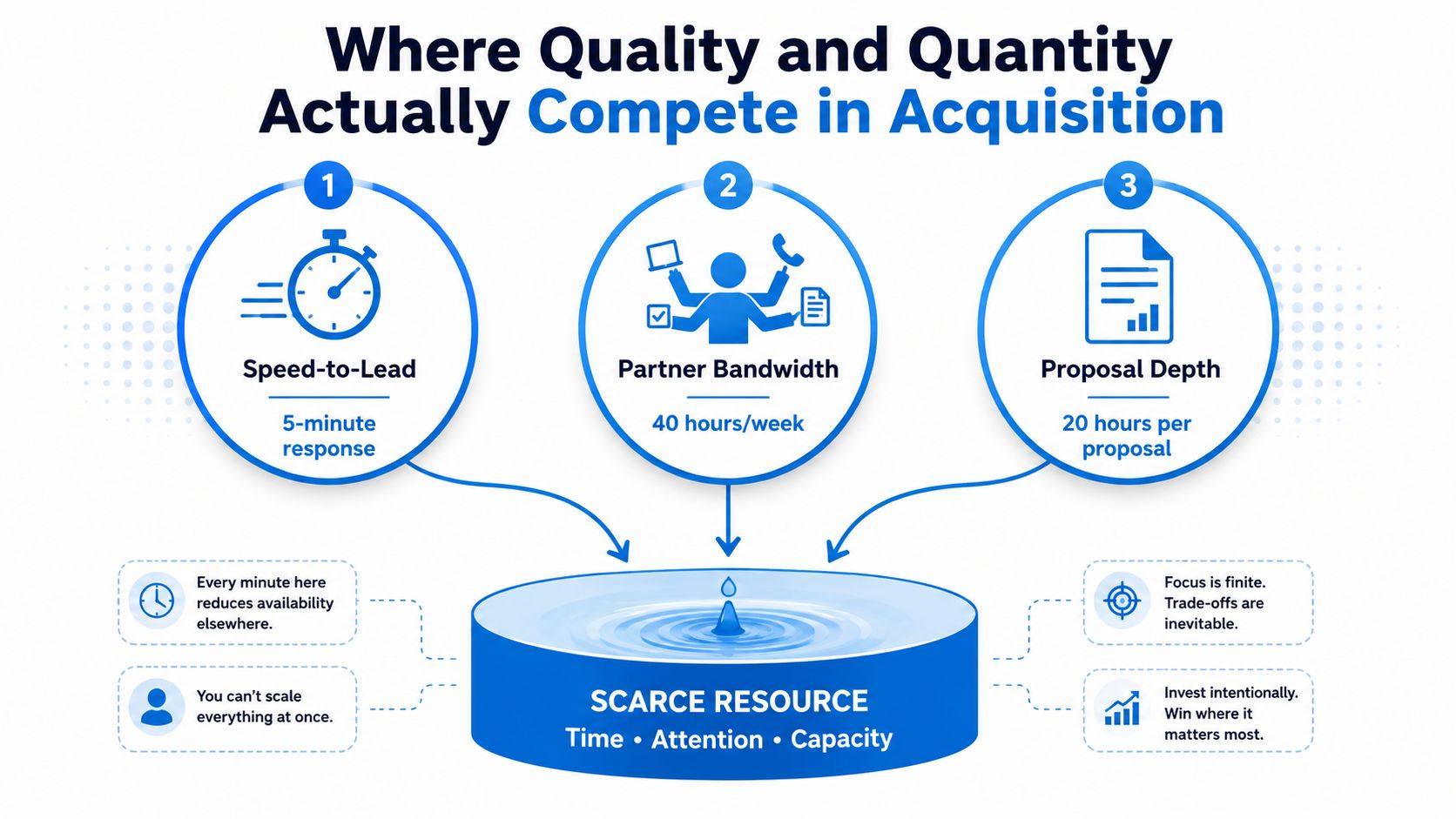
The tradeoff appears whenever the same scarce resource can support either more opportunities or better treatment of each opportunity. In a small consultancy, that resource is usually partner time. Three acquisition battlegrounds expose the conflict quickly.
Speed-to-lead is the first. Teams that respond within five minutes convert at about 21%, compared with roughly 2.3% for next-day responders, a gap of about 9x on the same lead pool, according to lead response-time benchmark data. The same source places the median B2B response time at about 42 hours, while only around 7% of teams respond within five minutes. A boutique firm that spends hours crafting a perfect first reply may be choosing quality in theory while surrendering the opportunity operationally.
Follow-up cadence creates the second conflict. Random persistence consumes attention without creating a reliable process. A structured 5-7-14 cadence, first follow-up after five days, then seven days later, then fourteen days later, gives the team a defined rhythm. Separate cold-outbound benchmark data reports that a 3-7-7 schedule captures about 93% of total replies within 10 days, with top-quartile results around a 15% reply rate, 70% positive reply rate, and 3.5% meeting rate. Those figures and the cadence guidance appear in the B2B follow-up benchmark research. The lesson is not to send more messages blindly. It's to concentrate the right touches around a repeatable sequence.
Proposal throughput exposes false quality
The third battleground is proposal production. A firm that spends weeks perfecting one proposal may be delivering thoughtful work, but if qualified opportunities never receive a clear commercial next step, the bottleneck is not quality. It's throughput and ownership.
Track the handoff from inquiry to qualification, qualification to meeting, meeting to proposal, and proposal to decision. Then ask where partner hours disappear. If the answer is “writing proposals for prospects who never met the qualification standard,” quantity has overwhelmed quality. If the answer is “waiting for the perfect prospect while capacity sits idle,” quality has become avoidance.
Referral acquisition deserves the same discipline. Record who introduced the opportunity, what stage it reached, and whether the partner received a timely update. A clear referral tracking process prevents warm introductions from becoming invisible pipeline activity.
Comparing Quality-Led and Quantity-Led Boutique Pipelines
A quality-led pipeline and a quantity-led pipeline should be judged by economics, not identity. The right model depends on the firm's offer, available delivery capacity, partner involvement, and tolerance for nurture time.
A quality-led model works best when the firm has a narrow ideal client profile and a high-trust sale. The team spends more time researching accounts, earning introductions, preparing for conversations, and tailoring proposals. Its cost per qualified meeting may be high, but that cost can make sense when partner-led conversion is strong and the engagement supports substantial value.
A quantity-led model works when the offer is repeatable enough to qualify consistently. Automated outreach, forms, routing, reminders, and structured discovery absorb administrative work. The firm doesn't need every prospect to be perfect because the process identifies fit before delivery resources are committed.
| Metric | Quality-Led Pipeline | Quantity-Led Pipeline |
|---|---|---|
| Cost per qualified meeting | Higher, justified by narrow targeting and partner involvement | Lower when automation and repeatable messaging handle early stages |
| Meeting-to-engagement conversion | Should exceed 40% when partner trust and fit are strong | Can be lower if funnel coverage and qualification volume support revenue |
| Monthly funnel boundary | Often appropriate below roughly 5 qualified meetings | Becomes more viable above 15 prospects entering the funnel |
| Partner time per closed deal | High, but acceptable when deal economics support it | Must stay at or below roughly 12 hours through routing and automation |
| Best use case | Complex, premium, relationship-heavy advisory work | Defined offers, multiple sellers, and fixed delivery capacity |
| Primary failure mode | Too few opportunities and excessive founder dependence | Low-fit meetings and partner calendar pollution |
These cutoffs are operating prompts, not universal laws. Below roughly 5 qualified meetings per month, a boutique firm can often justify a quality-led motion if engagement economics support intensive conversion work. Above 15 prospects entering the funnel monthly, a quantity-led model has more room to outperform because automation can reduce the marginal cost of handling demand. The conversion and partner-time benchmarks are drawn from the operating assumptions provided for this framework, not a promise of performance.
Practical rule: Switch modes when partner hours per closed deal or cost per qualified meeting stops supporting the commercial model, not when a sales philosophy becomes fashionable.
For firms selling through email, the decision should also account for list quality, targeting, and follow-up ownership. A defined email marketing lead-generation process can support quantity without making every partner responsible for manual prospecting.
Three Boutique Scenarios and the Right Answer for Each
The same quality-versus-quantity decision produces different answers in different firms. Start with the commercial situation, not the label.
A new advisory firm with no brand
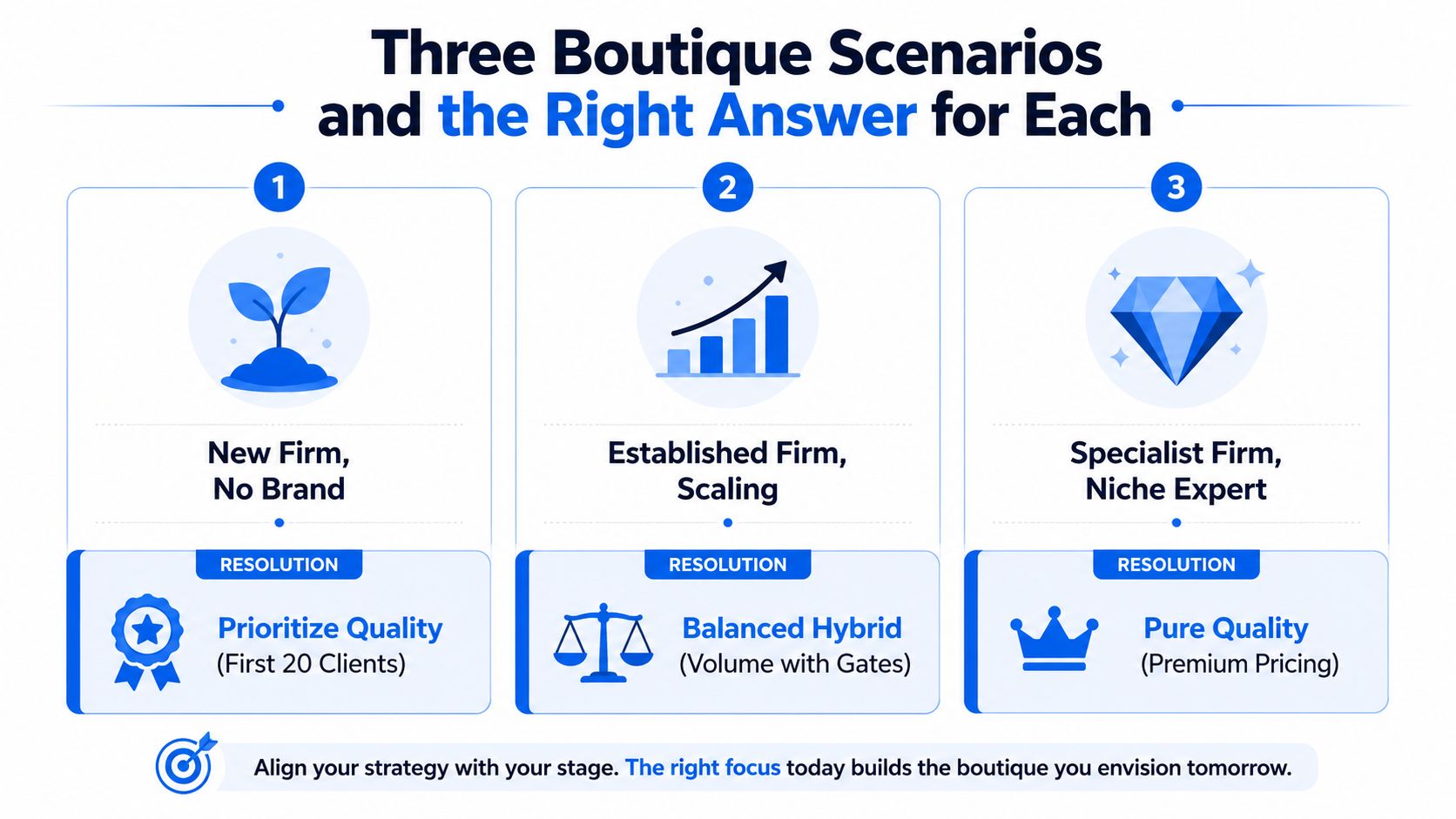
A new firm without proof points should run a quality-led motion. The partners need narrow vertical focus, warm introductions, and direct conversations that reveal the buyer's language. Broad outbound creates activity, but it also creates objections the firm hasn't yet learned to answer.
The operating decision is to accept fewer, better-matched conversations and document every serious engagement. The firm should turn delivery insight into proof, sharpen its positioning, and build a referral base before widening the market. Early acquisition is not merely a hunt for revenue. It's also the fastest route to a credible reputation.
A fractional executive practice with several sellers
A fractional CRO, COO, or CFO practice with multiple partners selling simultaneously should usually adopt a quantity-led motion once the offer and delivery capacity are defined. Automated outbound and structured discovery let the firm create coverage without asking every partner to research every account manually.
The gate is qualification. The practice should reject prospects that lack the required business problem, authority, timing, or delivery fit. Quantity belongs at the top and middle of the funnel. Quality belongs at the qualification and proposal stages.
An established consultancy adding referrals
An established consultancy adding a referral motion needs a hybrid system. Referral opportunities deserve a quality-led experience because the referring partner's trust is attached to the introduction. Outbound can run on a quantity-led process, with clear targeting, automated reminders, and meetings booked against defined criteria.
Measure the paths differently. Referral quality is visible through referral-stage progression, response discipline, partner updates, and conversion to meaningful conversations. Outbound quantity is visible through meetings booked, qualification rate, and partner time consumed.
The mistake is forcing one standard across every source. A warm introduction should not receive the same treatment as a cold contact, and a repeatable fractional offer should not depend on the same founder-led process as a complex transformation engagement.
How a Prebuilt Operating System Resolves the Tradeoff
Quality and quantity stop competing when the firm removes manual work from the parts of acquisition that don't require senior judgment. A prebuilt operating system doesn't decide which prospects deserve attention. It makes sure the right prospects receive the right action at the right stage.
Compress the response window
Inbound leads should be captured, assigned, and acknowledged through a defined workflow. Routing can send a lead to the correct owner based on source, service line, or qualification information. The partner then spends time on a better-contextualized conversation instead of checking scattered inboxes and forms.
The quality benefit is relevance. The quantity benefit is coverage. Fast acknowledgment protects both because the firm can respond promptly without requiring a partner to write every administrative message from scratch.
Enforce follow-up without adding headcount
Follow-up should not depend on memory. A system can trigger sequences for new leads, proposals, stalled opportunities, appointment reminders, and referral nurture. Partners still provide judgment and personal communication where it matters, but the system handles reminders and next-action visibility.
Many boutique firms fail at this stage. They generate enough interest, then let proposals sit because no one owns the next contact. A cadence makes persistence consistent without turning the partner into a full-time coordinator.
Track the relationship path
Referrals require more than a source field. The firm should know which partner introduced the opportunity, whether the lead was accepted, what conversation occurred, and whether the referrer received an update. That record turns relationship work into a managed commercial channel.
Starward Navigators' lead management platform is one example of a prebuilt system for lead capture, routing, automated follow-up, proposal tracking, client handoffs, and referral relationship stages. Other tools can work if they enforce the same operating disciplines rather than presenting a blank CRM that the team must design and maintain alone.
The system's job is not to choose quality or quantity. It's to stop preventable execution failures from making that choice for you.
A Decision Framework for Choosing Quality or Quantity
Run the decision quarterly. Don't debate the philosophy every week.
Start with partner capacity. Reserve time for delivery, selling, relationship management, and internal work. The remaining sales capacity sets the practical ceiling for meetings and proposals. A lead-volume target that ignores partner availability is not ambitious. It's a scheduling error.
Next, define the minimum qualification standard. Use explicit criteria such as problem fit, buyer access, urgency, budget suitability, and delivery compatibility. A small pipeline can demand a high qualification threshold. A larger pipeline can use a lighter initial gate, but it still needs a stronger gate before a partner meeting or proposal.
Then assign an allowable cost per qualified meeting. Count research time, outreach labor, software, partner involvement, and follow-up administration. Compare that cost with proposal conversion and engagement economics. If qualified meetings are expensive and fail to progress, narrow the market or improve qualification. If partner capacity is available and qualified demand is too low, widen the top of funnel.
Track the weekly control metrics
- Speed-to-lead: Measure the time from inquiry to first meaningful response.
- Qualified-meeting rate: Separate booked meetings from meetings that meet the firm's criteria.
- Proposal-to-close rate: Identify whether poor fit enters at discovery or whether proposals lack a clear decision path.
- Partner hours per closed deal: Include preparation, meetings, follow-up, and proposal work.
- Source performance: Compare website, inbox, LinkedIn, events, outbound, and referrals by stage progression.
Use the numbers to trigger a mode change. A low-volume firm with strong fit and healthy conversion should protect quality. A firm with repeatable demand and unused capacity should increase volume. A firm with rising meetings and declining proposal progression should reduce intake or strengthen its gate.
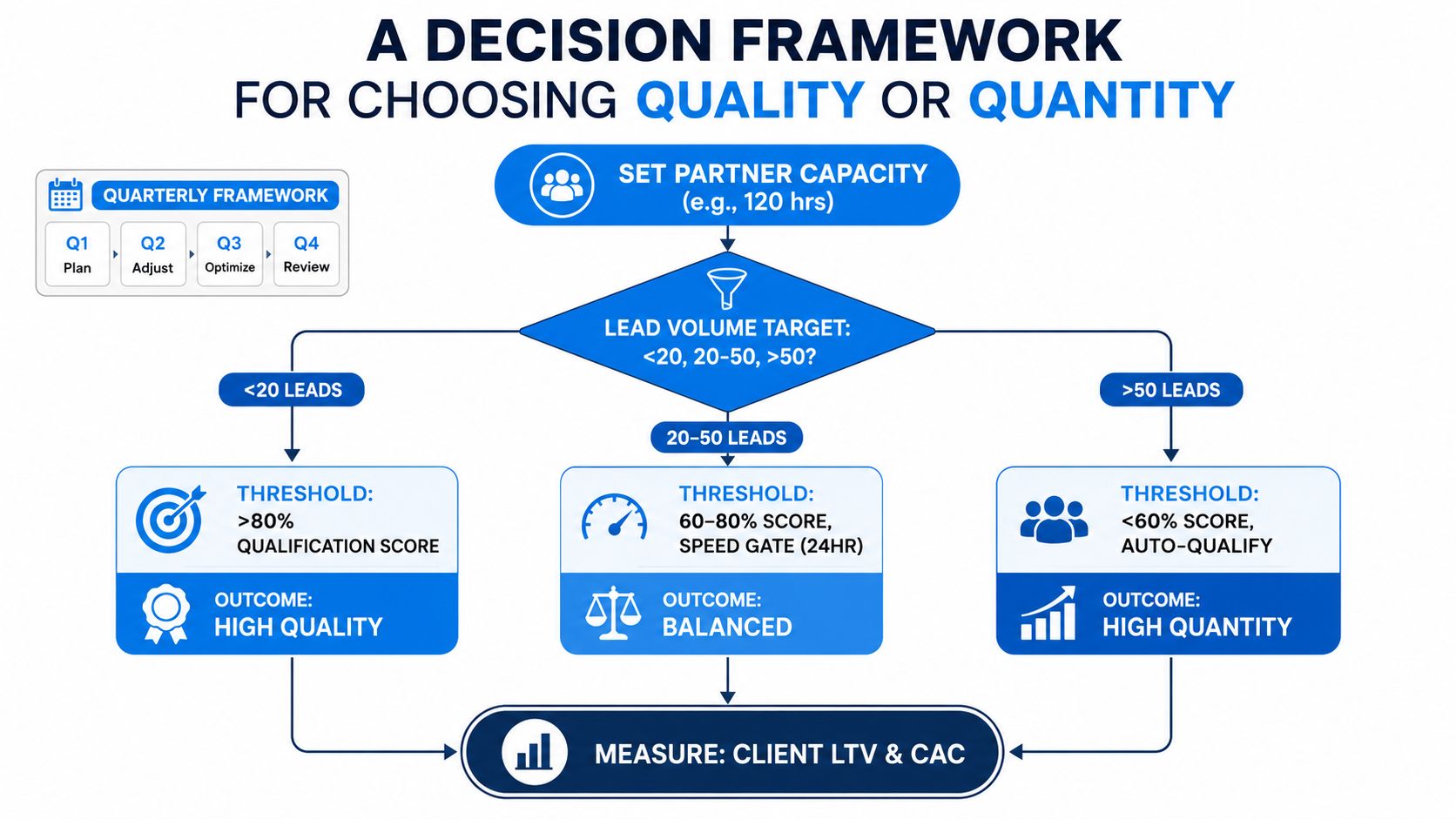
The operating system must support automated routing, cadence enforcement, source attribution, proposal stages, and referral tracking. Without those controls, the firm will confuse activity with progress and make the same decision repeatedly without clean evidence.
Your 30-Day Plan to Get the Balance Right
Use the next month to replace opinion with operating evidence.
Week 1
Set partner capacity and choose the acquisition mode for the quarter. Write the qualification criteria, define who owns each stage, and set the cost ceiling for a qualified meeting. If the firm wants a quality-led motion, narrow the target segment. If it wants quantity, define the automation and qualification gates before increasing outreach.
Week 2
Instrument speed-to-lead and follow-up. Set a sub-five-minute first-touch target for high-intent inbound inquiries, based on the response-time benchmark cited earlier. Create a fixed daily follow-up quota, then assign exceptions to a named partner rather than leaving them in a shared queue.
Week 3
Review cost per qualified meeting and conversion by source. Check whether referrals, inbound, outbound, LinkedIn, events, and email produce different levels of fit and partner effort. Count the work required after the meeting, not just the meeting itself.
Week 4
Adjust one variable. Increase or reduce lead volume, tighten qualification, change routing, or revise the cadence. Don't change everything at once, or you won't know which decision affected the result.
Watch for early drift: meeting counts rising while proposal rates fall, partners spending more than four hours weekly on unqualified calls, or proposals sitting without a scheduled next step. Those signs mean quantity has outrun the operating system, or quality has become an excuse for insufficient pipeline coverage.
The right balance isn't a permanent midpoint. It's a deliberate mode tied to capacity, qualification, conversion, and partner economics.
Starward Navigators provides prebuilt acquisition infrastructure for small consulting and advisory firms, including lead routing, automated follow-up, proposal tracking, client handoffs, and referral-stage management. Visit Starward Navigators to see how a defined operating system can help your firm protect lead quality while creating consistent pipeline volume.