The most popular advice about client onboarding software starts in the wrong place. It assumes every platform solves the same problem, then compares feature lists as if a shared checklist, a professional services automation system, and a customer-success platform were interchangeable. They aren't.
For a small consulting or advisory firm, onboarding might begin when a lead submits a form, when a proposal needs follow-up, or only after a contract is signed. Some tools manage that acquisition-to-onboarding handoff. Others run client-facing implementation workspaces, coordinate billable delivery through PSA features, operate inside Salesforce, or connect onboarding to health scores and renewals. The right choice depends on where your workflow breaks.
This comparison looks at each platform through the operating reality of smaller firms: pre-sale handoff, client-facing delivery, integrations, implementation burden, pricing visibility, limitations, and stack fit. Starward Navigators is especially relevant when the missing layer sits between lead capture, proposal follow-up, and delivery kickoff. It isn't the universal winner, but it addresses a gap that post-sale onboarding tools often leave outside their scope.
Table of Contents
- 1. Starward Navigators
- 2. Rocketlane
- 3. GUIDEcx
- 4. Onboard
- 5. TaskRay
- 6. Baton
- 7. Dock
- 8. OnRamp
- 9. Vitally
- 10. Custify
- Top 10 Client Onboarding Software Comparison
- Choose the Workflow You Need to Control
1. Starward Navigators
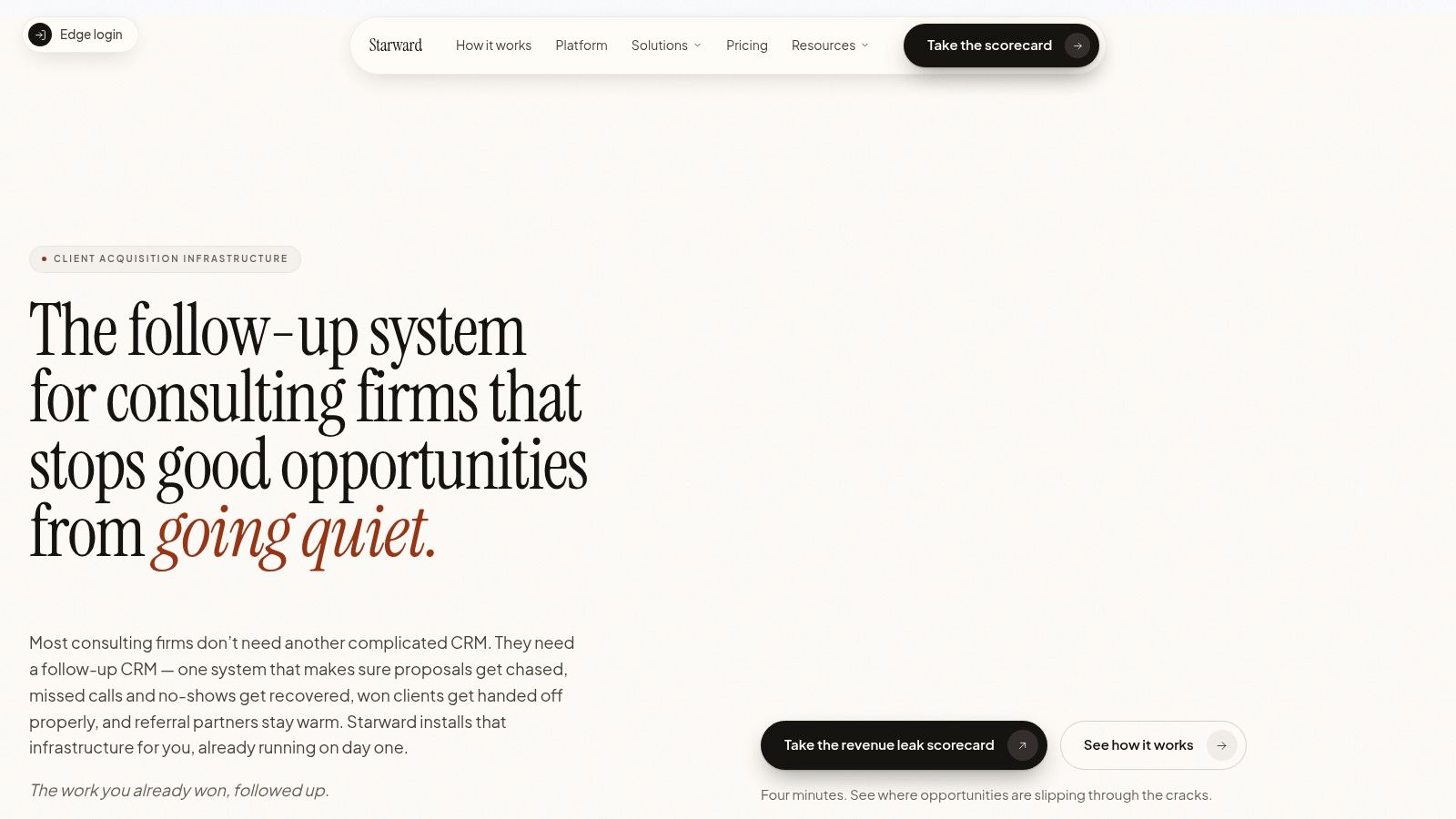
Starward Navigators is the most direct fit for small consulting and advisory firms whose onboarding problem starts before the contract is signed. It functions as a purpose-built follow-up CRM and client-acquisition operating system for small teams, independent advisors, fractional executives, and boutique business-development leaders. Instead of giving a firm a blank CRM to configure, it supplies prebuilt pipelines for Business Development, Client Delivery, and Relationships & Referrals.
That distinction matters. A delivery-only onboarding tool may begin with a new project. Starward can begin when an opportunity enters through a website form, inbox, LinkedIn, or event, then support appointment scheduling, proposal follow-up, decision tracking, and the eventual client handoff. When an opportunity is marked won, the client record can be updated, the delivery pipeline started, an internal owner notified, and onboarding and kickoff actions triggered.
The product's strongest use case is the space between a promising conversation and an active engagement. Automated multi-touch follow-up addresses leads that receive only one response. Proposal aging alerts and defined next steps address quiet opportunities. Appointment confirmations and no-show recovery address meeting logistics. Referral nurture sequences keep partner relationships visible instead of leaving them in someone's memory.
Why it fits a small advisory firm
Starward is vendor-implemented through a Map, Install, and Go Live process. The company states a 14-day go-live guarantee, with most firms live in about two weeks, and includes contact import and configuration support. Pricing starts at $97 per month, with plans scaling by user seats and contact limits, while advanced Campaigns, Triggers, and Workflows features are available on Core Plus plans and above. Those details are available on the Starward Navigators website.
Its trade-off is intentional specialization. A consulting firm gets opinionated workflows for lead response, proposal progression, handoffs, and referrals, but a large enterprise with unusual CRM governance may want a more extensible general-purpose platform. Firms should also check whether seat and contact limits will require a plan change as the business grows.
Practical rule: If your biggest leakage happens before delivery kickoff, don't evaluate onboarding software only by its client portal.
For teams that need the wider distinction explained, this client onboarding overview provides useful context. Starward works best as the operating system for the revenue-to-delivery transition, rather than as a replacement for a full PSA with deep resource planning, time tracking, or financial controls.
2. Rocketlane
Rocketlane treats onboarding as a staffed delivery project, which makes it a strong candidate for consulting firms that need more than tasks and reminders. Its platform combines a branded client portal, project and portfolio management, resource planning, time tracking, budgets, and customer collaboration. That places it closer to a PSA and onboarding operating layer than to a lightweight checklist tool.
The client-facing side is central. Customers can review project information, participate in approvals, and follow progress through a branded portal with loginless access. Internally, teams can use Gantt, Kanban, or list views, reusable templates, forms, automations, and portfolio visibility. Resource planning and time tracking become relevant when onboarding is itself billable delivery, or when partners need to understand capacity and effort across engagements.
Rocketlane is therefore a better fit after the sale than during acquisition. A firm may still need its CRM to manage leads and proposals, then pass the won engagement into Rocketlane for implementation and delivery coordination. That complement is sensible when sales context must become a structured project, but it also creates a handoff that needs to be designed carefully.
Where Rocketlane can be too much
Rocketlane publishes plan details and offers a 14-day trial, which gives buyers more pricing and evaluation visibility than quote-only alternatives. Its Academy, Help Center, and 24/7 support provide implementation resources, although implementation services cost extra and aren't bundled into the platform.
A small advisory firm running a few simple kickoff steps may find the PSA breadth excessive. The platform earns its place when the firm needs project governance, resources, budgets, and time capture in the same environment. It isn't the obvious choice when the failure is a proposal that goes quiet before the project exists.
For a practical explanation of how these stages connect, see this guide to client onboarding. Rocketlane complements an acquisition CRM well, but it doesn't remove the need to decide who owns the pre-sale-to-delivery transition.
3. GUIDEcx
GUIDEcx is built around structured, customer-facing implementation work. Its secure-link portal, white-label branding, persona-based views, task and email automation, and intelligent end-date forecasting are designed for teams that need customers and internal stakeholders to see the same plan. For a consulting firm, that makes it useful when onboarding depends on shared accountability rather than a one-way handoff of documents.
Its integration story is a major strength. GUIDEcx provides a built-in iPaaS through Workato and prebuilt connections for Salesforce, HubSpot, Jira, Slack, and NetSuite. That gives firms a route for keeping CRM context, delivery activity, collaboration, and financial systems connected. The optional PSA tier adds resource management, time, and margin capabilities, so the platform can expand beyond basic implementation coordination.
The limitation is buying friction. Pricing is gated behind sales conversations, there are no public dollar amounts, and there isn't currently a self-serve free trial. Typical implementation is described as taking about 45 days, which is a meaningful consideration for a small firm that needs to replace spreadsheets quickly.
Best fit and trade-off
GUIDEcx makes the most sense when a firm has repeatable, collaborative implementations and enough system complexity to justify deeper integrations. It can preserve information across teams more effectively than a standalone client portal, provided the firm invests in configuration and governance.
A smaller consultancy should test whether it needs the full integration and reporting layer before committing. If the workflow is “send the client a plan, collect files, and track completion,” GUIDEcx may be more platform than necessary. If delivery leaders need portfolio visibility, scheduled alerts, forecasting, and CRM synchronization, its heavier implementation burden may be justified.
The client onboarding workflow guide is useful when mapping the handoff points GUIDEcx would need to receive from an existing CRM.
4. Onboard
Onboard, also known as Onboard.io, focuses on repeatable onboarding playbooks and client-facing timelines. Its appeal is straightforward: a small or mid-size team can create reusable plans, assign tasks, show status to clients, and provide reminders without adopting a full PSA. That makes it a natural replacement for spreadsheets when the firm wants structure but doesn't need resource forecasting or financial operations.
The platform supports onboarding templates across customer projects, client-facing timelines, task status, role-based permissions, email automation, reminders, and portfolio visibility for managers. Those capabilities suit a firm that delivers a relatively consistent service and wants each engagement to follow a recognizable sequence.
Onboard's pricing is publicly presented through per-seat and team bundles, which helps smaller firms model adoption without beginning with a sales-led quote process. It also appears easier to stand up than tools designed around complex implementation governance. That simplicity is an advantage only if the firm keeps its operating requirements simple.
A focused tool, not a PSA
Onboard doesn't provide the deeper PSA and financial functions of a delivery suite. Advanced analytics and customization are concentrated in higher tiers, so firms should confirm which reporting and control features are included in the plan they need.
It also won't automatically solve acquisition-side problems such as lead routing, proposal aging, or referral nurture. A firm may use it alongside an existing CRM, or pair it with a system such as Starward that owns the commercial workflow and starts onboarding after a deal is won.
Choose Onboard when the central requirement is a clear, reusable client-facing plan. Don't choose it merely because “onboarding” appears in the product name. The important question is whether the firm needs a delivery workspace, an acquisition-to-delivery operating system, or both.
5. TaskRay
TaskRay is a 100% Salesforce-native option for organizations that already run sales and service operations inside Salesforce. Its project templates, milestones, task automation, success plans, post-sale handoff tools, customer communications, and Salesforce dashboards all live within that ecosystem.
That native position changes the implementation question. A Salesforce-centered firm doesn't need to create another external system of record for onboarding activity, and leaders can use familiar Salesforce governance and reporting patterns. For larger consulting practices with formal change management, complex permissions, or strong internal Salesforce administration, this can be more valuable than a lightweight portal.
TaskRay is also well suited to firms where the handoff from sales to delivery must remain connected to account and opportunity records. The benefit isn't fewer tools. It's the ability to retain CRM context while creating a structured post-sale plan.
The Salesforce dependency
The trade-off is equally clear. TaskRay uses custom pricing and likely depends on Salesforce licensing and administration. A firm that doesn't already use Salesforce, or that only uses it lightly, may be paying for ecosystem complexity it doesn't need.
It also isn't the natural choice for a solo advisor or small consultancy that wants vendor-led setup and fast workflow deployment without building inside an enterprise CRM. In that situation, the platform's governance strengths may become implementation overhead.
TaskRay should be evaluated as a Salesforce extension, not as a neutral onboarding product. If Salesforce is the firm's operating center, its fit improves sharply. If the firm is trying to move away from Salesforce complexity, another option will be easier to justify.
6. Baton
Baton focuses on customer onboarding and software implementation management, with project templates, status reporting, task insights, actionable emails, and a client portal. Its structure is useful for firms that want implementation discipline first, then the option to add resource management and broader operational capabilities at higher tiers.
Customers can collaborate through the portal, and the product supports unlimited customer collaborators. Higher tiers add time tracking, timesheets, and resource management, while integrations include Zapier, Jira, and Salesforce, along with an API and SSO. Baton also states SOC 2 compliance, which may matter when clients expect formal security controls.
The platform's tiering gives a small firm a possible growth path. A team can begin with standardized onboarding and move toward more operational control if delivery volume or complexity increases. That path needs to be tested rather than assumed, especially because the product's organizational change, including its joining ClientSuccess, makes roadmap confirmation part of due diligence.
What buyers should verify
Baton has no public list pricing and requires a demo or sales conversation. That reduces early cost comparability with tools that publish plan information. A buyer should ask which integrations, reporting functions, portal controls, and resource features are included at the proposed tier.
Baton is strongest when the firm wants a serious implementation layer and expects its operational requirements to expand. It may be unnecessarily heavy for a firm that needs only a polished workspace for documents, tasks, and kickoff dates.
The practical comparison is between implementation discipline now and future operational breadth later. If the firm already has a CRM for acquisition, Baton can complement it. If the firm needs to automate the full path from lead capture to proposal to handoff, Baton won't replace that commercial system.
7. Dock
Dock is a client portal and onboarding workspace rather than a full PSA. It centralizes timelines, checklists, tasks, documents, mutual action plans, approvals, file synchronization, and embedded content in a branded customer-facing environment. That makes it a strong fit for a firm whose priority is making the client experience easy to follow.
The product can work alongside an existing CRM or project-management stack through CRM and webhook integrations. Template libraries support onboarding and renewals, while paid tiers add white-labeling and role-based permissions. Dock also spans the sales-to-onboarding boundary through sales rooms and mutual action plans, although it shouldn't be confused with a complete acquisition CRM.
Its main advantage is clarity. A consulting client doesn't need to understand the firm's internal project board to see the next task, required document, or current status. That reduces the temptation to use email as the only shared workspace.
The cost of staying lightweight
Dock isn't a full PSA, so advanced reporting, resource planning, and automation may require pairing it with other tools. Higher tiers contain some advanced functions, including full white-labeling and webhooks, which means the attractive base experience may not include every integration or branding requirement.
Dock's published Workspace pricing and guidance make it easier to evaluate than quote-only tools. Still, the cost includes the system it doesn't replace. If the firm needs a CRM, a PSA, and Dock, the portal may improve client collaboration while increasing the number of places staff must maintain.
Choose Dock when the client-facing workspace is the bottleneck. Choose a broader operating system when the bottleneck is the commercial handoff that creates the onboarding record in the first place.
8. OnRamp
OnRamp targets complex B2B onboarding where branded portals, repeatable playbooks, automation, security, and governance matter. Its client-facing portals, automated assignments, reminders, real-time project tracking, Salesforce and HubSpot integrations, and enterprise security posture are designed for multi-stakeholder implementations rather than informal advisory kickoffs.
The platform offers a complete, opinionated onboarding stack. That can help organizations standardize work across complex engagements, reduce ambiguity around ownership, and give customers a controlled view of progress. Its security materials note SOC 2 Type II, and its product includes AI options under the Aero name.
The important trade-off is economics and scale. OnRamp starts around $15,000 and scales by volume and integrations, making it a premium option for organizations with serious governance requirements. The pricing information comes from the product positioning supplied for this comparison, and buyers should verify the current commercial terms directly with OnRamp.
When small firms should look elsewhere
A very small consulting team with straightforward onboarding may find OnRamp excessive. The portal and governance capabilities can be valuable, but only when the firm has enough implementation complexity to benefit from them.
OnRamp is also post-sale oriented. It can connect to Salesforce or HubSpot, but it doesn't replace a consulting-specific acquisition workflow that manages leads, proposals, appointments, and referral relationships. A firm would likely use it beside an existing CRM, not instead of one.
This is a governance-first choice. Select it when security, repeatability, and multi-party coordination justify premium implementation. Don't select it because enterprise features sound safer than a workflow that matches the firm's actual size.
9. Vitally
Vitally belongs in this list because onboarding is often only the first stage of a longer customer-success process. Its playbooks, automations, documentation, health scoring, segmentation, analytics, lifecycle workflows, integrations, and SSO support a firm that wants to continue managing account health after delivery begins.
That makes Vitally different from Rocketlane, GUIDEcx, or Dock. Those platforms primarily help teams execute and expose onboarding work. Vitally helps customer-success teams connect onboarding with adoption, risk, expansion, and renewal activity. For a consulting or advisory business with recurring engagements, retainers, or structured account-management motions, that continuity may matter more than a dedicated implementation portal.
The platform offers unlimited documentation and unlimited observer seats, with sandboxed trials and customer data made available through the sales process. Pricing is gated, so a firm needs to request commercial detail before comparing total cost with onboarding-only products.
A lifecycle platform with onboarding inside it
Vitally demands more implementation work than a lightweight onboarding tool. The firm must define health signals, segments, playbooks, ownership, and the point at which onboarding becomes ongoing success management. That makes it a poor fit if the immediate requirement is to collect intake information and schedule a kickoff.
It also doesn't replace a lead-to-proposal CRM by default. The firm may need a commercial operating layer before Vitally receives a won client, unless its existing CRM integration handles that transition cleanly.
Choose Vitally when the business cares about what happens after the client reaches first value. If the business mainly needs to stop proposals from going quiet and automate the handoff into delivery, a customer-success suite starts too late.
10. Custify
Custify combines onboarding automation with longer-term customer-success management. Its playbooks, health scores, alerts, dashboards, reports, customer portal, integrations, concierge onboarding, GDPR and ISO 27001 positioning, and EU data hosting make it relevant for smaller teams that want to scale high-touch coverage without abandoning lifecycle visibility.
The central value is not a standalone checklist. Custify helps teams create repeatable onboarding and then keep monitoring the account through health signals and alerts. That can suit an advisory firm with ongoing client relationships, multiple stakeholders, and a need to identify risk or engagement changes after the initial delivery phase.
Concierge onboarding is an important implementation consideration for a small team. Guided setup can reduce the internal burden, but it doesn't eliminate the need to define the firm's lifecycle stages, health model, escalation rules, and reporting expectations.
Stronger for ongoing success than simple kickoff work
Custify has no public list pricing, so firms must contact sales for a quote. It may also be too much if the requirement is only a basic client portal, intake form, or checklist. A customer-success system brings more operational surface area, and that surface area needs ownership.
For teams with ongoing account management, Custify can complement a CRM or delivery tool by extending visibility beyond onboarding. It won't automatically solve pre-sale follow-up, referral nurturing, or proposal aging unless those workflows are supported through integrations and deliberate configuration.
Use this client onboarding template to identify the minimum process before evaluating whether a lifecycle platform is justified. A clear template can reveal whether the firm needs customer-success intelligence or better handoffs and accountability.
Top 10 Client Onboarding Software Comparison
| Product | Core features ✨ | UX / Quality ★ | Value / Price 💰 | Target audience 👥 | Unique strength 🏆 |
|---|---|---|---|---|---|
| Starward Navigators 🏆 | ✨ Prebuilt BD/Delivery/Referrals pipelines; automated follow‑up, proposals, onboarding, centralized lead capture | ★★★★☆, consulting‑first, vendor‑led fast go‑live | 💰 From $97/mo; done‑for‑you setup; plans scale by seats/contacts | 👥 2–20 person consulting/advisory firms, independent advisors, BD leads | 🏆 Opinionated, turnkey acquisition OS + 14‑day go‑live; enforces follow‑up to stop revenue leaks |
| Rocketlane | ✨ Branded client portal, project/portfolio views, resource planning, automations & AI | ★★★★, strong implementation resources; client‑facing UX | 💰 Transparent tiers; 14‑day trial; implementation services extra | 👥 Post‑sale delivery, onboarding & PSA teams | ✨ All‑in‑one onboarding + PSA with branded portal & Resource AI |
| GUIDEcx | ✨ Loginless customer portal, multi‑channel engagement, forecasting, deep integrations | ★★★★, structured reporting; longer implementation (~45d) | 💰 Pricing gated (contact sales) | 👥 Teams needing strong CRM/PSA integrations and forecasting | ✨ Deep prebuilt integrations (Salesforce/HubSpot/Jira) + end‑date forecasting |
| Onboard (Onboard.io) | ✨ Playbooks/templates, client timelines, role permissions, email automations | ★★★★, simple, quick to adopt for small teams | 💰 Public per‑seat & team pricing (transparent) | 👥 Small→mid teams migrating from spreadsheets | ✨ Predictable per‑seat pricing + easy playbook setup |
| TaskRay | ✨ Salesforce‑native templates, milestones, task automation, dashboards | ★★★★, robust governance & native reporting | 💰 Custom pricing; requires Salesforce licensing | 👥 Organizations fully on Salesforce | ✨ Native CRM objects/dashboards, no external system needed |
| Baton | ✨ Templates, client portal, task insights, time/resource on higher tiers, SOC2 | ★★★★, client portal + clear tier progression | 💰 Pricing gated; demo required | 👥 Teams needing disciplined implementations and scalability | ✨ Scales from standard onboarding to PSA; strong integration set |
| Dock | ✨ Customer workspaces, mutual action plans, file sync, approvals, templates | ★★★★, polished client‑facing workspace UX | 💰 Visible Workspace pricing; multi‑team options | 👥 Teams wanting a branded portal without replacing PM/PSA | ✨ Clean mutual action plans + polished client portal UX |
| OnRamp | ✨ Branded portals, repeatable playbooks, automation, enterprise integrations | ★★★★★, white‑glove implementation & strong security | 💰 Premium, starts ≈ $15,000 (enterprise pricing) | 👥 Complex, regulated B2B enterprises | ✨ Enterprise‑grade security/compliance + full governance |
| Vitally | ✨ Onboarding playbooks + lifecycle health scoring, segmentation, analytics | ★★★★, strong for onboarding→expansion workflows | 💰 Pricing gated (contact sales) | 👥 Teams managing onboarding plus post‑onboarding growth/NRR | ✨ Unified onboarding + health scoring & expansion tooling |
| Custify | ✨ Playbooks, automation, health scores, alerts, customer portal, GDPR/ISO | ★★★★, automation helps small teams scale high‑touch | 💰 Pricing gated; concierge onboarding available | 👥 Small CS teams scaling high‑touch onboarding & adoption | ✨ EU hosting / compliance + strong guided implementation |
Choose the Workflow You Need to Control
The best client onboarding software isn't the platform with the longest feature list. It's the one that controls the point where work currently disappears.
Start with the first broken handoff. If leads are captured inconsistently, discovery calls aren't followed up, proposals age without a next step, or signed clients are manually re-entered into delivery, Starward Navigators is the most relevant option in this group. Its focus reaches from acquisition through proposal management and into delivery kickoff, which makes it different from tools that begin only after a client is won.
If the main challenge is post-sale delivery coordination, especially where onboarding includes staffed projects, time tracking, resource planning, budgets, or PSA reporting, evaluate Rocketlane. GUIDEcx fits a similar post-sale problem when customer visibility, structured task management, forecasting, and deep CRM or business-system integrations are central. Both are more appropriate than a lightweight workspace when implementation work has operational and portfolio-level consequences.
For a simpler customer-facing experience, Onboard.io and Dock deserve attention. Onboard.io is suited to repeatable playbooks, timelines, tasks, and portfolio visibility without full PSA depth. Dock is particularly useful when the client needs a clean branded hub for plans, documents, approvals, and mutual action items. Neither should be expected to replace a complete acquisition CRM or professional services back office.
The stack determines the next branch. TaskRay is the logical choice for Salesforce-centered operations that want onboarding, governance, and reporting inside Salesforce. Baton suits firms seeking disciplined implementation management with room to expand into resources and integrations. OnRamp is intended for complex enterprise governance, where its security posture, branded portals, and premium implementation model can be justified.
Finally, choose Vitally or Custify when onboarding must connect to ongoing customer-success management. Their health scoring, alerts, segmentation, lifecycle playbooks, and post-onboarding workflows address a broader relationship than an onboarding-only platform. That breadth is useful for recurring client relationships, but it adds implementation effort and doesn't automatically replace the commercial system that manages leads and proposals.
Before buying, test each product against the actual workflow:
- Starting point: Does the system begin at lead capture, proposal acceptance, signed contract, or project kickoff?
- Client collaboration: Can clients see tasks, documents, owners, approvals, and status without unnecessary friction?
- Handoff integrity: Does proposal and relationship context move into delivery without manual re-entry?
- Integrations: Does the platform connect to the CRM, email, calendar, project tools, finance systems, and collaboration channels you already use?
- Reporting: Can leaders identify stalled proposals, delayed client inputs, overdue tasks, project risk, and ongoing account health?
- Implementation support: Is setup self-serve, vendor-led, concierge-supported, or a separately priced service?
- Pricing transparency: Can you model the full cost, including seats, contacts, integrations, implementation, and higher-tier features?
- System cost: Will the product replace an existing CRM or PSA, or will it become another system that someone must maintain?
The market signals that onboarding software is no longer a niche add-on. One estimate values the global category at $3.8 billion in 2025 and projects $9.6 billion by 2034, with a 10.8% CAGR, while software accounted for 62.4% of the market and cloud deployment held 58.7% of revenue in 2025, according to DataIntelo's client onboarding software market analysis. The implication for a small firm isn't that it should buy the most advanced platform. It's that the category now offers enough specialization to demand a workflow-based decision.
Another estimate projects the market from about $3.2 billion in 2024 to roughly $11.4 billion by 2033, with a 13.6% CAGR, while a separate report forecasts growth from $1.49 billion in 2025 to $6.87 billion by 2033, according to DataHorizzon Research's market report. The estimates use different methodologies, so they shouldn't be combined into one precise forecast. Their shared direction is more useful: firms are moving from disconnected spreadsheets and CRMs toward dedicated systems, but the right system still depends on where onboarding starts and what it must replace.
Starward Navigators provides a prebuilt operating system for small consulting and advisory firms, with pipelines, automated follow-up, appointment reminders, proposal tracking, referral nurture, and client handoffs into delivery. If your biggest onboarding gap begins before the kickoff, visit Starward Navigators to review the workflow and request the revenue-leak scorecard before adding another platform to your stack.