Most advice about generating leads for email marketing starts in the wrong place. It obsesses over subject lines, follower counts, and traffic spikes, then acts surprised when the pipeline stays thin. The constraint for small consulting and advisory firms is usually operational, not creative. The list is only useful if the right lead reaches the right owner fast, with enough context to move.
Email still matters because it turns attention into owned follow-up at scale. Industry benchmark roundups put average return at about $36 for every $1 spent, and some retail and e-commerce categories reach about $45 for every $1 spent; benchmark summaries also show email ahead of common alternatives for lead generation, with 48% of marketers naming it their top channel, ahead of website landing pages at 44% and content marketing at 43% (email marketing lead generation statistics). For consulting firms, that only works when capture, routing, qualification, and cleanup are treated like one system.
Table of Contents
- Why Lead Quality Beats Lead Volume for Email Marketing
- Choosing a Lead Magnet That Matches Buyer Intent
- Building a High-Converting Opt-In Landing Page
- Routing and Speed to Lead in Under Five Minutes
- Designing a Two-Email Nurture Sequence That Earns Replies
- List Hygiene Habits That Protect Deliverability and Conversion
- Putting the Lead Generation System Together
Why Lead Quality Beats Lead Volume for Email Marketing
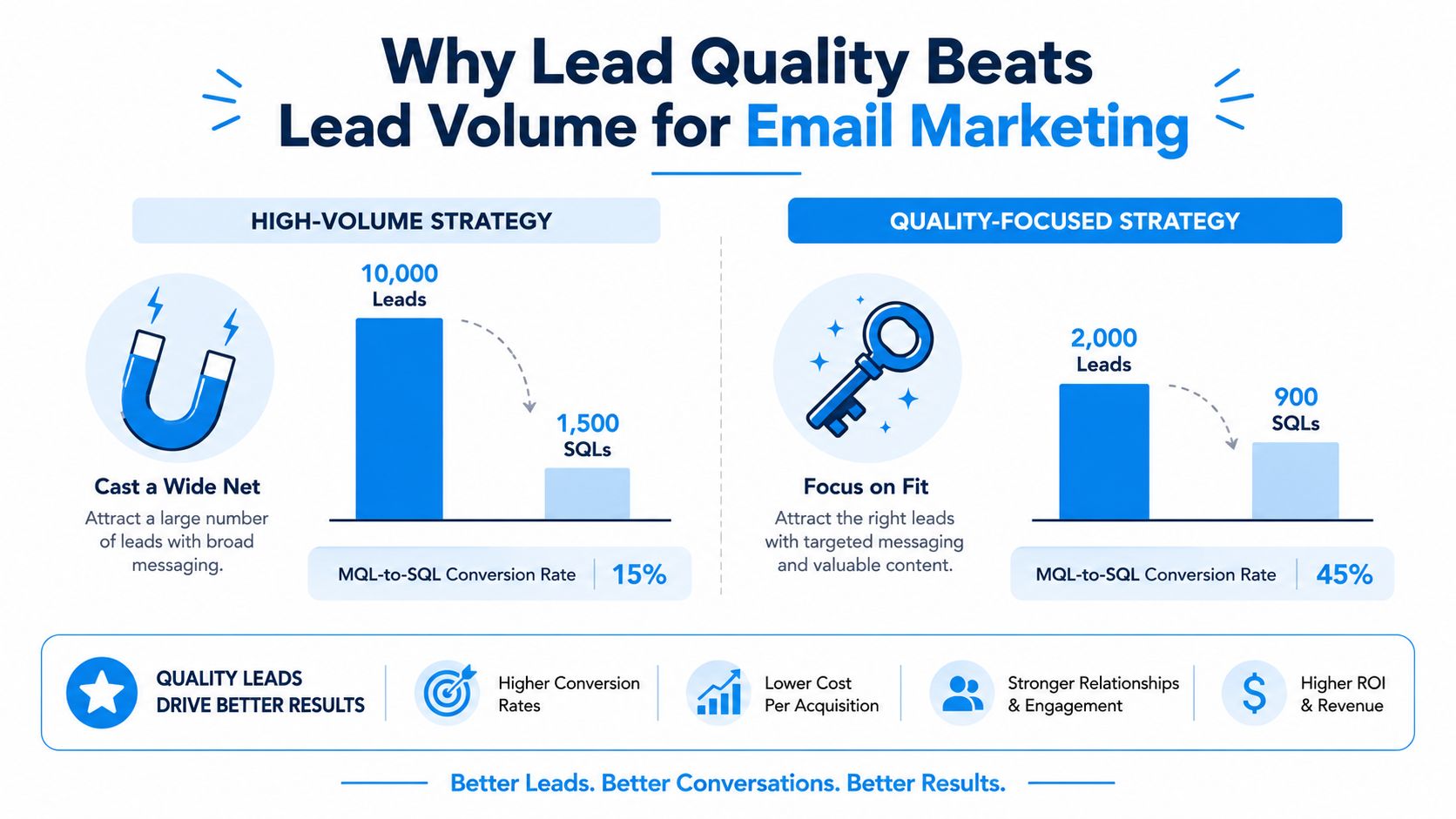
Lead volume looks good in a dashboard. Lead quality pays the bills. In 2026, 61% of marketers said generating quality leads is their top challenge, 79% of leads never convert into sales, and the median MQL-to-SQL conversion rate fell from 13% in 2024 to 9.8% in 2026 (lead generation statistics 2026). That combination should change the question from “How do I get more email leads?” to “How do I make sure fewer leads reach the list unless they can move?”
For a small advisory firm, that shift matters because the owned channel is doing more than capturing interest. It's creating a repeatable path from first touch to conversation to proposal to referral nurture, which is where pipeline control lives.
The wrong metric creates the wrong behavior
If a team celebrates every form fill, it starts optimizing for frictionless volume. That usually means generic lead magnets, broad messaging, and slow handoff to sales or advisory staff. The result is more contacts, but not more qualified conversations.
Practical rule: treat every opt-in as a screening event, not just a marketing win.
A better operating model asks three questions before a campaign launches. Will this offer attract a buyer who has a real problem? Will the form and routing logic preserve intent? Will the lead get a useful first response before interest decays?
That lens fits consulting firms especially well because their pipeline is usually small, high-context, and relationship driven. A durable email list doesn't need to be huge to be valuable. It needs to be aligned to the offers you can deliver and the follow-up you can sustain.
Why the list itself is only half the asset
The quality of the lead capture process determines how much downstream work you create. If a prospect downloads something vague, enters a half-baked email address, and lands in a shared inbox with no ownership, the “lead” is mostly noise. If the same prospect enters a focused diagnostic, gets tagged by source, and triggers immediate routing, the contact becomes operationally useful.
For teams that want a structured sales handoff, the capture system should support that handoff from the start. A practical example is a consulting sales scorecard that ties intake, qualification, and next steps together, rather than treating email as a separate marketing island. consulting sales scorecard
Choosing a Lead Magnet That Matches Buyer Intent
A lead magnet works when it matches where the buyer already is. Early-stage readers want clarity, mid-stage evaluators want comparison, and late-stage buyers want evidence that your process will work in their situation. If the offer is mismatched, the opt-in still happens, but the list gets polluted with people who aren't ready for the next step.
Match the asset to the buying stage
An early-stage prospect usually needs diagnosis. A checklist, assessment, or problem-framing guide helps them name what's broken without forcing a sales conversation too early. A mid-stage prospect often wants structure around the decision, so pricing guidance, ROI framing, or a simple calculator is usually a better fit than another long PDF.
Late-stage buyers behave differently. They want proof that you've solved a similar problem, or a low-risk pilot that shows how the engagement works. For consulting and advisory firms, a case study can work well here, but only if it speaks to a buyer's actual operating context rather than generic success language.
| Buyer Stage | Lead Magnet Type | Best For |
|---|---|---|
| Early stage | Diagnostic checklist | Problem awareness and self-assessment |
| Mid stage | ROI calculator or pricing breakdown | Evaluation and internal justification |
| Late stage | Case study or pilot offer | Decision support and risk reduction |
The key trade-off is simple. Gated depth can produce better intent, but ungated reach can widen awareness. If your list is already noisy, go narrower and more specific. If your market doesn't know you yet, use lighter gating and let the email sequence do more of the qualification work.
Keep the promise narrow. Broad magnets attract broad leads, and broad leads rarely convert cleanly.
How to pick one asset without overbuilding
Don't start by asking what you can write. Start by asking what decision the buyer is trying to make. If they're trying to define the problem, a diagnostic beats a whitepaper. If they're trying to compare options, a calculator beats a thought-leadership essay. If they're trying to choose a vendor, a pilot or case study beats a general newsletter signup.
The best lead magnet is the one that creates a useful next action. For a consulting practice, that often means the asset should either qualify the lead or prepare them for a call. Anything else tends to attract curiosity without moving pipeline.
Building a High-Converting Opt-In Landing Page
The landing page is where email lead generation happens, or fails. Not because people don't want the offer, but because the page asks for too much, says too little, or spreads the promise across too many distractions. A strong page does four things well. It states one promise, shows one form, uses proof that feels familiar, and keeps the friction low.
Make the promise visible in one glance
The headline should mirror the lead magnet, not reinterpret it. If the offer is a diagnostic, the page shouldn't sound like a brand manifesto. If the promise is a pricing breakdown, the headline should say exactly that in plain language.
Form length matters more than page length. A five-field form on a cold offer often creates more resistance than the buyer is willing to give. For consulting firms, asking only for what's needed to route and personalize the follow-up usually performs better than collecting every detail up front.
Short forms don't just reduce friction, they protect intent.
Use proof that fits the reader's situation
Social proof works best when it mirrors the buyer's world. A B2B operator doesn't need a generic testimonial wall. They need to see that someone with a similar role, budget, or challenge found the offer useful.
A simple before-and-after structure helps. Before, the page opens with a vague headline, a long paragraph, and a form buried below the fold. After, the page opens with the exact promise, a short supporting sentence, a visible form, and one sentence explaining what happens next. That's enough for most consulting offers.
The call to action should stay operational, not hype driven. “Get the diagnostic” or “Send me the pricing guide” works better than language that sounds like a campaign slogan. The page's job is to earn the opt-in, then hand the lead to the follow-up system without confusion.
Routing and Speed to Lead in Under Five Minutes
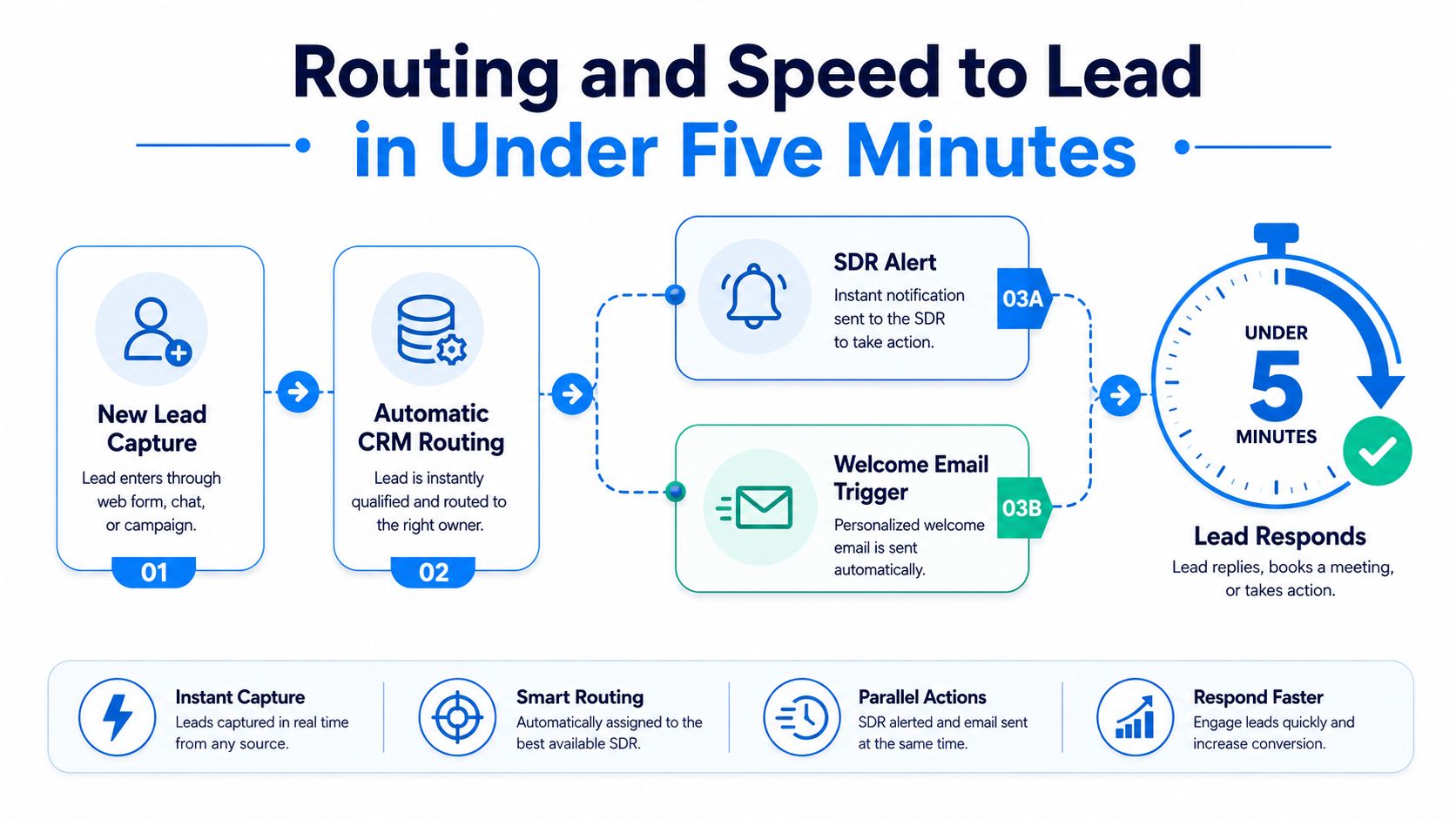
Speed to lead is where many good campaigns break. The lead arrives, the team sees it later, and the response goes out after the buyer has already moved on. Benchmarks report that a lead is 21 times more likely to enter the sales process if a business replies within five minutes instead of 30 minutes, and that conversion rates are 8× higher when first contact happens within 5 minutes versus 6+ minutes (lead response management). That makes speed to lead an operations problem, not a marketing nicety.
Build the routing path before the campaign
Every form fill, reply, and referral should trigger an immediate first-touch sequence. See our guide to follow-up automation for how to set that up so the inquiry gets acknowledged, receipt is confirmed, and the next step is clear without waiting for someone to spot the inbox. Human ownership should kick in inside minutes, not hours.
The workflow for a small consulting firm should be boring in the best way. A new lead comes in, the system tags the source, the CRM routes it to the right owner, the owner gets alerted, and the lead gets an immediate reply. If the inquiry is qualified, the person follows up before momentum fades.
Stop treating the inbox as the system
Shared inboxes slow response because nobody owns the next move. A form lands at 4:55 p.m., and no one responds until the next day, even though the buyer was ready to act when they filled it out.
Route intent signals into a structured workflow immediately. One option for firms that want a prebuilt system for this is Starward Navigators' platform, which standardizes capture, follow-up, reminders, and handoffs for consulting workflows. The tool matters less than the design principle. The moment the system captures the lead, it should assign ownership and trigger the first response.
Designing a Two-Email Nurture Sequence That Earns Replies
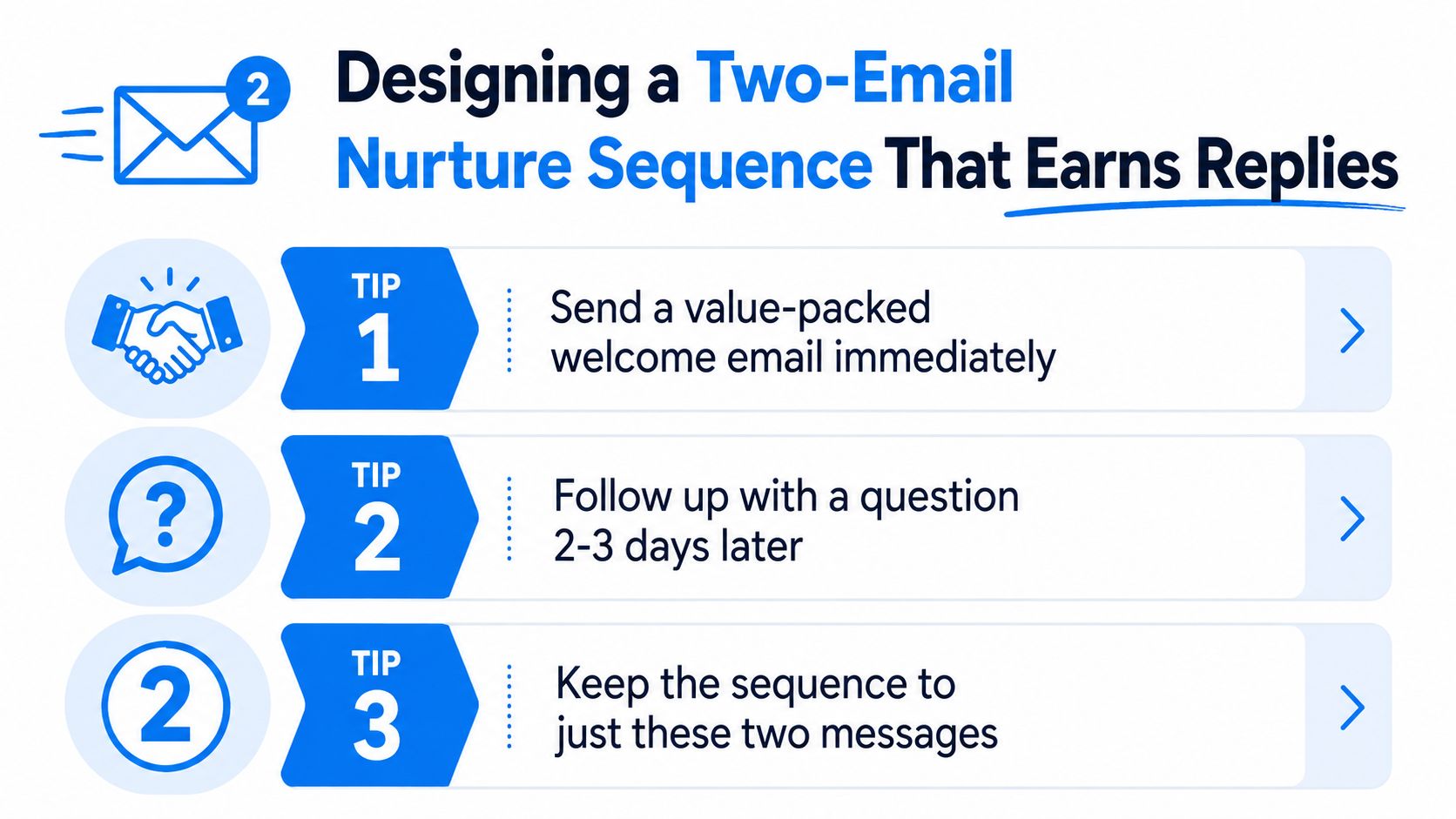
Long nurture chains feel safe because they create the appearance of persistence. The data points the other way. One benchmark reports that a 2-email sequence with a single follow-up produces the highest response rate at 6.9%, while average B2B cold-email response rates are around 5.1% and open rates around 27.7% (cold email benchmarks). Another cited finding shows 220% more B2B leads answering after the first follow-up, while a third follow-up can reduce response rates by 20%. The message is clear, a tight sequence usually beats a long one.
Write the second email as a different angle
The first email should do the obvious work. State the reason for contact, restate the value, and make the next step easy. The second email should not repeat the same pitch in softer language. It should add a different angle, such as a relevant question, a concrete outcome, or a narrow reason the prospect might care.
That second email is also the right place to stop chasing broad engagement. If the lead opens and doesn't reply, the system should branch to a lighter touch or a human follow-up, not keep blasting the same message. Over-sequencing usually turns a promising contact into a quiet unsubscribe.
If the second email doesn't change the conversation, the sequence is too long or too vague.
Use engagement to decide when to stop
A good rule is to end the sequence when the lead has either replied, booked, or shown no meaningful response after the follow-up. Anything beyond that should be a separate re-engagement path, not a continuation of the same nurture. That protects list health and keeps the active sequence focused on people with actual buying intent.
For consulting firms, the purpose of nurture isn't to create endless touches. It's to create enough momentum for a real conversation. Two sharp emails can do that more reliably than a longer sequence that trains prospects to ignore you.
List Hygiene Habits That Protect Deliverability and Conversion
A growing list is only an asset if the addresses stay healthy and the contacts stay relevant. If you keep adding people without tagging source and intent, the list turns into a pile of undifferentiated names. If you never clean inactive contacts, conversion drops and sender reputation gets harder to protect.
Segment at capture, not later
Tagging by source should happen the moment the lead enters the system. A webinar signup, a content download, and a referral should not sit in the same bucket. They need different follow-up paths because they arrived with different intent.
Inactive subscribers should also be handled deliberately. If someone hasn't engaged for a while, they should move into a re-engagement or sunset path instead of staying in the active nurture stream forever. That keeps the list from bloating with dead weight.
The simplest quarterly routine is straightforward. Review source tags, check engagement, and remove or reclassify contacts that no longer belong in active sends. If verification is the problem, invest in a checking tool before you send another campaign into a polluted list.
Clean lists convert better because they're easier to trust
Deliverability and conversion aren't separate problems. If your messages miss the inbox or keep landing with people who don't care, reply rates fall for reasons that have nothing to do with copy. That's why list hygiene is an operating habit, not a once-a-year cleanup project.
The warning signs are usually obvious. Engagement drops. Replies become rarer. More leads come in, but fewer move. At that point, the fix is rarely “send more.” It's usually to segment harder, sunset stale contacts, and stop polluting the active list with bad fits.
Putting the Lead Generation System Together
Generating leads for email marketing works when capture, route, follow up, qualify, and clean all sit in one flow. A good magnet brings in the right person. A clean landing page gets the opt-in. Fast routing preserves intent. A short nurture sequence earns replies. Hygiene keeps the list worth mailing to.
The biggest near-term lift for most small consulting firms is to fix the slowest handoff first. If leads sit in a shared inbox, start there. If the form is too broad, tighten it. If the list has no source tags, add them at capture. The system doesn't need more complexity, it needs fewer gaps.
Set up the operating cadence, then measure what happens after the first response, not just who clicked. That's the difference between a lead generator and a pipeline system.
Starward Navigators helps small consulting and advisory firms standardize capture, automate follow-up, and manage handoffs inside one operating system. If your current process loses leads between form fill and first reply, visit Starward Navigators and look at how the platform organizes business development, delivery, and referral workflows around one connected system.