The contract is signed. Everyone feels good about the decision. Then the proposal disappears into an inbox, the delivery team waits for context, and the client spends several days wondering what happens next. By the time someone sends a welcome message, the confidence created during the sales process has already started to fade.
That gap between won and kickoff is where many consulting and advisory firms lose momentum. Improving the customer onboarding process isn't about adding more forms or sending a longer welcome email. It means designing a reliable handoff that turns a commercial decision into visible progress, with a named owner, a clear next step, and an early experience of value.
Table of Contents
- The High Cost of Post-Contract Silence
- Diagnose Before You Prescribe Finding Onboarding Gaps
- Designing Your Signature Onboarding Experience
- Introducing Automation Without Losing the Human Touch
- Measuring What Matters Onboarding KPIs for Consultants
- From Process to System Essential Tools and Templates
The High Cost of Post-Contract Silence
A signed agreement feels like the finish line to a business development team. For the client, it's the moment their risk begins. They've committed budget, time, and internal attention, so they need evidence that the firm can now deliver with the same confidence it showed during the sales process.
A common failure pattern looks harmless at first. The partner who sold the engagement assumes operations will take over. Operations assumes the partner will provide context. The consultant assigned to delivery receives a forwarded proposal without the discovery notes, promised outcomes, stakeholder details, or constraints discussed during the buying process. Meanwhile, the client receives no confirmation beyond an automated payment receipt.
That isn't a minor administrative delay. It creates uncertainty about ownership, priorities, and competence.
Practical rule: Treat the first post-contract interaction as the first deliverable, not as paperwork.
The strongest firms design onboarding as a continuation of the promise made during the sale. Their process confirms the decision, captures the information delivery needs, schedules the next conversation, and gives the client a visible path toward the first meaningful outcome. A useful overview of this transition appears in what client onboarding involves, particularly the movement from agreement to active delivery.
The performance gap can be substantial. A 2026 customer onboarding benchmark found that the top 20% of firms complete onboarding in 5 days or fewer and use automated follow-ups. The bottom 20% often take 2–3 weeks and lose 25–35% of clients in the first 90 days, according to the 2026 client onboarding benchmark report.
Those figures don't mean every consulting firm should force a complex engagement into a rigid five-day template. A high-value advisory project may require stakeholder alignment, document collection, access requests, or a careful scoping conversation. The lesson is different: complexity should be managed visibly. Clients can tolerate necessary work when they know who owns it, what has been completed, and what they need to do next.
Post-contract silence also weakens the handoff internally. Sales may remember critical context that never reaches delivery. Delivery may ask the client to repeat information already provided. The client then experiences the firm as disconnected departments rather than one coordinated advisor.
A dependable onboarding process protects three things at once:
- Client confidence: The buyer sees that the firm is organized after the sale, not just persuasive before it.
- Delivery quality: The project team starts with the commercial and strategic context needed to work effectively.
- Revenue continuity: Early friction is addressed before it becomes disengagement, scope tension, or an avoidable cancellation.
Diagnose Before You Prescribe Finding Onboarding Gaps
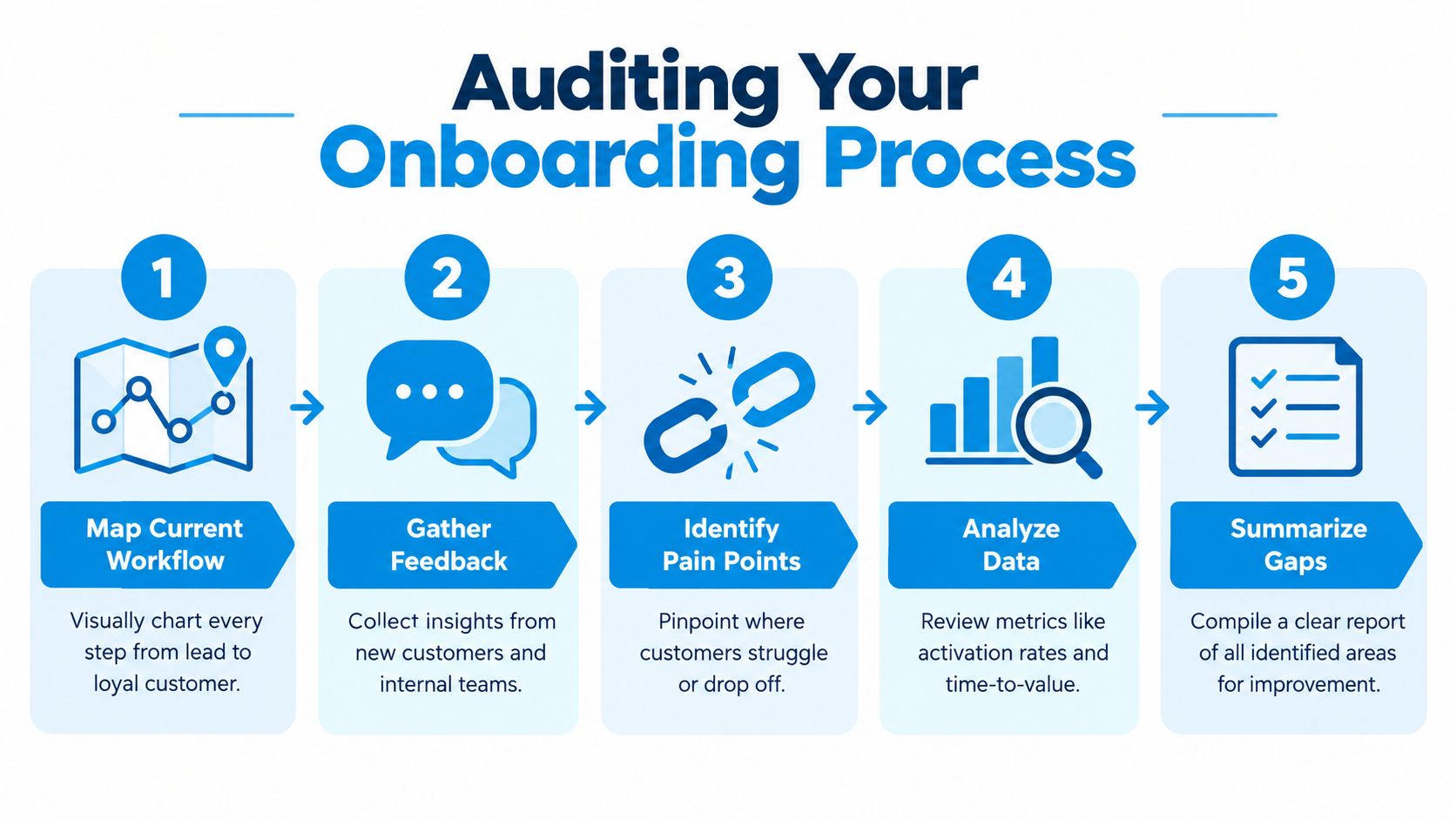
Don't redesign onboarding from memory. Audit the actual path a client follows from the moment a proposal is marked Won to the moment the kickoff meeting ends.
Start by creating a simple timeline. Put every customer-facing and internal event on it, including CRM updates, emails, calls, forms, document requests, scheduling steps, approvals, and handoffs. Record the responsible person, the system used, the information required, and the condition that moves the client forward.
Map the handoff rather than the checklist
A checklist tells you what your team hopes will happen. A workflow map shows what occurs when a busy partner closes a deal on a Friday afternoon.
Trace these points in order:
- Contract confirmation: Who knows the agreement was signed, and how do they find out?
- Information transfer: Where do discovery notes, proposal commitments, risks, and stakeholder details live?
- Ownership assignment: Who owns the client before kickoff, and who owns the first delivery milestone?
- Client communication: What does the client receive immediately, and what remains unsaid?
- Readiness: What must be collected before kickoff, and who follows up if it's missing?
- Kickoff completion: What decision or artifact proves the engagement has properly started?
At each point, ask whether the next step is triggered automatically, manually, or not at all. Manual work isn't automatically bad. In a high-touch advisory firm, a partner may need to make a personal introduction. The problem appears when the process depends on someone remembering every administrative consequence of a closed deal.
The operational evidence supports this distinction. 62% of customer success leaders lack real-time visibility into onboarding progress, and the leading momentum killers include complex setup, scattered tools, and unclear next steps and ownership, as reported in the 2026 state of onboarding report.
Interview the people inside the process
Review several recent onboardings with the salesperson, delivery lead, project manager, and client-facing coordinator. Don't ask only whether the process worked. Ask where each person had to improvise.
Useful questions include:
- What information did delivery need but not receive?
- Which task was most likely to be forgotten?
- When did the client first ask, “What happens next?”
- Which system contained the authoritative status?
- What did the salesperson promise that wasn't visible in the delivery plan?
- Who noticed when the client stopped responding?
- Which client request required searching across email, documents, and chat?
- What could the client complete without waiting for the firm?
Then ask the client for their version of the timeline. Clients often identify friction your team has normalized, such as duplicate questionnaires, unclear scheduling instructions, or a kickoff invitation that arrives without an agenda.
Summarize gaps by failure type
Don't produce a long list of disconnected complaints. Group findings into operational categories:
- Visibility gaps: Nobody can see whether the client is waiting on the firm, the client, or a third party.
- Ownership gaps: A task exists, but no individual is accountable for completing it.
- Context gaps: Delivery receives a contract but not the reasoning behind the purchase.
- Communication gaps: Messages are inconsistent, delayed, or sent from different people without coordination.
- Value gaps: The client completes administrative steps without experiencing a meaningful early benefit.
This classification helps you fix the system rather than patching isolated symptoms. If three different tasks fail because ownership is unclear, adding another reminder won't solve the underlying problem. Assign the owner first, then automate the reminder.
Designing Your Signature Onboarding Experience
A consulting firm's onboarding should feel like an early demonstration of its method. If you sell clarity, the transition into delivery should be clear. If you sell strategic partnership, the first communication should show that someone understands the client's context. A generic checklist can't carry that responsibility on its own.
Call the experience your signature onboarding sequence. It doesn't need to be elaborate or expensive. It needs to be deliberate, recognizable, and consistent enough that every client receives the same level of care while still feeling personally understood.

Build the first client-facing package
The first message should confirm more than the transaction. It should answer the questions that otherwise create uncertainty:
- Who is leading the engagement?
- What happens next?
- What does the client need to provide?
- When will the kickoff occur?
- Where should questions go?
- What will the team discuss first?
A useful welcome package can include the signed scope, a concise engagement brief, the names and roles of the delivery team, a readiness checklist, the kickoff agenda, and a communication plan. Keep the documents purposeful. Clients don't need a library of internal material before they've had their first working conversation.
The best welcome message combines automation with a personal sentence from the lead consultant. For example, it can reference the business outcome that motivated the engagement and explain why the first activity matters. That small detail connects the handoff to the client's original reason for buying.
Make the path visible
Clients shouldn't have to infer your process from calendar invitations. Give them a short sequence of stages, such as:
- Agreement confirmed and internal owner assigned.
- Intake information reviewed.
- Access, documents, or stakeholder availability confirmed.
- Kickoff scheduled.
- Initial priorities agreed.
- First working output defined.
Use plain language and distinguish firm-owned tasks from client-owned tasks. If a document is required, state what “complete” means and where to submit it. If the firm needs internal preparation time, explain that without making the client chase an update.
Speed matters because the client's expectations are already high. 90% of customers consider an immediate response important or very important, and Zendesk-oriented channel guidance cited by customer onboarding response-time research places the email target at 12 hours or less. For a consulting firm, the exact channel target matters less than the operating discipline behind it: confirm the agreement promptly, acknowledge the next action, and give the client a named contact.
Turn kickoff into a working session
A kickoff shouldn't be a ceremonial introduction followed by vague agreement to “get started.” Send an agenda in advance and use the meeting to establish the operating contract for the engagement.
Cover the business outcome, current context, scope boundaries, decision-makers, communication rhythm, immediate risks, and first value milestone. End with explicit owners and dates for the next actions. The client should leave knowing what the firm will do, what they will do, and how progress will be judged.
The sequence should also contain a human moment that software can't manufacture. A lead consultant can acknowledge a concern raised during discovery, explain a trade-off, or connect the project to the client's broader priorities. That interaction reinforces the premium nature of advisory work without adding unnecessary ceremony.
A practical client onboarding workflow should therefore combine visible stages with flexible judgment. Standardize the moments that prevent confusion, but leave room for the consultant to adapt the conversation to the client's goals and level of complexity.
Introducing Automation Without Losing the Human Touch
Automation becomes useful when it protects human attention. It becomes damaging when it replaces the moments clients interpret as evidence of care, judgment, and accountability.
For a consulting firm, the dividing line is straightforward. Automate state changes, reminders, routing, scheduling, and internal coordination. Keep interpretation, reassurance, strategic framing, and relationship repair with a person.
Automate the administrative chain
When an opportunity changes to Won, a well-designed system can perform a sequence of dependable actions:
- Update the client record: Carry the opportunity, contacts, scope, source, and relevant commercial details into the delivery context.
- Create the handoff tasks: Assign intake review, document collection, kickoff preparation, and project setup to named people.
- Notify the delivery owner: Send an internal alert with the information needed to review the engagement before contacting the client.
- Start the client sequence: Send a confirmation, readiness instructions, and scheduling options.
- Monitor outstanding actions: Flag missing documents, unanswered messages, or an unscheduled kickoff for human follow-up.
- Record milestones: Keep the CRM and project workspace aligned so the team sees the same status.
This chain removes the fragile step where someone must remember to update three systems after closing a deal. It also creates an audit trail. If a client asks what has happened, the team can answer from the record rather than reconstructing events across personal inboxes.
Keep judgment in human hands
Don't automate the lead consultant's welcome message if the engagement depends on trust. Don't send a generic “checking in” email after kickoff when the team should be discussing a specific concern. Don't allow a workflow to make promises about scope, timing, or outcomes that require professional judgment.
A better pattern uses automated prompts to create space for personal action. The system alerts the consultant that the contract is signed, displays the discovery context, and suggests the next step. The consultant then writes the message, chooses the appropriate tone, and confirms the client's priorities.
The sector distinction matters. B2B services have different onboarding needs from SaaS, and 48% of teams identify keeping customers engaged as their biggest challenge, according to the 2026 customer onboarding benchmark by industry. A consulting firm shouldn't copy a product-led sequence that assumes customers can discover value alone.
Design for exceptions
Every workflow needs an exception path. A client may have a delayed procurement process, several decision-makers, sensitive materials, or a start date that changes after signing. If your automation only handles the ideal path, the team will bypass it as soon as reality appears.
Create clear exception statuses such as Waiting on client, Internal review, Blocked by access, and Needs partner decision. Give each status an owner and a next review action. Automation should make the exception visible, not pretend it doesn't exist.
The right system doesn't make the relationship feel automated. It makes the firm feel prepared. Clients receive timely confirmations, consultants retain control of important conversations, and delivery teams stop relying on memory to discover that a new engagement exists.
Measuring What Matters Onboarding KPIs for Consultants
Consulting firms need measures that describe readiness, confidence, participation, and early value, not just activity inside a platform. A client can receive every automated email and still feel uncertain about the engagement. Conversely, a complex project may require several preparation steps while remaining healthy because the client understands the reason for each one.
Start with a small operating dashboard. Track the time between contract signature and the key handoff events, then pair those measures with evidence of client participation and delivery readiness.
Use time-to-value carefully
Time-to-first-value, or TTFV, is the period between the start of onboarding and the first meaningful benefit the client experiences. For a software product, that benefit might be a completed workflow. For consulting, it could be a prioritized decision brief, a clarified operating model, an actionable diagnostic, or an agreed project direction.
A technical benchmark classifies TTFV under 15 minutes as excellent, 15–60 minutes as good, 1–24 hours as acceptable for complex offerings, and over 24 hours as problematic. For consulting, the relevant benchmark is the complex-offering range, not a SaaS activation target. These classifications and the associated retention rationale are detailed in time-to-value onboarding benchmarks.
Don't define value as “the kickoff happened.” Define the first outcome the client can recognize and use. Then ask whether your onboarding sequence helps the team produce it sooner without compromising quality.
Build a practical KPI view
| KPI | What It Measures | Why It Matters for Consultants |
|---|---|---|
| Time to kickoff | The elapsed time from signed agreement to the first official working meeting | Shows whether the handoff creates momentum or leaves the client waiting |
| Time to first value | The time from contract confirmation to the first tangible client benefit | Connects onboarding activity to the reason the client hired the firm |
| Handoff completeness | Whether delivery received scope, goals, risks, stakeholders, and commercial context | Prevents clients from repeating discovery and reduces avoidable delivery confusion |
| Client engagement score | Responsiveness, attendance, completed intake actions, and participation in early decisions | Helps the team distinguish a healthy delay from silent disengagement |
| Owner clarity | Whether every open action has one accountable person | Exposes tasks that sit between sales, delivery, operations, and the client |
| Kickoff readiness | Completion of required information, access, participants, and agenda preparation | Prevents the first meeting from becoming an administrative inventory |
| Early scope alignment | Agreement on outcomes, boundaries, assumptions, and decision rights | Reduces misunderstandings before the project develops delivery friction |
The dashboard should support action, not reporting theatre. If time to kickoff rises, inspect the scheduling and ownership steps. If engagement falls, identify the last completed client action and contact the responsible stakeholder with a specific question. If handoff completeness is weak, improve the close-stage information capture rather than asking delivery to compensate later.
Review the measures with both sales and delivery. Sales sees whether the promise survives the handoff. Delivery sees whether the information supports good work. The client experiences the combined result.
From Process to System Essential Tools and Templates
A reliable onboarding process needs a small set of connected tools, not an impressive collection of disconnected software. The system should preserve one source of truth for the client record, make ownership visible, and move work from commercial close into delivery without re-entry.
A practical stack usually includes four layers:
- CRM: Stores the opportunity, client contacts, proposal context, stage history, owner, and next action.
- Scheduling tool: Offers kickoff availability, confirms the booking, and sends reminders without prolonged email exchange.
- Project management platform: Holds the delivery plan, tasks, milestones, files, and project communication.
- Document and communication workspace: Gives the client a clear place to submit information and find approved materials.
The specific products matter less than the handoffs between them. A CRM that doesn't trigger delivery work is just a database. A project platform that doesn't receive the commercial context forces the team to reconstruct the sale. A scheduling tool without ownership can produce a meeting while leaving the engagement unprepared.
Create the minimum viable template library
Build these assets before trying to optimize the workflow:
Welcome email
- Confirm the agreement and express genuine enthusiasm.
- Name the delivery lead and the primary contact.
- State the next action, usually scheduling or completing intake.
- Link to the readiness checklist and explain why each requested item matters.
- Set expectations for communication and the kickoff agenda.
Internal handoff brief
- Client objectives and definition of success.
- Problem statement and relevant discovery notes.
- Scope, exclusions, assumptions, and commitments.
- Stakeholders, decision-maker, subject-matter contacts, and preferred channels.
- Risks, sensitivities, timing constraints, and unresolved questions.
- First value milestone and proposed kickoff outcomes.
Kickoff agenda
- Confirm the business outcome and current situation.
- Review scope, roles, decisions, and working assumptions.
- Identify dependencies, risks, and missing information.
- Agree on communication rhythm and escalation route.
- Define the first tangible output.
- Assign actions and confirm the next working session.
Communication plan
State where routine updates will appear, who can approve decisions, how quickly urgent issues should be raised, and when the team will review progress. The plan should reduce ambiguity rather than promise unrealistic availability.
For firms that want a prebuilt operating layer, Starward Navigators provides client acquisition infrastructure that includes proposal tracking, automated follow-up, appointment reminders, and a post-sale handoff that can update a Won opportunity, start delivery work, notify an owner, and support kickoff scheduling. It's one implementation option among CRM and project-management combinations, and it fits firms that prefer a configured workflow over assembling every trigger themselves.
Launch in a controlled sequence
Don't automate the entire customer journey on the first day. Install the workflow in stages:
- Define the Won-stage information required for delivery.
- Assign the delivery owner and create the internal handoff brief.
- Automate the confirmation and scheduling steps.
- Add reminders for incomplete client actions.
- Connect kickoff completion to the first delivery milestone.
- Review the first engagements and adjust the exceptions.
Test the process with real scenarios, including a straightforward engagement, a delayed kickoff, missing documents, and a changed stakeholder. A system earns trust when it handles normal work and makes unusual work visible.
A strong onboarding process should leave no one guessing what happens after the contract is signed. The client sees progress, the consultant receives useful context, and the delivery team starts with ownership rather than a forwarded email.
If your firm is losing momentum between proposal acceptance and project kickoff, Starward Navigators can help install a connected operating system for pipelines, follow-up, scheduling, handoffs, and client onboarding. Visit Starward Navigators to see how the platform can turn your post-sale process into a visible, repeatable workflow.