A partner is delivering a client workshop when a website inquiry arrives. It lands in a shared inbox, waits through lunch, and remains unassigned while everyone assumes someone else has seen it. By the time the consultancy replies, the prospect has already spoken with another provider.
That failure rarely comes from poor expertise or weak demand. It comes from an operating gap between lead capture, ownership, first contact, and follow-through. The same gap appears when a discovery call ends without a scheduled next step, when a proposal sits in a partner's inbox, or when a new client is won but the delivery team never receives a clean handoff.
The business case for fixing the first part is well established. A Harvard Business Review audit of 2,241 companies found that web leads waited an average of 42 hours for a first response, while 23% of companies never responded at all, as summarized in this speed-to-lead benchmark. A separate study found that contacting an inbound lead within 5 minutes made a team about 21 times more likely to qualify the lead than waiting 30 minutes, while manual assignment commonly takes 5 to 15 minutes and automated routing can complete assignment in under 10 seconds (lead routing automation research).
For a consultancy with 2 to 20 people, the pressure is sharper. A partner may sell, deliver, manage relationships, and approve proposals in the same day. There isn't always a sales development team waiting for an alert. Lead distribution software must therefore do more than send a new inquiry to a person. It must create an accountable path from first contact to decision, onboarding, and referral nurture.
This guide moves from the basic mechanics of routing to the capabilities that make it reliable, the trade-offs between a purpose-built system and a generic CRM, and the implementation patterns that prevent quiet opportunities from disappearing. It also addresses two problems generic CRM advice often overlooks, bad data at the point of entry and continuity after the initial handoff.
Table of Contents
- Introduction Why Leads Slip Through the Cracks
- What Lead Distribution Software Really Does
- Core Capabilities That Make Routing Work
- Purpose Built System Versus Generic CRM
- How to Evaluate Lead Distribution Software for Boutique Firms
- Implementation Patterns From Map to Go Live
- Putting Lead Distribution to Work for Repeatable Growth
Introduction Why Leads Slip Through the Cracks
A promising inquiry arrives while the principal is on a client call. The consultant who understands the service is traveling, and the person monitoring the shared inbox is away. The message is relevant, yet no one clearly owns the next step, from accepting it and replying to arranging a conversation.
That makes lead distribution a revenue process, not clerical housekeeping. A historical benchmark found that web leads sometimes waited 42 hours for a first response, while 23% of companies never responded, as reported in this historical speed-to-lead analysis. The same weakness can appear later, after discovery, while a prospect reviews a proposal, or between a signed agreement and the delivery kickoff.
Boutique consultancies have fewer layers to absorb uncertainty. An owner may need to spot the inquiry, choose the right specialist, check capacity, send the reply, schedule the meeting, and remember the follow-up. If any handoff depends on memory, the opportunity can become invisible without anyone deliberately abandoning it.
The practical test: every new inquiry should have a known owner, a visible next action, and a fallback if the owner doesn't act.
Lead generation remains part of the system. Acquisition channels determine whether suitable prospects reach the firm, and resources such as this guide to generating leads for email marketing can strengthen that upstream work. More traffic, however, cannot repair an intake process that leaves inquiries in an inbox.
The better question is broader than assignment speed: what should happen from form submission until the firm wins the work, closes the loop, or deliberately nurtures the relationship? That lifecycle includes qualification, appointment reminders, proposal follow-up, stalled-opportunity recovery, client onboarding, and referral nurture. A referral may need a different owner and a lighter sequence than a new prospect, while a proposal requires scheduled attention after the initial conversation.
For a small advisory practice, continuity matters as much as rapid response. A routing process should preserve context when ownership changes, make the next commitment visible, and show whether follow-up occurred. The remaining guide explains the operating pieces, system choices, evaluation criteria, and practical setup decisions behind that process.
What Lead Distribution Software Really Does
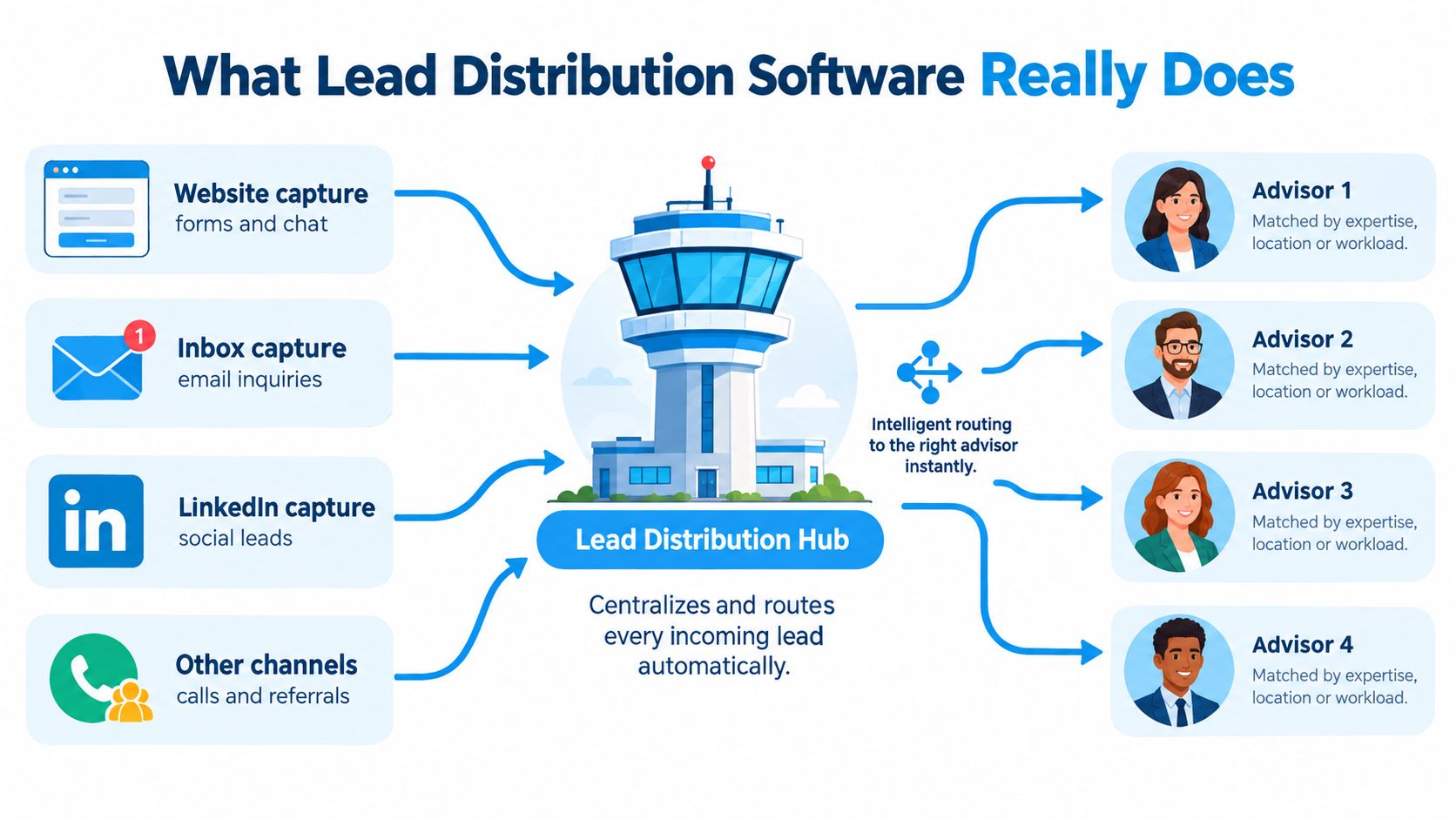
Think of a consultancy's intake process as air traffic control. Aircraft arrive from different directions, each with different destinations, priorities, and requirements. A control tower collects the signals, checks the conditions, assigns a runway, and keeps a record of what happened. Without that coordination, every pilot must negotiate independently.
Lead distribution software plays the control-tower role for inquiries. It gathers leads from multiple channels, applies assignment logic, creates ownership, and starts the follow-up sequence. The channels might include a website form, a shared inbox, LinkedIn, an event list, a phone call, or a partner referral.
Capture comes before routing
The system first needs a reliable intake point. A website form might collect name, email, company, service interest, urgency, and referral source. An inbox integration may turn an inquiry into a record. An event upload may create a contact that still needs qualification before assignment.
Many teams get confused. A CRM can store a contact without managing the event that brought the contact into the sales process. A distribution layer should preserve the source, timestamp, relevant answers, and current status so the team knows what arrived and why it matters.
Rules turn intake into ownership
Once the record exists, the routing engine evaluates conditions. A healthcare strategy inquiry may go to the advisor with healthcare experience. A referral from an existing partner may go to the relationship owner. A lead submitted while the primary consultant is unavailable may go to a designated backup.
Round-robin assignment can work when team members have similar expertise and capacity. It is less suitable when the firm sells several specialties or when one partner owns a longstanding account relationship. The rule should reflect how the consultancy works, not merely what is easiest to configure.
Assignment should trigger action
A distribution system isn't complete when it fills an owner field. It should notify the owner, create a task, send an appropriate first response, and start a timer or escalation path. The assigned consultant should see the lead's context, source, and next action in one place.
A static contact database answers, “Who is this person?” Lead distribution answers, “Who owns this opportunity, what must happen next, and what happens if nobody acts?” That difference creates accountability and auditability, which are essential when a partner asks why an opportunity stalled.
Core Capabilities That Make Routing Work
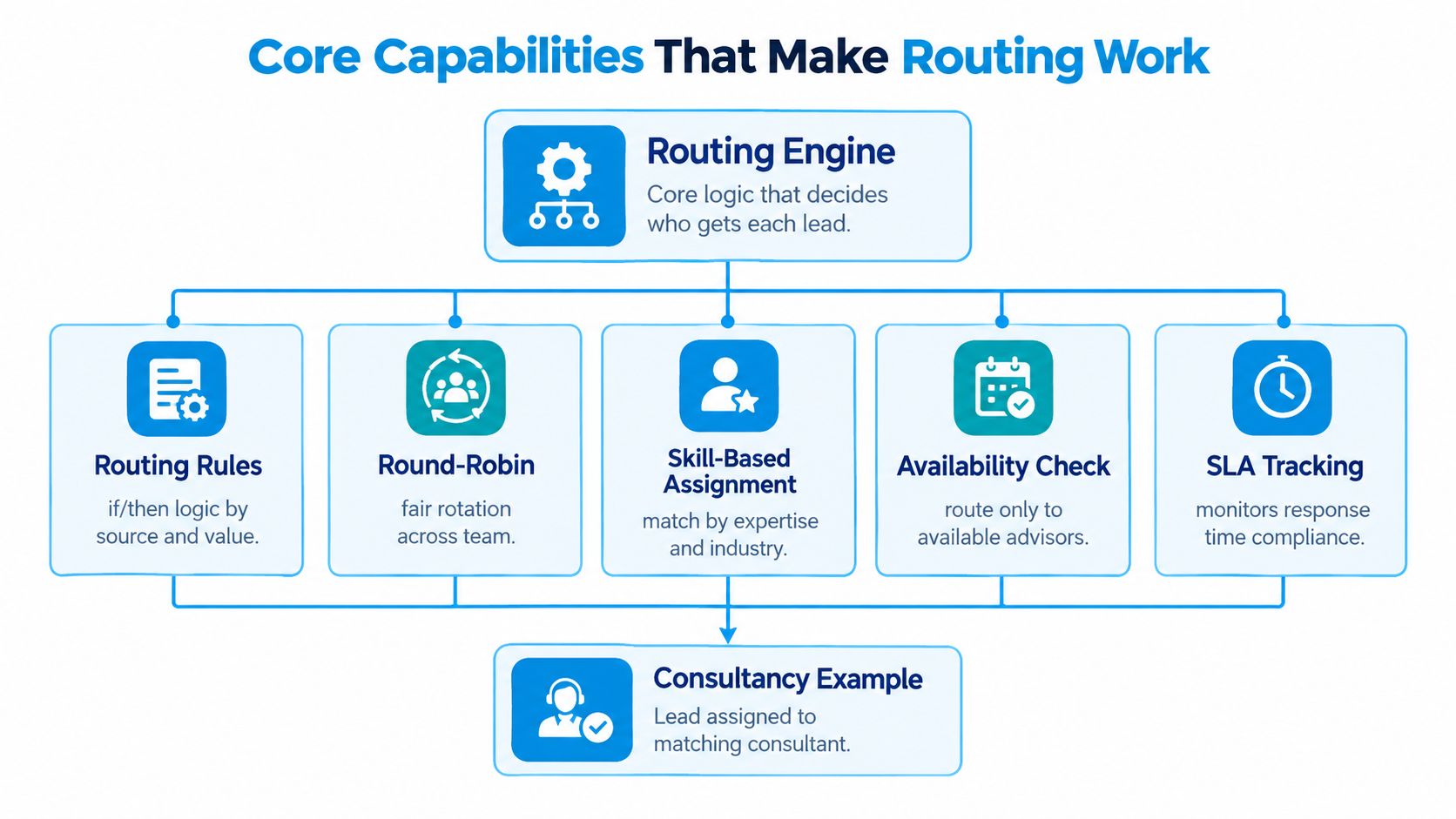
A routing engine is only as good as the operating rules around it. Boutique firms often begin with a simple assignment requirement, then discover that fairness, expertise, availability, response timing, and follow-up all need separate controls.
Routing rules and fallback logic
Rules are the if/then statements that decide who receives a lead. For example:
- Service fit: assign an operations transformation inquiry to the consultant who sells and delivers that service.
- Relationship ownership: return an inquiry from an existing client or partner to the person who owns the relationship.
- Source handling: send a referral to the partner manager rather than treating it like an anonymous web inquiry.
- Fallback assignment: route an incomplete or unmatched record to a shared qualification queue.
Simple rules are easier to explain and maintain. Complex rules can improve fit, but they create more conditions to test. A firm should document what happens when fields are blank, two rules apply, or the preferred consultant is unavailable.
Round-robin and skill-based assignment
Round-robin distributes leads in rotation. It's useful when consultants offer similar services and the firm wants a transparent workload model. Skill-based assignment is more appropriate when a prospect expects a specific domain, industry, language, or engagement model.
Availability checks add another layer. The system can distinguish between "this person is the right fit" and "this person can respond now." If no one is available, it should escalate or place the record in a monitored queue rather than waiting.
SLA timers and escalation
A service-level agreement, or SLA, defines the expected time to acknowledge or contact a lead. The routing event and the response event should be measured separately. Software can assign immediately, but the owner may still fail to respond.
Independent B2B benchmark data shows why this distinction matters. In an audit of 114 companies, organizations using routing tools still averaged hours to first response, while companies without routing averaged nearly 13 hours. Other reported B2B response averages ranged from 29 to 47 hours, according to this lead response time study.
SLA principle: assignment is an event. Response is a behavior. Your system must monitor both.
A useful escalation path might notify the owner first, then a partner or operations lead if the record remains untouched. The exact timing should match the firm's capacity and service promise, but the rule must be visible and enforceable.
Owner visibility and automated follow-up
An audit trail should show when the lead arrived, which rule assigned it, who owns it, whether the first action occurred, and what changed afterward. This prevents the common meeting where several people remember seeing an inquiry but nobody can identify the next step.
Automated follow-up extends the value beyond the first response. A discovery call can create a reminder to send a recap. A proposal stage can create a task for a decision conversation. A stalled opportunity can enter a measured nurture path rather than remain in an inactive column.
Consultancies can use a lead management platform to connect routing with those downstream actions. The important design choice isn't the tool name. It's whether the system keeps ownership, timing, context, and next steps together.
Purpose Built System Versus Generic CRM
A generic CRM gives a consultancy a flexible container. A purpose-built consultancy operating system gives it a starting process. Both can work, but they place different demands on the team.
A blank CRM typically requires the firm to define stages, fields, notifications, proposal rules, handoff steps, and referral workflows. That flexibility is valuable when the firm has unusual requirements and someone has time to design and maintain them. It becomes a burden when the partners bought software to reduce operational work but must first become system architects.
A purpose-built system starts with the recurring motion of an advisory firm. Starward Navigators, for example, provides Business Development, Client Delivery, and Relationships & Referrals pipelines, with workflows for lead follow-up, proposals, onboarding, and partner relationships. Those capabilities don't remove the need for judgment. They reduce the amount of process design required before the team can use the system.
A decision matrix for boutique consultancies
| Capability | Purpose Built Consultancy OS | Generic CRM |
|---|---|---|
| Initial pipeline setup | Ready-to-use stages for business development and delivery | Requires custom stages, fields, and views |
| Lead assignment | Capture and routing patterns aligned to advisory roles | Usually requires configuration or integrations |
| Proposal-to-decision follow-up | Built around defined next steps and reminders | Must be designed with custom workflows |
| Client handoff | Won-stage triggers can start delivery and notify owners | Often depends on manual updates or custom automation |
| Referral management | Dedicated relationship stages and nurture patterns | Usually needs a separate pipeline or custom object |
| Customization | Faster start, narrower assumptions | Broader flexibility, more design work |
| Maintenance | Vendor maintains the core operating pattern | Team owns rules, logic, and documentation |
| Best fit | Firms seeking repeatable implementation | Firms with internal admin or unusual processes |
The trade-off is straightforward. A purpose-built platform may make assumptions that don't fit every consultancy, while a generic CRM can support more variations if the firm invests in configuration. The right choice depends on whether your constraint is process fit or build capacity.
A generic CRM is not automatically inferior. HubSpot, Zoho, Salesforce, and other systems can support advanced routing when the firm has the people and discipline to configure them. The risk is not the software category. The risk is buying a flexible blank canvas and never completing the operating model.
For a boutique partner, the evaluation should include the full lifecycle. Ask whether the system handles not only “who gets this lead?” but also “who follows up after the proposal?” and “who owns the relationship after delivery begins?”
How to Evaluate Lead Distribution Software for Boutique Firms
A product demo can make routing look finished. A vendor shows a form, a rule, an owner notification, and a tidy record. Your evaluation should go further by testing the conditions that cause routing to fail in daily consulting work.
Start with capture and data quality
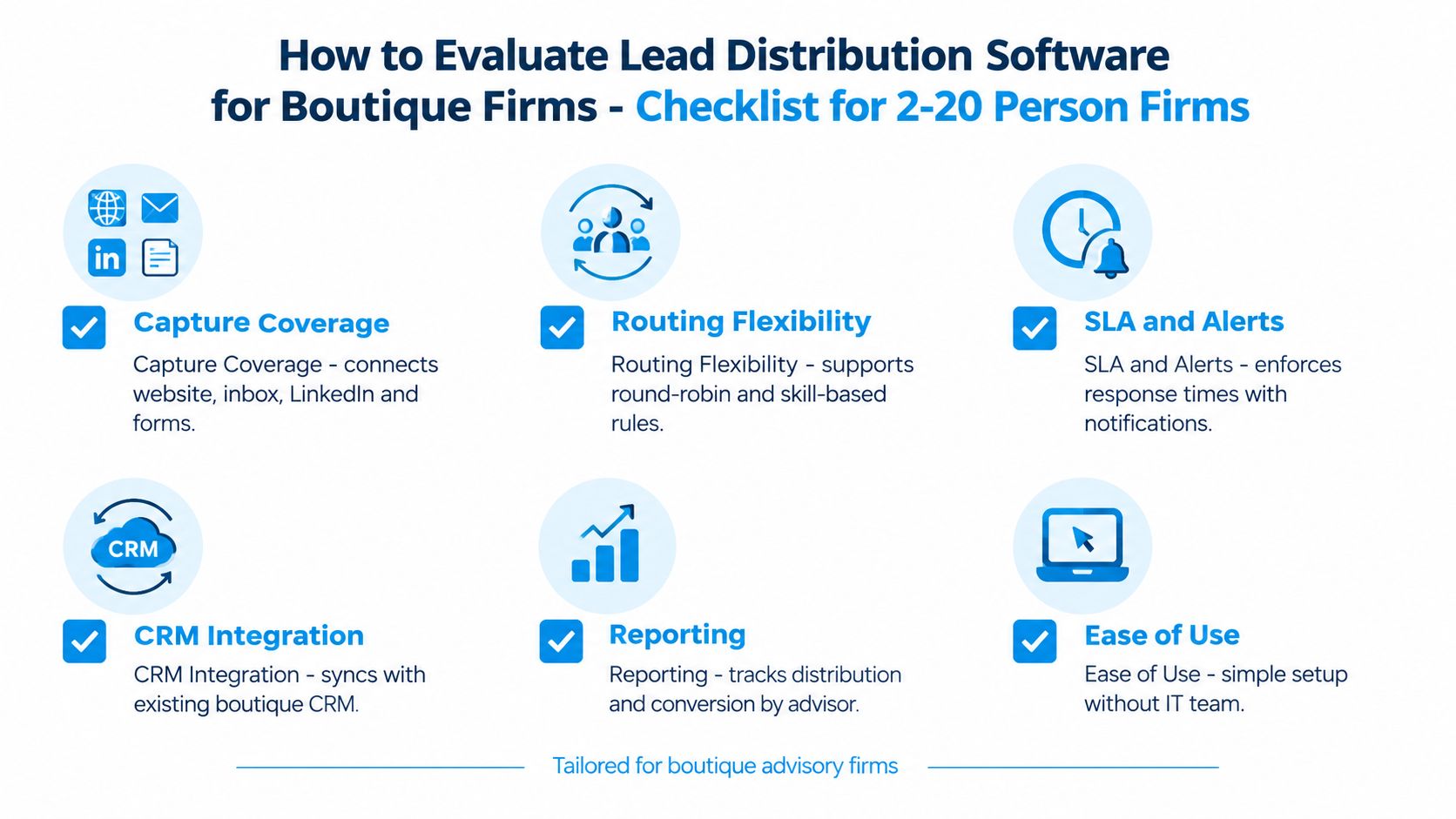
List every source that creates an opportunity, including the website, shared inbox, LinkedIn, events, introductions, and direct messages. Then ask the vendor to demonstrate how each source enters the system with source attribution and a consistent owner.
Test incomplete data deliberately. Remove the service field, use an invalid company name, or submit a form with an ambiguous location. A rule engine can't reliably route a blank or malformed field. Recent coverage of lead distribution software and data quality highlights this upstream problem, including the growing importance of enrichment and validation at the point of entry.
Your checklist should include:
- Required-field controls: Can the form prevent critical routing fields from being omitted?
- Validation and normalization: Can the system identify malformed or inconsistent values?
- Fallback queues: Does an unmatched record reach a monitored person?
- Duplicate handling: Can the team distinguish a new inquiry from an existing relationship?
Test the complete lifecycle
Don't stop at assignment. Ask the vendor to show a lead moving through discovery, proposal, decision, onboarding, and referral nurture.
You should be able to see:
- SLA and escalation controls: Can the system alert an owner and then a manager when action doesn't occur?
- Proposal next steps: Can a proposal record require a follow-up date or decision action?
- Handoff continuity: Does a won opportunity notify delivery, start the appropriate pipeline, and preserve the sales context?
- Referral nurture: Can the system schedule relationship touches and record introductions?
- Reporting: Can leadership review response behavior, stalled stages, source quality, and advisor ownership?
The broader benchmark evidence is a useful warning here. Routing tools alone didn't guarantee fast responses in the audit summarized by this speed-to-lead guidance for consulting firms. Your demo should therefore include an unworked lead, a missed appointment, and a proposal with no recent activity.
Judge effort, not feature count
For a small firm, usability is an operating requirement. If changing a routing rule requires a technical project, partners may leave outdated logic in place. If reports require manual reconciliation, leadership may stop reviewing them.
Ask who configures the system, who owns ongoing changes, how contact imports work, and what support exists during launch. The best fit is the system your team can keep accurate after the implementation team leaves.
Implementation Patterns From Map to Go Live
Implementation works best when the firm maps the operating model before installing software. The sequence should connect intake, assignment, communication, decision-making, delivery, and relationships rather than treating routing as an isolated feature.
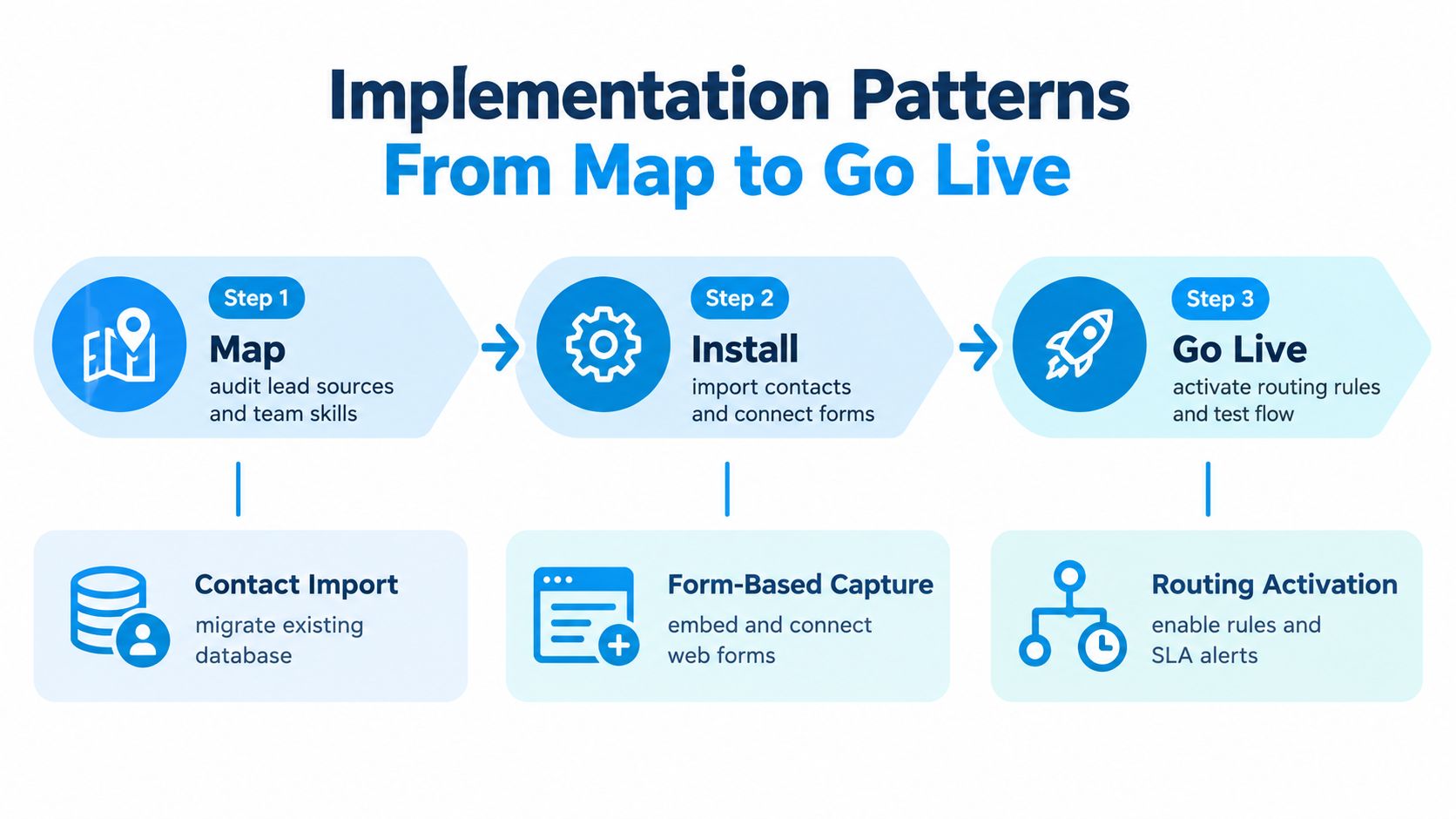
Map the real workflow
Start by documenting current lead sources and the people who handle each service. Record the existing stages from inquiry to signed engagement, then note where proposals pause, where reminders live, and how delivery receives a new client.
The map should answer practical questions:
- Which fields determine assignment?
- What happens when the preferred advisor is unavailable?
- Who owns the proposal after it is sent?
- What event starts client onboarding?
- Which partner receives a thank-you or nurture task after a referral?
Import existing contacts only after deciding how to distinguish active opportunities, past clients, referral partners, and general contacts. A clean classification makes later automation safer.
Install connected capture and triggers
Connect forms to the existing website or use included site tools. Configure the form to collect the information the routing rules need, then test the record, notification, source attribution, and first follow-up together.
Appointment confirmations and reminders should be generated from the booking event. Proposal-stage triggers should create the next action rather than relying on a partner's memory. A stalled opportunity can receive a planned follow-up sequence, with an escalation route for records that remain inactive.
On Core Plus and above, Starward Navigators provides a Campaigns, Triggers, and Workflows builder for configuring these connected behaviors. Its implementation model follows Map, Install, and Go Live, with done-for-you setup and a 14-day go-live guarantee, as specified in the platform information provided for this article.
Go live with a controlled test
Before launch, run representative scenarios. Submit a new web inquiry, create a referral, book a discovery call, send a proposal, mark an opportunity won, and simulate a missed action. Verify that every event creates the intended owner, alert, task, and downstream update.
The final test should include an exception. Use incomplete data or an unavailable advisor and confirm that the system sends the record to a human queue. A workflow that works only under perfect conditions isn't ready for production.
The following video provides a visual overview of the implementation approach:
Putting Lead Distribution to Work for Repeatable Growth
A consultancy can improve routing and still lose opportunities later. Repeatable growth requires a visible path from inquiry to decision, with clear ownership at each handoff. The practical question is not only who receives a lead, but whether the record shows what happens next.
Run a 30-day audit using real opportunities. For each record, log time-to-first-response, proposal follow-up completion rate, handoff error rate, and the age of the next uncompleted task. Review the results weekly by source, partner, and stage. A fast response with incomplete proposal follow-up points to a different fix than a clean sale followed by a confused delivery handoff.
Use the audit to create a short exception register. Record the condition, the intended action, the actual outcome, and the person responsible for correction. Examples include an unassigned inquiry, a proposal with no scheduled follow-up, or a referral whose referring partner received no update. This turns vague leakage into a ranked implementation backlog.
Client onboarding should carry the same operating discipline into delivery. A structured client onboarding process preserves sales context and reduces repeated questions for the new client.
Lead distribution software earns its place when audit results become visible tasks, owners, and review points. Starward Navigators offers lead capture and routing, proposal follow-up, appointment reminders, client handoffs, and referral workflows in one process. Visit Starward Navigators to review its Map, Install, and Go Live approach.