
A founding partner at a six-person advisory firm takes a Tuesday call from a trusted referral partner. The partner promises to introduce the firm to a CFO at a mid-market company. The email arrives on Friday, gets forwarded to a senior associate, and sits in an inbox through the weekend. By Monday, the CFO has already shortlisted two other firms. The introduction contained no context, no agreed follow-up time, and no clear owner.
The relationship didn't fail. The handoff failed.
That distinction matters. A referral is not merely a favor, a warm email, or a name passed between professionals. It's a workflow event with a source, recipient, deadline, owner, next action, and eventual outcome. Small firms that treat referrals as goodwill lose opportunities they've already been handed. Firms that treat them as a pipeline stage can make introductions repeatable, measurable, and easier to improve.
The following referral management best practices focus on that operational layer, including source attribution, ownership, response-time SLAs, nurture sequences, reconciliation, and auditability.
Table of Contents
- The Moment a Warm Introduction Goes Cold
- What Referral Management Actually Means for Advisory Firms
- Why Referrals Shape the Shortlist Before You Even Know It
- The Core Set of Referral Management Best Practices
- Manual Tracking Versus an Acquisition Operating System
- The Numbers Behind a Working Referral SLA
- A 30-60-90 Day Rollout Plan for Small Firms
- Turning Best Practices Into Default Behavior
The Moment a Warm Introduction Goes Cold
The founding partner marks a referral as active when the introduction is promised. The referral partner does the same when the email is sent. An associate may assume the partner will respond when ready. The CFO experiences none of that internal progress, only a vendor conversation that arrived without enough context to warrant an immediate reply.
A warm introduction can therefore stall without deliberate neglect. The firm lacks an intake rule, an acknowledgement trigger, and an escalation path for untouched referrals. The opportunity exists, but nobody has converted it into an owned workflow with a deadline.
The same failure appears in smaller moments. A client mentions a possible need during a delivery call, yet no one records it. A professional partner sends a LinkedIn message that never enters the business development pipeline. A consultant owns an opportunity but gives the introducer no update after the first meeting. By the time the referral resurfaces, the trust behind it has lost momentum.
Practical rule: Treat every introduction as a new operational record, not as an informal conversation.
The healthcare referral literature provides a useful process analogy. A closed-loop workflow covers ordering, scheduling, reconciliation, status documentation, note transmission, and auditing. Each handoff can lose the referral. CRICO's referral workflow review describes that sequence and supports a practical lesson for advisory firms: referral leakage is usually a process-control problem, not a relationship-quality problem.
For a consulting or advisory firm, the controls are specific:
- Capture: Log the source, arrival time, stated need, and available context.
- Assign: Name one person accountable for the next action and set its deadline.
- Acknowledge: Confirm receipt with the referrer and, where appropriate, the prospective client.
- Advance: Record the next meeting, decision, disqualification, or stalled state.
- Reconcile: Review open referrals against completed actions, owners, and aging.
- Close the loop: Report the outcome to the source and thank them.
This structure preserves the personal side of referrals while making every introduction traceable from source to outcome. It also gives a small firm something relationships alone cannot provide, an auditable way to find missed handoffs, test response-time SLAs, and improve throughput.
What Referral Management Actually Means for Advisory Firms
Referral management is the end-to-end discipline of capturing, routing, nurturing, attributing, and closing introductions from clients, partners, and professional networks. It covers what happens before the introduction, immediately after it, during the sales process, and after the opportunity is won or lost.
That's different from referral marketing. Referral marketing usually focuses on program design, incentives, campaigns, and requests for introductions. Referral management focuses on execution. It answers questions such as:
- Who received the referral?
- What context came with it?
- Who owns the next action?
- How quickly must that action happen?
- Which partner or client originated the opportunity?
- What happened after the introduction?
- When and how should the source receive an update?
A small firm needs one shared model for the referral lifecycle. Four core state changes provide a practical foundation.
Source captured
Record the referrer, original introducer, date, channel, company, contact role, stated problem, and relevant context. If a partner sends an email, attach or summarize the message. If the referral begins in a conversation, create the record before the end of the working day.
Qualified and routed
Check whether the opportunity fits the firm's target client profile, service capability, geography, capacity, and commercial model. Then assign the right owner. A referral for a complex finance transformation shouldn't default to whoever happened to see the message first.
Engaged and worked
The assigned owner contacts the prospect, keeps the referrer informed when appropriate, and records every meaningful step. Human outreach should work alongside automated reminders, not be replaced by generic automation.
Closed and attributed
Record whether the opportunity became a client, was declined, went to another provider, or remains open. Preserve the source attribution through the sales cycle so the firm can understand partner contribution and deliver a relevant thank-you.
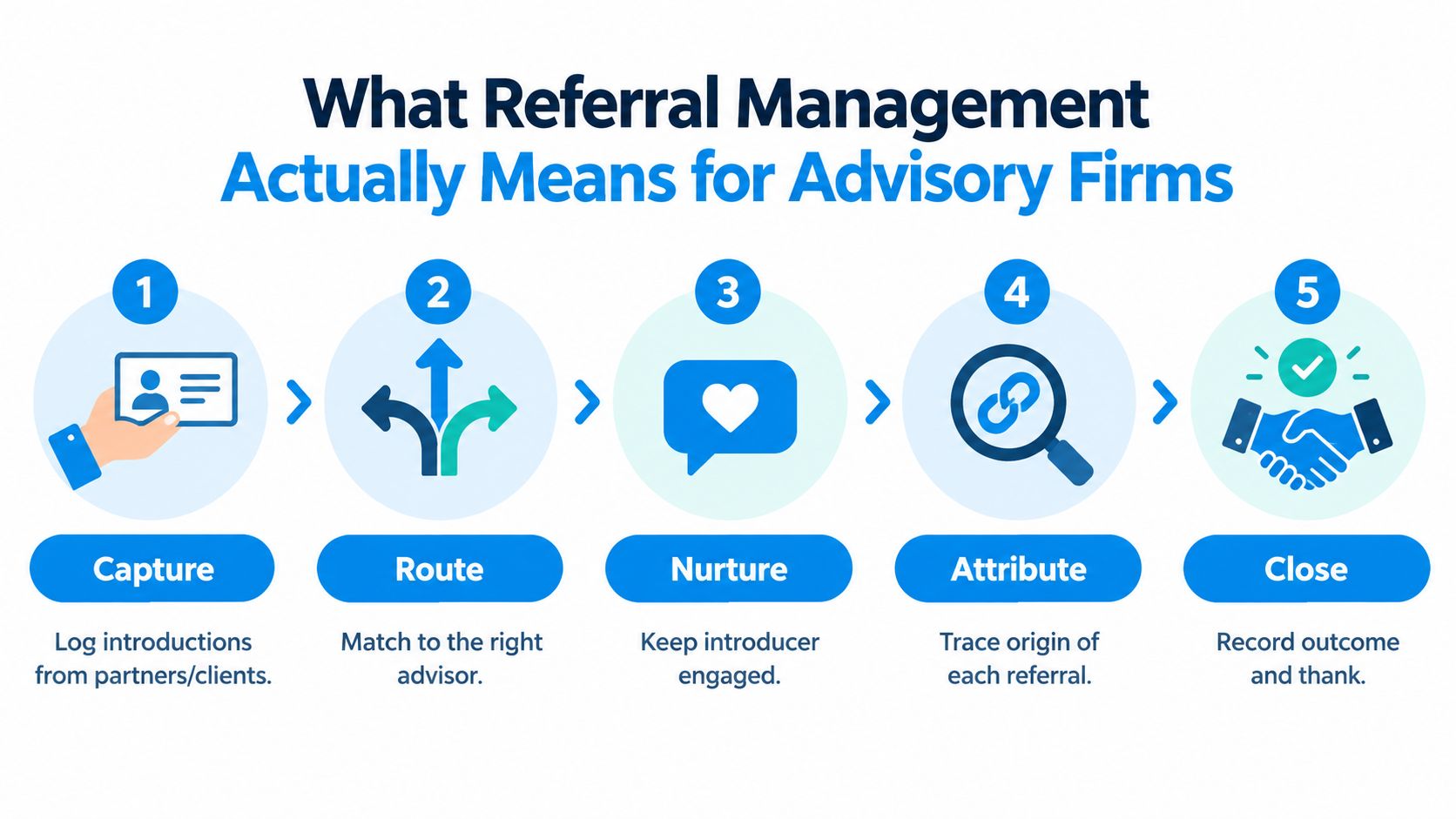
A referral that skips capture becomes untraceable. One that skips routing becomes ownerless. One that reaches a meeting without attribution loses the relationship value behind the deal. The firm doesn't need a complicated system first. It needs consistent state changes.
Why Referrals Shape the Shortlist Before You Even Know It
Referral management matters because B2B buyers often enter a formal evaluation with trust already formed elsewhere. A 2024 summary of B2B referral research reported that 93% of B2B buyers trusted word of mouth over other forms of advertising, while 86% of B2B purchases were influenced by word-of-mouth referrals. The same summary also cited Forrester findings that 92% of B2B buyers began with at least one vendor already in mind before formal evaluation began. The B2B referral research summary provides the source for these findings.
A separate synthesis reported that 73% of B2B marketing executives ranked word of mouth and peer recommendations as the most influential factor in deciding which vendors to consider. These figures point to a commercial reality that small advisory firms often underestimate: the shortlist may be forming inside a partner's network before a buyer visits the firm's website or books a discovery call.
| Buying stage | Typical referral influence | Implication for small advisory firms |
|---|---|---|
| Before a formal search | Peer recommendations create early awareness and trust | Maintain partner visibility before a mandate appears |
| Vendor consideration | Existing vendor awareness can shape who enters the shortlist | Give partners clear language about services, fit, and outcomes |
| Formal evaluation | A referral can provide context that generic marketing cannot | Equip the introducer and receiving advisor with shared context |
| Final decision | Trust in the source can reduce perceived buying risk | Keep the source informed without compromising confidentiality |
“Good work speaks for itself” is only partly true. Good work gives a referral partner something credible to talk about, but the partner still needs to remember the firm, understand its current focus, and feel confident making the introduction. Silence between engagements doesn't preserve top-of-mind awareness. It creates space for another firm to become the default recommendation.
That makes partner management a pipeline activity, not a quarterly courtesy. Useful partner communication can include relevant client outcomes, changes in capacity, updated service focus, reciprocal introductions, and concise follow-up after a referred opportunity moves forward. The point isn't to manufacture constant contact. It's to make the relationship visible, useful, and easy to activate when a buyer's need surfaces.
The operational response is a systemized partner pipeline. Track the relationship separately from active sales opportunities, capture every introduction against its source, and define what happens before and after a referral. A thank-you email matters, but it can't substitute for a partner process that keeps the firm present before the buying window opens.
The Core Set of Referral Management Best Practices
The most reliable referral programs track the partner relationship and the referred opportunity as connected records. That prevents a common failure mode where the firm remembers the deal but forgets the person who created access to it.
Start with partner stages such as Source Identified, Introduction Made, First Meeting Held, Opportunity Opened, Deal Closed, and Thank-You Sent. These stages show whether a relationship is producing activity, whether an introduction has been accepted, and whether the firm has completed its obligation to close the loop.
Capture attribution at intake. At minimum, tag the partner, original introducer, referral channel, date received, and opportunity record. Don't wait until the deal closes. Months later, the person who remembers the commercial outcome may not remember whether the opportunity originated in an email, event conversation, client mention, or partner exchange.
Set response rules that people can follow
Use SLAs expressed in hours, with one owner assigned to each event. A practical starting model is four hours to acknowledge an introduction, 24 hours to send personalized notes to both sides, and 72 hours to record the next step in the CRM. These are operating targets, not universal laws, so adjust them for your firm's working hours and client expectations.
| Stage | Owner | SLA in hours | Trigger |
|---|---|---|---|
| Referral received | Intake owner | 4 | New introduction captured |
| Referral acknowledged | Assigned advisor | 24 | Source and prospect record created |
| Referral qualified | Assigned advisor | 24 | Initial review completed |
| Next action logged | Opportunity owner | 72 | First contact attempted |
| Outcome updated | Opportunity owner | 48 after decision | Meeting, proposal, loss, or close recorded |
| Source thanked | Relationship owner | 48 after outcome | Opportunity status changes |
The handoff checklist should preserve the context that makes a referral warm. Include the business problem, urgency, relevant stakeholders, why the referrer believes there's a fit, what has already been said, and the promised next step. A forwarded email alone rarely carries enough operational context.
For sequence design, trigger messages from stage changes, not personal memory or arbitrary calendar dates. Send an immediate acknowledgement when the referral arrives, a useful status update after meaningful movement, and a specific thank-you after the outcome is known. The source shouldn't receive a generic newsletter when a personal update is appropriate.
Use referral tracking practices for advisory firms to make attribution and stage history visible. A system that records only the lead name and company won't tell you whether the firm responded, whether the partner received feedback, or where referrals stall.
The handoff is complete only when the next owner, next action, and deadline are recorded.
Manual Tracking Versus an Acquisition Operating System
Manual tracking starts innocently. Two partners share a spreadsheet. Each keeps inbox labels for active introductions. One person maintains a personal reminder to thank the source if a proposal closes. For a low and predictable flow, that arrangement may be adequate.
The trouble begins when referral activity becomes distributed. One partner receives introductions through email, another through LinkedIn, and a third hears about opportunities during delivery calls. The spreadsheet records some of them. The inbox labels record others. Attribution becomes dependent on memory, and the firm can't distinguish a quiet partner from a partner whose referrals were never properly handled.
| Manual approach | Acquisition operating system |
|---|---|
| Each partner follows a personal method | One intake and routing method applies to every referral |
| Reminders depend on individual calendars | SLA timers and triggers surface due actions |
| Context is stored in emails or notes | Context is attached to the referral record |
| Thank-you messages happen inconsistently | Stage changes trigger defined sequences |
| Attribution is reconstructed later | Source fields are captured at intake |
| Managers discover delays informally | Dashboards expose aging and missed steps |
A prebuilt system such as Starward Navigators' referral management platform is designed around this operating distinction. It gives referral partners a dedicated relationship pipeline separate from active sales opportunities, logs partner touches, links incoming opportunities to their sources, and supports automated thank-you and nurture workflows.
The important comparison isn't software versus no software. It's personal habit versus enforceable process. A spreadsheet can store a referral, but it won't reliably tell the assigned advisor that the acknowledgement is overdue unless someone has built and maintained that control. A generic CRM can hold contacts, but a blank pipeline still leaves the firm to design stages, triggers, ownership, and exceptions.
The system earns its place when the workflow must survive ordinary disruption. A partner goes on vacation. A new associate joins. A referral arrives outside the usual channel. A proposal remains undecided. The process should continue to identify the owner, send the right reminder, preserve source attribution, and display the breach without requiring one person to remember everything.
The Numbers Behind a Working Referral SLA
A warm introduction can sit in an inbox for weeks while everyone assumes someone else is handling it. Referral speed needs measurement because informal opportunities make delay easy to excuse. In a primary-care study, 36.4% of referral requests received no response from the specialist office within the five- to seven-week follow-up window, and the mean appointment wait was 60.1 days. The referral follow-up study examines healthcare, but the operational parallel applies to advisory firms: an introduction may remain psychologically “active” without producing a next action.
Healthcare timing should not be copied into a consulting pipeline without judgment. Use the evidence to establish a measurement habit, then set targets that match the buying context and engagement value.
Measure latency at each handoff
A useful dashboard tracks:
- Time to first acknowledgement: How long the firm takes to confirm receipt.
- Time to first prospect contact: How quickly the assigned owner reaches out.
- Time to scheduled conversation: How long it takes to secure the next meeting.
- Stage-to-stage drop-off: Where referrals stop progressing.
- Aging referrals: Which records have exceeded their expected interval.
- Closed revenue by source: Which partner relationships generate commercial outcomes.
Reconciliation, status documentation, and auditing help prevent missed steps, as noted in the earlier referral-management evidence review. For a small advisory firm, reconciliation means comparing expected referrals with logged referrals, open referrals with completed actions, and closed opportunities with completed thank-yous.
A Monday review should answer four questions. Which referrals are late? Who owns each one? What is blocking progress? Did the source receive an update? The team should also decide whether each stalled referral needs re-engagement, disqualification, or reassignment.
A referral SLA is useful only when a named person can miss it and a manager can see that it was missed.
Metrics can create false confidence when viewed alone. Fast acknowledgement does not prove strong qualification. A scheduled meeting does not prove the source received feedback. A closed deal without attribution hides the partner contribution that could have produced future opportunities. The dashboard should measure speed, progression, ownership, and relationship follow-through together.
A 30-60-90 Day Rollout Plan for Small Firms
A small firm shouldn't attempt to automate every relationship process at once. Build the referral workflow in sequential sprints, with one concrete artifact and one review point per phase.
Days 1 through 30 focus on source capture
List every entry point where introductions currently arrive, including email, LinkedIn, conference conversations, client calls, messaging platforms, and partner portals. Decide which events qualify as referrals and define the minimum record:
- Referrer: The relationship responsible for the introduction.
- Original introducer: The individual who made the connection.
- Prospect details: Company, role, and contact information.
- Problem stated: The need expressed or inferred.
- Date and channel: When and how the referral arrived.
- Initial owner: The person accountable for the next action.
The artifact is a single referral intake form or pipeline view. The review checkpoint is a short audit of recent introductions. If the firm can't find them, fix capture before adding automation.
Days 31 through 60 build stages and ownership
Create a small number of states: Referred, Qualified, Engaged, Closed-Won, and Closed-Lost. For each state, specify the entry condition, responsible owner, required fields, and next deadline. Don't create a stage called “Follow-Up” unless the firm can define what the advisor is waiting for and when the record should escalate.
The artifact is a stage and SLA matrix. Review it with every person who receives referrals. Their objections will reveal where the workflow depends on hidden judgment or missing context.
Days 61 through 90 add sequences and reporting
Build the minimum sequence set: referral acknowledgement, prospect nurture, source update, thank-you, and stalled-opportunity escalation. Add a dashboard showing late actions, aging referrals, response time, stage movement, and source attribution.
The artifact is a weekly referral operations dashboard. The checkpoint is a recurring review, not a one-time launch meeting.
Client handoffs deserve the same discipline. A structured client onboarding workflow can connect a closed-won decision to delivery ownership, kickoff scheduling, and internal notifications, preventing the referral process from ending at the signed proposal.
By day 90, the firm should be able to answer one question for every introduction: who sent what, when did it arrive, who owned it, and what happened next?
Turning Best Practices Into Default Behavior
Referral management becomes dependable when the firm changes four defaults.
First, replace ad-hoc asking with systemized intake. Every introduction, whether it arrives through an email, conversation, event, or existing client relationship, should enter the same record structure. The firm can't audit what it hasn't captured.
Second, replace manual follow-up with triggered sequences. A referral acknowledgement should start from the intake event. A source update should follow meaningful movement. A thank-you should trigger from the recorded outcome, not from someone's memory of the deal.
Third, replace untracked introductions with attributed partner stages. Keep the relationship visible separately from the sales opportunity, then connect the records through source fields. That preserves the long-term partner history even when an individual opportunity is lost.
Fourth, replace goodwill-only handoffs with SLA-backed ownership. Every stage needs a person, deadline, and required next action. A referral isn't progressing because someone feels responsible. It's progressing because the pipeline shows what must happen next.
A practical first-quarter target is ten logged introductions and a thank-you SLA hit rate above 90%, using the target defined for this rollout. The purpose isn't to create a vanity metric. It's to prove that the firm can capture referral activity and complete the relationship obligation consistently.
The strongest referral management best practices are not complicated. They make invisible work visible, turn warm introductions into accountable stages, and give partners confidence that their trust won't disappear into an inbox.
Starward Navigators provides prebuilt acquisition infrastructure for small consulting and advisory firms, including referral pipelines, automated follow-up, partner nurture, appointment reminders, proposal tracking, and client handoffs. Visit Starward Navigators to see how a closed-loop referral workflow can become part of your firm's operating system.