
A promising prospect submits a form late on Friday afternoon. The message lands in a shared inbox, the founder sees it between meetings, and someone plans to reply after the weekend. By Monday, a discovery call from the previous week is still unread, while the prospect has sent a second message that nobody has claimed. On Tuesday, the prospect chooses another consultancy, not necessarily because its expertise was stronger, but because its response arrived first and its next step was obvious.
This is the operational reality behind many lost consulting opportunities. The firm may have capable people, a credible offer, and good intentions. What it lacks is a lead follow up system that turns interest into an owned action, records what happened, and keeps the next step visible.
Table of Contents
- The Monday Morning Problem
- What the Research Says About Speed and Persistence
- Core Components of a Lead Follow Up System
- Designing Sequences That Match Each Buyer Stage
- Knowing When a Human Should Step In
- Connecting Follow Up to Scheduling and Proposals
- Measuring, Troubleshooting, and Rolling Out in 30 Days
The Monday Morning Problem
Consider a small operations consultancy with a handful of specialists. A prospect asks for help with process redesign, a partner forwards the email to the team, and a consultant takes notes during a discovery call. Each interaction contains useful context, but the information lives in different places: one inbox, a calendar, a call note, and somebody's memory.
The founder assumes the consultant will follow up. The consultant assumes the founder will send the proposal. Nobody has a visible task with a deadline, an owner, or a defined outcome. By the time someone checks the thread, the prospect has already moved on.
Practical rule: If a lead can arrive without creating an assigned next action, your process is relying on memory.
The alternative doesn't require a complicated sales operation. A website form, event inquiry, LinkedIn message, and referral email can feed one intake queue. A routing rule assigns the record to the right person, an immediate acknowledgement confirms receipt, and a short sequence creates the next few tasks. The owner can still personalize the conversation, but the system removes the risk that the first action disappears in an inbox.
The difference isn't effort or professional ability. It's accountability at the moment of capture. A consultant who receives a named task with the original pain statement can act quickly. A consultant who has to search several tools, reconstruct the conversation, and decide whether someone else is handling it will often delay.
Where memory-based follow-up breaks
Founders usually notice the problem only after the opportunity has gone quiet. They remember the lead, search for the last message, send a rushed check-in, and then create another reminder in a calendar. That approach creates several predictable failures:
- Unclear ownership: Multiple people see the inquiry, but nobody is responsible for moving it forward.
- Broken context: The person following up hasn't seen the original question or discovery notes.
- Invisible delays: Nobody measures how long the lead has waited.
- Duplicate outreach: Two team members contact the same prospect from different channels.
- No stopping rule: Messages continue after a reply, booking, opt-out, or disqualification.
A proper lead follow up system doesn't promise that every inquiry becomes a client. It ensures that every inquiry receives a deliberate decision. The lead is contacted, routed, qualified, nurtured, paused, or closed with a recorded reason.
Follow-up fails when it lives in someone's head instead of in a workflow. Small consultancies don't usually lose deals because their people can't write a decent email. They lose them because the right action never reaches the right person at the right time.
What the Research Says About Speed and Persistence
A lead can arrive while a consultant is in a client meeting, then sit untouched until the next morning. By that point, the buyer may have contacted another firm, lost urgency, or moved the project into a slower internal process. Speed and persistence address different operating failures. Fast contact protects initial intent. Continued, organized follow-up keeps a legitimate opportunity from disappearing during a long B2B decision cycle.
Analysts who reviewed more than 100,000 call attempts found that contacting a lead within five minutes made successful contact 100 times more likely than waiting 30 minutes, while qualification was 21 times more likely. These figures are directional benchmarks, not a promise that every consulting inquiry behaves like a call-center lead. The underlying detail is available in the lead-response-time research summary.
The gap remains significant after the first few minutes. A 2011 Harvard Business Review study examined approximately 1.25 million Internet-generated sales leads. Companies attempting contact within an hour were nearly seven times more likely to have a meaningful conversation with a decision-maker than companies waiting an additional hour. Organizations that waited 24 hours or longer were more than 60 times less likely to qualify a lead than those responding within the first hour.
That evidence supports immediate routing and escalation, not careless automation. A system should acknowledge the inquiry, assign accountability, and alert a human when intent or deal value warrants judgment. The first response can be prompt and useful without pretending that a complex consulting purchase will close through a short email sequence.
| Benchmark | Reported finding | What it means for a small consultancy |
|---|---|---|
| Initial response | Contact within five minutes made successful contact 100 times more likely than waiting 30 minutes, and qualification 21 times more likely in the analyzed call attempts, as reported in the lead-response research summary. | Route new inquiries immediately, then let a consultant add context instead of asking that person to find the inquiry first. |
| First hour | Companies responding within an hour were nearly seven times more likely to have a meaningful decision-maker conversation than those waiting another hour, according to the Harvard Business Review study. | Track response time as an operating metric, with an owner and escalation path. |
| Extended delay | Waiting 24 hours or longer made qualification more than 60 times less likely than responding within the first hour, according to the same findings. | A next-business-day routine can be too slow for high-intent inbound demand. |
| Persistence | InsideSales reported that representatives averaged 1.3 call attempts before giving up, while teams making at least six attempts could contact as many as 90% of leads, based on its lead follow-up test. | Build a sequence with a stopping condition instead of treating one unanswered message as rejection. |
Published figures diverge because the sources examine different channels, markets, definitions of contact, and lead quality. A referral to a specialist is not equivalent to a low-context form submission. A proposal-stage opportunity also needs different treatment from a new inbound inquiry. Use the figures to justify system design, then calibrate stages with contacted-to-qualified, qualified-to-meeting, and proposal-to-win outcomes.
Persistence also needs restraint. The same InsideSales test reports that 77% of leads received no response and 81% of sellers made five or fewer attempts. Seven or more attempts produced 15% more connections in the cited analysis. The operating lesson is to make each touch purposeful, stop when the buyer responds or opts out, and move quiet opportunities into respectful nurture. Proposal-stage prospects may need a scheduled decision check or a clear next action, not endless reminders.
Core Components of a Lead Follow Up System
A workable system has four connected parts: capture, routing, sequences, and ownership. Remove one, and the others become unreliable. Capture without routing creates a queue nobody controls. Sequences without ownership produce automated activity but no accountable human.
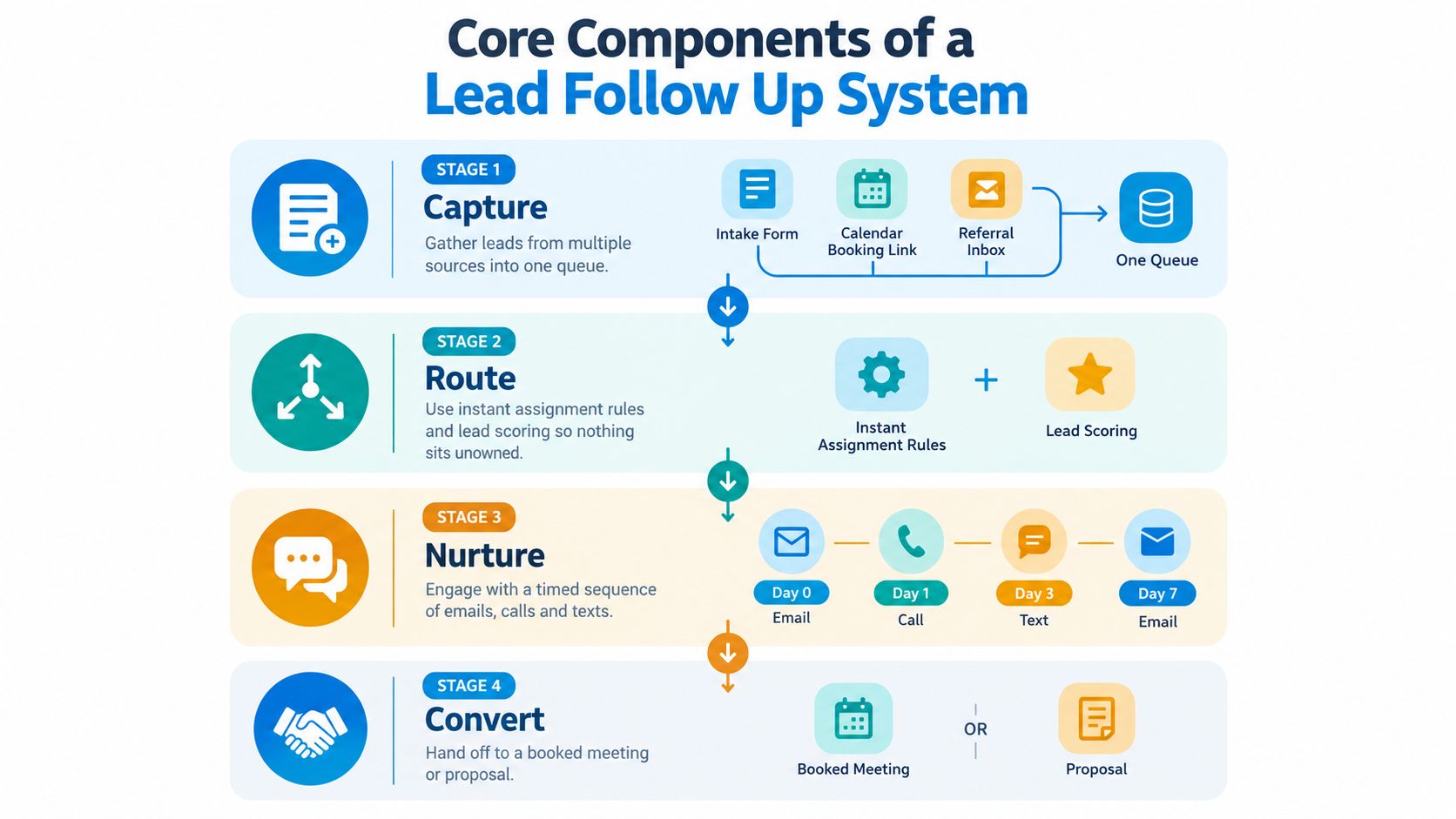
Capture every entry point
Start with the places where demand already appears:
- Website forms: Store the inquiry, service interest, source, and consent status in a record.
- Calendar bookings: Create or update the contact when someone schedules a conversation.
- Referral inboxes: Preserve who made the introduction and what context they supplied.
- Events and social channels: Give messages from LinkedIn and events a deliberate intake path instead of leaving them in personal accounts.
The objective isn't to force every conversation into the same script. It's to create one reliable record with the original message, source, timestamp, and requested service.
Route by a rule someone can explain
A routing rule might assign by service line, geography, account type, or relationship. For a small firm, the rule can be simple, but it must be visible. The record should show the owner, backup owner, stage, next action, and escalation condition.
A shared inbox can still receive notifications. It shouldn't be the place where accountability ends. If a lead sits unassigned, the system should alert a manager or backup owner rather than wait passively for someone to notice.
Sequence around an event
A sequence starts because something happened, such as a form submission, missed appointment, completed discovery call, proposal delivery, or referral introduction. Each touch should have a distinct purpose and one clear call to action. The workflow must suppress future messages when a prospect replies, books, opts out, becomes disqualified, or reaches a closed decision.
For a practical implementation, connect intake, ownership, reminders, and stage movement in Starward Navigators' lead management platform. Other CRM tools can support the same design if they expose activity history, routing logic, and task queues.
Make ownership visible
Every active lead needs one named owner. That owner doesn't have to perform every task, but they remain responsible for the next decision. A visible queue should show overdue actions, unanswered replies, proposal follow-ups, and records waiting for qualification.
The system should also record disposition codes such as replied, booked, not now, no fit, referred elsewhere, and opted out. Those codes prevent the team from confusing a delayed buyer with a dead opportunity and give reporting a usable foundation.
Designing Sequences That Match Each Buyer Stage
A generic drip campaign treats every prospect as if they have the same question. Consulting buyers don't. A new inquiry needs reassurance that the firm understood the problem. A post-call contact needs a clean recap. A proposal-stage buyer may need help aligning stakeholders, not another introduction to the consultancy.
Build separate tracks around the buyer's current decision:
- Inquiry: Acknowledge the request, reflect the stated problem, offer a discovery conversation, and ask one soft-qualification question.
- Post-call: Send the agreed recap, confirm the next action, and provide one relevant artifact that supports the discussion.
- Proposal: Tie each message to a specific part of the proposal, such as scope, implementation, risk, or decision criteria. Don't send generic educational content here.
- Stall: Ask whether timing, scope, budget, or internal alignment is blocking progress. Offer a clear way to pause without creating friction.
- Referral: Thank the referrer promptly, confirm how you'll handle the introduction, and make the requested introduction easy to complete.
Every template should accept the lead's first name, company, named pain, discussed deliverable, and next action as fields. If the system can't populate those fields, the message should become a task for a human rather than an automated send.
| Stage | Touch | Timing | Channel | Primary CTA |
|---|---|---|---|---|
| Inquiry | Initial response | Immediately after capture | Email or original channel | Confirm the need and choose a discovery time |
| Inquiry | Helpful follow-up | Next suitable business day | Email or LinkedIn | Answer one likely question |
| Post-call | Recap | After the conversation | Confirm the agreed next step | |
| Proposal | Decision support | During active review | Email with human task | Identify the remaining decision question |
| Stall | Requalification | After meaningful silence | Email or call task | Choose whether to continue, pause, or revise |
| Referral | Relationship touch | After the introduction | Confirm the introduction or next conversation |
A sequence should vary channel and angle, but not merely for the sake of activity. Use LinkedIn when the relationship already exists there. Use email for material the buyer needs to review. Reserve SMS for permitted, expected reminders and urgent scheduling logistics. Consent and suppression rules must apply across every channel.
The stopping logic matters
The sequence ends when the prospect replies, books, opts out, is disqualified, or reaches a decision. A reply should create a human task, not trigger another automated message. A proposal marked accepted should close the sales sequence and start the appropriate handoff.
For implementation, Starward Navigators' follow-up automation is one example of a workflow layer designed around new leads, proposals, stalled opportunities, and referral nurture. Whatever tool you choose, test the exit rules before activating the sends.
The strongest message is usually specific and modest: “You mentioned that inconsistent reporting is slowing the leadership review. Would it help to compare the proposed diagnostic with the decision criteria your team is using?” That is more useful than “just checking in” because it gives the buyer a reason to respond.
Knowing When a Human Should Step In
Automation should handle predictable movement. It shouldn't flatten signals that require judgment. The mistake is to use the same low-pressure nurture message after a prospect has shown a clear sign that they need an answer from a specialist.
Escalation triggers can include:
- A prospect repeatedly returns to pricing or scope information.
- A proposal is opened several times without a recorded decision.
- The prospect replies with a question, objection, or request for comparison.
- The calendar link is used but no meeting is booked.
- A trusted referral source introduces a strategically important relationship.
- The account matches a firm-defined priority profile.
The exact threshold should reflect your capacity and sales model. A solo advisor may escalate fewer records than a larger boutique team. The rule must still be explicit, because “this feels important” isn't a reliable routing condition.
The buyer may prefer to research independently before involving a seller. Gartner reports that 61% of B2B buyers prefer an overall rep-free buying experience, while 69% experience inconsistencies between information on a company website and information from sellers, according to Gartner's B2B sales survey. That supports a restrained model: make the early journey useful for self-service, then bring in a senior consultant when behavior shows a contextual question or serious evaluation.
The handoff package
A human escalation should arrive with enough context to prevent a cold restart. Include:
- Activity timeline: Every message, page interaction, booking attempt, and status change.
- Last meaningful signal: The proposal section reviewed, question asked, or resource consumed.
- Original pain statement: Use the prospect's language from the inquiry or call.
- Suggested opening: Give the consultant a relevant first sentence, not a generic task label.
- Decision context: Record known stakeholders, timing, objections, and requested deliverables.
Set a defined response-time standard for escalated records and monitor compliance. The human response needs to arrive while the signal is meaningful, not after the prospect has finished evaluating alternatives.
False positives carry a cost. Pulling a senior consultant into every mildly engaged record consumes the firm's most expensive hour and trains the team to ignore alerts. Good routing protects human attention by escalating fewer, better-qualified moments.
Connecting Follow Up to Scheduling and Proposals
A follow-up system is only useful if it moves the buyer toward a clear next step. Scheduling should therefore be part of the workflow, not a separate tool that the consultant checks manually.
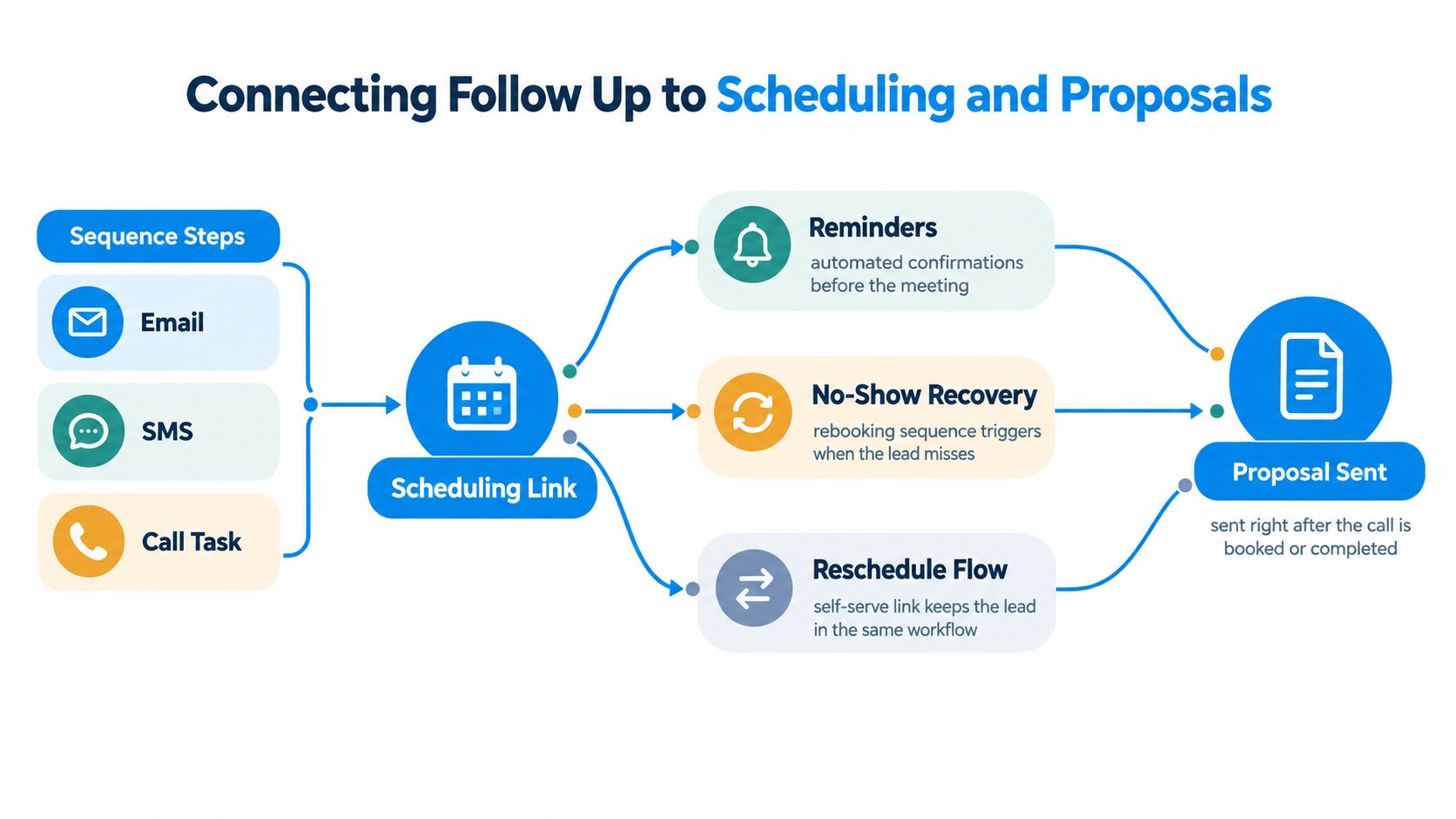
When a prospect books, the system should update the lead stage, assign the meeting owner, send the confirmation, and create the internal preparation task. Reminder messages should contain the meeting time, expected format, and an easy rescheduling path. If the prospect doesn't attend, the no-show flow should offer a respectful rebooking option while preserving the original context.
Avoid a generic calendar pool when the promise depends on specialist knowledge. A pooled link can route a strategy inquiry to someone who can't answer the substantive question, creating a poor first impression and forcing another handoff. Route by service line or named owner when the buying experience requires continuity.
Proposal follow-up needs its own track
The proposal email is not the end of the sales process. It marks a change in the buyer's job. The prospect may now need to compare scope, secure approval, involve procurement, or explain the recommendation internally. Your messages should help with that work.
A proposal track can include:
- Confirmation: Verify that the document arrived and ask whether the stated scope reflects the discussion.
- Value reinforcement: Point to one specific deliverable and explain the business decision it supports.
- Decision question: Ask what remains unresolved and whether the firm should revise, pause, or proceed.
The tracker should record the sent date, proposal version, most recent engagement, expected decision date, stakeholders copied, and competitor references in replies. Those fields let the owner follow up with judgment rather than sending a prewritten “any thoughts?” message.
One named human must own every active proposal. The owner is responsible for the next action even if an assistant prepares the email or another consultant joins the decision call. Proposal follow-up workflows from Starward Navigators illustrate this stage-based approach, with defined next steps instead of leaving the proposal in an unmonitored status.
Two integration failures appear repeatedly. The calendar link routes every lead into a generic pool, so the system loses service-line context. The proposal tool tracks engagement but doesn't send that event back to the CRM, so the sequence can't distinguish an unopened document from an actively reviewed one. In both cases, the automation is present, but the workflow is blind.
Measuring, Troubleshooting, and Rolling Out in 30 Days
A lead follow up system needs a review rhythm or it will steadily decay. Templates become outdated, routing rules drift, and completed opportunities continue receiving messages because nobody maintained the exit conditions.
Track the funnel as a connected chain:
- Lead-to-call rate: Shows whether capture, response, qualification, and scheduling work together.
- Call-to-opportunity rate: Reveals whether discovery conversations identify a viable problem and buying path.
- Opportunity-to-proposal rate: Indicates whether scope and decision criteria are clear enough to justify a proposal.
- Proposal close rate: Shows whether the offer, commercial framing, and proposal-stage follow-up support a decision.
- Average days to decision: Helps distinguish a healthy long cycle from an unmanaged stall.
Read these metrics together. A strong lead-to-call rate with weak call-to-opportunity performance may indicate fast but poorly targeted routing. A healthy proposal close rate with a long decision period may reflect procurement or internal approval rather than a messaging failure.
Long-cycle B2B buying requires its own interpretation. Available prospecting research reports that 63% of B2B leads take at least three months to decide, while 20% wait more than a year before purchasing, as reported in the B2B buyer statistics research. Treat those figures as directional, but design for the underlying reality: inactivity can mean timing, not rejection.
A practical rollout
Use a staged implementation rather than trying to automate every edge case at once.
First phase, instrument capture and ownership. Connect forms, booking tools, referral sources, and key inboxes. Define the stages, owners, required fields, disposition codes, and escalation path.
Second phase, activate two essential sequences. Start with new inquiries and proposals. Check every message for accuracy, consent, personalization fields, and exit conditions before enabling automatic sends.
Third phase, add human escalation. Identify high-intent signals, assign a response owner, and create a handoff package that includes activity history and the original pain statement.
Final phase, review and prune. Inspect overdue tasks, duplicate records, stale templates, missed suppressions, and stage conversion. Remove touches that add activity without helping a buyer make a decision.
Common failures deserve explicit monitoring. A closed deal shouldn't receive another sales email. A revised offer shouldn't leave old proposal language in an active template. An enterprise inquiry shouldn't enter the same queue as a low-intent newsletter signup. Each failure points to a missing stage rule, data field, or ownership condition.
Assign one person to maintain the system and schedule a monthly review. The system should change when the offer changes, when the team changes, and when buyer behavior reveals a better route. Automation creates consistency, but accountable operators keep that consistency useful.
Starward Navigators provides acquisition infrastructure for consulting and advisory firms, including lead capture and routing, automated follow-up, appointment reminders, proposal tracking, and client handoffs. If your team is still managing these steps through memory and scattered inboxes, visit Starward Navigators to see how the workflow can be organized in one operating system.