Lead nurturing is the deliberate process of maintaining relevant, timely communication with a prospective buyer until a commercial decision. Contacting a lead within 5 minutes makes it approximately 100 times more likely to be reached than waiting 30 minutes, while qualification is about 21 times more likely within that shorter window.
What happens after the discovery call, when the proposal is sent and the prospect goes quiet? Most consulting firms treat that silence as a lack of interest, even though the buyer may still be comparing options, seeking internal approval, or trying to explain the recommendation to other stakeholders.
That gap is where lead nurturing earns its place. It isn't a string of generic emails. It's a managed process for preserving momentum, answering the next question, assigning ownership, and helping a buying group move from interest to confidence. For advisory firms with longer, higher-trust sales cycles, the proposal-to-decision interval deserves as much operational attention as lead generation itself.
Table of Contents
- Defining Lead Nurturing for Advisory Firms
- The Three Stages of a Nurturing Funnel
- Best Practices for Effective Follow-Up
- Why Generic CRMs Fail Small Consulting Firms
- Leveraging Automation for Client Acquisition
- Implementing a Structured Operating System
Defining Lead Nurturing for Advisory Firms
Lead nurturing is the deliberate process of maintaining relevant, timely communication with a prospective buyer between an initial inquiry and a commercial decision. In consulting, that definition needs one addition: nurturing controls the lifecycle of an opportunity when the buyer isn't ready to decide immediately.
A useful system captures the inquiry, routes it to an owner, acknowledges the prospect, records the next action, and continues with information matched to the buyer's situation. The objective isn't to keep sending messages indefinitely. The objective is to move the prospect toward a clear outcome, such as a qualified conversation, a proposal decision, a declined opportunity, or a later follow-up date.
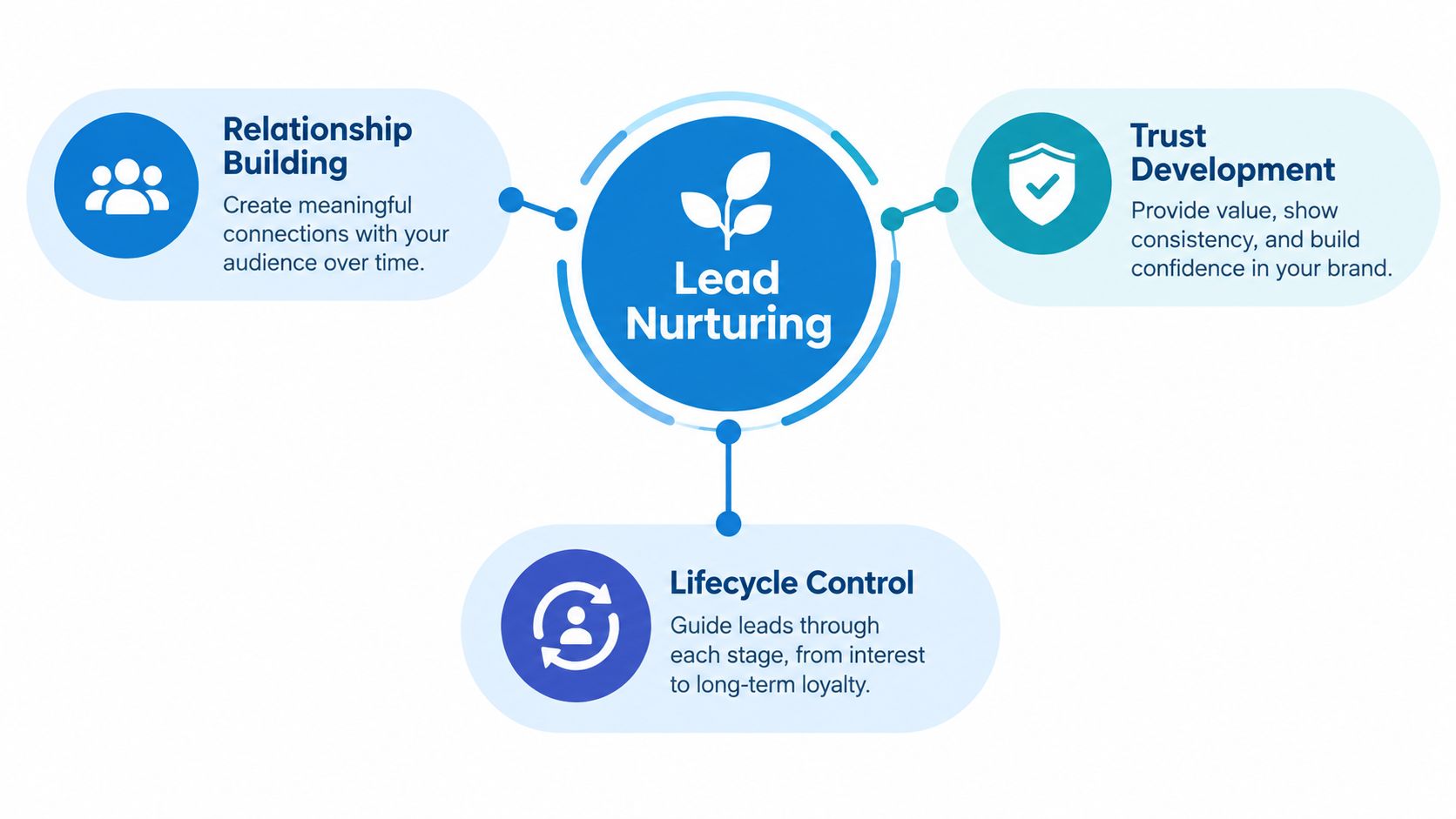
Speed protects the opportunity
Interest decays when nobody responds. A Lead Response Management study associated with Dr. James Oldroyd and InsideSales.com analyzed more than 15,000 online leads across over 100 companies in 2007. It reported that attempting contact within 5 minutes made a lead approximately 100 times more likely to be reached than waiting 30 minutes, while qualification was about 21 times more likely within 5 minutes than after the longer delay. The findings are summarized in this report on speed to lead.
Separate reporting on Harvard Business Review research involving roughly 2.24 million sales leads found that companies attempting contact within 1 hour were nearly 7 times more likely to qualify a lead than companies waiting an additional hour, and approximately 60 times more likely than companies waiting 24 hours or longer, as reported by Callingly's speed-to-lead analysis.
Practical rule: Automate the acknowledgment immediately, then make human ownership visible through an assigned task, alert, and specific next step.
Nurturing is more than marketing status
A marketing-qualified lead and a sales-qualified lead represent different levels of readiness, but consulting firms often need more detail than a simple label. The record should show the problem, service line, stakeholders, urgency, decision process, and agreed next action. For a clear explanation of how these statuses differ, see MQL vs SQL explained.
The history of marketing automation supports this operational view. Database marketing and customer databases developed through the late 1980s and 1990s, followed by workflow-based platforms in the 2000s. Eloqua was founded in 1999, while HubSpot and Marketo launched in 2006, milestones discussed in this history of marketing automation. The important shift was from storing contacts to triggering the next action based on behavior.
For a boutique firm, that might mean a form submission creates an owner task, a completed discovery call starts a proposal workflow, and an unanswered proposal creates a respectful reminder with a useful decision document. Consistency, not message volume, is the differentiator.
The Three Stages of a Nurturing Funnel
A consulting funnel usually moves through awareness, consideration, and decision, but the movement isn't linear. A prospect can return to an earlier stage after a budget review, a leadership change, or a new stakeholder's objection. Treating the funnel as a fixed sequence causes teams to send decision-stage content to someone still defining the problem.
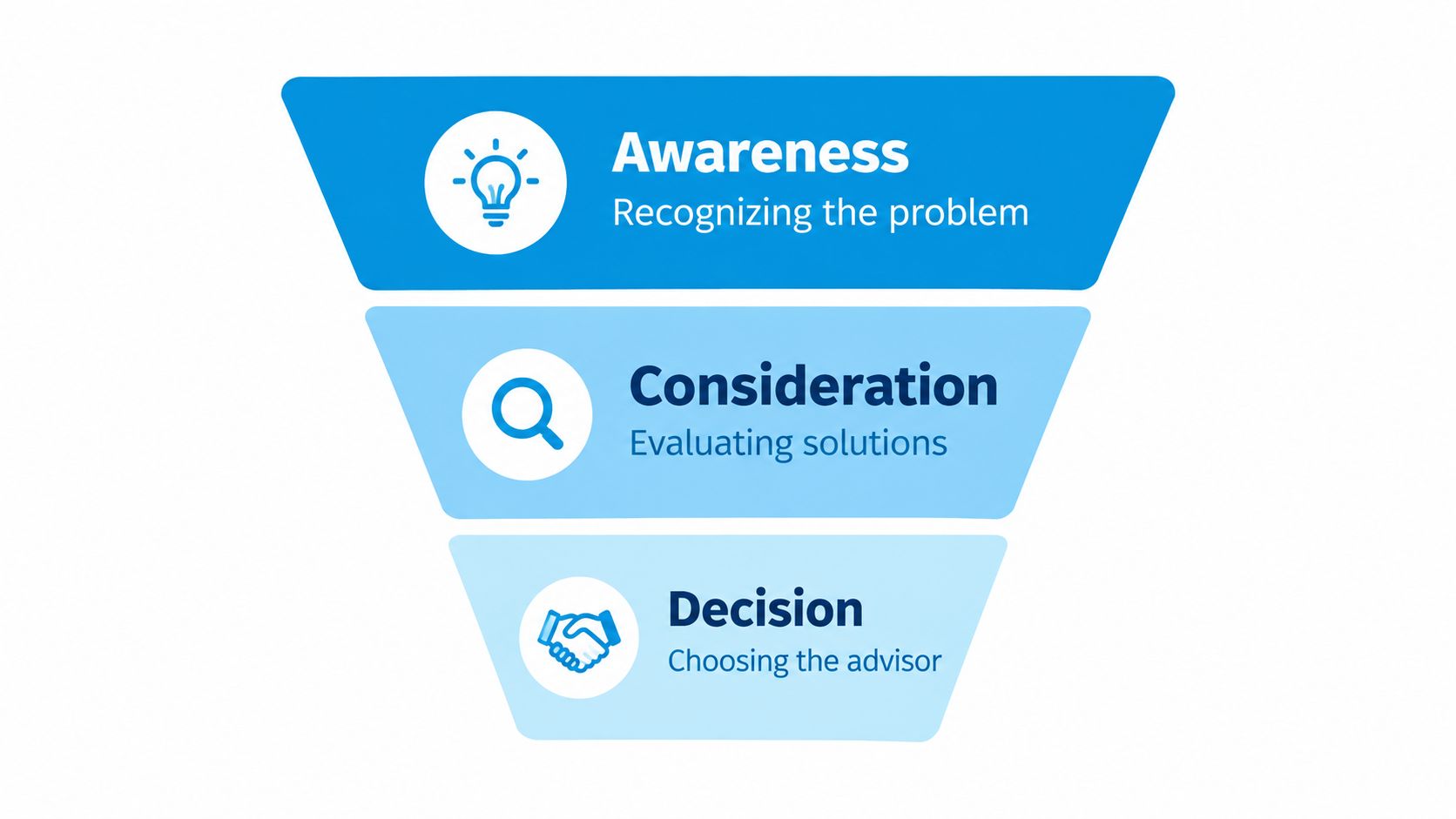
Awareness means naming the problem
At this point, the buyer may recognize a symptom without agreeing on its cause. A fractional executive prospect might know that pipeline reviews are inconsistent, while an advisory client might see margin pressure but lack a shared diagnosis.
The appropriate nurture asset is educational and diagnostic. Use a problem guide, assessment checklist, or clear explanation of engagement triggers. Avoid forcing a consultation before the prospect understands whether the issue fits your expertise.
The main friction is problem ambiguity. If your content only describes your service, the buyer has to translate your offer into their own situation. Good awareness content makes that translation easier.
Consideration requires comparison support
During consideration, the prospect evaluates approaches, providers, timing, and risk. Consulting buyers often need more than a service page. They may want to know what an engagement includes, who participates, how recommendations become implementation work, and what happens if the scope changes.
Provide transparent engagement criteria, a methodology overview, relevant evidence, and proposal FAQs. A useful follow-up message might answer one question raised during discovery rather than repeat the original pitch.
The friction here is often internal interpretation. Adobe's 2026 B2B research reports approximately 14 meaningful interactions before a decision, spanning websites, reviews, analyst material, demonstrations, internal discussions, and live conversations, as described in its State of Customer Experience research. Each interaction should reduce uncertainty, not introduce a new version of the offer.
Decision means helping the group agree
A decision-stage prospect needs a practical path to approval. That may include a one-page business case, implementation outline, risk summary, or executive briefing. A reminder that asks whether the prospect has “had a chance to review” adds little value.
Buying committees make this stage harder. Recent buyer coverage cited in the Adobe research reports that 53.4% of committees contain four to ten people, while 28.9% contain more than ten. The original contact may support the purchase but lack authority to approve it, so nurture records should capture stakeholder roles, objections, dependencies, and the materials each person needs.
The strongest decision-stage follow-up doesn't pressure one person to persuade everyone else. It equips the group to reach agreement.
Best Practices for Effective Follow-Up
Effective follow-up starts with usefulness, not frequency. A short sequence can outperform a long cadence when each contact responds to a real question, decision event, or change in buyer behavior.

Build the first response around the next action
The first acknowledgment should confirm receipt, identify the responsible person, and state what happens next. If the prospect requested an assessment, send the assessment criteria. If they asked about a proposal, confirm when the advisor will respond and what information would help refine the recommendation.
Don't make the first response a brochure. Buyers need orientation while the original problem is still salient.
A practical workflow includes:
- Immediate acknowledgment: Confirm the inquiry without pretending that automation is a personal conversation.
- Human assignment: Give one person responsibility for the next meaningful contact.
- Context capture: Record the source, problem, service interest, and relevant timing.
- Decision path: Define whether the next step is a call, diagnostic, proposal review, or disqualification.
- Exception handling: Create an alert when a lead remains unassigned or a promised response is late.
For firms managing follow-up across forms, inboxes, and appointment tools, follow-up automation for consulting teams can support the handoffs that otherwise depend on memory.
Make every touchpoint answerable
Buyers increasingly research without speaking to sales. A 2025 study reported that 58% of surveyed U.S. B2B buyers were using or experimenting with AI tools for vendor research, while separate reporting found that roughly 60% use tools such as ChatGPT or Gemini to augment vendor lists, summarize content, or identify competitors, according to the B2B Buyers Content That Converts report.
That behavior changes what nurturing means. Your material must be clear enough for a buyer or an AI system to summarize accurately. Define who you serve, when an engagement fits, what the work involves, what it doesn't include, and what evidence supports your approach.
Useful content beats additional reminders. A transparent proposal FAQ can remove more friction than another request to book a call.
Use original diagnostic guides, decision criteria, case evidence where available, and plain-language explanations of risks. Avoid unsupported superlatives and vague claims. A prospect should be able to forward the content internally without needing you to interpret it.
The video below offers another perspective on business guidance and trust in the buying process.
Measure the process with response-time percentiles, contact rate, qualification rate, and meeting-booked rate, not email opens alone. Opens can indicate delivery or curiosity, but they don't prove that the buying group understands the recommendation or has a path to approve it.
Why Generic CRMs Fail Small Consulting Firms
A generic CRM usually gives a consulting firm fields, objects, and a blank pipeline. That flexibility sounds useful until the owner must decide which stages to create, which reminders to automate, how to handle a stalled proposal, and where referral relationships belong.
A boutique firm rarely loses opportunities because it lacks another place to type a note. It loses them because the next action isn't obvious, the proposal owner changes, or the original contact is expected to remember every dependency without support.
Blank canvas versus operating workflow
| Generic CRM setup | Structured consulting workflow |
|---|---|
| Stages are created by the team | Stages reflect discovery, proposal, decision, delivery, and referral activity |
| Follow-up depends on manual tasks | Stage changes trigger reminders and defined next actions |
| Client handoff is recorded as a note | A won opportunity starts delivery work and alerts the responsible owner |
| Referral contacts sit in a separate list | Referral relationships have their own status and nurture path |
| Multiple channels require manual consolidation | Forms, inboxes, events, and social sources feed a central record |
The generic option can work when someone has time to design and maintain the system. The trade-off is ongoing administration. A small firm may spend more energy maintaining the CRM than improving the client acquisition process.
The proposal gap exposes the weakness
Most CRMs can display that a proposal exists. Fewer systems enforce what should happen next. Did the prospect receive it? Has the decision meeting been scheduled? Which stakeholder needs clarification? Is the opportunity paused, declined, or just forgotten?
A structured system turns those questions into workflow rules. It can create proposal follow-up, appointment reminders, owner alerts, and handoff tasks without requiring the consultant to remember each one.
For advisors comparing implementation approaches, how to transform your practice with CRM provides useful context on aligning CRM use with an actual practice workflow rather than treating software as a contact database.
The right choice depends on the firm's capacity. A generic CRM offers control and customization, but demands design discipline. A purpose-built operating system reduces setup decisions, but the firm must accept a more opinionated workflow. The failure isn't caused by generic software alone. It comes from adopting a tool without defining the work it must enforce.
Leveraging Automation for Client Acquisition
Automation is valuable when it removes administrative failure without removing judgment. A system should not decide whether a complex advisory engagement is strategically appropriate. It should make sure the inquiry is captured, the owner is notified, the meeting is confirmed, and the proposal doesn't disappear into an inbox.
A useful acquisition workflow begins at intake. A form submission can assign the lead according to service line or source, send an acknowledgment with a concrete next step, and create an internal task. Once the discovery call is booked, confirmations and reminders reduce avoidable scheduling friction.
Automation should enforce accountability
The proposal stage deserves its own automation because it contains a distinct behavioral risk. The prospect may be interested, but internal approval can take time. A stage-based workflow can schedule a review reminder, prompt the advisor to share a business case, and flag an opportunity when the promised next action is overdue.
That doesn't mean every silent prospect should receive the same sequence. Segment by service line, lead source, buying stage, and stated concern. A prospect comparing fractional finance support needs different material from a referral partner deciding whether to introduce you to a client.
For firms building their acquisition process around consistent inbound activity, lead generation for email marketing explains how lead capture and follow-up can work together rather than operating as separate projects.
Keep the human decision where it belongs
Automation handles timing, routing, reminders, and record updates. The advisor still handles diagnosis, scope, trust, pricing, and the quality of the recommendation. That division is important because excessive automation can make a high-trust service feel transactional.
Automation should make the next human conversation better prepared, not make the human conversation unnecessary.
Starward Navigators is one example of a client acquisition infrastructure option for small consulting and advisory firms. Its documented setup includes prebuilt business development, client delivery, and relationships and referrals pipelines, along with lead routing, appointment reminders, proposal tracking, stalled-opportunity follow-up, and client handoff workflows.
The operational case for automation is straightforward. It reduces dependence on memory, makes ownership visible, and gives the firm a consistent response when a lead enters, a meeting changes, or a proposal pauses. Those controls support better measurement because the team can distinguish a truly unqualified opportunity from one that was just left without a next step.
Implementing a Structured Operating System
A practical implementation starts with a stalled opportunity, not a software tour. Take a proposal that has gone quiet and map what should have happened after discovery, who owned each step, what the buyer needed to approve the work, and when the firm should have intervened.
Then build the workflow in a clear order:
- Map the lifecycle: Define intake, qualification, discovery, proposal, decision, delivery, and referral stages.
- Import the contacts: Bring in active prospects, proposal contacts, clients, and referral relationships, then clean ownership and status fields.
- Connect capture and routing: Link site forms and other intake channels to a central record with an assigned owner.
- Install triggers: Add acknowledgments, meeting reminders, proposal follow-up, stalled-opportunity alerts, and won-stage handoffs.
- Test exceptions: Check what happens when a meeting is canceled, a proposal is delayed, a contact replies through another channel, or a prospect asks to reconnect later.
- Go live with measurement: Track response time, contact rate, qualification, meetings, proposal movement, and overdue next actions.
Suppose a consulting firm receives an inquiry, completes discovery, and sends a proposal. The system acknowledges the inquiry, assigns the advisor, records the decision participants, schedules a proposal review, and sends useful follow-up when the review is delayed. Once the prospect accepts, the record can trigger delivery ownership and kickoff scheduling instead of leaving the handoff to an email thread.
The same principle applies after the sale. A defined client onboarding workflow keeps the promise made during acquisition connected to the work delivered afterward.
A structured operating system won't replace a strong recommendation or a trusted advisor. It makes sure the firm consistently performs the small actions that protect both.
Starward Navigators provides client acquisition infrastructure for small consulting and advisory firms, including structured pipelines, automated follow-up, appointment reminders, proposal tracking, and client handoffs. Visit Starward Navigators to see how a purpose-built operating system can close the proposal-to-decision gaps in your firm.