A principal at a boutique advisory firm opens the inbox on Monday morning and finds three promising inquiries. One came from a trusted referral, one through the website, and one from a conference attendee who had asked a specific question about an engagement. None received a response before the weekend ended. By the time the team checks the messages, two prospects have already scheduled calls with a competitor.
The problem isn't demand generation. It's timing and routing. The inbox has become a makeshift CRM, and important opportunities are being managed through memory, forwarded emails, spreadsheets, and goodwill. For a small advisory firm, lead management in CRM must do more than store contact details. It must catch every inquiry, identify its value, assign ownership, trigger the next action, and keep the relationship moving until the prospect is ready to decide.
Table of Contents
- The Moment a Great Inquiry Slips Through the Cracks
- What Lead Management in CRM Actually Means
- The Five Stages of Lead Management in CRM
- Best Practices a Small Advisory Team Can Run This Quarter
- Where Lead Management Usually Breaks Down
- Generic CRM vs a Prebuilt Acquisition Operating System
- Mapping Lead Management to Starward Navigators
The Moment a Great Inquiry Slips Through the Cracks
The principal doesn't need another dashboard to understand what happened. The referral was visible in one partner's inbox, the form submission landed in a shared mailbox, and the conference contact was buried in a personal notes app. Each lead existed somewhere, but no shared process identified who owned it or what should happen next.
That distinction matters. A lead can be captured without being managed. It can sit in a CRM record without anyone being responsible for contacting it. It can receive a polite acknowledgment while the proposal that follows receives no scheduled follow-up. These are workflow failures, not character flaws.
The operating problem: A lead without a named owner, a response target, and a next action is not in your pipeline. It's waiting for someone to remember it.
For advisory firms, the risk is especially high because inquiries often arrive with meaningful context. A referral may mention a sensitive business issue. A conference attendee may have a narrow deadline. A website visitor requesting a consultation may already understand the service and be comparing providers. Treating all of them as generic contacts strips away the buying signal that should determine the response.
A practical system starts by placing every source into one intake path. Website forms, calendar bookings, direct email, LinkedIn inquiries, event contacts, and partner referrals should create or update a record with the source, creation time, owner, service interest, and next step. From there, automation can acknowledge the inquiry, alert the right advisor, and create a task that can't disappear into an inbox.
A small team can implement this with a modest CRM configuration and disciplined ownership rules. It can also use dedicated follow-up automation for new advisory inquiries so that the first response doesn't depend on which partner happens to be online.
The principal's conclusion should be blunt: the firm doesn't have a lead shortage. It has an operating-system gap. The remedy is a repeatable process for capture, scoring, routing, nurturing, and reporting, with each stage connected to a human decision and a measurable output.
What Lead Management in CRM Actually Means
Lead management in CRM is the operating system for moving a potential client from first contact to qualified opportunity. It governs what happens when an inquiry arrives, how the firm determines whether it fits, who receives it, how follow-up continues, and how the principal learns which channels produce viable work.
It isn't the same as marketing automation. Marketing automation distributes campaigns and tracks engagement. Lead management decides whether a specific inquiry deserves immediate personal attention, which advisor should handle it, and what happens when the prospect goes quiet. It also isn't the same as deal closing. Closing begins after the firm has established a real opportunity and is managing scope, proposal, negotiation, and decision activity.
A useful analogy is a restaurant. A CRM without lead management is a host stand covered with illegible notes. The staff may know that guests have called, emailed, or asked for a table, but nobody knows who was promised what. A CRM with lead management works like a reservation book, seating chart, and pager operating together. The reservation records the request, the seating chart assigns responsibility, and the pager tells the team when action is due.
The five stages are straightforward:
- Capture: Bring every inquiry into one record with its source and timestamp.
- Scoring: Rank the inquiry by fit and buying intent.
- Routing: Assign it to the advisor best equipped to respond.
- Nurturing: Continue relevant contact when the prospect isn't ready to decide.
- Reporting: Measure response, progression, and leakage across the pipeline.
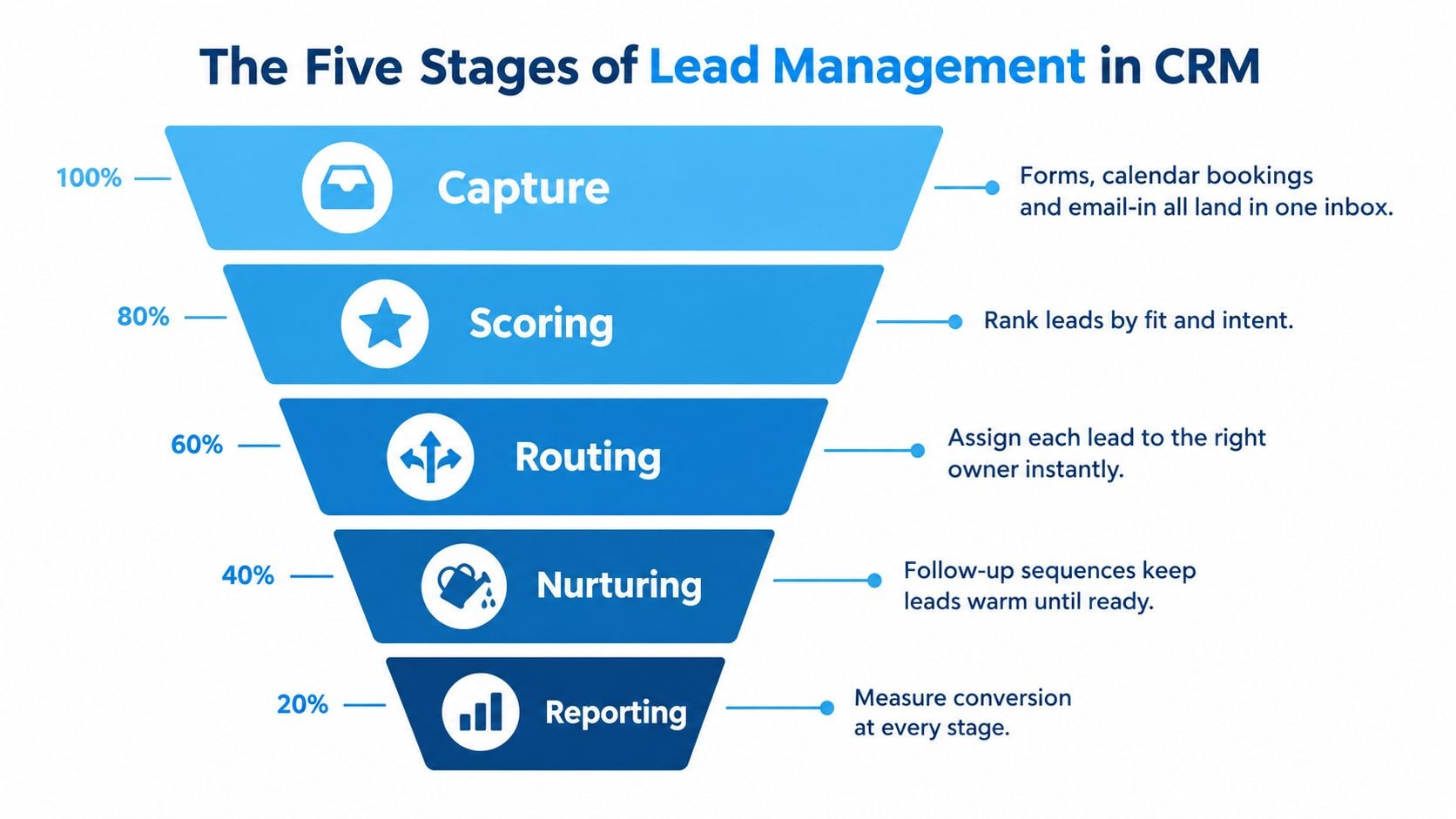
Each stage needs an owner, a response target, and a definition of completion. For example, capture is complete when the record includes a valid contact, source, service interest, and creation time. Routing is complete when a named advisor accepts responsibility. Reporting is useful only when the team can trace a number back to a specific process decision.
A five-to-fifteen-person advisory firm doesn't need a complicated architecture. It does need a shared system that behaves consistently when the principal is travelling, an advisor is in delivery, or a referral arrives outside normal working habits.
The following explainer provides additional context on how CRM systems structure lead capture, qualification, nurturing, and conversion:
The Five Stages of Lead Management in CRM
A strong lead process doesn't ask advisors to work harder at every stage. It removes avoidable decisions and reserves human attention for the moments where judgment matters.
Capture creates a usable record
Capture should consolidate web forms, calendar bookings, direct inquiries, event contacts, LinkedIn conversations, and referrals. The record needs more than a name and email address. Store the source, submitted time, requested service, company context, and initial message so the first advisor can respond intelligently.
The first operational target should be a five-minute acknowledgment for high-intent inquiries during coverage hours, followed by a personal first touch within one hour. The reasoning is supported by the MIT and InsideSales speed-to-lead research lineage, which reported that leads contacted within five minutes were about 21 times more likely to qualify than leads contacted after thirty minutes. The same research lineage analyzed 15,000+ leads and 100,000+ call attempts, giving the benchmark practical operational weight.
Scoring protects senior attention
Scoring answers one question: which inquiries deserve attention first? Use simple rules based on firm fit, role, expressed urgency, service need, referral strength, and buying behavior. A partner referral requesting a defined engagement should outrank a general content download, even if the latter has generated more digital activity.
Don't copy a vendor's default scoring model. Start with the signals your advisors already use intuitively, then compare them with closed-won and closed-lost outcomes. If a signal doesn't help the team prioritize or qualify, remove it.
Routing puts context with the right advisor
Routing converts priority into ownership. Use round-robin assignment when opportunities are broadly comparable. Use service-line, territory, relationship, or expertise rules when the inquiry requires a particular advisor.
The CRM should assign the owner automatically, notify that person, and create a task with a due time. A principal shouldn't have to inspect a shared inbox to decide who handles a complex referral. The system should also escalate unaccepted records so that an absence or overloaded calendar doesn't create silent leakage.
Nurturing keeps undecided prospects visible
Advisory prospects often need time to align partners, clarify scope, obtain internal approval, or compare approaches. Nurturing should keep the relationship active without forcing a sales conversation before the buyer is ready.
Build short sequences by source, service interest, and reason for delay. A sequence may combine a useful point of view, a relevant example of the firm's method, a personal check-in, and a task for the advisor. Stop automation when the prospect replies, books a meeting, or enters an active opportunity stage.
Reporting shows where progression stops
Reporting should show where the operating system loses momentum. Review speed-to-lead, source-to-qualified conversion, stage progression, proposal follow-up, and revenue per source. The principal needs to know whether the problem begins with weak capture, poor qualification, delayed handoff, or stalled decisions.
Measure time from lead creation to the first documented rep touchpoint, not merely the time from email arrival. LeanData's guidance on response-time measurement highlights why routing and processing delays can distort speed-to-lead metrics. Separate service-level expectations by intent. Demo requests, pricing inquiries, and partner referrals warrant a fast response, while lower-intent content downloads can use longer nurture.
These stages form one operating rhythm. The principal owns the definitions, the advisors own the conversations, and the CRM records whether the handoff occurred.
Best Practices a Small Advisory Team Can Run This Quarter
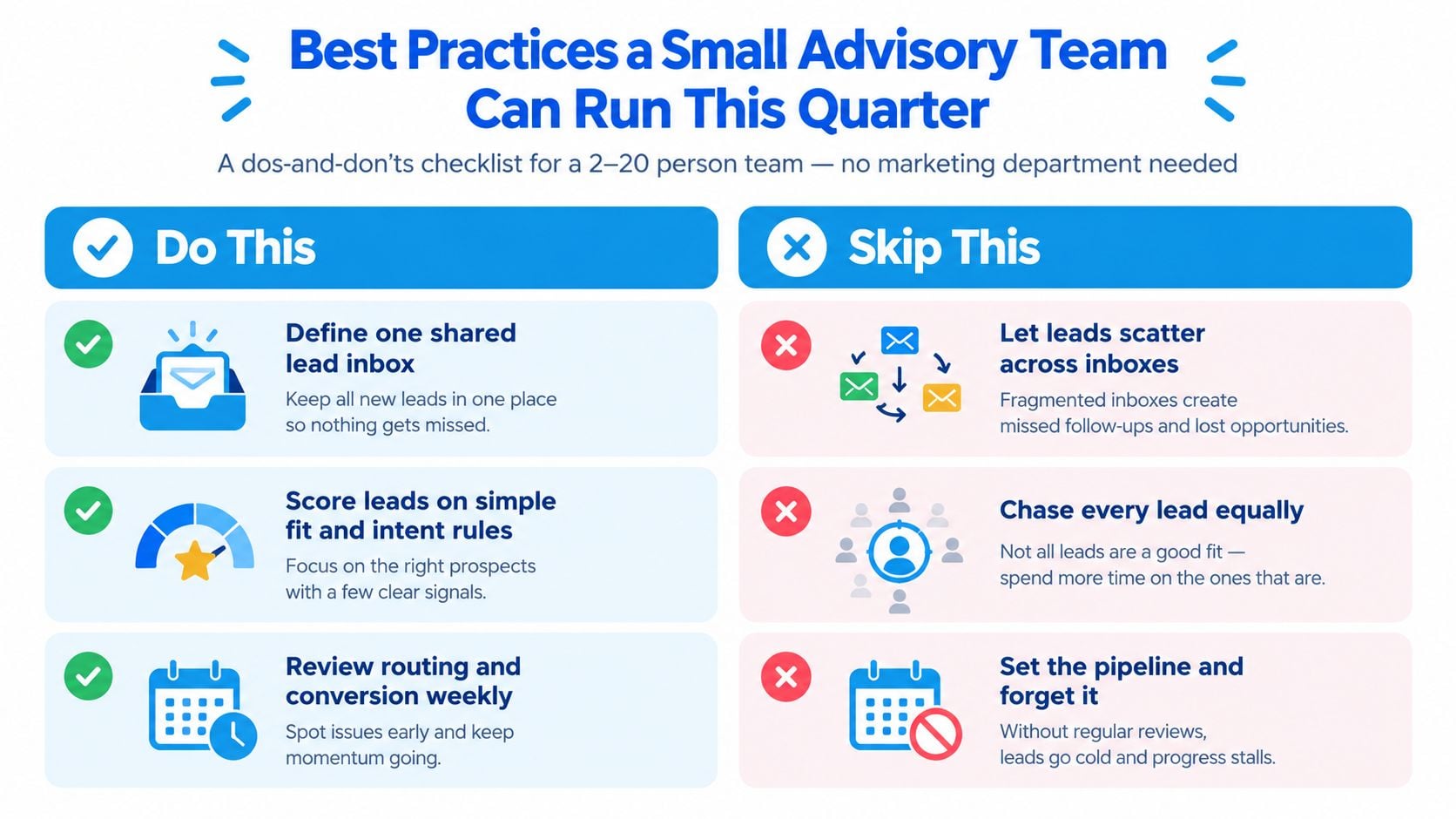
Small teams don't need a marketing department to improve lead management. They need a short list of rules that the CRM can enforce and the team can review without debate.
Capture
Do this: Create one shared lead intake path. Connect every form, calendar booking, and monitored inbox to the CRM, and require a source on every record.
Skip this: Let leads scatter across personal inboxes, spreadsheets, and chat threads. That setup makes ownership invisible and makes source performance impossible to trust.
The practical test is simple. Ask a partner to identify every new inquiry from the previous working day. If the answer depends on searching several systems, capture isn't working.
Scoring
Do this: Build a rules-based model around fit and intent. Use fields such as service need, company context, role, urgency, referral status, and stated problem. Define the threshold for a sales-qualified lead in language every advisor understands.
Skip this: Chase every lead equally or outsource judgment to an opaque AI score. A small firm needs a model people can challenge, inspect, and recalibrate against actual outcomes.
Review the rules when the team sees repeated mismatches. If low-fit leads rise to the top, change the criteria. If good referrals remain unprioritized, strengthen the referral signal.
Routing
Do this: Encode service-line and relationship rules in the CRM. Give every record a named owner and an escalation path when the owner doesn't accept the task.
Skip this: Use a shared queue as a substitute for routing. Shared visibility without individual accountability still leaves the principal doing manual triage.
Routing should answer three questions immediately: who responds, by when, and what context must they review first?
Nurturing
Do this: Trigger sequences from behavior and stage. A proposal awaiting a decision needs a different message from a prospect who downloaded an educational resource. Document when the advisor takes over from automated communication.
Skip this: Send the same sequence to every contact based only on time since form submission. Time alone doesn't reveal intent, objections, or readiness.
For firms developing a repeatable demand engine, email marketing lead generation workflows should feed the same CRM records used by advisors, not a disconnected list.
Reporting
Do this: Review a small set of operating metrics weekly. Focus on response time, stage conversion, open next steps, proposal progression, and source quality.
Skip this: Celebrate contact volume, email activity, or form submissions while qualified opportunities stall. Activity is not pipeline health.
Use the weekly review to make decisions, not to produce a decorative dashboard. Reassign neglected records, remove broken automations, update scoring rules, and identify the stage where prospects are most often losing momentum.
Where Lead Management Usually Breaks Down
Most failures look like individual mistakes because the CRM hides the workflow behind a contact record. A principal sees an untouched lead and blames the advisor. The better question is whether the system assigned the lead, notified the advisor, set a due time, and escalated the record when nothing happened.
Orphaned records
A new lead enters the CRM but receives no owner assignment. It remains visible to everyone and accountable to nobody. The fix is automatic assignment plus a required next step before the record can leave the new-lead stage.
Slow first response
Some firms measure response in days because nobody owns the clock. The benchmark gap is substantial. Recent summaries place average B2B response time at about 42 to 47 hours, while only about 7% to 23% of companies respond within five minutes, as reported in recent lead response benchmark summaries. Don't set one SLA for every source. Set the fastest target for the highest-intent inquiry and a more practical nurture target for low-intent activity.
Uncalibrated scoring
A score that never changes becomes decoration. If closed-won data shows that partner referrals and specific service requests produce strong opportunities, the model should reflect that. If the team keeps prioritizing noisy engagement over clear buying intent, the scoring rules are working against the firm.
Fragmented follow-up
The prospect receives an email from one partner, a reminder from an assistant, and a message in a chat thread. Nobody sees the full history. Centralize calls, messages, tasks, proposals, and outcomes on the lead record, then define which channel is the source of truth.
Vanity reporting
A dashboard can show a healthy number of new contacts while hiding a conversion leak after discovery or proposal. Review stage-level movement and ownership, not just top-of-funnel volume. Industry commentary on the lead management crisis also points to weak handoffs, unclear routing ownership, and poor progression measurement as recurring operational problems.
Audit the workflow before auditing the people. A well-designed process makes the right action obvious and the missed action visible.
Generic CRM vs a Prebuilt Acquisition Operating System
A blank CRM gives a firm flexibility, but flexibility creates implementation work. Someone must define stages, fields, ownership logic, scoring, sequences, dashboards, alerts, and handoffs. That work often competes with billable delivery, which means the firm launches with partial automation and keeps improvising.
A prebuilt acquisition operating system makes the opposite trade-off. It starts with opinions about how advisory firms capture leads, follow up on proposals, schedule appointments, and hand off won work. The firm still needs to adapt the configuration, but it doesn't begin with an empty canvas.
| Capability | Generic CRM, Blank Slate | Prebuilt Acquisition Operating System |
|---|---|---|
| Setup | The firm designs the process, fields, stages, and automations | Core advisory workflows arrive structured for adaptation |
| Data structure | Contacts and opportunities require local definitions | Source, owner, stage, next step, and relationship context are built into the process |
| Routing | Advisors configure assignment rules and exception handling | Ownership and routing logic are prepared for common advisory scenarios |
| Follow-up | The team writes and tests sequences from scratch | New-lead, stalled-opportunity, proposal, and referral sequences are available to configure |
| Appointments | Scheduling and reminders require separate setup or tools | Confirmations, reminders, and internal alerts are part of the workflow |
| Reporting | The firm decides which dashboards to build | Pipeline and activity views are aligned to acquisition stages |
| Maintenance | Every change depends on internal CRM knowledge | The implementation partner can own or support process updates |
| Primary trade-off | Maximum flexibility, greater configuration burden | Faster operational consistency, less blank-slate freedom |
The important comparison isn't software price. It's the time before the team can trust its pipeline. During a long build, inquiries still arrive, proposals still need follow-up, and partners still rely on memory. A prebuilt system can reduce configuration decisions and expose process gaps earlier, while a generic CRM can be the right choice for a firm with internal RevOps capacity and unusual requirements.
Choose the blank slate when you genuinely want to design and maintain the operating model. Choose a prebuilt approach when the immediate priority is consistent intake, ownership, follow-up, and visibility.
Mapping Lead Management to Starward Navigators
The value of an acquisition system appears in the handoffs between stages. A form should not merely create a contact. It should place the inquiry in a pipeline, identify its source, assign an owner, and create the next action. A proposal should not merely change status. It should trigger a clear follow-up path until the prospect decides.
| Lead Management Stage | Starward Navigators Workflow |
|---|---|
| Capture | Web forms and manual entries feed a unified inbox with source and contact context |
| Scoring | Configurable rules assign tiers based on fit, intent, service interest, and relationship signals |
| Routing | Ownership assignment and round-robin logic place the inquiry with the appropriate advisor |
| Nurturing | Scheduled sequences and task reminders maintain contact with new, stalled, proposal, and referral leads |
| Reporting | Dashboards track response activity, pipeline movement, open next steps, and velocity |
The system also connects acquisition to the operational work that follows. When an opportunity becomes won, the delivery pipeline can start, the owner can receive a notification, and kickoff scheduling can move forward without a manual re-entry exercise. That connection matters because lead management shouldn't end at qualification. Advisory firms lose momentum when discovery, proposal, decision, and onboarding live in separate tools.
A practical thirty-day rollout keeps the scope narrow:
- Week one: Inventory current leads, remove duplicates, identify missing owners, and standardize source fields.
- Week two: Configure capture forms, the shared intake path, service rules, and routing ownership.
- Week three: Activate the scoring model and one nurture sequence for a clearly defined lead segment.
- Week four: Review response and stage data, fix broken handoffs, and tighten the team's response expectations.
Don't attempt to automate every exception in the first month. Install the basic operating loop, watch where advisors still improvise, then improve the rules from observed behavior. The principal's job is to keep the process aligned with how the firm sells, not how a software demo suggests it should sell.
Starward Navigators provides a prebuilt acquisition operating system for advisory firms, with lead capture, routing, follow-up sequences, appointment reminders, proposal tracking, and client handoffs connected in one workflow. Visit Starward Navigators to see how your firm can replace inbox-driven lead handling with a consistent CRM operating process.