A client says the project is straightforward. The proposal deadline is close, the sponsor sounds enthusiastic, and the delivery team believes it can start as soon as the contract is signed. Then someone asks a basic question: who approves the outcome, what existing workflow will change, and how will the client decide the work is finished?
If nobody can answer clearly, you don't have a qualified opportunity yet. You have an attractive story with unresolved commercial risk.
A disciplined project discovery process gives consultants more than requirements. It reveals whether the client has a problem worth solving, whether the firm can solve it with the available evidence and access, and whether the opportunity should be pursued, priced differently, converted into a paid diagnostic, or declined. That makes discovery a control system for both delivery and sales.
Table of Contents
- The Strategic Value of Discovery in Consulting
- Five Phases of a Controlled Discovery Process
- Conducting Effective Stakeholder Interviews
- Creating Discovery Deliverables and Documentation
- Managing Scope Creep and Uncontrolled Changes
- Using Templates and Tools for Consistency
- The Handoff – From Discovery to Delivery
The Strategic Value of Discovery in Consulting
Two engagements can begin with the same confident kickoff call and end very differently. In one, the consultant identifies the decision maker, maps the current workflow, tests a risky assumption, and documents what the client won't receive. The proposal reflects the actual complexity, the delivery team understands its authority, and disagreements become decisions rather than surprises.
In the other, the buyer describes a desired solution, several stakeholders interpret it differently, and the consultant rushes to produce a price. The team discovers later that the data is incomplete, the operational owner wasn't involved, and the sponsor expected a broader transformation. Delivery may be competent, but competence can't compensate for a commercially unqualified brief.
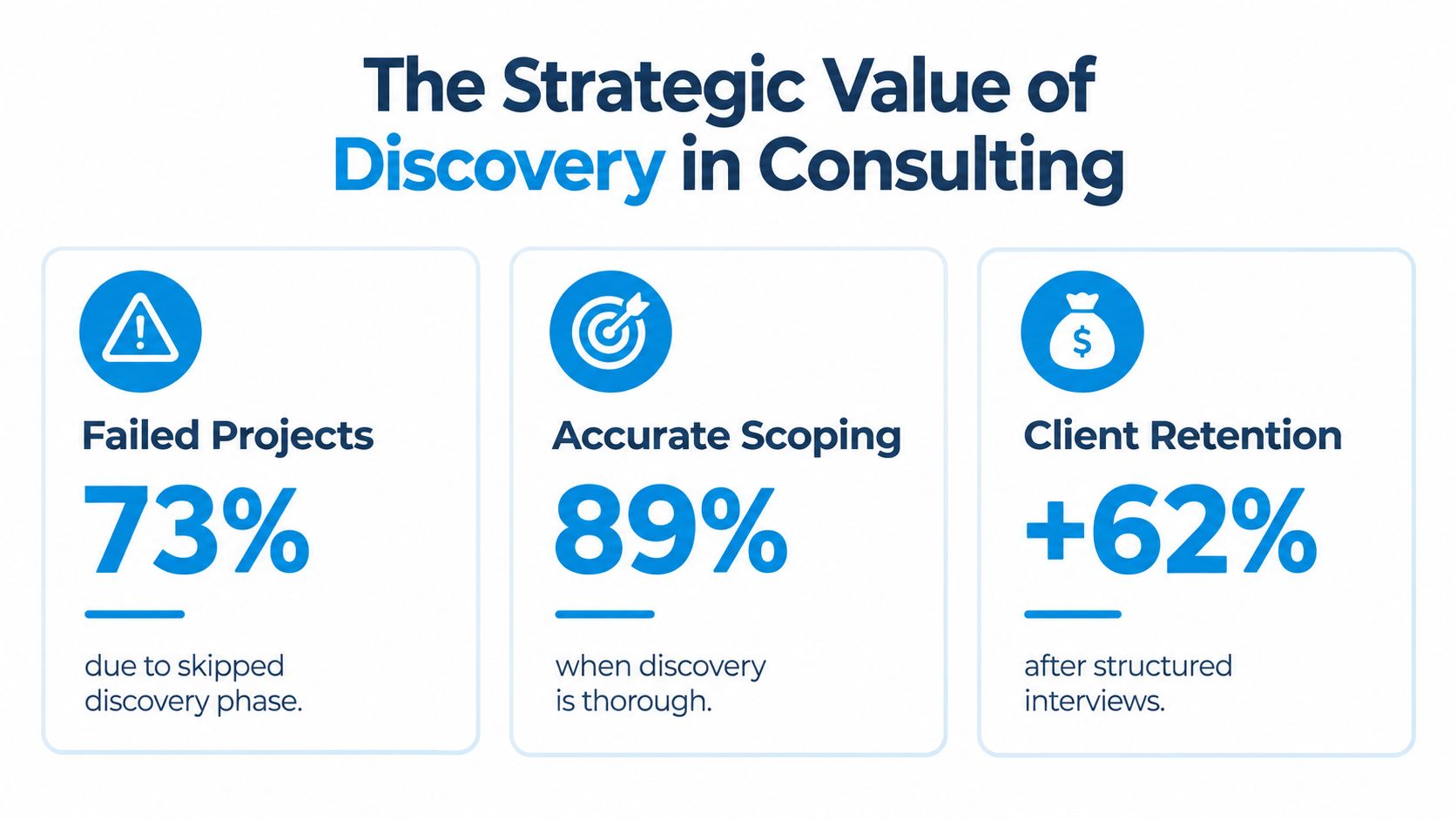
The historical rationale for formal discovery is unusually clear. The 1995 CHAOS Report recorded 16.2% of projects as successful, while 52.7% were challenged and 31.1% were canceled. Challenged projects finished late, exceeded budgets, or delivered fewer functions than required, and their final costs averaged 189% of original estimates. The same report found success varied by organization size, from 9% in large organizations to 28% in small organizations, and identified user involvement, executive support, and clear requirements among the leading contributors to success. These findings are summarized in the historical CHAOS Report reference.
Discovery protects the decision to bid
Small firms feel ambiguity quickly because a poorly defined engagement consumes scarce senior capacity. A strong discovery conversation should therefore answer two separate questions:
- Can we deliver this? Consider capability, access, dependencies, data quality, decision speed, and technical uncertainty.
- Should we pursue this? Consider client fit, commercial value, realistic margin, willingness to collaborate, and whether the buyer will support the decisions delivery requires.
Those questions lead to better options than an automatic proposal. You might pursue the work with conditions, price a paid diagnostic, narrow the outcome, or decline. A 2025 peer-reviewed study on consulting and engineering RFPs links poor RFP quality with scope creep and recommends assessing uncertainty before deciding whether to develop a proposal or bid, as discussed in the study on RFP quality and uncertainty.
Commercial rule: Discovery isn't complete when the client answers your questions. It's complete when you can make a defensible decision about scope, price, delivery risk, and whether the opportunity deserves a proposal.
Five Phases of a Controlled Discovery Process
A controlled project discovery process moves from people to evidence, then from evidence to an agreed delivery boundary. Skipping a phase doesn't remove the work. It pushes the work into proposal writing, implementation, or conflict resolution, where it costs more.
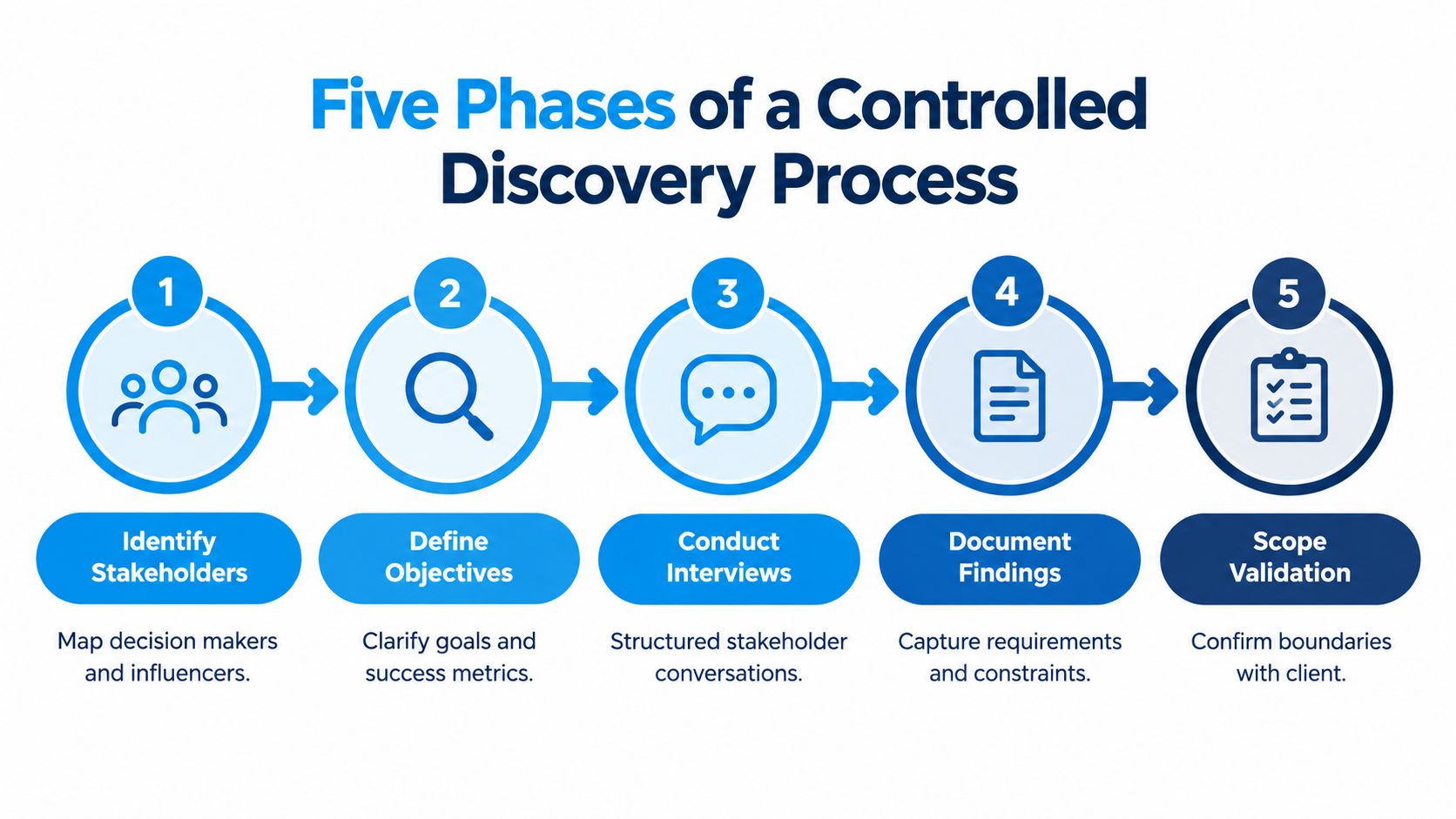
1. Identify stakeholders and decision rights
List users, operators, sponsors, subject-matter experts, technical owners, procurement contacts, and approvers. Then record what each person can decide, what they can influence, and what they only need to know. A stakeholder map without decision rights is just a contact list.
2. Elicit goals, constraints, and acceptance conditions
Use interviews, observation, existing documents, workflow reviews, and targeted data requests. Ask what the client wants to change, why it matters, what cannot change, and what evidence will prove the outcome works. Separate business goals from requested features. “Build a portal” is a solution request. “Reduce manual status chasing and give account owners a reliable view” describes a problem worth investigating.
3. Reconcile competing needs
Conflicts are useful discovery evidence. A finance leader may want control, while an operations team wants speed. Convert both positions into prioritized, testable requirements, then identify who owns the trade-off. Don't hide disagreement inside a vague phrase such as “user-friendly and flexible.”
4. Validate what you've captured
Use a prototype, walkthrough, process scenario, or sample output. Ask stakeholders to react to something concrete, because agreement with a meeting summary doesn't prove that the scope is understood. Validation should expose missing rules, edge cases, dependencies, and assumptions while change is still affordable.
5. Baseline the commercial boundary
Before delivery begins, record scope, assumptions, risks, dependencies, exclusions, acceptance tests, and change-control rules. PMI reported that inaccurate requirements were the primary reason for project failure for 37% of surveyed organizations, while only 47% had a formal validation process and 49% had adequate requirements-management resources, according to PMI's requirements-management research.
A signed discovery brief should contain a problem statement, stakeholder map, prioritized backlog, out-of-scope register, definition of done, risk log, and an owner for every unresolved decision. Every high-priority requirement should trace to a business objective, an observable acceptance test, and a named approver.
For a practical way to keep discovery follow-up connected to the opportunity record, Starward Navigators' follow-up automation can support reminders and next-step management.
Conducting Effective Stakeholder Interviews
Good interviews don't collect a pile of wishes. They uncover how work happens, where it breaks, who bears the cost, and what the client will accept as evidence of improvement.

Start by interviewing across roles rather than relying on the person who issued the request. The executive sponsor explains the business case, the process owner describes priorities and controls, frontline users reveal workarounds, and technical owners expose integration or data constraints. A consultant who speaks only with the sponsor may produce a polished brief that the people doing the work can't use.
Ask for evidence, not preferences
Use a sequence that moves from context to behavior:
- Context: What outcome prompted this initiative now?
- Current state: Walk me through the last time this happened.
- Friction: Where did someone wait, re-enter information, make a judgment, or escalate?
- Consequence: What happens when the process fails or stalls?
- Constraint: What must remain unchanged?
- Acceptance: What would you need to see to approve the result?
The request “we need better reporting” becomes useful only after you learn which decisions the report supports, which fields are trusted, how often the information changes, and who signs off. Ask for examples of recent work, not idealized descriptions of the process. People often describe policy. Their artifacts and exceptions reveal practice.
“Show me the last example” is usually more valuable than “Tell me how the process works.”
Test commercial readiness during the interview
Discovery should also establish whether the opportunity is viable. Confirm access to decision makers, baseline data, internal availability, dependencies, procurement constraints, and the client's appetite for resolving open questions. If the buyer wants a fixed price while withholding the information needed to estimate responsibly, record that as a commercial condition, not a minor inconvenience.
For website engagements, Contesimal's planning advice offers useful prompts around goals, content, structure, and preparation. Use resources like this to improve the conversation, but adapt the questions to the client's operating reality rather than running a generic questionnaire.
Finish each interview with a playback. Summarize what you heard, identify disputed points, and assign an owner and deadline to unresolved items. A short, written confirmation protects the client from being misrepresented and protects the consultant from treating an untested interpretation as fact.
Creating Discovery Deliverables and Documentation
Discovery becomes commercially useful when another person can read the outputs and understand what was decided, what remains uncertain, and what the firm is being asked to price. Notes alone don't provide that control. They preserve conversation, not accountability.
The central artifact is a discovery brief. Treat it as the working contract between sales, consulting, and the client, even when the legal contract comes later. It should state the problem in business terms, identify the intended outcome, list stakeholders and decision rights, summarize the current workflow, define the prioritized backlog, and make exclusions visible.
A practical brief usually contains:
- Problem statement: The situation, affected users, business consequence, and reason for action.
- Outcome and acceptance tests: Observable evidence that the agreed result exists.
- Stakeholder map: Roles, influence, approval authority, and availability.
- Prioritized backlog: Must-have outcomes, valuable additions, and deferred ideas.
- Out-of-scope register: Related work the proposal won't include.
- Decision log: Open questions, owners, deadlines, and final decisions.
- Risk and dependency register: External conditions that could affect delivery.
Turn uncertainty into evidence
An assumption-to-evidence matrix prevents teams from smuggling guesses into estimates. Put each material assumption in one column, the evidence supporting it in another, and the validation method, owner, and consequence of being wrong beside it. “The client can provide clean customer data” should lead to a sample-data check, not a hopeful note.
A useful risk score considers business impact, technical uncertainty, dependency complexity, and reversibility. Investigate high-impact, hard-to-reverse assumptions first. A prototype can test an interaction. A technical spike can test integration feasibility. A sample review can establish whether the source data is usable. The point isn't to eliminate uncertainty. It's to understand enough of it to price and govern the work.
A literature review on project risk reports approximately 20% of projects fail outright, about 50% are delayed, over budget, or incomplete, and roughly 30% meet budget, schedule, and functional expectations. It attributes approximately 50–60% of failures to weak requirements work and cites inappropriate elicitation methods in 43% of failures, while empirical requirements research found requirement quality correctly distinguished 78% of projects overall and predicted 89% of successful projects in its analyzed sample. These figures and the associated methodology appear in the requirements-engineering literature review.
For teams building their own research structure, an actionable research planning template can help organize questions, evidence, owners, and decisions. The final test is simple: can the deliverables support a bid, a no-bid decision, a revised diagnostic, and a clean delivery handoff without relying on someone's memory?
Managing Scope Creep and Uncontrolled Changes
Scope change isn't automatically bad. Sometimes discovery exposes a genuine gap, new evidence changes the problem, or a client learns enough during delivery to make a better decision. The danger comes when the team accepts the change without deciding what it means for outcome, effort, timing, risk, and price.
Recent industry survey evidence identifies scope creep as the top profitability challenge for 26% of respondents, with one-third saying it affects 10–25% of projects and four in five reporting higher average project cost. Those findings are reported in the 2025 state-of-market survey.
A practical decision matrix
| Situation | What it usually means | Consultant response |
|---|---|---|
| New request supports the agreed outcome and replaces an existing item | Prioritization change | Confirm the swap in writing and update the backlog |
| New evidence invalidates a discovery assumption | Discovery correction | Revisit scope, estimate, and acceptance conditions |
| Request adds a new user group, workflow, or integration | Expansion | Issue a change proposal or separate work package |
| Small adjustment has negligible delivery impact | Strategic accommodation | Record it and state why it was absorbed |
| Request has unclear value or no approver | Unqualified demand | Pause, clarify ownership, and don't commit |
A lightweight discovery-to-delivery contract should carry assumptions, non-goals, decision rights, dependencies, acceptance signals, and a change log. Verbal approval can keep a meeting moving, but it doesn't preserve the reasoning behind a later decision. Record who requested the change, what evidence prompted it, what it displaces, and who approved the consequence.
The consultant's job isn't to reject every request. It's to make the trade-off visible before the team pays for it. That preserves trust better than absorbing work and presenting an angry invoice later.
Using Templates and Tools for Consistency
Small firms often depend on one experienced person to remember every discovery question, follow-up task, proposal stage, and handoff condition. That feels efficient until that person is unavailable, a lead arrives through another channel, or a promising opportunity sits without an owner. Consistency is a capacity advantage, not administrative decoration.
Standard templates should encode judgment, not create paperwork. A useful discovery template prompts for decision rights, business outcome, current workflow, constraints, evidence, acceptance conditions, exclusions, risks, and the next commercial decision. A proposal template should pull from those fields rather than invite the consultant to rewrite the opportunity from memory.
Automation belongs around the process, not in place of it. Route new inquiries into one opportunity record, trigger reminders for unanswered questions, schedule discovery calls with confirmations, and require a next step before an opportunity can remain active. Keep the human judgment for qualification, interpretation, pricing, and the decision to proceed.
Operating principle: Automate the follow-up that people forget, not the judgment that clients pay you to provide.
A consulting-focused platform such as Starward Navigators' client onboarding template can connect defined sales stages with delivery preparation, while a general CRM, project tool, or spreadsheet may be sufficient for a smaller operation. The tool matters less than the operating rules. Every opportunity should have an owner, a current stage, a scheduled next action, and a visible reason for any unresolved risk.
Start with the minimum viable system. Standardize the discovery brief, risk log, proposal checklist, and handoff record before adding complex automations. Review lost bids and troubled projects against those templates. If the same gap appears repeatedly, improve the template or process rather than relying on another reminder to be more careful.
The Handoff – From Discovery to Delivery
A handoff is ready when delivery can act without reconstructing the sales conversation. That requires more than a signed proposal. The delivery lead should understand the outcome, boundaries, stakeholders, evidence, risks, dependencies, commercial assumptions, and unresolved decisions.
Use a short readiness gate before scheduling implementation:
- Outcome confirmed: The client and delivery owner agree on the business result, not just the requested deliverable.
- Decision rights assigned: Every material decision has a named approver and an escalation path.
- Scope baselined: Included work, exclusions, assumptions, dependencies, and definition of done are recorded.
- High-risk assumptions tested: Important unknowns have evidence, an owner, or an explicit contingency.
- Acceptance agreed: The client knows what will be reviewed, by whom, and what constitutes approval.
- Commercial choice made: The firm has decided to proceed, narrow the work, sell a diagnostic, revise the price, or decline.
- Operational next step scheduled: The kickoff, data request, workshop, or technical spike has an owner and date.
Make the decision explicit
A go decision should identify why the firm believes the work is viable and what conditions must remain true. A no-go decision is also a useful outcome. It protects capacity, prevents an avoidable dispute, and can preserve the relationship when you explain the evidence behind the decision. If uncertainty is material but solvable, convert it into a paid discovery or diagnostic rather than pretending a fixed implementation estimate is reliable.
The handoff meeting should walk through the discovery brief, not replace it. The delivery lead asks questions, challenges assumptions, and confirms which risks they own. The sales or account owner remains accountable for client context, while delivery owns execution feasibility and the client confirms priorities and access.
For a fuller view of the transition from a won opportunity into delivery, this guide to client onboarding provides a useful operational frame. After the meeting, update the record with decisions and send the client a concise confirmation. That message becomes the shared reference when a new request appears or an old assumption is challenged.
The project discovery process earns its value at this point. It has converted a conversation into a decision, a proposal into a boundary, and a client promise into work the delivery team can govern.
Starward Navigators helps small consulting and advisory firms standardize discovery stages, automate follow-up, track proposals, and carry client context into handoff and delivery records. Visit Starward Navigators to see how its consulting-focused operating system can turn your discovery process into a repeatable commercial control.