You've got a polished proposal ready to go out, the team feels good about it, and then the silence starts. No reply after the first open, no clear next step, and two weeks later someone asks whether the prospect ever saw it. That gap between discovery complete and decision is where a lot of deals drift, not because the proposal was weak, but because the process around it was never managed like a real stage.
Proposal management best practices only matter if they change what happens after the send. In small consulting firms, the proposal isn't a document you archive and hope for the best, it's a live workflow with owners, checkpoints, and follow-up rules. The firms that win more deals usually aren't writing prettier proposals, they're running a tighter operating system around the handoff from interest to commitment.
Table of Contents
- Why Most Proposals Go Quiet After You Hit Send
- The Standardized Proposal Pipeline From Discovery to Decision
- Pre-Send Readiness and the Delivery SLA
- Stage-Based Triggers That Fire on Engagement Signals
- Follow-Up Sequences That Keep the Decision Moving
- Knowledge Governance That Keeps Proposals Accurate
- A 30-Day Rollout Plan for Your Firm
Why Most Proposals Go Quiet After You Hit Send
A common pattern shows up over and over. A partner sends a proposal late in the day, marks it as done, and assumes the buyer will circle back when ready. What happens is slower and messier, the proposal gets forwarded, compared against a second option, discussed internally, and then left to sit while everyone waits for someone else to move first.
The buyer has already started a process you can't see
Once the proposal leaves your inbox, the buyer's work begins. The internal sponsor has to sell it, finance may need to sanity-check it, and other stakeholders may want their own read before anyone commits. If your side treats “sent” as the finish line, you've effectively abandoned the deal at the moment it became competitive.
The data pattern behind this is consistent. Proposal research points to follow-up discipline as a decisive best practice, with 80% of sales requiring five or more follow-ups to close and nearly half of reps stopping after one attempt, according to the benchmark summarized in this proposal follow-up analysis. That same research line says proposals followed up within 24 hours repeatedly outperform slower cadences, which matches what most operators see in practice.
Three failure modes show up again and again
The first is no internal sponsor advocacy. The proposal lands, but nobody on the buyer side is actively pushing it through the maze. The second is no defined re-engagement cadence, so everyone waits for a signal that never comes. The third is no diagnostic view of the stall, so the team can't tell whether silence means confusion, comparison, or a dead deal.
A proposal that goes quiet usually needs ownership, not more hope.
Historical benchmarks back that up. In one large proposal analysis, winning proposals had a median close time of 51.4 hours, and 50% of proposals were opened within 74 minutes of being sent. That tells you the window is short, which is exactly why a managed stage matters more than a polished PDF.
The Standardized Proposal Pipeline From Discovery to Decision
A proposal process works when every deal moves through the same named stages. If the team improvises the path each time, follow-up gets inconsistent, owners get fuzzy, and nobody knows when a proposal has stalled long enough to need intervention. A standard pipeline makes the next action obvious and prevents “sent” from becoming a parking lot.
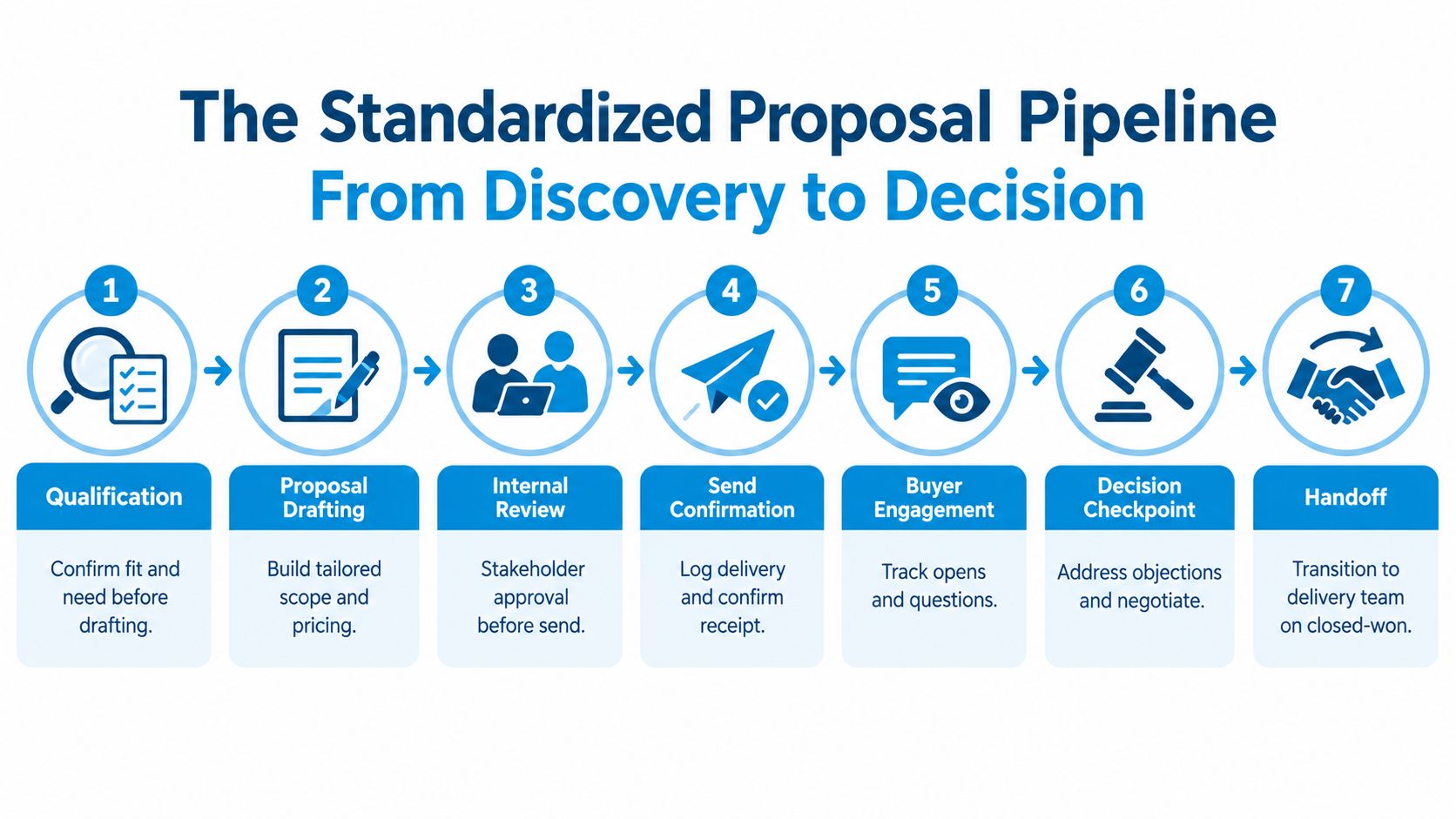
The seven stages that keep the deal moving
- Qualification, the owner confirms fit, urgency, and buying process before drafting starts. The checkpoint is a clear yes from the deal owner that the opportunity is worth time.
- Proposal Drafting, the team builds scope, pricing, and assumptions from discovery notes. Completion is proven by a draft tied to source notes, not memory.
- Internal Review, a partner or senior reviewer checks scope, pricing, and risk before send. The checkpoint is approval, not just a quick skim.
- Send Confirmation, the proposal is delivered through the buyer's preferred channel and logged. The artifact is a timestamped send record and the final version.
- Buyer Engagement, opens, questions, and revisits are tracked as live signals. The proposal stays in this stage while there's meaningful activity.
- Decision Checkpoint, objections get addressed and the team asks for the next step directly. The checkpoint is a verbal or written decision signal.
- Handoff or Close-Lost, the deal either moves into delivery or exits the active pipeline with a reason attached.
The rule that keeps this spine useful is simple, no proposal sits without a next step longer than 48 hours. That prevents the common violation where someone skips internal review to look fast, then pays for it later with scope confusion or rework. It also stops the other bad habit, leaving a proposal in Sent without a trigger for whether anyone has even opened it.
For teams that want a fuller pipeline reference, the structure maps cleanly to a sales pipeline operating model.
Why the checkpoint matters more than the stage name
A stage name without a checkpoint is just labels. The checkpoint forces someone to own the move, proves the step happened, and creates a clean handoff to the next person. That's what turns proposal management from a folder of documents into a live process.
If a stage doesn't have an owner and a proof of completion, it isn't a stage. It's a wish.
Pre-Send Readiness and the Delivery SLA
A proposal should never go out until it passes a readiness gate. If pricing is still floating, scope language doesn't match the discovery call, or the signature block is stale, the buyer gets an unforced reason to slow down. Small firms lose more deals to sloppy handoffs than they admit.
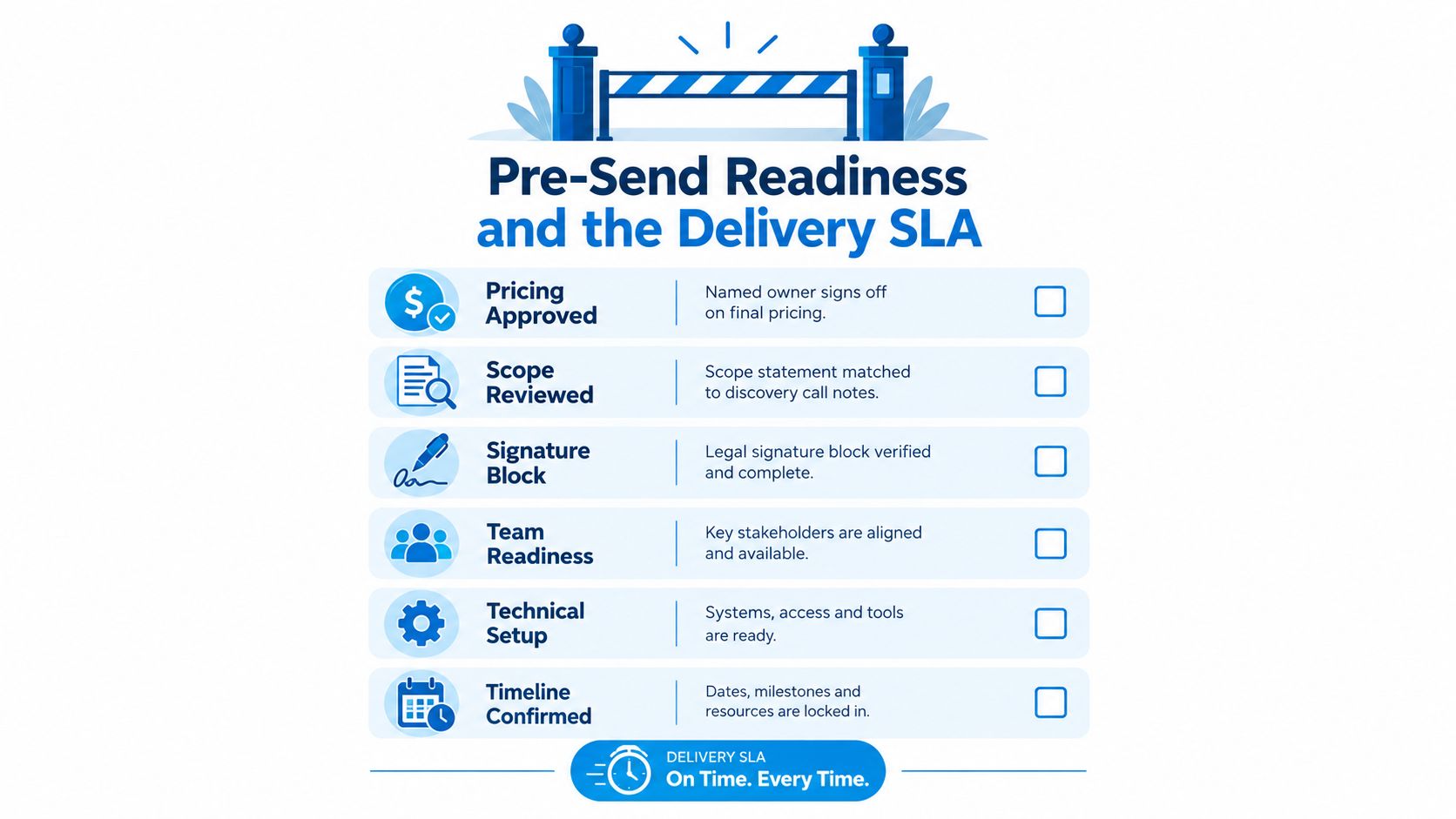
The readiness gate should be non-optional
The basic checks are straightforward. Pricing needs a named owner, scope needs to be matched against discovery notes, metadata has to be current, and the delivery channel should match what the buyer prefers. If the buyer asked for a PDF by email, don't send a portal link because it looks more polished.
A Delivery SLA helps. It's the firm's internal commitment on turnaround time, format, and the first post-send touch. A 48-hour default is a sensible baseline for small consulting teams, with a 24-hour expedited tier when the opportunity is hot or the buyer's timeline is tight. The point isn't to move recklessly, it's to remove uncertainty.
What the SLA does for the buyer and for your team
A visible SLA gives the buyer a planning anchor. They know when to expect the proposal, when follow-up will happen, and who owns the next contact. Internally, it forces the proposal lead to think beyond delivery and into the first touch after send, which is where a lot of teams fall apart.
The post-send sequence should fire the same day. That first contact doesn't need to be pushy, but it should add value, confirm receipt, and reinforce the decision path. A simple checklist should sit with every proposal package so no one sends from habit alone.
- Pricing Approved: named owner signs off on the final commercial terms.
- Scope Reviewed: the scope mirrors the discovery notes and any buyer changes.
- Signature Block Verified: legal and company details are current and complete.
- Delivery Channel Confirmed: the file goes out the way the buyer asked for it.
- Post-Send Owner Assigned: one person owns the next touch, no ambiguity.
For broader workflow coordination, the same discipline fits a lead management system, because proposals shouldn't sit apart from the rest of the buyer journey.
Stage-Based Triggers That Fire on Engagement Signals
Engagement data only helps if it causes action. A notification sitting in someone's inbox doesn't move the deal, and it can even create false confidence if the team assumes “someone saw it” means “someone is handling it.” The useful move is to attach a rule to each signal before the proposal leaves.
Watch the signals that actually change behavior
The first open tells you the proposal has entered the buyer's attention stack. A reopen often means someone is comparing scope, pricing, or language with another stakeholder. Section dwell time can reveal confusion, and total view count over a short window shows whether the buyer is still actively evaluating or just circling without resolving anything.
The research is useful here. Proposal tracking guidance notes that winning proposals were viewed about 2.5 times on average before close, while unsuccessful ones were viewed about 3.5 times, which suggests more views can mean unresolved objections rather than intent. It also reports that roughly 42.5% of closed-won proposals are won within 24 hours of the first open, so the response window matters.
Pre-write the trigger, don't improvise it later
| Engagement Signal | Detection Threshold | Stage Triggered | Required Action |
|---|---|---|---|
| First open | Within 2 hours of send | Buyer Engagement | Same-day confirmation touch with next-step reminder |
| Repeat reopen | Pricing or scope section reopened | Decision Checkpoint | Offer a live pricing or scope conversation that day |
| Section dwell | Under 2 minutes across the full proposal | Buyer Engagement | Re-engagement check at hour 24 with a value-add note |
| View count | Three or more views with no reply in 48 hours | Decision Checkpoint | Direct decision question by hour 48 |
That table works only if one person owns the trigger and the response language is already drafted. Otherwise, the insight gets passed around internally and the buyer hears nothing. A trigger without a script is just more admin.
Silence doesn't always mean no interest. It often means the buyer is comparing, forwarding, or waiting for someone else to weigh in.
Follow-Up Sequences That Keep the Decision Moving
The proposal-to-decision window needs an operating system, not a series of polite reminders. After discovery is complete, assign an owner, define the next checkpoint, and give every touch a reason that helps the buyer decide. A follow-up message should add context, answer a likely objection, or make the next action easy.
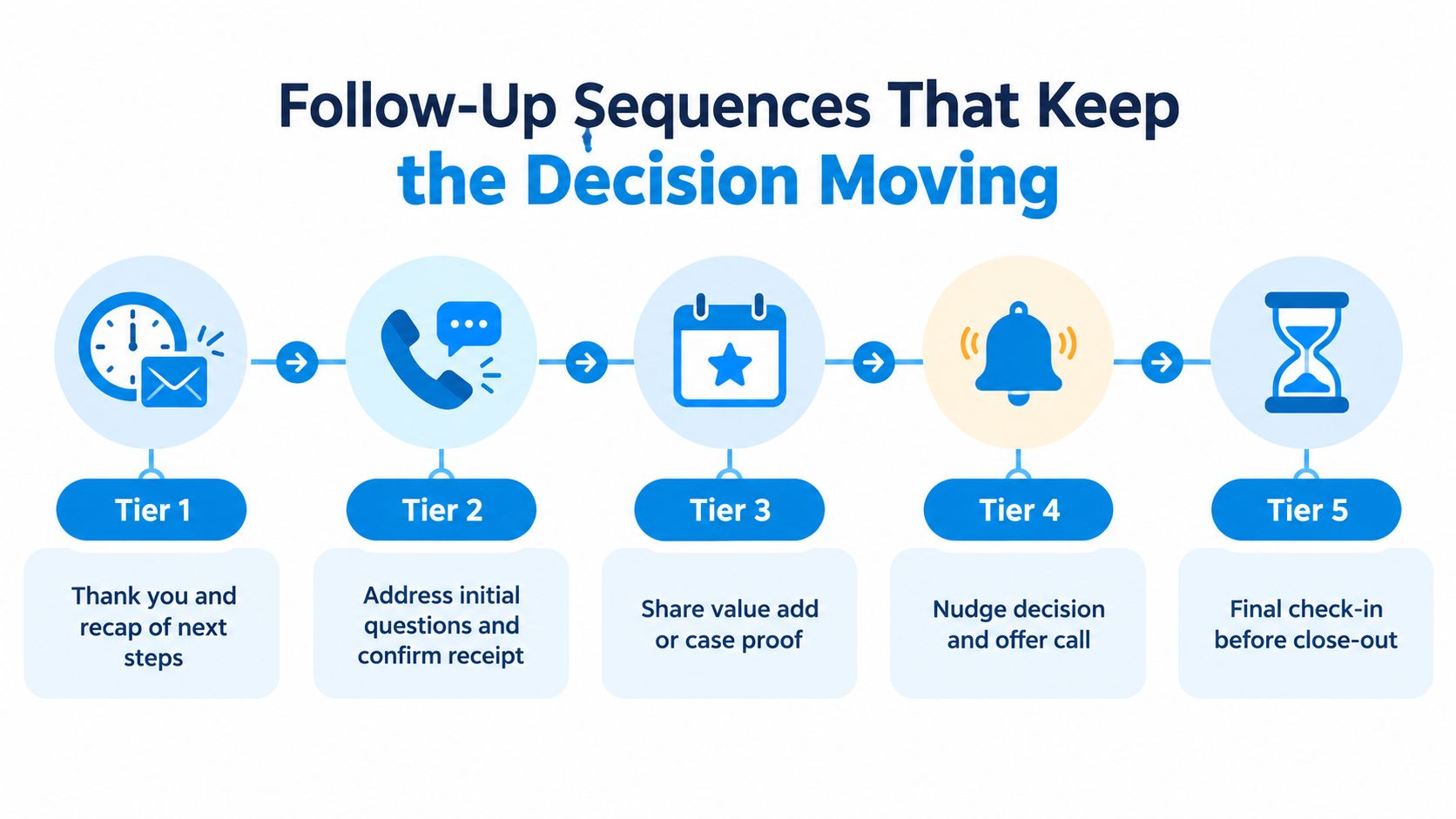
A five-tier cadence keeps pressure without noise
The 24-hour touch confirms receipt and reconnects the proposal to the agreed outcome. Restate the main result, identify the next decision step, and name the person responsible for it. Avoid a status check that gives the buyer nothing useful to answer.
The 48-hour touch offers a live walkthrough. A short call lets the buyer raise pricing, scope, or approval concerns without drafting a long email. The proposal follow-up playbook cites research that opportunities contacted within 5 minutes are 21x more likely to convert than those reached after 30 minutes. That speed applies most directly to an active inquiry, but the operating lesson still matters after a proposal is sent: assign ownership before the signal appears.
By day 3, send one useful item tied to the buyer's stated problem. Use a process note, relevant benchmark, or scope clarification. The purpose is to help the buyer explain the recommendation internally, not to announce that you are still waiting.
Days 7 and 14 name the decision
The day 7 touch asks for a decision and offers two specific call times. If the proposal is viable, continued ambiguity usually reflects an unresolved question, competing priority, or missing approver. Ask which condition applies and record the response.
The day 14 touch closes the active sequence respectfully. State that you will remove the proposal from active pursuit unless the buyer wants to keep it open, then give them a clear way to restart the conversation.
A proposal follow-up system for consulting workflows can track ownership, schedule reminders, and start a defined sequence after delivery. The value is operational: fewer missed checkpoints and less dependence on someone remembering every touch manually.
Each tier needs one owner and one exit criterion. A buyer reply, scheduled call, requested revision, explicit decline, or agreed pause should stop the automated sequence and move the opportunity to its next stage. Skipping a tier is fine when engagement changes. Leaving the deal without a recorded next action is what lets it disappear.
Knowledge Governance That Keeps Proposals Accurate
Speed doesn't help if the content is stale. I've seen firms send fast proposals that still used outdated pricing, retired case studies, or scope language that no longer matched delivery reality. That doesn't just create polish issues, it creates trust issues.
The real bottleneck is often the source material
If the service catalog lives in one folder, case studies live in another, and pricing sits in the founder's head, every proposal becomes a manual reconstruction job. The writing may be quick, but the verification is slow and error-prone.
A useful operating model has one owner per core asset, one review cadence, and one locked source of truth. The four assets that need discipline are the service catalog, the case study library, the pricing model, and the standard scope templates. If those drift, the whole proposal process drifts with them.
The content system should be lighter than people expect
This doesn't require an enterprise knowledge platform on day one. It does require someone to own updates and someone else to check that proposals are pulling from current material. When teams skip that layer, they end up with Google Docs that look fine until a prospect asks a question the document can't answer cleanly.
The bigger trade-off is between speed and decision quality. Recent commentary in the 2025 proposal management industry snapshot notes heavy AI use for research and summarization, and that some organizations implementing AI proposal systems report faster response times. Faster production sounds good, but if the content base is weak, you just produce inaccurate proposals more efficiently.
Accuracy is a process, not a proofreading step.
For small consulting firms, that means lightweight governance wins. A quarterly review, named ownership, and a source-of-truth folder are usually enough to stop the same mistakes from repeating across every send.
A 30-Day Rollout Plan for Your Firm
A rollout works when each week produces one artifact the team can use. If you try to “improve proposal management” without dividing the work, the effort gets vague and dies in Slack. The goal is a working operating system by the end of the month, not a perfect one.
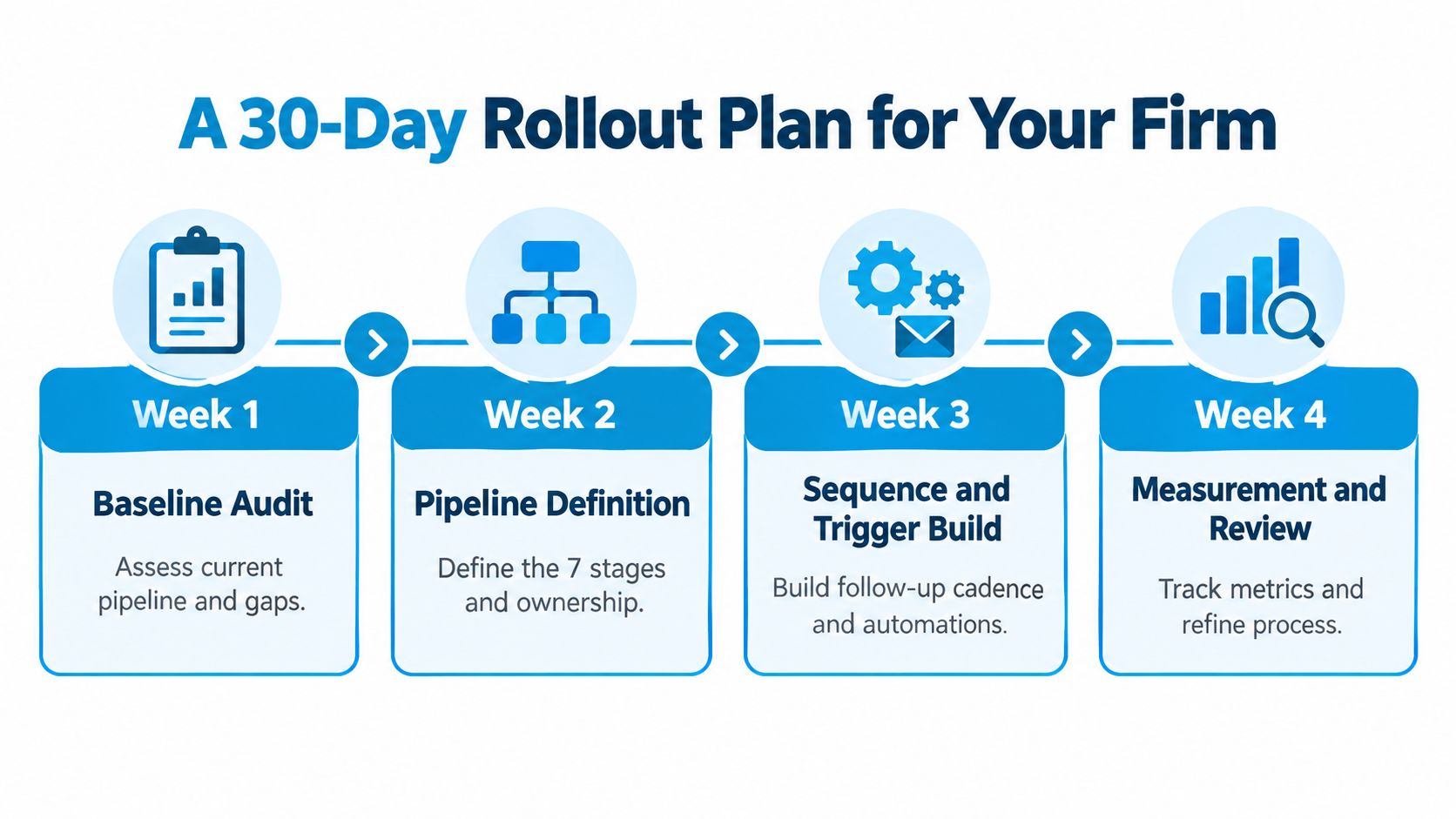
Week 1 through Week 4
Week 1, baseline audit. The proposal lead reviews recent deals and maps where proposals sat untouched past 48 hours. The artifact is a short audit document that shows where the delays are happening.
Week 2, pipeline definition. The founder-operator and deal owner agree on the seven stages, the owners, and the checkpoint for each stage. The artifact is a stage definition sheet that everyone can reference.
Week 3, sequence and trigger build. The team writes the follow-up sequence, sets the engagement triggers, and assigns response ownership. The artifact is a usable sequence template, not a concept note.
Week 4, measurement and review. The team builds a simple dashboard and checks whether proposals are still sitting untouched past 48 hours. The first measurable outcome is a reduction in that weekly count.
What happens after the first month
A Week 5 handoff should make the cadence self-owned. That means the proposal lead knows the rules, the deal owner knows the trigger points, and the founder only steps in for exceptions. At that point, the operating system is no longer a project, it's the way the firm works.
The important thing is to connect each week back to the prior discipline. Baseline audit comes from the quiet-proposal problem, pipeline definition comes from the stage model, sequence and trigger build comes from engagement signals, and measurement comes from the fact that follow-up only works when someone watches the clock. If those links hold, the rollout will stick.
If you want help turning proposal follow-up from a manual headache into a repeatable system, Starward Navigators builds the acquisition infrastructure that small consulting firms need, from proposal tracking to automated reminders and handoffs. Visit Starward Navigators to see how the workflow can be standardized around your sales process and decision stages.