
A warm introduction arrives in your inbox from a trusted client. You forward it to a colleague, add a note to a spreadsheet, and promise yourself you'll follow up after the proposal already in progress. A week later, the prospect hasn't received a clear response, the referring client assumes you weren't interested, and the opportunity disappears into an email thread nobody owns.
That failure rarely comes from a lack of relationships. It comes from treating relationships as memory work. A referral management system gives every introduction a visible owner, a defined next action, and a path from first contact to proposal, delivery, renewal, and the next suitable introduction.
Table of Contents
- Why Consulting Firms Need a Dedicated Referral Management System
- Purpose-Built Infrastructure Versus Generic CRMs
- Core Features That Drive Advisory Client Acquisition
- Metrics to Track for Partner-Led Growth
- Connecting Referrals to the Client Lifecycle
- Implementation Patterns for Small Consulting Teams
- Evaluating the Right Solution for Your Firm
Why Consulting Firms Need a Dedicated Referral Management System
Small consulting firms often win work through people who already trust them. A former client introduces a founder, an accountant recommends an operations advisor, or a fractional executive sends a colleague who needs help with a problem your firm has solved before. These introductions usually carry more context than a cold inquiry, but that value vanishes when the handoff is informal.
The operational problem is easy to recognize. One partner receives the introduction, another person conducts the discovery call, and a third person prepares the proposal. The referring source may never be recorded against the opportunity. Nobody knows who should send the thank-you message. If the prospect pauses after receiving the proposal, the follow-up depends on whoever remembers the conversation.
A referral management system is the operating layer that connects those actions. It records who referred the opportunity, captures the relationship history, routes the inquiry to an owner, tracks the proposal, and preserves the link between the source and the eventual client. It isn't just a contact database, and it isn't a campaign aimed at generating one temporary burst of introductions.
Practical rule: A referral isn't managed when you've logged the name. It's managed when someone can answer what happens next, who owns it, and whether the relationship was properly closed.
Referrals are an asset, not a side activity
The commercial case is strong. The global referral management market was estimated at USD 4.81 billion in 2024 and USD 5.69 billion in 2025, and one forecast projects USD 7.2 billion by 2034. The same market analysis describes the category's expansion from a narrow workflow into software used to systematize partner-led growth (market forecast for referral management software).
Referral-led clients also tend to behave differently from clients acquired through paid channels. A Journal of Marketing finding cited in industry research puts referred customer lifetime value at 16% higher, while the same summary reports that referred customers make 27% more purchases, spend 28% more, and retain at a 37% higher rate than customers acquired through paid channels (referral marketing research summary). Those figures are from broader referral research, not a guarantee for every consultancy, but they explain why a neglected introduction deserves more than a spreadsheet row.
What the system must protect
For a boutique firm, the basic workflow should preserve four relationships:
- The source relationship: Who made the introduction, what context do they have, and who owns communication with them?
- The opportunity: What service does the prospect need, and where is the inquiry in the sales process?
- The handoff: What must happen between discovery, proposal, decision, and onboarding?
- The future relationship: When should the firm thank, update, nurture, or re-engage the source?
The system earns its place when it makes those links visible without asking consultants to become full-time administrators. A referral should enter one shared workflow whether it arrives through email, LinkedIn, an event, a website form, or a direct message. That consistency prevents high-value sources from going dormant and gives every warm introduction the same minimum standard of care.
Purpose-Built Infrastructure Versus Generic CRMs
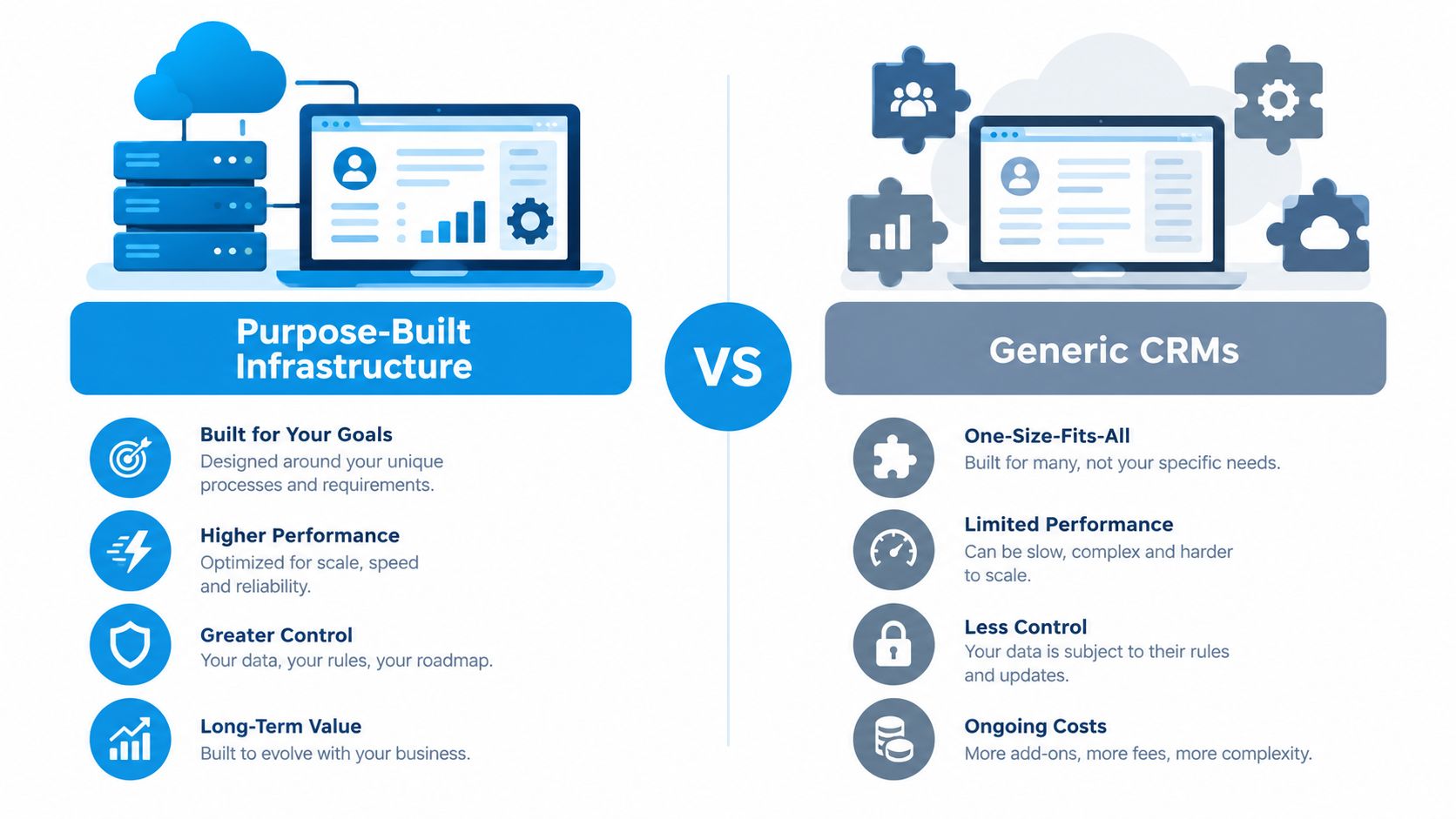
A generic CRM gives you fields, records, stages, and flexibility. That sounds attractive until a small consultancy has to decide which fields to create, what each stage means, who receives alerts, when follow-ups run, and how a won opportunity becomes an active delivery relationship.
A purpose-built referral system starts with those decisions already translated into workflows. The distinction isn't that one tool stores contacts and the other doesn't. Both can store contacts. The distinction is whether the firm receives a usable operating process or a blank workspace that someone must design, test, maintain, and explain.
The trade-off in daily operations
A generic CRM can work well when the firm has internal operations capacity and genuinely needs extensive customization. It may integrate with existing sales tools, support complex reporting, or accommodate unusual commercial processes. The cost is that someone must translate the firm's referral habits into a reliable system, and that work doesn't end when the initial configuration is complete.
A dedicated system is less flexible by design. It gives up some blank-slate freedom in exchange for prebuilt stages, reminders, proposal follow-up, source attribution, partner nurture, and client handoffs. For a small advisory team, that constraint often improves adoption because staff don't have to debate how every introduction should be handled.
| Workflow Element | Generic CRM | Purpose-Built Referral System |
|---|---|---|
| Referral intake | Requires fields, forms, and routing rules to be configured | Captures the source, opportunity, owner, and next action in one workflow |
| Partner history | Often stored as notes or custom objects | Maintains a relationship record with referral activity and communication history |
| Proposal follow-up | Depends on manually created tasks or custom automation | Uses defined stages and reminders for stalled decisions |
| Client handoff | Usually requires a separate process or integration | Moves a won opportunity into onboarding and delivery steps |
| Referral nurture | Needs campaigns and segmentation designed by the team | Provides structured thank-you and relationship follow-up |
| Accountability | Reporting depends on consistent user behavior | Ownership and overdue actions are built into the workflow |
Where generic tools usually break
The proposal-to-decision gap is the most revealing test. A generic CRM may show that a proposal exists, but it won't necessarily tell the owner what should happen after the prospect goes quiet. Teams then create personal reminders, send inconsistent follow-ups, or stop contacting the prospect because the opportunity still appears active.
A purpose-built workflow can assign the next action at each stage. It can distinguish an unqualified inquiry from a completed discovery call, attach the referring partner to the opportunity, notify the right person when a proposal needs attention, and trigger a client handoff when the opportunity is won.
The right choice depends on your firm's operating maturity. Choose a generic CRM when you have the time and expertise to build the process. Choose purpose-built infrastructure when the priority is consistent execution with low administrative overhead, not unlimited configuration.
Core Features That Drive Advisory Client Acquisition
A small advisory firm doesn't need every feature found in an enterprise sales suite. It needs a short chain of dependable actions that moves an introduction from arrival to decision without relying on personal memory.
The first requirement is centralized capture. Referrals arrive through inboxes, LinkedIn messages, event conversations, contact forms, and direct introductions. If each channel has its own informal process, the firm can't tell whether a source was acknowledged, whether the prospect was contacted, or whether a proposal is waiting for a decision.
Capture and route the opportunity
The system should record the opportunity source as soon as the referral arrives. That record should include the referring person, the prospect, the context of the introduction, the service area, and the person responsible for the next step.
Routing rules don't need to be complicated. They might assign financial advisory inquiries to one partner, transformation work to another, or urgent requests to whoever is available. What matters is that the assignment is explicit and visible rather than implied by who happened to receive the original email.
Appointment scheduling belongs in the same chain. Confirmation messages, reminders, internal alerts, and discovery-call preparation should follow a standard pattern. That prevents one consultant from sending a polished confirmation while another leaves the prospect waiting for a calendar link.
Control the proposal-to-decision gap
Most referral processes receive attention at intake and again when the work is won. The quiet middle is where opportunities lose momentum. A useful system should define what happens after discovery, after proposal delivery, when a question is outstanding, and when a decision has been delayed.
A practical proposal workflow includes:
- A defined stage: Discovery complete, proposal in preparation, proposal sent, decision pending, won, or lost.
- A next action: The owner knows whether to clarify scope, schedule a review, send a reminder, or close the record.
- An accountable owner: The opportunity can't sit in a shared queue with no named person responsible.
- A source connection: The referring partner remains attached to the opportunity even after it enters the sales pipeline.
- An onboarding trigger: A won stage starts the delivery handoff instead of creating another manual data-entry task.
Preserve the handoff
The strongest acquisition workflow doesn't end at the signed agreement. It updates the record, starts the client delivery pipeline, alerts the delivery owner, and schedules the kickoff process. That continuity matters because the client experience after the introduction affects whether the source will refer again.
Clinician-facing referral research offers a useful parallel. In one evaluation, users rated functions including information sharing with the recipient, specialty-specific reasons, provider search, overdue-referral detection, and close documentation as useful at rates ranging from 71% to 78% (evaluation of closed-loop referral functions). Consulting firms don't need to copy healthcare workflows, but the principle applies: intake alone isn't management. The system must help people complete the handoff and record the outcome.
Metrics to Track for Partner-Led Growth
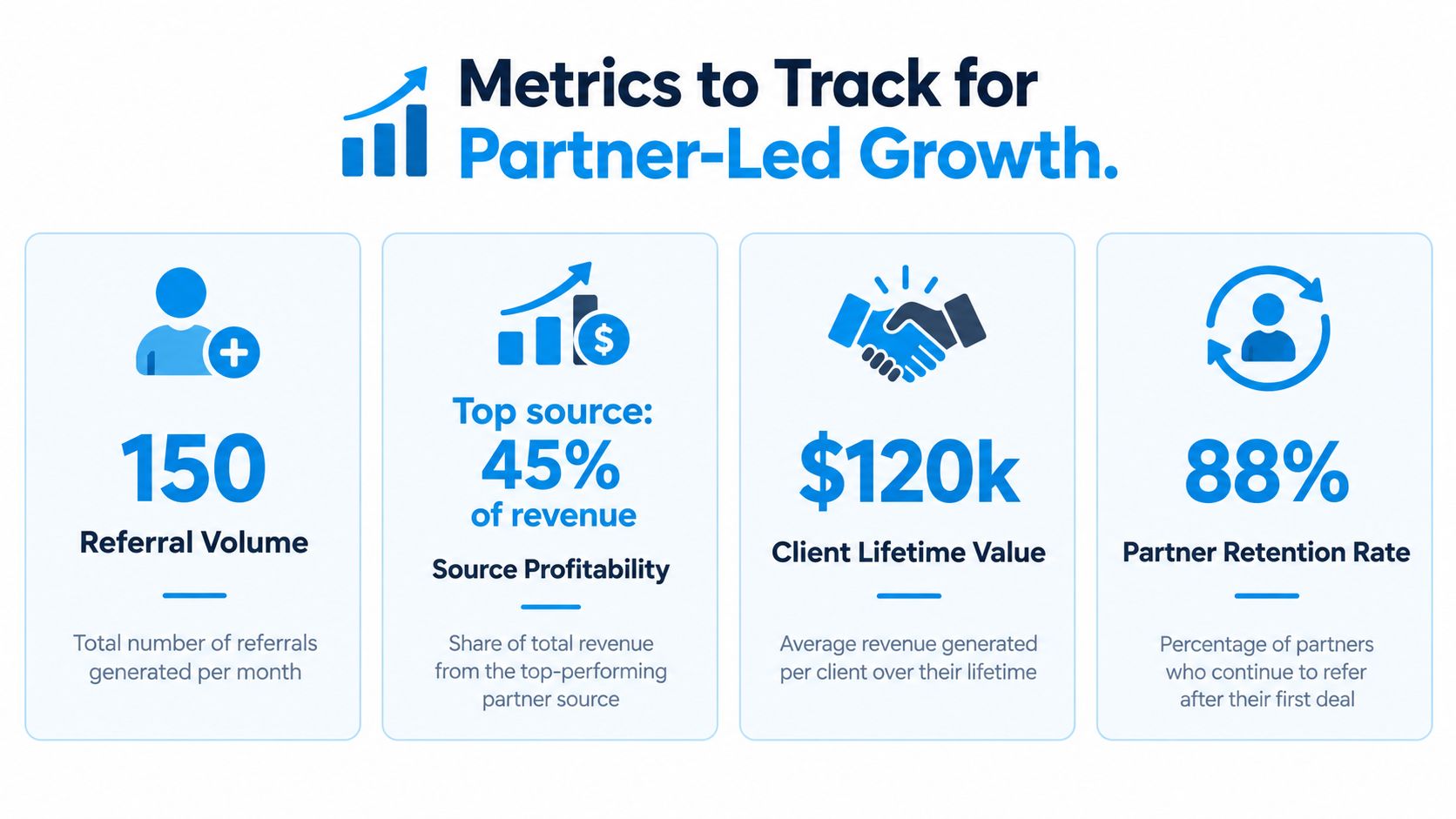
Referral volume is an attractive number because it's easy to count. It also tells you very little by itself. A source can send frequent inquiries that rarely fit your services, while another sends fewer introductions that become durable, profitable relationships.
Start with four operational metrics. They reveal where the workflow is working and where the firm is allowing opportunities or relationships to stall.
Four measures that expose quality
- Referral volume by source: Count introductions by partner and channel. This shows who is active, but it shouldn't determine priority on its own.
- Inquiry-to-conversion rate by source: Compare inquiries with signed engagements for each source. A lower-volume partner may produce a stronger commercial fit.
- Average response time by source: Measure how quickly the firm acknowledges and acts on an introduction. Slow response signals a routing or ownership problem.
- Source retention over time: Track whether partners continue referring and engaging with the firm after their initial introduction.
The recommended operational set of measures, along with source database fields such as referral history, conversion rates, preferred communication methods, and relationship-owner assignments, is outlined in this referral management definition and metric guide.
Build a source database people will actually use
A source record should answer more than “who are they?” Capture the relationship owner, the partner's preferred communication method, past introductions, the status of each opportunity, the outcome, and the last meaningful interaction.
Keep the fields practical. If a field won't change how someone follows up, routes work, or evaluates the relationship, it may not belong in the operating record. The objective is to support tiered nurture, not to create a detailed archive nobody opens.
A simple review process can assign sources to working categories:
- Active strategic sources receive personal updates, relevant insights, and direct relationship attention.
- Promising sources receive timely thank-yous and occasional useful follow-up after an introduction.
- Dormant sources receive a thoughtful re-engagement rather than a generic campaign.
- Poor-fit sources remain documented, but the firm doesn't spend disproportionate time trying to increase their volume.
Use the metrics to improve decisions, not to pressure partners. Automation should reduce missed follow-ups and routine acknowledgments. It shouldn't encourage the team to chase more low-quality referrals just because the dashboard is rising. For a practical implementation perspective, see this guide to tracking referrals across sources.
Connecting Referrals to the Client Lifecycle
A referral request feels awkward when it appears without context. It feels natural when it follows a moment in which the client has experienced value, gained confidence, or reached a meaningful transition.
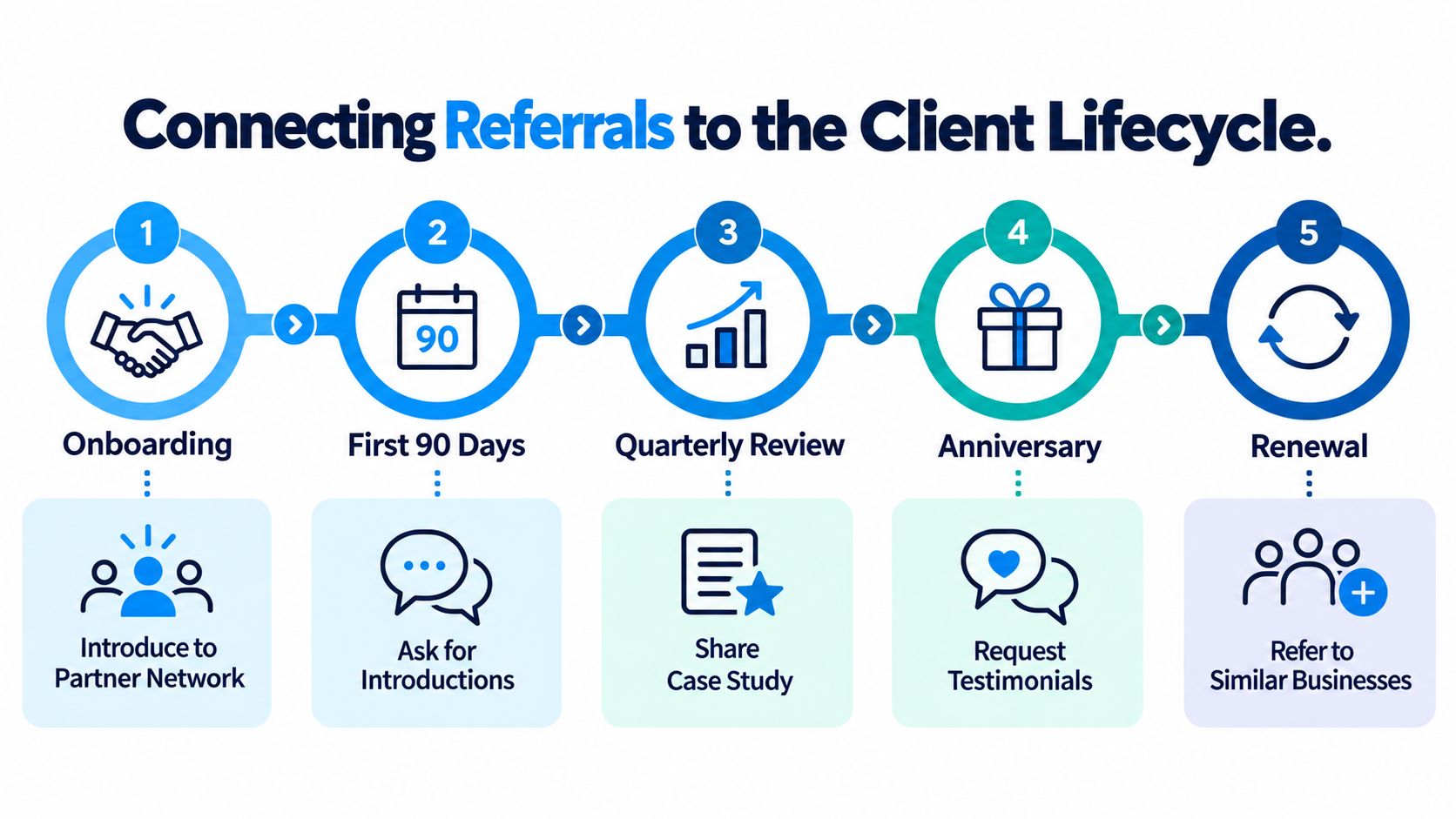
That makes referrals a lifecycle process, not a one-time marketing campaign. The right question isn't “When should we send the referral email?” It's “Which client event creates a credible reason to invite an introduction?”
Match the request to the moment
At onboarding, the firm should focus on confidence and clarity. A referral request at this stage may be premature, but a client can introduce the firm to relevant members of a partner network if that introduction is part of the engagement context.
After the initial delivery milestone, the client has more evidence of how the firm works. If the client confirms that the project is on track, the consultant can ask whether another leader in their network faces a similar challenge. The request should name the type of problem the firm helps with, not ask vaguely for “any referrals.”
At a quarterly review, use the client's own language. What outcome has improved? Which internal issue has become easier to manage? Those details help the client identify someone who may benefit from a conversation.
Renewal is another useful point, particularly when the client is continuing because the relationship has produced value. A referral request can sit alongside the renewal conversation, provided the delivery team has first confirmed satisfaction and addressed outstanding concerns.
Turn satisfied clients into visible partners
The system should record the event that prompted the request, the client's response, and the next appropriate touch. If an introduction arrives, it should connect to the source relationship automatically. If no introduction arrives, the firm shouldn't keep asking on a fixed schedule without considering the client's current priorities.
This approach also improves repeat-business handoffs. A client who refers someone may later need another service, introduce a colleague, or become a formal partner. Those possibilities require relationship ownership, not just a closed sales record.
A practical client onboarding process creates the foundation for these later moments because it establishes goals, owners, communication expectations, and early satisfaction signals. The referral workflow can then use those signals to identify appropriate opportunities for a request.
The best referral prompt follows evidence of value. It doesn't interrupt delivery to satisfy a marketing calendar.
Implementation Patterns for Small Consulting Teams
Implementation fails when the firm tries to automate confusion. Before choosing fields or writing follow-up messages, map how introductions move through the business. Include the informal paths, such as a partner forwarding an email, a consultant meeting someone at an event, or a prospect replying to a LinkedIn message.
A small team can use a three-phase approach: Map, Install, and Go Live. Each phase should produce a usable result, not another planning document.
Map the real workflow
Start by listing the sources that currently generate introductions and the people who handle them. Identify where referral information is stored, how the firm assigns ownership, what happens after discovery, and how a won opportunity reaches the delivery team.
Include the existing contact data. Importing records without deciding which fields matter just moves clutter into a new system. Separate active partners, past referral sources, current prospects, existing clients, and contacts who need clarification.
The map should answer:
- Where does an introduction arrive? Email, website form, LinkedIn, event, phone, or direct message.
- Who receives it first? A managing partner, business development lead, assistant, or delivery consultant.
- What must happen immediately? Acknowledgment, qualification, scheduling, or internal assignment.
- What causes delay? Missing context, unclear ownership, proposal preparation, or a lack of follow-up discipline.
- What marks completion? A decision, signed engagement, onboarding kickoff, declined opportunity, or deliberate nurture status.
Install the minimum viable workflow
Configure the pipelines and notifications around those answers. Connect forms to the existing website where appropriate. Create a single intake path that records the source and assigns an owner. Set up appointment confirmations, internal alerts, proposal stages, and the handoff into delivery.
Don't automate every possible message at the start. Automate the events that routinely fail when people are busy, such as the first acknowledgment, a reminder after a proposal, a thank-you to the referrer, and an owner notification when an opportunity changes stage.
The publisher's implementation model uses a defined Map, Install, Go Live process, with contact import, centralized source capture, workflow configuration, and a stated 14-day go-live guarantee as part of its setup offer. Those are implementation terms to verify directly before purchase, not assumptions to apply to every vendor.
A short walkthrough can help the team see the operating pattern before configuration begins.
Go live with a controlled pilot
Choose a small group of active opportunities and referral relationships for the initial pilot. Test the full path from intake to acknowledgment, discovery, proposal, decision, onboarding, and source follow-up. Ask the team to report where the workflow conflicts with actual practice.
Fix ownership and stage definitions before adding more automation. A workflow that reflects the firm's real decisions will be adopted; a workflow that merely reproduces a software vendor's terminology will be bypassed.
Evaluating the Right Solution for Your Firm
The right referral management system is the one your team will use when a partner sends an introduction during a busy delivery week. It should reduce the number of places people check, make the next action obvious, and protect the source relationship after the prospect enters the sales process.
Start with a direct audit. Pull together current spreadsheets, inbox labels, proposal trackers, calendar notes, and partner lists. Then compare the records against recent introductions. If you can't identify the owner, current stage, next action, source, and outcome for each opportunity, your problem is operational visibility rather than lead generation.
A practical decision matrix
| Your current condition | Sensible response |
|---|---|
| The team has a simple, consistent process and only needs contact storage | A light CRM may be sufficient |
| Referrals arrive through several channels and ownership is unclear | Use centralized capture and explicit routing |
| Proposals often go quiet after delivery | Add stage-based follow-up and overdue visibility |
| Partners are thanked inconsistently or forgotten after an introduction | Create a separate relationship pipeline |
| Won opportunities are handed to delivery manually | Automate the record update and owner notification |
| The firm has internal capacity for extensive configuration | Consider a flexible CRM with a documented build plan |
| The firm needs a working process without maintaining custom automation | Evaluate purpose-built infrastructure and implementation support |
Look for a separate relationship pipeline rather than treating every referrer as a sales prospect. The source needs its own history, owner, communication preferences, and nurture logic. The opportunity needs its own qualification, proposal, and decision stages. Connecting the two preserves attribution without forcing unrelated work into one record.
Questions to ask vendors
Ask vendors to demonstrate a real referral, not a feature tour. Show them an introduction arriving through a website form, an owner receiving the alert, a discovery appointment being scheduled, a proposal becoming stalled, and the referring partner receiving the appropriate follow-up.
Then ask what happens when the prospect is not a fit. A mature system should preserve the relationship, record the reason, and support a respectful close or future nurture. It shouldn't treat every referral as either won or deleted.
Finally, verify implementation responsibilities, data import, integrations, user access, reporting, and exit procedures. Market research describes a shift toward centralized, integrated, and more automated referral handling, while also highlighting the need for segmentation, routing, and relationship intelligence (referral marketing software market analysis). Another market overview emphasizes the movement toward real-time visibility across intake, scheduling, and accountability, including for smaller organizations (referral management market overview).
A firm should move beyond spreadsheets when missed ownership and inconsistent follow-up are costing trust. It should move beyond a generic CRM when the team has already built workarounds for referral attribution, proposal follow-up, partner nurture, and client handoffs. A dedicated referral management platform becomes a reasonable option when those workflows need to operate together without becoming another administrative project.
Starward Navigators provides client acquisition infrastructure for consulting and advisory firms, including prebuilt pipelines for business development, client delivery, relationships, and referrals, with automated follow-up, proposal tracking, scheduling, and handoffs. Visit Starward Navigators to review the platform and discuss how to turn warm introductions into a managed lifecycle process.