A website inquiry arrives on Saturday morning. On Monday, two partners ask who owns it. One has taken nine new leads this month, the other three, and nobody can say whether that's the rotation, the referral flow, or a form that stopped firing webhooks back in March.
That is the usual state of lead routing in a firm of four to twenty people. Someone switched on round robin two years ago, it looked fair, and it has been distributing work ever since, with no rule about who is eligible, no backup when a partner is on leave, and no record of who called the lead back.
Round robin lead assignment is a good default for a narrow case and a poor one for everything else. What separates the two is not the rotation. It's the rules you build before any lead reaches it.
Table of Contents
- What Round Robin Lead Assignment Is and When It Fits
- Build the Routing Rules Before Leads Enter the Rotation
- How to Configure Round Robin in Starward Navigators
- Measure Fairness With Outcomes Instead of Lead Counts
- Fix Common Round Robin Problems in Live Routing
- Confirm Your Routing Before You Go Live
What Round Robin Lead Assignment Is and When It Fits
A new inquiry arrives, and any of three consultants could handle it equally well. Round robin assigns it to the next person in a fixed rotation: Priya, then Marcus, then Elena, then back to Priya. The rotation settles ownership before the team has to decide who gets the next lead.
The key word is eligible. A rotation works only when the people in it can serve the lead and are available to take it.
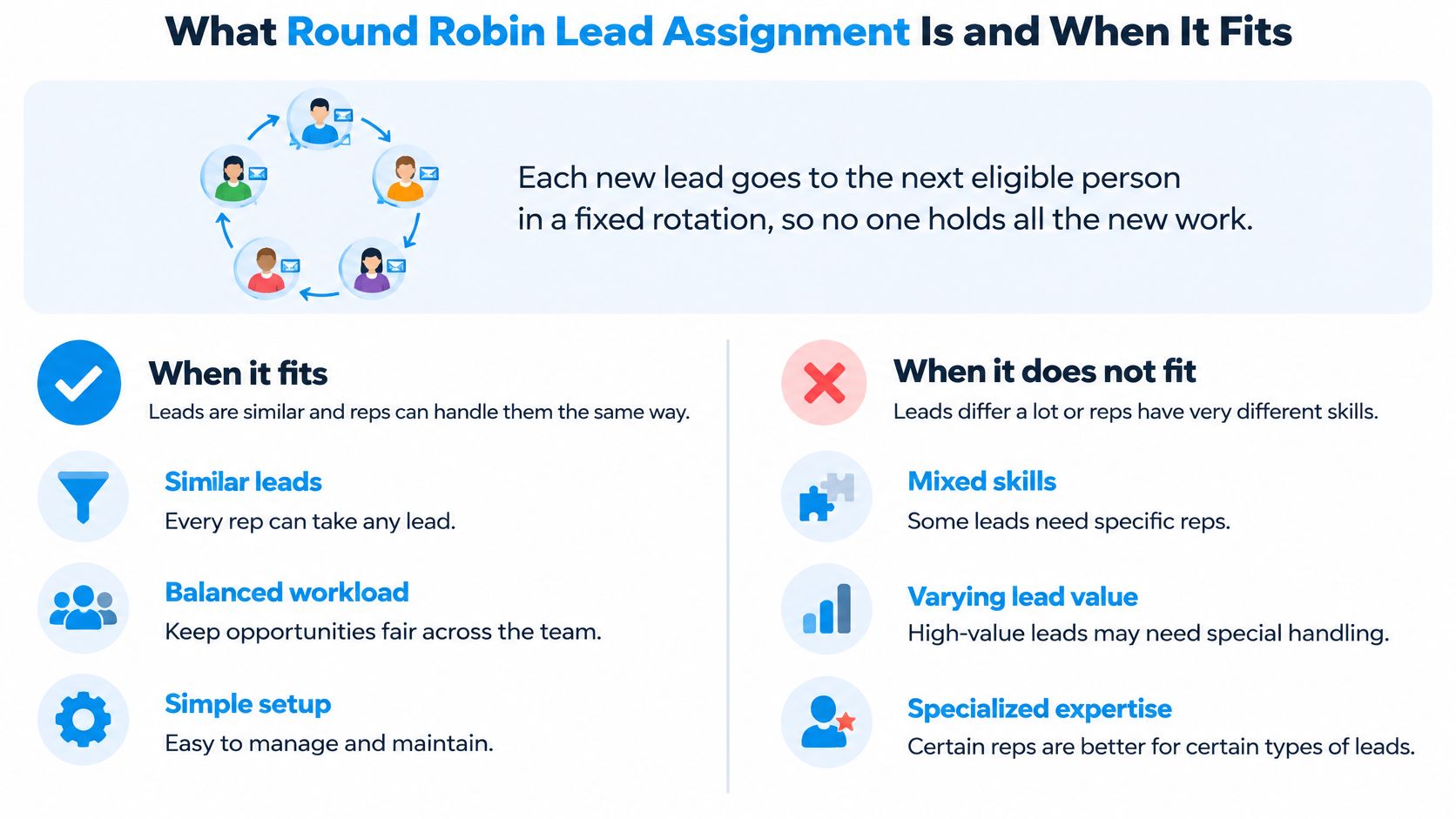
Round robin fits best when leads are similar and consultants have comparable capacity. A firm handling one kind of inquiry for one kind of buyer can use a plain rotation. Equal lead counts, however, do not guarantee equal opportunity: some leads are a better fit, easier to serve, or more likely to move forward than others.
| Lead situation | Best routing method | Why it fits |
|---|---|---|
| Similar leads, interchangeable reps | Round robin | Distributes comparable opportunities across the team |
| Reps differ by territory or market | Territory rules, then round robin | Preserves relevant local context |
| Specialist needed by industry or language | Skills-based routing | Matches expertise to the lead's needs |
| Existing client or named account | Ownership rule | Avoids conflicting contact |
| Assigned rep unavailable or over capacity | Round robin with backup owner | Keeps the lead from waiting on an unavailable assignee |
Where a strict rotation goes wrong
A mixed lead pool can make an even rotation unfair. A complex enterprise inquiry may go to a generalist because it is their turn. A time-sensitive introduction may reach a partner who is away. Consultants with very different workloads may receive the same number of leads but have little else in common.
Consider a four-partner firm where two partners handle healthcare clients and two handle fintech. Rotating across all four sends some healthcare referrals to partners without that sector's experience. The count stays even; the match does not.
Use fit rules first, then rotate what remains. The Graph8 guide to round robin sales scheduling describes putting ownership, named-account, territory, and segment rules ahead of the rotation, with a backup owner for unavailable assignees. Buyers may also want seller input when a decision requires contextual judgment, even if they prefer to handle other parts of the buying process themselves.
Routing rule: apply ownership, territory, and segment rules first. Rotate only the leads that remain.
For an example of capture, assignment, and follow-up working as one pipeline, see Internal Systems' real estate automation build.
Count how many of your lead types are interchangeable: any consultant could take one and serve it just as well. If most are, a plain rotation may fit. If only two of seven types are interchangeable, reserve round robin for that smaller pool.
Build the Routing Rules Before Leads Enter the Rotation
A rotating list and a routing queue behave differently the moment two leads arrive in the same second. Treat the rotation as a stateful queue: it holds a pointer to whose turn is next, and that pointer advances inside a transaction rather than in someone's memory or a spreadsheet row.
The build sequence, in order.
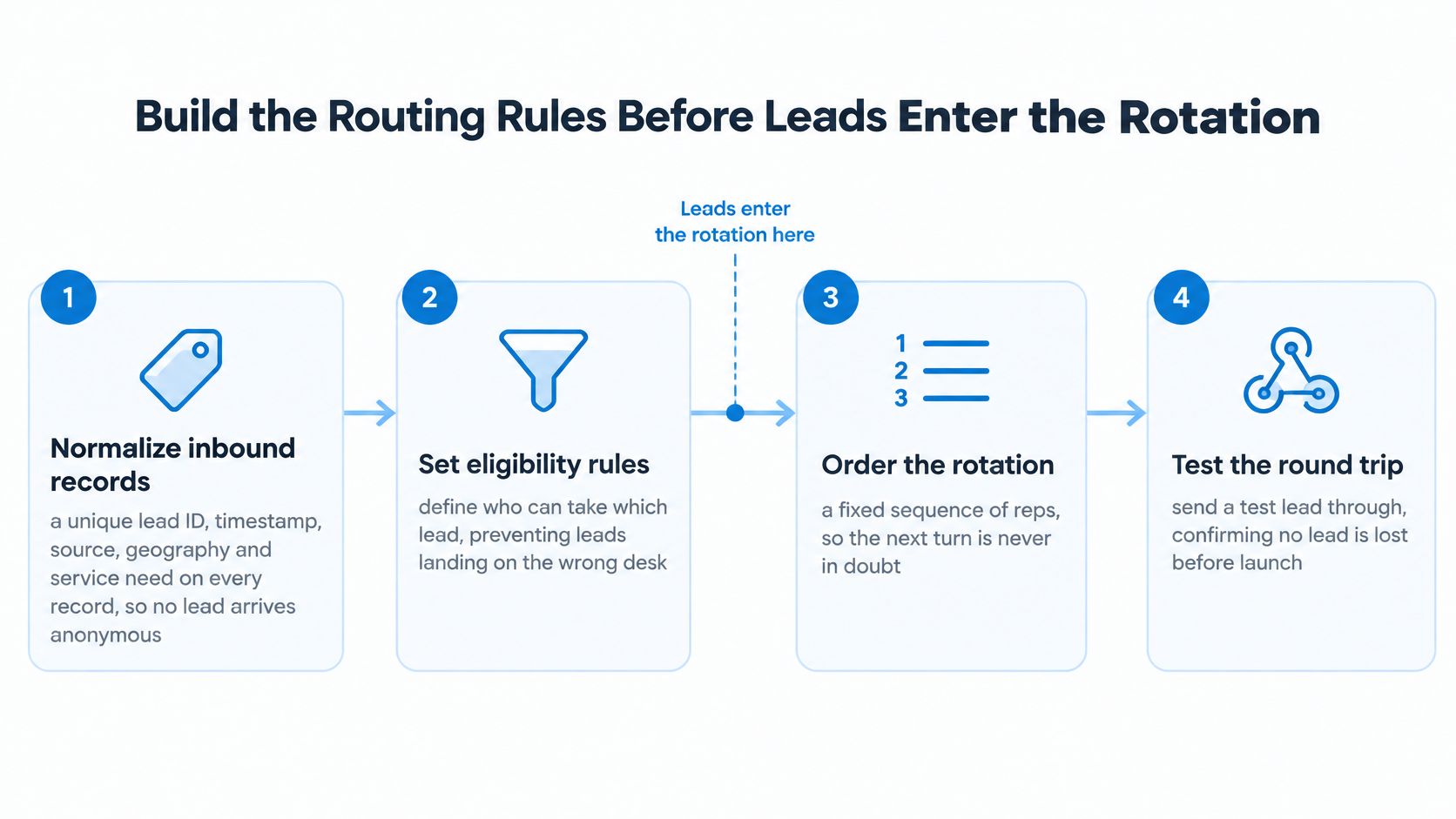
1. Normalize every inbound record. Give each lead a unique lead ID, a timestamp, source, geography, service need and consent status. Without a stable ID, a prospect who submits the form twice becomes two leads and two assignments and two follow-ups. Without consent status, nobody can tell whether the person agreed to be contacted at all.
2. Apply eligibility filters before the rotation runs. Four checks do most of the work: the owner is active, the lead fits their market, they have capacity, and no one already owns the account. Filter after assignment and you get the worst sequence in lead routing, where a lead is handed to someone and then pulled back.
3. Assign with a persisted pointer and advance it atomically. The next eligible representative takes the lead, and the pointer moves in the same transaction. Skip the transaction and two simultaneous submissions both read the same pointer, both write the same owner, and one lead disappears.
4. Start an acknowledgment and a first-contact SLA immediately. Stamp the assignment time and the first-contact time, then escalate when the owner has neither accepted nor attempted contact inside the window. A rule with no timer attached is a suggestion.
5. Exclude unavailable, inactive, over-capacity and rejected owners while keeping an audit trail. Every skip gets logged with its reason. Without that log you can't tell a routing fault from a seller who never called.
Where the eligible-owner list should sit, and how it relates to the client record, is covered in our guide to a CRM built for consulting firms. If inbound volume makes step 1 heavy, Prometheus Agency's approach to AI for inbound sales triage covers how to classify and prioritize inquiries before they reach the assignment rules.
Why speed needs its own measurement
Fairness and speed are separate metrics, and most firms miss the second one badly. An audit of 2,241 U.S. companies found that only 37% responded to web leads within one hour, 23% never responded, and the average response among companies that did reply within 30 days was 42 hours, per Inflowave's lead routing research. That same audit found firms contacting leads within an hour were nearly seven times more likely to qualify them than firms waiting another hour.
Handle joins, leaves and holidays mid-cycle
When a partner joins, leaves or takes extended leave, record the change in the eligibility list and reset the next pointer deliberately. Get this wrong in either direction and the returning owner is skipped for a month, or appears twice in one rotation and takes double volume in a week. Log the change with a date and a name so a fairness dispute six months from now has an answer.
Before go live, answer three questions in writing. Who is eligible to receive each lead type? Who is the backup for every owner? What exactly counts as a missed response, in minutes?
How to Configure Round Robin in Starward Navigators
A rotation only works when its rules match how your firm handles different leads. Starward Navigators configures routing alongside pipelines, follow-up, reminders, and handoffs, using a map of how work currently moves through your firm.
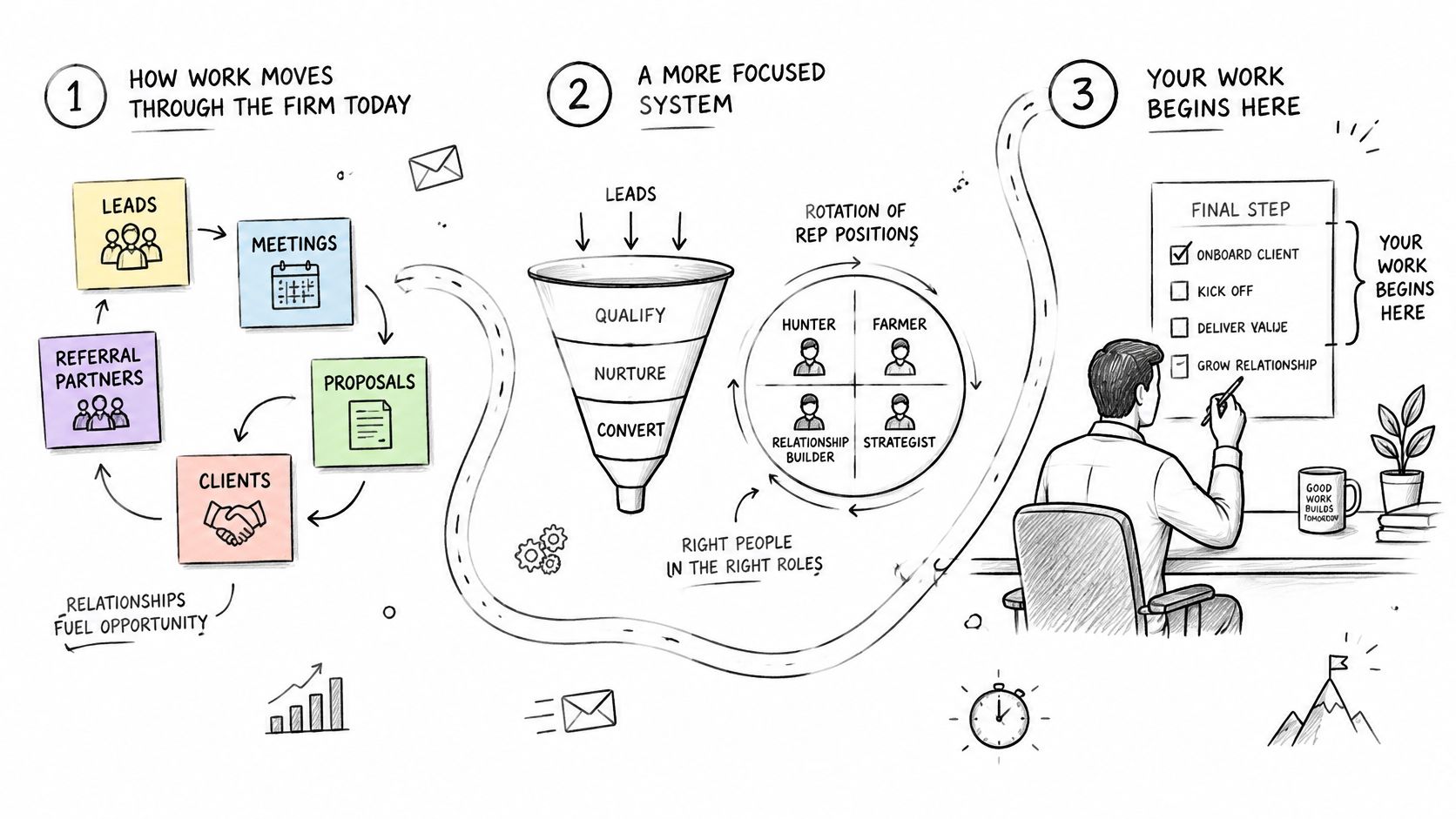
Implementation follows three steps: Map, Install, and Go Live.
Map how work moves through the firm today
Start by describing how leads, meetings, proposals, clients, and referral partners move through the firm now. Note who handles each lead type and which relationships call for a specific owner. That gives Starward the context to configure routing around how your firm already works.
Install the pipeline and drop the routing rules into it
The Business Development pipeline comes with stages from New Lead through Contacted, Qualified, Discovery Booked, Discovery Complete, Proposal, Decision, Won, and Nurture. Each card has an owner and a next action. The routing rules you wrote in the previous step, such as which owners are eligible for each lead type, go in here, and Starward configures routing around how your firm already works. Routing sits alongside follow-up in the lead management pipeline.
For example, a fractional CFO firm might send referral leads to the partner who owns the referrer, while rotating website inquiries among eligible associates. Fit comes first; rotation distributes the leads that remain.
Go live in one system and check the first week
Go Live means using one operating system while repetitive follow-up runs automatically. A new inquiry is tagged, sourced, and receives an automatic first response. During the first week, check whether assignments match the eligibility rules and whether each card has a clear owner and next action.
Bring your lead sources, owner eligibility by lead type, and any relationship-specific routing requirements to the Map step. Those decisions give the Install step a practical basis without assuming every lead belongs in the same rotation.
Measure Fairness With Outcomes Instead of Lead Counts
Three introductions from a trusted referral partner can carry more opportunity than eleven guide downloads. Equal assignment counts do not mean equal commercial value. Route by fit first, rotate only the leads that remain eligible for shared assignment, and judge fairness by what happens after assignment.
Review distribution quality and downstream revenue together, broken out by source and lead type. The table separates assignment balance from the outcomes that show whether leads are reaching the right owners.
| Metric | What it reveals | Target or benchmark |
|---|---|---|
| Assignment share per owner | Share of leads versus eligible-pool mean | Investigate large gaps |
| Time to first attempt | Speed of human contact | Under 1 hour; alert path under 5 minutes |
| Acceptance rate | Whether owners accept what they're given | Two weeks below the pool mean triggers a review of that owner's eligibility and availability settings |
| Contact rate | Whether leads are actually reached | Compare within one source and lead type; a drop on a single source points to routing or data |
| Meeting rate | Whether contacts book a call | Compare owners handling the same lead type |
| Opportunity rate | Whether meetings become qualified work | Compare within a segment; a referral and a guide download should not share a target |
| Revenue per lead | Whether distribution is commercially fair | Review by source, since a low-volume referrer can outweigh a high-volume channel |
Run a weekly review that catches drift
Sample the last 30 to 50 assignments each week. Compare each owner's share with the eligible-pool mean, then check whether differences reflect lead source, lead type, or routing rules before judging performance. Review revenue alongside distribution quality, and use referral source tracking to connect introductions with the partners who sent them.
Faster first contact is the reason to build an alert path. Set a clear response target and make sure a missed first attempt reaches the designated backup promptly.
Separate routing performance from seller performance. A consultant assigned a lead late has a different problem from one who receives it promptly and does not follow up. Track assignment time and follow-up activity separately so the review points to the right fix.
Fix Common Round Robin Problems in Live Routing
The first complaint is almost always volume. One owner is getting most of the leads. Sometimes the rotation is broken. More often, the eligible pool shrank because someone's availability status was never reset after a holiday, and the queue has been skipping them ever since.
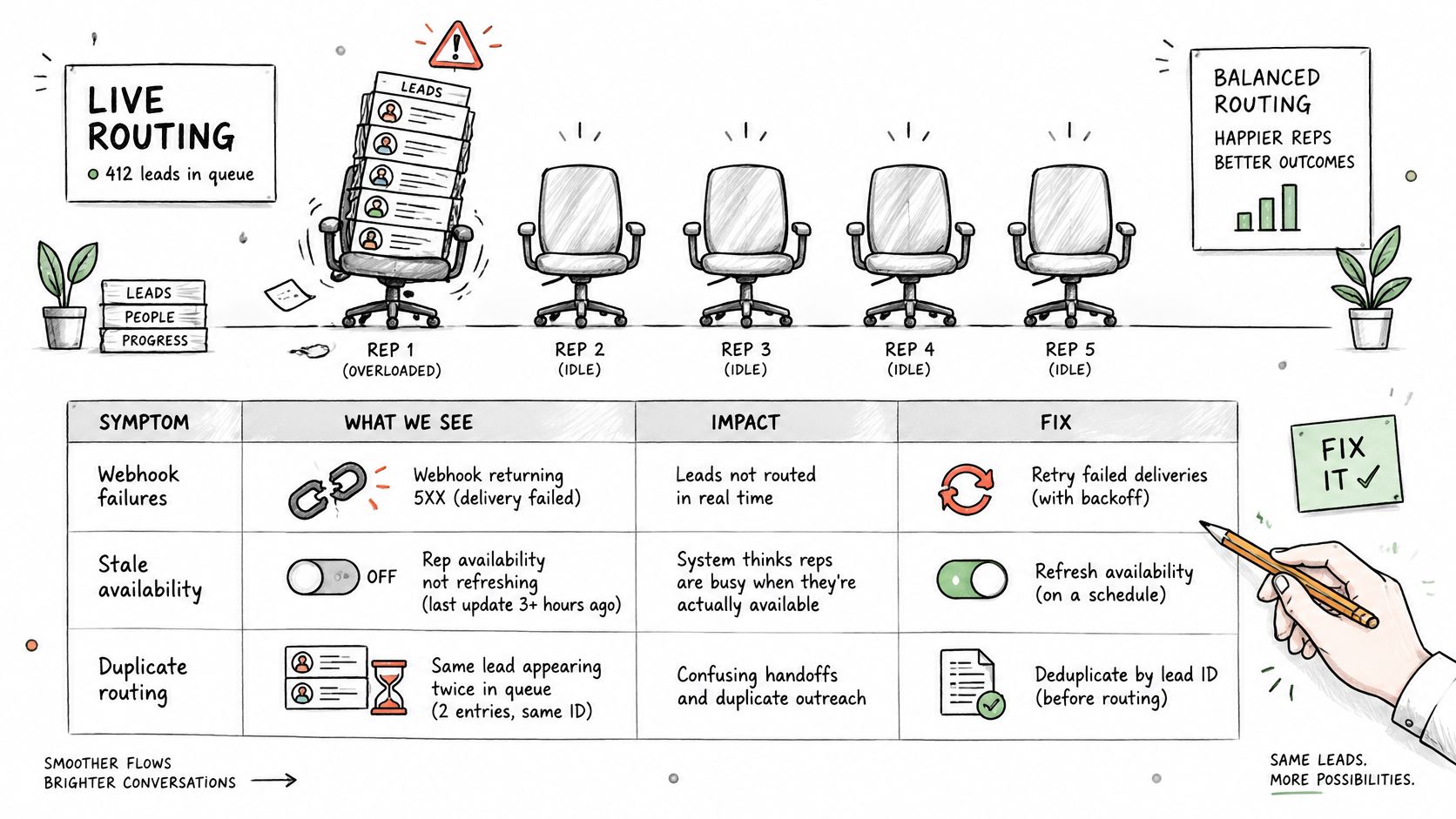
Duplicate assignment is the second most common fault, and the one that damages trust fastest. Two form submissions land within the same second, both read the same pointer, and both write the same owner while a third lead vanishes entirely. A queue transaction with idempotent retries closes that hole. A manual workaround never does.
| Symptom | Likely cause | Fix | Time to fix |
|---|---|---|---|
| One owner gets most leads | Stale availability rules or failed webhook retries | Refresh availability status and check duplicate suppression | Same day |
| Same lead assigned twice | Concurrent submissions advance the pointer without a transaction | Use a queue transaction and idempotent retries | Same day |
| Leads sit unanswered | No backup owner or escalation after missed acceptance | Name a backup owner and escalate on the first missed window | Same day |
| High-value lead goes to a junior rep | Strict rotation ignores complexity | Route by segment or named account before rotating | Same day for named accounts; one week of data for segment rules |
| Buyers ignore sales calls | Every lead triggers immediate rep outreach | Acknowledge fast, offer self-service and let the prospect choose timing | One week of data to confirm response |
| Reps dispute fairness | Only lead counts are tracked | Measure outcomes by source and lead type | One week of data, 30 to 50 assignments |
Design for the buyer who doesn't want a call yet
Most routing advice assumes every captured lead deserves an instant callback from a partner. Buyer behavior is messier. A 2025 benchmark cited by Gartner's sales survey on rep-free buying found that 84% of B2B buyers consider self-service tools critical and that slow vendor response is a leading frustration for 24% of respondents. Fast and pushy are not the same thing.
The fix is a two-speed design. Send immediate acknowledgment, useful material and a clear next step. Reserve direct human outreach for the four cases where expertise earns the interruption: an urgent fit question, a referral introduction, a research request that needs a specialist, and an explicit meeting request.
That distinction should show up in your form, not just your nurture copy. Separate research requests from meeting requests at capture, assign only the latter to an owner immediately, and let the rest choose a channel or a time.
Judge the result on buyer-selected engagement, qualified meetings and no-response rates, not on assignment volume. Most of these fixes take an afternoon. Confirming whether they worked takes a week of clean data.
Confirm Your Routing Before You Go Live
You can run this check in a single afternoon, and it will save you the first month of arguments.
- Confirm which lead types enter the rotation. Everything else routes by ownership, territory or skill first. Write the list down; if it's still in someone's head, it isn't a rule.
- Name the eligible owners and the backup for each one. A rotation with no backup produces exactly one outcome whenever the assigned person travels, which is an unanswered lead.
- Set the escalation time for a missed first contact. In minutes, not "as soon as possible", and pick the person who receives the alert.
- Send ten test leads through the rules. Include one referral, one website inquiry and one enterprise-style request. Check that each lands with the right owner and that the backup fires when the primary is marked unavailable.
- Confirm consent status and source are recorded on every record. Without both fields, the fairness review in a month has nothing to work from.
One boundary worth stating plainly. Starward is a CRM and follow-up automation system and does not provide compliance, regulatory or licensing guidance. Your firm remains responsible for its own regulatory obligations, including how and when you contact prospects who have asked for information.
Then do the practical thing: book a Map session with Starward Navigators, bring your current lead flow and the routing rules you just wrote, and have the team configure round robin with the backup and escalation rules in place before the first live lead arrives.
Starward Navigators gives small consulting and advisory firms a client acquisition system that already includes lead capture, automatic assignment and the follow-up that runs after it. Whether you rotate across two associates or route referrals to a named partner first, the rules, backups and escalation timers live in the same place as your pipeline, so nothing depends on who remembers to check the inbox. Visit Starward Navigators to book a Map session and have your routing configured before the next inquiry lands.