Only about 1 in 106 captured leads becomes revenue in a 2026 full-funnel benchmark. That's not primarily a traffic problem. It's an operating problem: leads arrive through forms, inboxes, LinkedIn, and events, then wait for someone to notice, assign, qualify, follow up, and move the opportunity forward. The benchmark data shows why sales funnel lead generation must cover the entire journey, not just the moment someone submits a form.
For consulting firms, the biggest leak usually appears after interest has already been earned. A prospect books a discovery call, receives a thoughtful proposal, and then disappears into an unowned gap between “sent” and “decision.” The firms that fix this gap don't necessarily publish more content or buy more traffic. They build a reliable system for routing, response time, qualification, proposal follow-up, and handoff.
Table of Contents
- Why Most Consulting Firms Lose Leads They Already Won
- How a Sales Funnel Works Stage by Stage
- What the Conversion Data Really Tells You
- Tactics That Work at Each Stage of the Funnel
- Speed to Lead and the Follow-Up Gap
- Fixing the Silent Proposal Problem With Automation
- Your Implementation Path and What to Measure
Why Most Consulting Firms Lose Leads They Already Won
About 80% of new leads never convert into a sale, and a 2026 benchmark places full lead-to-closed-won conversion at 0.94%, or roughly 1 in 106 captured leads. As the benchmark above shows, capturing contact details is only the beginning. A consulting firm needs a controlled process that turns each inquiry into an owned action, a qualified opportunity, and a clear decision.
Boutique firms usually receive leads from several channels. One prospect submits a website form, another emails a partner, a third sends a LinkedIn message, and an event attendee hands over a business card. Each channel creates a separate risk when the firm lacks a shared queue, a response-time standard, and a named owner. The inquiry is real, but the operating process is not.
The same breakdowns appear repeatedly:
- Unassigned inquiries: A form notification reaches a shared inbox, and no one accepts responsibility.
- Incomplete context: A partner sees a LinkedIn message without the prospect's earlier content engagement or event discussion.
- Untracked follow-up: A consultant promises to reconnect after a proposal review, then delivery work takes priority.
- Unclear qualification: The firm fills its calendar with poor-fit meetings while high-intent opportunities wait.
- Broken handoffs: A signed client enters delivery without an updated record or alert to the responsible owner.
The uncomfortable truth: Until every inquiry has a named owner and a recorded next action, additional leads only enlarge the unmanaged queue.
Treat the funnel as an operating system
Sales funnel lead generation has two connected jobs. Marketing attracts relevant prospects and gives them a reason to engage. Sales and operations then route each signal, respond within a defined window, qualify the opportunity, and keep proposal-to-decision accountability visible.
Document the path from source to outcome. For every inbound lead, record the capture point, owner, first response, qualification event, next stage, and escalation rule. Apply the same standard to website forms, inbox messages, LinkedIn conversations, and event contacts. If a step relies on memory, it will fail when client work becomes busy.
Measure the operating backbone, not just demand. Traffic and form submissions show activity, while speed to first response, stage progression, proposal follow-up compliance, and closed-won handoff completion show whether the firm creates usable pipeline. These measures identify the gaps that generic lead-generation advice leaves untouched.
How a Sales Funnel Works Stage by Stage
A sales funnel converts scattered interest into a managed buying process. A prospect may discover your expertise through search, LinkedIn, an event, an inbox message, or a referral. Each interaction should create a clearer commitment, a recorded next action, and an accountable owner.
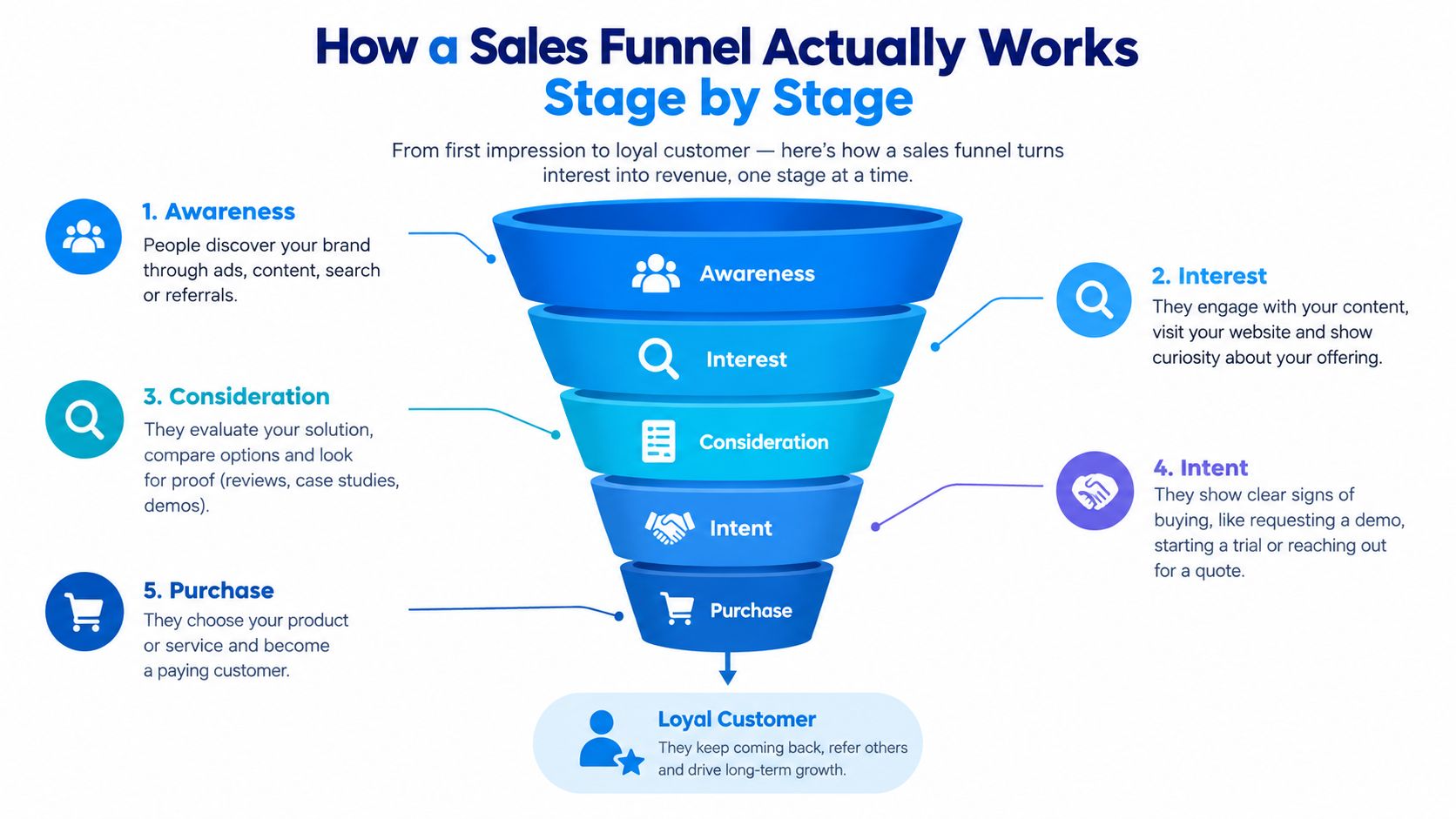
A funnel is a sequence of commitments. Every stage needs an entry condition, an exit condition, and a named owner.
Awareness and interest
At awareness, the prospect has identified a business problem and is looking for a credible way to address it. They may read a search article, see a consultant's LinkedIn post, attend an event, or receive a referral. Publish material that demonstrates judgment, such as a diagnostic article, benchmark interpretation, or practical checklist. The aim is to earn a relevant next action, not force a sales conversation.
At interest, the prospect gives you permission to continue. They may download a guide, join an email sequence, reply to a post, or complete a short form. Route that signal to a named owner and capture its source, topic, and requested action. The exit condition is a usable context record and an agreed next step, whether that is a call, a follow-up resource, or continued education.
Long forms and vague offers create avoidable leakage. Ask only for information needed to route and qualify the first interaction. Collect deeper context after the prospect shows intent.
Evaluation and decision
During evaluation, the buyer compares approaches, checks evidence, and tests whether your firm understands the problem. Your content and discovery process should clarify scope, fit, method, risk, stakeholders, and expected involvement. A discovery call advances only when it produces a documented problem, qualification judgment, next action, and decision path.
The evaluation exit condition is specific: the buyer has named decision participants and a review date. If either is missing, the call did not advance evaluation.
At decision, the proposal translates the discussion into a defined choice. It should state the recommended scope, ownership, decision date, review meeting, and follow-up sequence. “Let us know what you think” leaves accountability with nobody. Assign the proposal owner, record each contact attempt, and escalate stalled decisions according to a set rule.
A structured sales pipeline keeps these conditions visible across website, inbox, LinkedIn, and event leads. The platform matters less than the operating discipline. A lead should never sit between stages without an owner and a dated next action.
Advocacy after the sale
The funnel continues after purchase. A clean handoff from signed agreement to kickoff protects trust and creates conditions for expansion, renewal, and referrals. Transfer the original problem, promised outcomes, key stakeholders, scope, and next milestones into the delivery record.
Set a follow-up point for client feedback and future needs, then track referral opportunities separately from active delivery work. Consulting firms grow through trust networks. Treat advocacy as an owned stage, not an informal hope after the project ends.
What the Conversion Data Really Tells You
The first benchmark to examine is visitor-to-lead conversion. The 2026 median is 1.8%, while top-quartile performance is 4.7%. For a firm receiving 10,000 qualified monthly visits, that means roughly 180 leads at the median compared with 470 at top-quartile performance, more than twice the output without additional traffic. The benchmark source makes a practical point: improving the first conversion can create more pipeline than merely publishing more content.
That doesn't mean every consulting firm should chase the top-quartile number. Traffic quality, offer complexity, brand strength, and buying context all matter. It does mean you should identify whether your landing pages, forms, calls to action, and routing process are losing qualified interest before sales ever has a chance to act.
Find the stage where momentum stops
Use the following benchmarks as diagnostic reference points, not promises:
| Funnel Stage | Benchmark Conversion Rate |
|---|---|
| Lead to MQL | 28.0% |
| MQL to SAL | 47.1% |
| SAL to SQL | 31.7% |
| Opportunity to closed-won | 21.7% |
These stages show why “we generated plenty of leads” isn't a meaningful performance conclusion. A firm may have an acceptable visitor-to-lead rate but weak qualification. Another may qualify well but lose opportunities during proposal review. The corrective action depends on the broken transition.
Turn the funnel into a calculation
Export your recent opportunities and count how many records move from one stage to the next. Don't average away the differences between website, referral, event, and direct outreach sources. A referral may require a different qualification path from an organic search lead, but both still need clear ownership and a recorded next action.
Then ask four questions:
- Where do records stop moving?
- How long do they remain in that stage?
- Which owner or source produces the cleanest progression?
- What action should trigger movement or removal?
The point isn't to create a complex dashboard. It's to replace the statement “our funnel feels weak” with a precise diagnosis such as “qualified opportunities reach proposal, then lose ownership.” Once the break is visible, you can fix the workflow rather than guessing at another campaign.
Tactics That Work at Each Stage of the Funnel
A small firm doesn't need an enterprise marketing stack to improve sales funnel lead generation. It needs a compact set of offers, capture points, response rules, and follow-up sequences that people use.
Build a useful entry point
At the top of the funnel, publish content that helps a specific buyer diagnose a costly problem. For a fractional CFO, that might be a cash-planning checklist. For an operations advisor, it could be a diagnostic around delivery bottlenecks. For a cybersecurity consultant, it might be a practical readiness review.
Connect each asset to a focused form. Ask only for information that changes the next action, then route every submission into one queue. A form that creates a notification but no assignment is not a lead-generation system.
Nurture by intent, not by calendar alone
Mid-funnel prospects need relevant reasons to continue. Create branches for people who request a consultation, download a diagnostic, attend an event, or reply to an email. A newly captured high-intent lead deserves immediate human attention. A low-intent contact can receive educational nurture until a stronger signal appears.
Leads handled within 24 hours convert to SQL or SAL at 8% to 12%, while leads processed in a weekly batch convert at 1% to 3%. The nurturing benchmark supports a simple rule: don't make high-intent leads wait for an administrative batch.
Use automated confirmations, calendar reminders, and owner alerts, but keep human judgment in the qualification conversation. Automation should protect the process, not pretend to understand the buyer.
Make proposals active objects
At the bottom of the funnel, track the proposal as an active opportunity rather than a document that was emailed. When the proposal is sent, create the next action immediately. Schedule the review meeting, record the decision participants, and trigger reminders based on the agreed process.
For stalled opportunities, define a re-engagement sequence. One message can confirm whether priorities changed. Another can offer a narrower next step. A final task can close the loop cleanly instead of leaving the record in permanent limbo.
Practical rule: No proposal should exist without a dated next step, a named owner, and a defined decision event.
A platform such as Starward Navigators for email lead generation can support connected capture, automated follow-up, reminders, and pipeline movement. The firm still has to define its qualification criteria and sales language, but the system can remove the manual gaps between those decisions.
Speed to Lead and the Follow-Up Gap
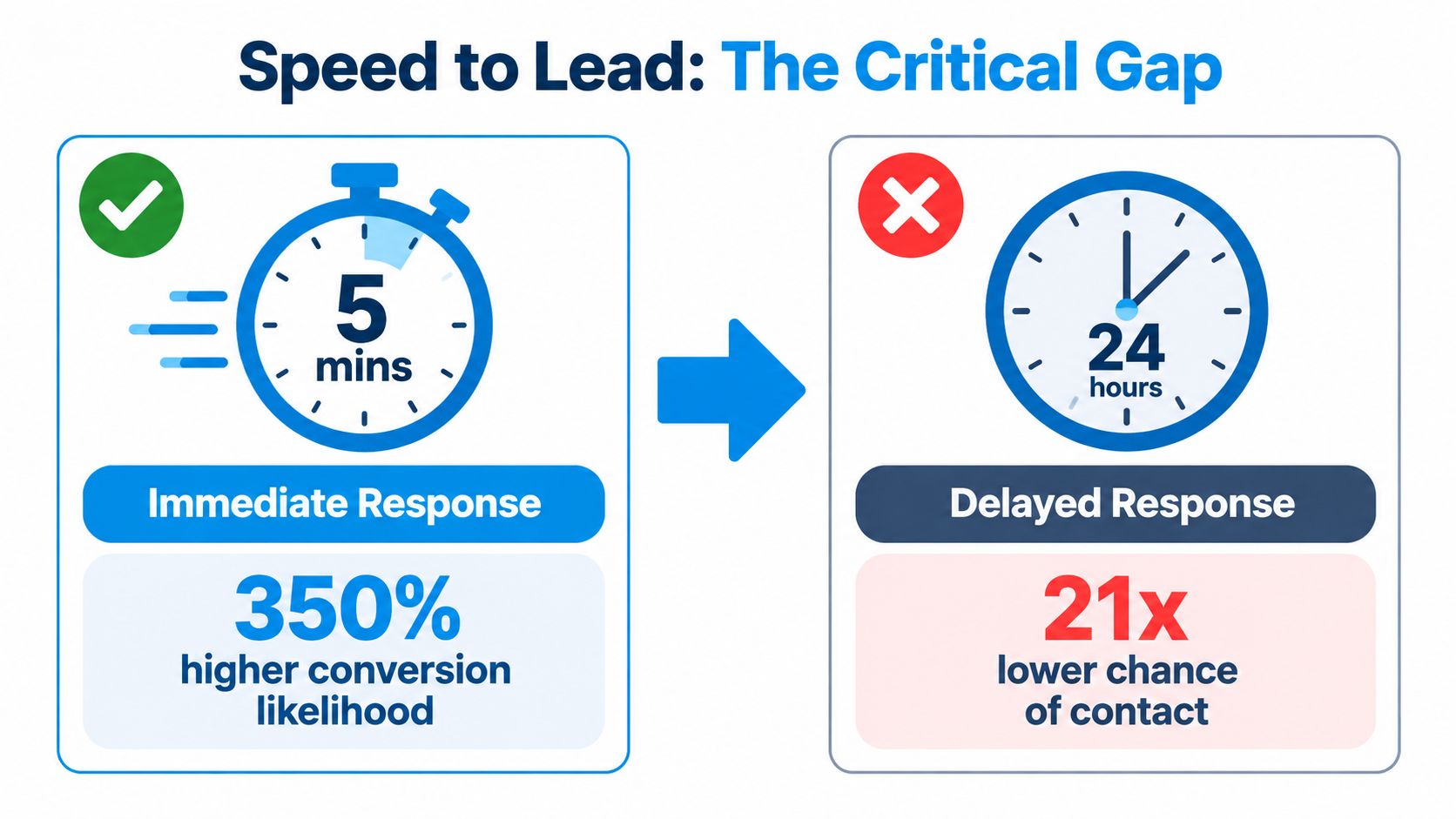
Response speed is the most neglected high-impact variable in many consulting funnels. Leads contacted within five minutes convert at about 21%, compared with 2.3% for next-day replies. They close at 32% when contacted within that window, compared with 12% when contact slips past 24 hours. The response-time benchmarks also show that the median B2B response time remains 42 to 47 hours.
That gap is especially damaging for firms with fragmented intake. A website notification goes to one person, an inbox inquiry sits with another, a LinkedIn message remains in a partner's account, and event notes stay in a notebook. Nobody has a complete view of the queue, so nobody can guarantee a consistent response.
Centralize the first five minutes
During business hours, route every high-intent inquiry into one queue and assign it immediately. The first response can be short: confirm receipt, show that a human has seen the request, and offer a clear next step. If the inquiry arrives after hours, trigger an acknowledgement and assign a follow-up task for the next working period.
Your process should define:
- Source capture: Website forms, inboxes, LinkedIn, and event contacts enter the same record system.
- Immediate assignment: A named person owns the first human response.
- Intent classification: The record identifies whether the contact requested a call, pricing, information, or a referral.
- Escalation: If no human response occurs, another owner receives an alert.
- Measurement: Track time from capture to first human contact, not merely time to an automated email.
The objective isn't to pressure prospects. It's to reach them while the reason for their inquiry is still clear. Fast contact also gives consultants a better chance to ask useful qualifying questions before the prospect moves on or chooses another firm.
Don't confuse automation with follow-up
An autoresponder proves that your software works. It doesn't prove that your sales process works. Use automation to create tasks, send confirmations, surface stale records, and maintain context. Keep discovery, diagnosis, negotiation, and relationship-building human.
The same principle applies after the call. A consultant who sends a proposal without scheduling the review has transferred the next step to the buyer. Buyers are busy, and a valuable proposal can still go silent when nobody owns the decision path.
Fixing the Silent Proposal Problem With Automation
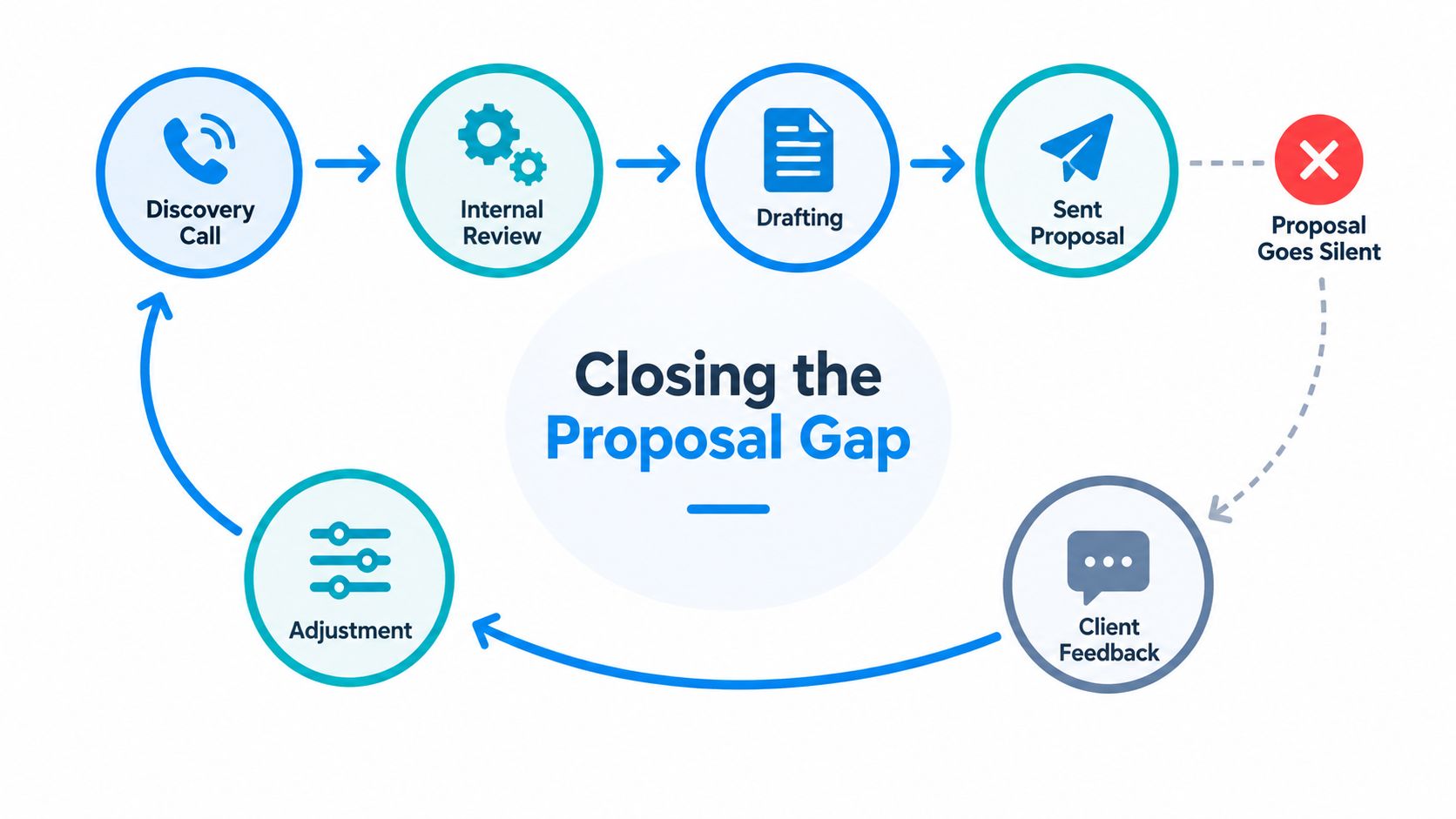
The proposal-to-decision gap is where many advisory firms lose opportunities they worked hard to create. The consultant completes discovery, drafts a thoughtful recommendation, and sends it with good intentions. Then delivery work starts, the buyer needs internal approval, and the proposal becomes an unowned record in someone's inbox.
The timeline makes manual follow-up difficult. A 2026 benchmark places median MQL-to-SQL conversion at 9.8%, lead-to-closed-won conversion at 0.94%, and average lead-to-closed-won time between 192 and 287 days, depending on deal size. The benchmark source reinforces the need for a process that can preserve accountability over a long buying cycle.
Design the decision path before sending the proposal
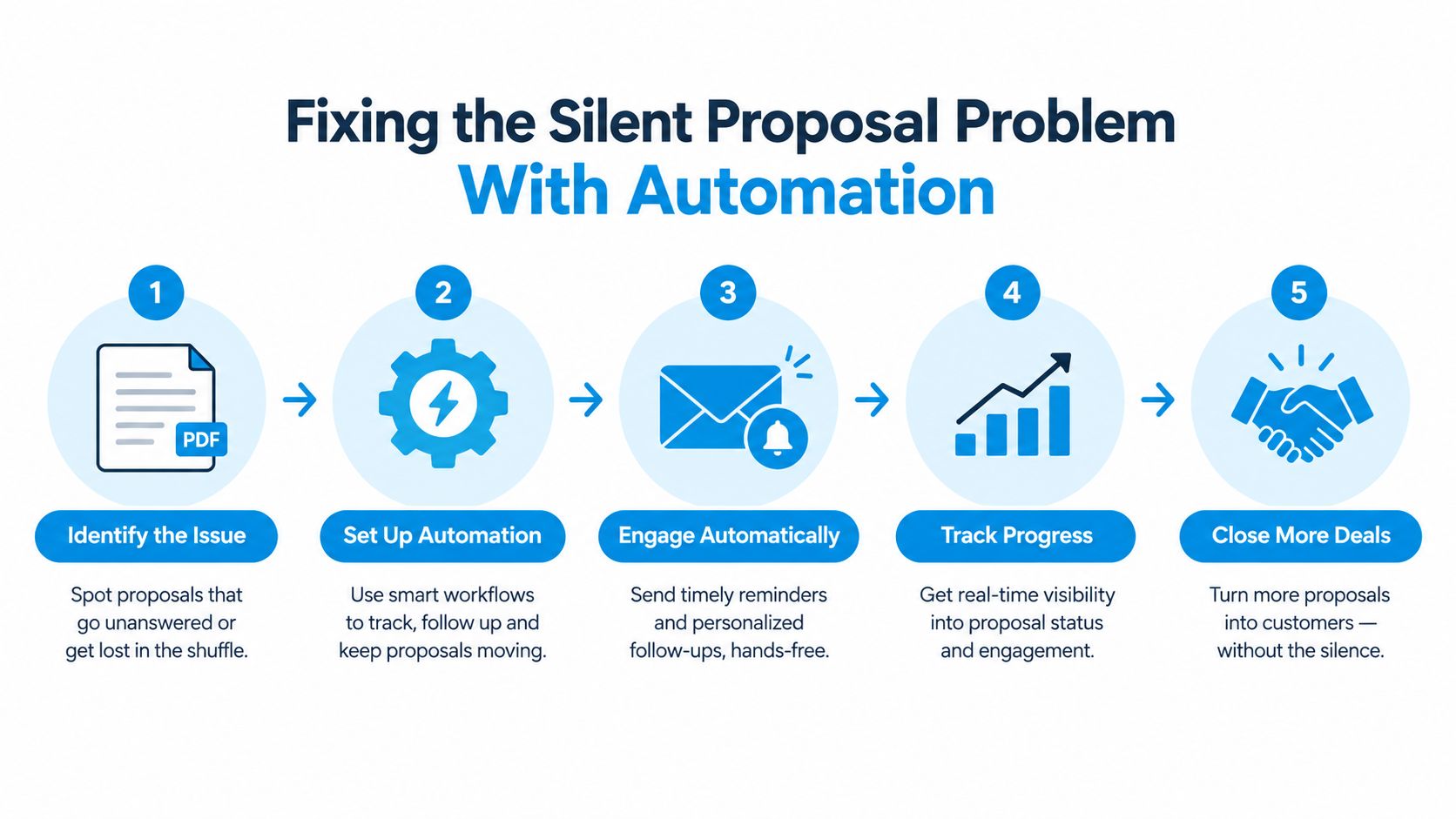
A proposal workflow should begin before the document leaves your firm. Confirm the buyer's problem, decision participants, evaluation criteria, timing, and agreed review method. Then create the actions that correspond to the opportunity's state.
A practical sequence looks like this:
- Discovery complete: Record the problem, desired outcome, scope, and decision participants.
- Internal review: Assign proposal preparation and confirm commercial approval.
- Proposal sent: Log the delivery date and schedule the review conversation.
- Feedback pending: Trigger an owner task if the buyer hasn't responded.
- Decision: Mark the outcome and initiate either onboarding or a structured re-engagement path.
This isn't about sending more messages. It's about making the next commitment visible and preventing a proposal from becoming a passive file.
Automate the repetitive control points
Use triggers for stalled opportunities, reminders for scheduled reviews, and internal alerts when a decision date passes. Keep the messages useful and specific. “Checking in” is weak. “Are you still evaluating the operating model we discussed, or has the priority moved?” gives the buyer an easy way to provide a real answer.
An operating system such as proposal follow-up automation from Starward Navigators can support proposal stages, defined next steps, follow-up sequences, and client handoffs. The implementation should also update the delivery pipeline when an opportunity is won, notify the responsible owner, and schedule the kickoff so revenue doesn't create a new operational scramble.
Protect the relationship when the answer is no
A lost proposal isn't always a dead relationship. Record why the opportunity didn't proceed, when the issue may be revisited, and what useful resource or introduction is appropriate. A respectful closeout keeps the relationship available without pretending that every lead belongs in active sales follow-up.
Your Implementation Path and What to Measure
Start with Map, Install, Go Live. Don't begin by buying a CRM and asking the team to invent a process inside it. Map the full journey first, including website forms, direct email, LinkedIn, events, referrals, discovery calls, proposals, decisions, onboarding, and referrals.
Map the current intake
List every source and answer three questions for each one:
- Where does the inquiry arrive?
- Who sees it first?
- What happens if that person is unavailable?
Document the stage names you use. Keep them simple enough for a small team to maintain. Define what qualifies a lead for a discovery call, what makes an opportunity proposal-ready, and what evidence moves a record to decision.
Install the control system
Configure one pipeline, one ownership model, and one set of response rules. Add forms, inbox capture, calendar confirmations, proposal tasks, stalled-opportunity triggers, and won-stage handoffs. Import existing contacts with enough context to avoid starting every relationship from zero.
Measure the few indicators that expose execution:
- Visitor-to-lead rate: Shows whether qualified traffic and capture offers work together.
- Speed to first human response: Reveals whether routing works in practice.
- Stage-to-stage conversion: Identifies the exact transition that needs attention.
- Proposal follow-up compliance: Shows whether owners complete the agreed next actions.
- Referral activity: Indicates whether completed client relationships create future opportunities.
Go live with a real operating rhythm
Launch with defined owners and a short review cadence. Each review should examine new leads, overdue tasks, stalled proposals, recent wins, and handoff quality. Don't turn the dashboard into a reporting exercise. Use it to decide which workflow needs a specific correction.
In the first 90 days, prioritize reliability over complexity. Make every inquiry visible, every high-intent lead quickly owned, every proposal attached to a next step, and every win connected to delivery. Once those basics work, improve messaging, segmentation, and source-level conversion. A clean operating backbone gives every later marketing investment a better chance to produce revenue.
Starward Navigators provides client acquisition infrastructure for small consulting and advisory firms, including connected lead capture, routing, automated follow-up, proposal tracking, appointment reminders, and client handoffs. Visit Starward Navigators to see how a Map, Install, Go Live implementation can turn fragmented sales funnel lead generation into an accountable operating process.