
Referral management is the system a firm uses to track every referred lead from receipt through conversion and reuse, including the source, owner, follow-up timing, and post-engagement relationship. In practical terms, it turns a warm introduction into an accountable workflow rather than leaving the opportunity in someone's inbox.
A client forwards an email. A former colleague sends a LinkedIn message. Someone mentions your firm at an event, and a prospect appears three days later with a trusted introduction already attached. Referral management captures what happened next, who owns the opportunity, when the next action is due, and how the relationship with the referrer develops after the engagement.
The distinction matters because referrals rarely fail at the moment they arrive. They fail during handoffs, delayed replies, unclear ownership, incomplete notes, and the quiet period after delivery. A small consultancy needs a process that protects referral momentum without turning relationship-building into a second full-time job.
Table of Contents
- When a Warm Referral Goes Cold
- The Referral Lifecycle From Source to Repeat Work
- Referral KPIs That Show Where the Funnel Leaks
- Where Most Referral Programs Break
- How a Purpose Operating System Solves It
- A 30-Day Referral Operating Plan
- Referral Management Questions Small Firms Ask
When a Warm Referral Goes Cold
A fractional CFO receives a glowing introduction from a trusted client. The founder replies to the prospect that afternoon, the prospect responds with a few details, and the conversation looks promising. Then a deliverable runs late, a client needs help with Q3 invoicing, and the founder's attention moves elsewhere.
Three weeks later, the email thread is buried. Nobody has recorded the referring client, nobody has assigned a next step, and nobody can tell whether the prospect received a proposal. The original referrer assumes the firm is handling it. The prospect assumes the firm isn't interested enough to respond.
That isn't a relationship problem first. It's a workflow-control problem.
For a small advisory firm, referral management means recording the source, assigning a named owner, setting a first-touch deadline, moving the opportunity through defined stages, and maintaining the source relationship after the sale. A thank-you message may be part of the process, but it can't substitute for ownership. The useful question isn't “Did we thank the person?” It's “Can we see what happened to the introduction, and does the referrer know the outcome?”
Practical rule: Every referral needs one source record, one opportunity record, one named owner, and one next action with a due time.
The pressure is practical. Consulting buyers often need more internal alignment than buyers of simple products, and advisory engagements carry meaningful switching costs once a firm has earned trust. A slow first response gives the prospect time to question the fit, lose urgency, or accept another recommendation. Firms that want a consistent pipeline can't rely on the principal remembering every warm lead while managing delivery.
A workable system answers three questions immediately:
- Who sent the referral? The source is a relationship to manage, not merely a field on a deal.
- Who acts next? A named closer prevents responsibility from disappearing into a shared inbox.
- What happens after the project? The firm needs a post-engagement path that keeps the source informed and makes future introductions easier.
The follow-up automation workflow should support those decisions, not hide them behind a generic contact list.
The Referral Lifecycle From Source to Repeat Work
A referral becomes manageable when the firm treats it as a sequence of controlled transitions. Healthcare provides a useful model because a referral isn't considered complete merely because someone sent an order. The receiving party must act, the appointment must happen, and the outcome must return to the referring provider. A consultancy can apply the same discipline to commercial referrals without copying the clinical workflow.
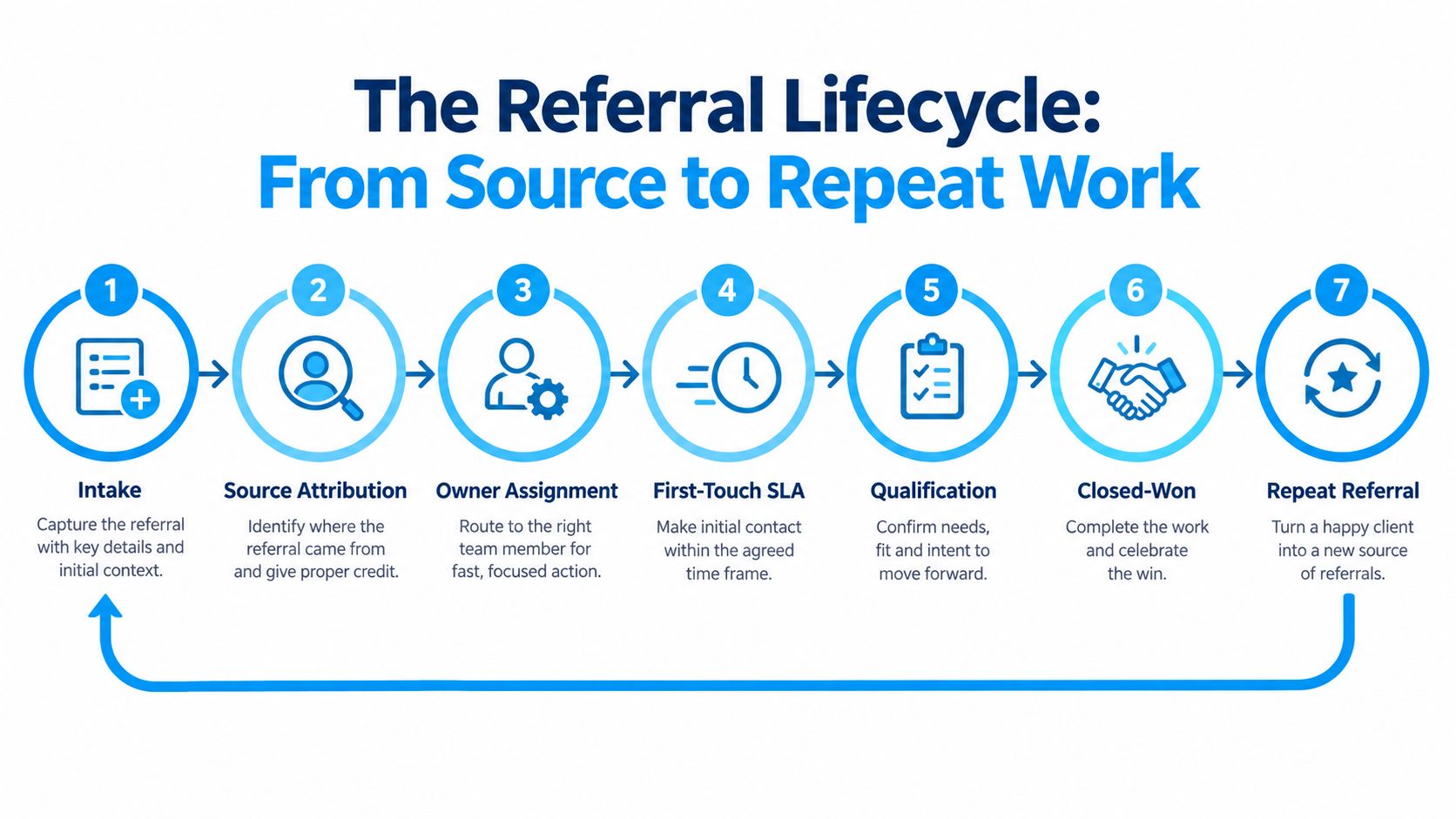
Intake and attribution
1. Intake: Capture the referral when it arrives, whether it comes through email, LinkedIn, an event, a client conversation, or a website form. Record the prospect's name, organization, contact details, referral date, need, and original message. The artifact is a complete opportunity record rather than a loose email thread.
2. Source attribution: Link the opportunity to the referring person and organization. Keep the source relationship separate from the prospect record, because the referrer needs its own interaction history, stage, and communication preferences. Many firms lose useful context at this point, before anyone has even qualified the lead.
3. Owner assignment: Assign the person responsible for moving the opportunity forward. In a two-person firm, that might be the principal or an operations lead, but it must be explicit. The owner accepts the handoff and records the next action.
Response and qualification
4. First-touch SLA: Set the expected response window and monitor whether the owner meets it. Healthcare referral guidance cited by Behave Health's referral management glossary calls for an initial callback within 15 minutes during business hours, benefits verification within 30 minutes, and an intake appointment offered within 24 hours for residential referrals. Those are healthcare-specific benchmarks, not universal consulting targets, but they illustrate the value of measurable response discipline. A small consultancy might choose a less aggressive target, provided it can monitor compliance.
5. Qualification and discovery: Move from acknowledgment to a useful conversation. Capture the problem, urgency, buying context, fit, likely scope, and agreed next step. The artifact changes from a raw referral to a qualified opportunity with a scheduled conversation or a documented reason to recycle it.
6. Conversion or recycle: A closed-won opportunity should trigger delivery handoff, proposal records, and source feedback. A stalled or unsuitable opportunity should move to a recycle path with a reason and future review date, rather than disappearing.
Closing the loop
7. Post-engagement relationship: Tell the referrer what you can appropriately share, thank them with context, and update the relationship record. Once the client has experienced a visible delivery outcome, ask deliberately whether someone else in their network faces a similar problem. The next referral is earned through confidence in the handoff and the result, not through a generic automated thank-you.
client onboarding workflows connect acquisition to delivery. The handoff should carry the referral source, promises made during discovery, commercial details, and the owner responsible for keeping the source relationship healthy.
Referral KPIs That Show Where the Funnel Leaks
A referral dashboard should help the owner assign the next action, not merely count introductions. The right measures show whether the channel is dependable, whether partners receive appropriate feedback, and whether too much pipeline depends on a small group of relationships.
Track these diagnostic measures:
- Referral share of pipeline: Referral-sourced pipeline divided by total pipeline. This shows how dependent the firm is on referrals.
- First-touch SLA compliance: Referrals contacted within the firm's stated target divided by all new referrals. It tests whether response speed is a managed process.
- Source-to-meeting conversion: Referred opportunities that reach a meeting divided by referred opportunities received. This identifies problems in intake and qualification.
- Meeting-to-engagement conversion: Referred meetings that become engagements divided by referred meetings. It tests positioning, qualification, and proposal follow-through.
- Referral velocity: Time from referral receipt to the next meaningful stage. Delays expose queue buildup and unclear handoffs.
- Referral retention rate: Referring partners who send another opportunity during the selected review period divided by active referring partners at the start. This indicates whether the firm maintains trust.
- Revenue per referrer: Attributed referral revenue divided by the number of referring partners in the selected period. It helps identify relationships that merit deeper investment.
Keep the weekly dashboard small. Track no more than five measures each week, then review the remaining indicators in a monthly or quarterly relationship meeting. A practical scorecard might include first-touch compliance, source-to-meeting conversion, meeting-to-engagement conversion, referral velocity, and repeat referral activity.
| KPI | Formula | Benchmark |
|---|---|---|
| Referral share of pipeline | Referral-sourced pipeline ÷ total pipeline | Set an internal target based on capacity and risk tolerance |
| First-touch SLA compliance | On-time first touches ÷ new referrals | Use a written target, then improve consistency |
| Source-to-meeting conversion | Referred meetings ÷ referrals received | Compare by source and channel |
| Meeting-to-engagement conversion | Won engagements ÷ referred meetings | Review by offer and partner type |
| Referral velocity | Time from receipt to next stage | Shorten avoidable waiting periods |
The healthcare closed-loop model supplies a useful operating discipline. Measure whether the referral reached a named owner, received a timely response, progressed to a documented outcome, and generated an appropriate update to the source. For consulting firms, the workflow should also record the next review date when an opportunity is postponed or unsuitable. That turns referral management into workflow control rather than a sequence of thank-you notes.
For a fuller walkthrough of attribution setup, see how to track referrals. The dashboard should connect each source to the opportunity, owner, stage changes, response timestamps, outcome, and follow-up cadence. Without those fields, a high conversion rate can still hide slow handling or weak partner coverage.
The market context shows why firms are formalizing this work. Straits Research's referral management market estimate places the global market at USD 4.29 billion in 2025, projected to reach USD 13.02 billion by 2034, a 13.13% CAGR. The practical implication is straightforward: consistent ownership and measurable service levels matter as referral workflows become a defined operating category.
Where Most Referral Programs Break
Sending the thank-you email closes the visible social obligation. The commercial loop stays open until ownership, qualification, delivery, and feedback are handled. In small advisory firms, referrals usually fail in those handoffs, where a warm introduction becomes an unowned task instead of a managed opportunity.
Source amnesia
A partner introduces a prospect, but the firm records only the prospect. Soon, the original connection is hard to find, especially when the conversation moves from email to LinkedIn or a call. The salesperson may remember the source, while the delivery team and future account owner do not.
The intake record should require the partner name, referral date, channel, and context before the opportunity advances. Keep that source relationship attached when ownership changes. The partner also needs an appropriate update when the opportunity is won, lost, postponed, or unsuitable.
Ownership diffusion
The founder acknowledges the introduction, but no one owns the next action. A message remains in a shared inbox, two people assume the other replied, and the prospect receives a delayed or inconsistent response.
Assign one named owner and set a first-touch target. The referral management guidance from Improving Primary Care emphasizes workflows, staff roles, and information systems that close the loop from receipt through completion. A consulting firm needs the same discipline, with completion defined in commercial terms.
Post-engagement silence
The project ends, the invoice is paid, and the referring partner hears nothing. Confidentiality may limit the detail you can share, but the firm can still confirm that the engagement progressed, thank the partner, provide an approved high-level outcome, and record the relationship stage for future contact.
Set a quarterly relationship refresh. Record the last meaningful interaction, the partner's current interests, and the next appropriate conversation. Without that prompt, a productive partnership can lose momentum while the principal concentrates on delivery.
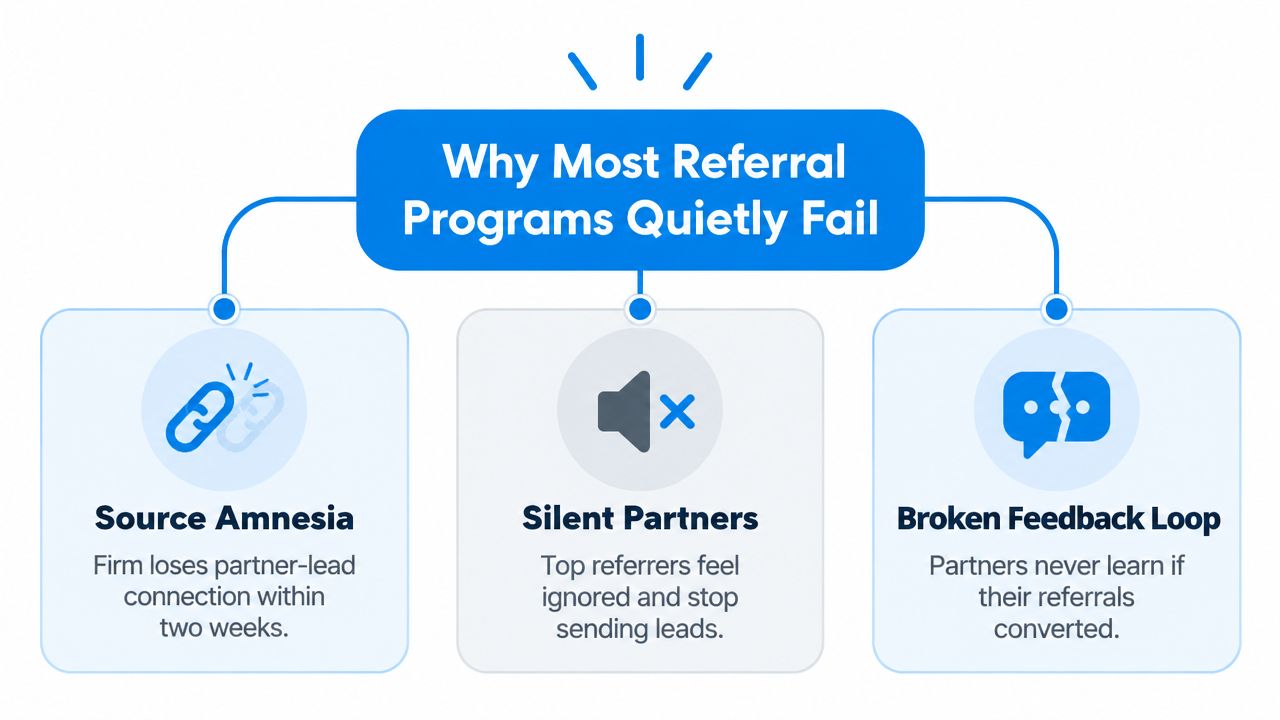
The commercial case rests on referral dependence. A consulting industry summary reports that 31% of consultants derive 60–80% of business from referrals, while 19% derive 80–95%. These figures do not guarantee results for every consultancy, but they show the operational risk. A missing source record, delayed response, or absent partner update can weaken pipeline stability when referrals supply a substantial share of new work.
How a Purpose Operating System Solves It
A purpose-built operating system replaces memory with controlled events. The point isn't to automate every human interaction. It's to make sure the right person receives the right prompt, with enough context to act.
Start with a structured intake form. Require the partner name, referral date, prospect details, source channel, need, owner, and opportunity value estimate. If a referral arrives by email, someone should enter it into the same record rather than allowing email to become a parallel system.
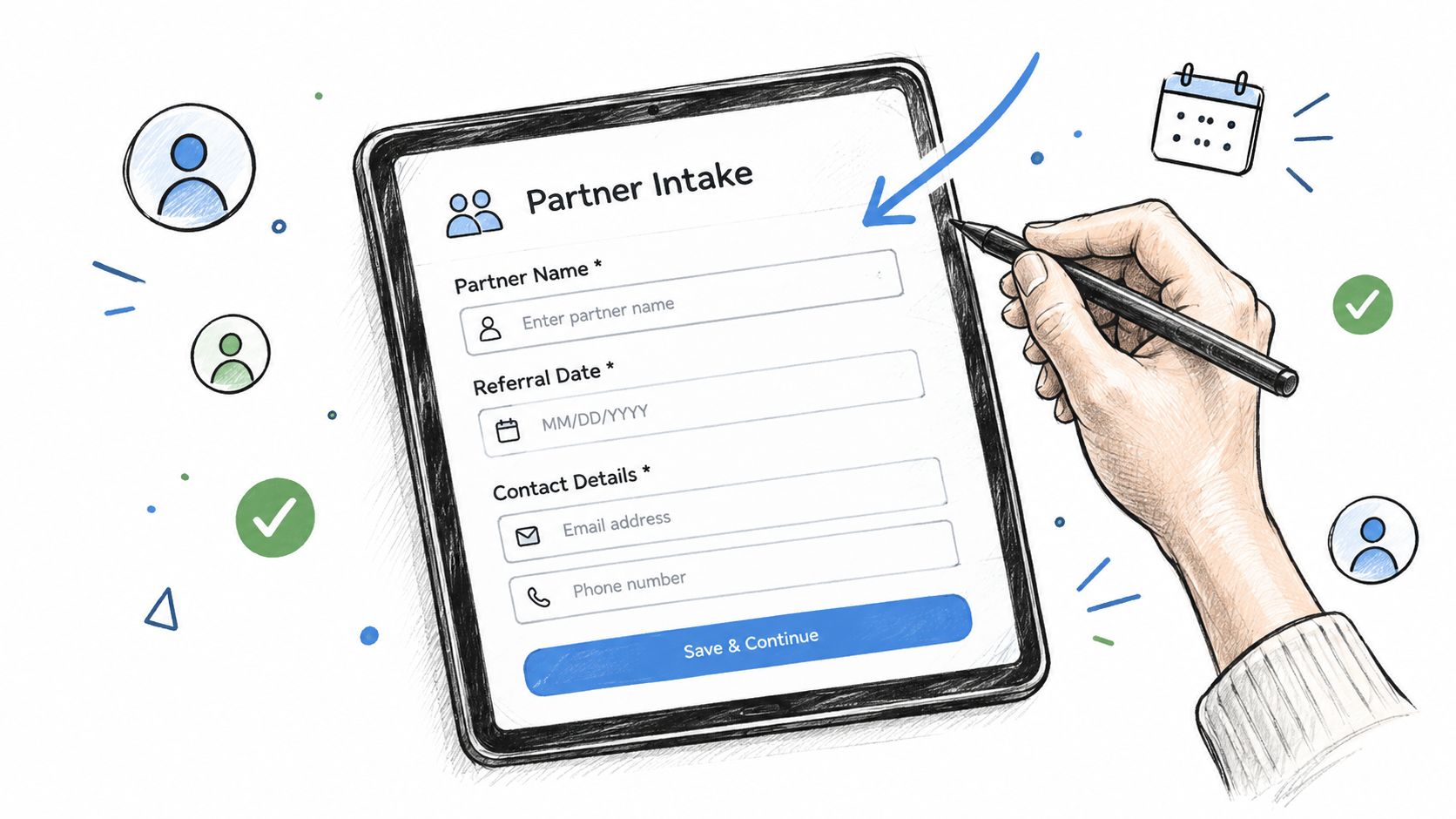
Build the control points
Use stages that reflect real decisions:
- Received: The firm has accepted the referral and recorded its source.
- Qualified: The owner has confirmed fit, need, urgency, and next action.
- Engaged: The prospect has agreed to a commercial next step, such as a proposal or workshop.
- Closed: The opportunity is won, lost, or recycled with a reason.
Each stage should have an owner, exit criteria, and a trigger. A move from Received to Qualified can create a follow-up task. A move to Engaged can start proposal reminders. A Closed-Won change can notify delivery, launch onboarding, and create the source-update task.
The partner record needs its own stages, such as identified, introduced, active referrer, and nurture. Log calls, notes, thank-you messages, status updates, and review conversations there. This prevents a common error, treating the partner as a one-time lead source instead of an ongoing commercial relationship.
A stage change should trigger the partner notification, not the principal's memory.
Automation should also respect judgment. A system can send a receipt acknowledgment, remind the owner about an overdue next step, and draft a status update. The owner still decides what can be shared, especially where client confidentiality applies.
Starward Navigators is one example of a platform built around consulting acquisition workflows, with separate pipelines for active opportunities and referral relationships, automated follow-up, proposal tracking, and client handoffs. A spreadsheet can work at very low volume, but it won't enforce ownership or stage-based prompts unless someone maintains those controls manually.
A 30-Day Referral Operating Plan
A referral system doesn't need a long transformation program. It needs a narrow first version that records the full loop and gives the team a repeatable operating rhythm.
Week 1
Audit the last six months of closed deals. Identify which engagements came from clients, partners, events, LinkedIn, email introductions, or other channels. Attribute revenue to the best available source, then rank partners by conversion and relationship quality. Don't wait for perfect historical data. Mark uncertainty clearly and use the audit to identify the relationships worth preserving.
Week 2
Define the intake fields, opportunity stages, partner stages, and service-level targets. Decide who owns intake, who owns qualification, who sends proposals, and who communicates with the source. Write the rule for exceptions, including referrals that lack consent, need more information, or aren't a fit.
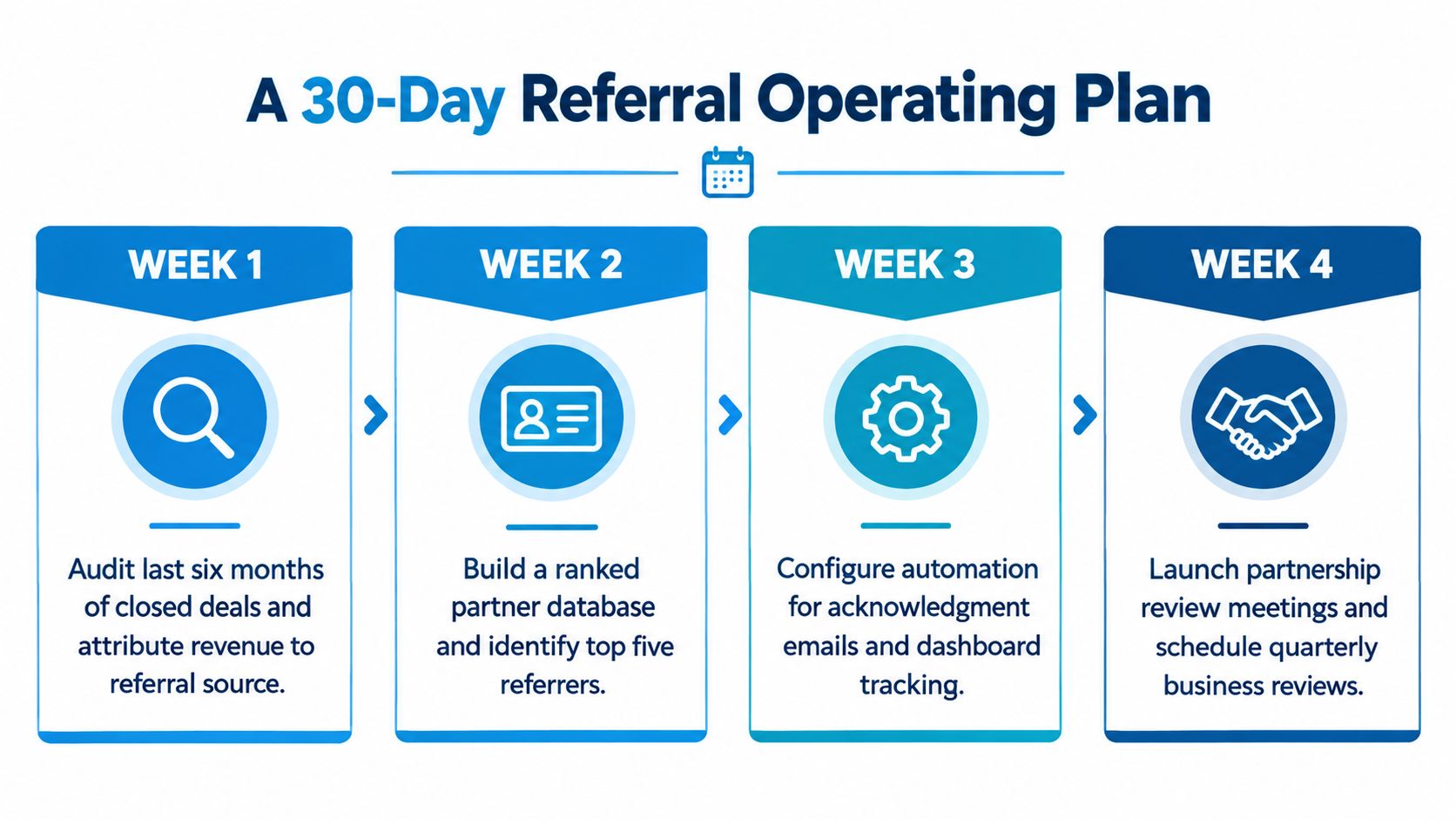
Week 3
Configure the intake form, pipelines, tasks, reminders, and dashboard. Load partner contacts and link known opportunities to their sources. Write three trigger-based templates: acknowledgment on receipt, a status update when the opportunity changes stage, and a quarterly relationship check-in. Keep the language personal enough that the owner can edit it quickly.
Week 4
Pilot the process with the top three partners. Measure first-response time, stage velocity, missing source fields, and partner-update completion. Ask the people using the workflow where it creates friction, then remove fields and steps that don't support a decision.
The operating rhythm starts after launch:
- Monday: Run a five-minute open-referral check. Every active opportunity needs an owner and next action.
- Monthly: Review partner activity, conversion, stalled opportunities, and upcoming relationship touches.
- Quarterly: Hold a referral-program retrospective tied to attributed revenue, repeat introductions, and source feedback.
Referral Management Questions Small Firms Ask
Is a spreadsheet enough?
It can be enough when referral volume is low, one person owns the process, and every opportunity receives a due date. It stops being enough when source attribution, proposal follow-up, partner updates, and delivery handoffs live in separate places. The test isn't company size. It's whether the current system reliably shows the next action and the relationship behind it.
When does implementation help pay for itself?
Outside implementation makes sense when the team knows referrals matter but can't agree on fields, stages, owners, or triggers. A specialist can map the lifecycle, configure the workflow, import contacts, and train the people responsible for the stages. If the firm can define those rules internally and has time to maintain them, a lightweight in-house setup may be sufficient.
How long should setup take?
A focused first version can follow the 30-day plan above. The timeline depends on data cleanliness, tool choice, consent requirements, and how many channels feed the intake process. Don't delay launch while designing every possible exception.
What are the legal risks?
Check privacy, permission to contact, confidentiality, data retention, and attribution expectations. A referring partner may not have consent to share every detail about a prospect, and a client outcome may not be safe to disclose. Record only what the team needs and define who approves partner communications.
How do we revive dormant referrals?
Start with context, not a sales blast. Review the original introduction, confirm whether the need is still relevant, and offer a useful conversation without pretending the delay didn't happen. Update the source record, assign an owner, and place any future follow-up on a defined schedule.
Referral management is working when a referral can be traced from source to outcome, every handoff has an owner, and the relationship remains active after the deal closes.
Starward Navigators helps small consulting and advisory firms install structured pipelines, automated follow-up, proposal tracking, client handoffs, and referral relationship workflows. Visit Starward Navigators to see how the system can turn warm introductions into an accountable path to repeat business.