Most advice about client onboarding gets the order wrong. It starts with a welcome email, a kickoff call, and a polished template, then treats everything after signature as routine administration. In practice, the dangerous part is the gap between contract signature and delivery kickoff, where scope, access, ownership, and client confidence can all slip at once.
That gap matters because onboarding is where the relationship either stabilizes or starts to unravel. 63% of customers say onboarding is a key consideration when deciding whether to subscribe or buy, and 44% of subscription cancellations happen within the first 90 days, according to customer onboarding statistics from SundaySky. In consulting, that means onboarding isn't a courtesy. It's the operating system that protects revenue after the deal closes.
Table of Contents
- Why Most Consulting Onboarding Processes Fail
- The Six Stages of a Consulting Client Onboarding Workflow
- Defining Roles and Ownership at Each Stage
- Automation Triggers That Actually Reduce Friction
- Stage-by-Stage Checklists for Consulting Firms
- A Real Consulting Onboarding Scenario from Start to Finish
- Common Failure Points and How to Fix Them
Why Most Consulting Onboarding Processes Fail
Consulting teams usually lose clients after the contract is signed, not because the work is weak. The failure point is the handoff. The client waits, the delivery team waits for context, and no one clearly owns the next move. That delay reads as disorganization, even when people are busy behind the scenes.
The mistake is treating onboarding as admin work. It is the first live test of whether the firm can deliver on what sales promised. If the post-signature process is slow, vague, or split across too many tools, clients start to doubt the firm before work has even begun.
The hidden cost of the post-signature gap
The gap after signature is where scope, access, and expectations fall apart. Sales may assume the deal is done. Delivery may assume the client has already been briefed. The client expects momentum right away. Without a defined workflow, that handoff turns into a dead zone where progress stalls and nobody feels accountable.
Independent research in financial services shows how much time can disappear into the wrong places. In an EY survey, contract negotiations consumed 40% to 50% of onboarding time for many institutions, and operational setup took about 20%. Consulting is a different business, but the pattern is familiar. Time slips away because systems do not talk to each other, duplicate entry creeps in, and handoffs get buried in email.
Practical rule: If the client cannot tell who owns the next step within a day of signature, your onboarding process is already failing.
Fragmented systems create client-visible friction
A weak workflow is usually a systems problem, not a people problem. The intake form sits in one tool, the project plan sits in another, and the kickoff date lives in someone's inbox. Every time someone retypes the same information, delay and error become more likely.
That friction shows up fast on the client side. They are asked for the same details again. They see mixed messages from different people. They wait while the team reconciles version conflicts behind the scenes. A process like that does more than waste internal time, it tells the client the firm has not sorted out how delivery will begin.
A single source of truth is key for the transition from sold work to active delivery. Without it, onboarding becomes a series of manual rescues. With it, the team asks fewer repeat questions, moves faster after signature, and gives the client a clear start instead of a pause.
The Six Stages of a Consulting Client Onboarding Workflow
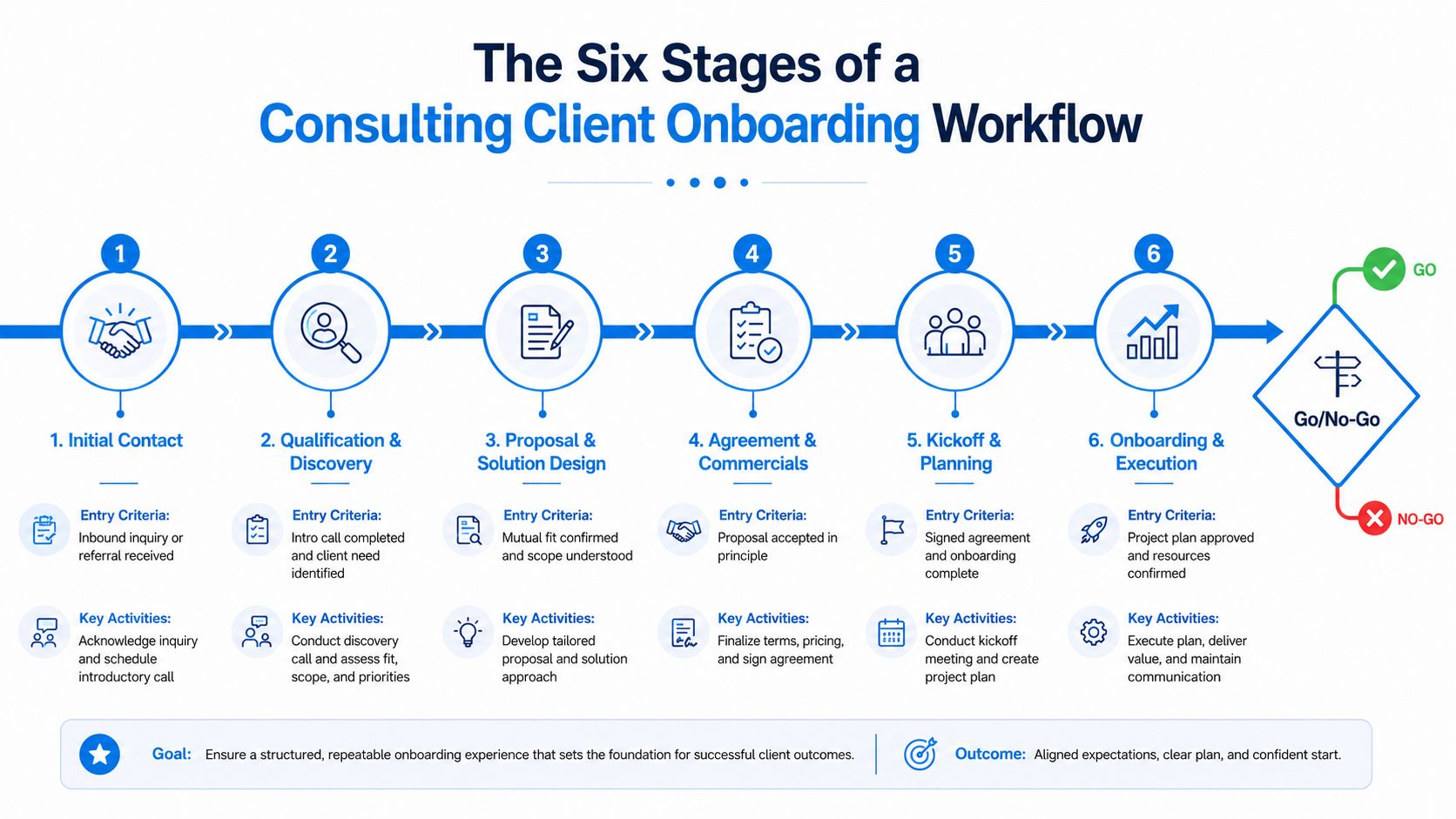
A consulting client onboarding workflow works best when every stage has a clear entry trigger, a named owner, and an exit condition. Without that structure, teams drift into “almost done” territory, which is where projects stall. The cleanest workflows I've seen move from signature to delivery in a straight line, with no ambiguity about what happens next.
The video below is a useful visual companion if you're mapping your own process.
Stage 1 Contract confirmation and internal notification
This stage starts the moment the agreement is signed. The entry trigger is a closed deal, and the exit condition is simple, the delivery team has the context it needs to begin work. That means the account record is updated, the right people are notified, and the project lead knows the next deadline.
Stage 2 Intake and discovery documentation
Once the internal handoff is complete, the client needs a structured intake path. Scope details, stakeholder names, assets, and constraints are gathered in one place. The stage ends when the client has submitted everything required to start setup without another round of follow-up.
Stage 3 Access and system provisioning
If your work requires documents, platforms, shared folders, approvals, or collaboration spaces, this is the point where access gets provisioned. Entry is the completion of intake, and exit is verified access for both sides. A stage like this often becomes the bottleneck because teams wait too long to request credentials or permissions.
Stage 4 Kickoff scheduling and expectation setting
Kickoff should be scheduled as soon as the core inputs are ready, not after the team has already begun improvising. The point of this stage is to align on scope boundaries, communication rhythms, and the first real milestone. It ends when everyone has a written understanding of what happens first and who is responsible.
Stage 5 First deliverable or milestone execution
This is the first moment where the client sees something tangible. The team should not treat this as a nice-to-have. It is the first proof that the sold promise is becoming real value, which is why the stage should include a concrete deliverable date and clear review path.
Stage 6 Transition to ongoing delivery
The last stage hands the engagement from onboarding into steady-state work. That transfer should happen only after the first milestone is delivered and the working rhythm is stable. When this is done well, onboarding doesn't disappear, it stops being a special project and becomes part of delivery discipline.
The stage boundaries matter more than the labels. A lot of firms have a kickoff meeting, but they don't know what exit criterion ends the kickoff stage. That's where ambiguity creeps in.
A workflow is only as strong as its stop points. If no one can say when a stage is finished, the project can't move cleanly to the next one.
Defining Roles and Ownership at Each Stage
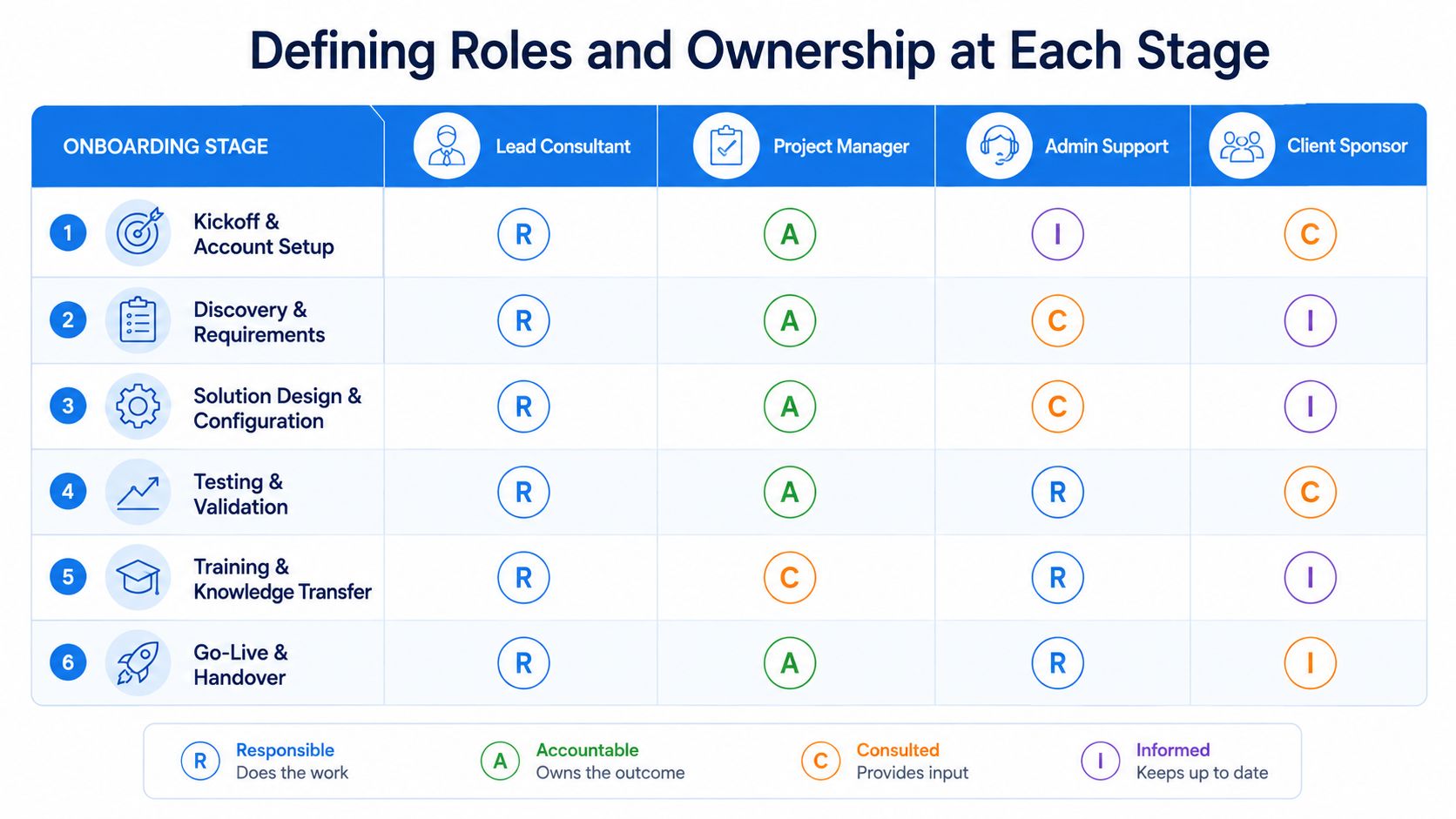
Onboarding breaks when ownership is fuzzy. Everyone assumes someone else is handling the next action, and the client is left waiting while internal messages bounce around. The fix is to assign one accountable owner per stage, even if several people contribute.
What each role actually owns
The Lead Consultant should own the commercial and strategic thread, especially scope confirmation, kickoff direction, and the first deliverable's business framing. The Project Manager should own timing, sequencing, reminders, and the movement between stages. Admin Support should handle the mechanics, like documentation chasing, file setup, and access coordination. The Client Sponsor should approve inputs, respond to requests, and keep decisions moving on the client side.
This division matters because small firms often try to make one person the owner of everything. That works for a week, then collapses the moment the calendar gets crowded. A better approach is to keep the lead consultant accountable for outcomes while letting the project manager run the workflow.
How small teams avoid bottlenecks
Tiny teams don't need more hierarchy, they need clearer rules. If one person is doing both delivery and project management, the role split still has to exist on paper. Otherwise, the team will keep rediscovering the same delays every time a client asks for an update or a document.
Here's the simplest way to make ownership hold up:
- Stage owner defined up front: Name one person who is accountable for moving the stage forward.
- Backup assigned in writing: Decide who steps in if the owner is unavailable.
- Client contact mapped explicitly: Identify the client-side person who can unblock the stage.
- Escalation trigger agreed: State what happens if a request sits too long without a response.
That last item matters more than many teams realize. Delays rarely come from bad intent, they come from hesitation around who should press for action. Clear escalation rules remove that hesitation.
Automation Triggers That Actually Reduce Friction
Automation helps most when it removes repetition, not judgment. The best triggers are the boring ones, the ones that shouldn't require a person to remember them, chase them, or re-enter them by hand. That's where workflow design pays off.
The strongest evidence I'd trust here comes from a peer-reviewed 2025 study on document automation and risk profiling in client onboarding, which reported a 40% reduction in onboarding time and a 25% improvement in error detection, with some low-risk cases moving to 3 to 5 business days or even 24 to 48 hours (Multidisciplinary Frontiers PDF). The lesson is not “automate everything.” It's that structured intake, risk-based routing, and automated document handling reduce back-and-forth where the process is most fragile.
Five triggers worth automating first
The first trigger is signed contract. That should generate the project record, alert the delivery owner, and send the client a clear next-step message. The second is intake form submitted, which should update the internal checklist and route the right follow-up without manual copying.
The third is access approved, which should initiate collaboration steps and move the project toward kickoff readiness. The fourth is kickoff scheduled, which should trigger agenda distribution and reminder logic. The fifth is first deliverable ready, which should notify stakeholders and advance the engagement into steady delivery.
What to automate and what to keep human
Automate confirmation emails, internal notifications, task creation, and checklist progression. Keep humans on scope confirmation, exception handling, and any moment where the client could interpret the interaction as a substantive commitment. That balance is what keeps the process fast without making it feel robotic.
A useful reference point for a practical automation stack is Starward Navigators' follow-up automation workflow, especially for consulting teams that want triggered ownership updates and kickoff scheduling without building everything from scratch. It's most relevant where the handoff between signature and delivery keeps slipping because no one wants to manually chase each next step.
Practical rule: Automate the handoff, not the relationship. Clients notice when a process moves fast, but they still want a person to own the promises that matter.
The primary benefit is internal. When the first response, intake capture, ownership notification, and checklist progression are automated, the team spends less time on coordination and more time on actual client work. That's especially useful when volume rises and the old email-driven method starts collapsing under its own weight.
Stage-by-Stage Checklists for Consulting Firms
A checklist is only useful if it tells people who does what, what triggers the task, and how completion is verified. Otherwise it becomes a polite document that nobody trusts. The version below is designed to be adapted, not admired.
For a ready-made starting point, the client onboarding template can be used as a structural reference for teams that need a more repeatable setup.
Onboarding stage checklist summary
| Stage | Key Tasks | Owner | Completion Criteria |
|---|---|---|---|
| Contract confirmation | Update record, notify delivery, send next-step message | Project Manager | Delivery lead has the signed scope and named contacts |
| Intake and discovery | Collect goals, constraints, stakeholders, and assets | Admin Support | Intake is complete and no mandatory fields are missing |
| Access and provisioning | Set up workspace, permissions, and shared files | Admin Support | All required access is active and tested |
| Kickoff scheduling | Book meeting, send agenda, confirm attendees | Lead Consultant | Kickoff is on calendar with the right people invited |
| First deliverable setup | Define milestone, assign tasks, set review path | Lead Consultant | First deliverable date and acceptance path are documented |
| Transition to delivery | Hand off cadence, close onboarding checklist, shift ownership | Project Manager | Delivery rhythm is stable and onboarding is marked complete |
The checklist items that actually prevent rework
Contract confirmation should start with a clean internal note that captures scope, client names, and the first deadline. Intake should be a single request, not a chain of follow-ups. That keeps the client from feeling like they're being asked to reconstruct the same information twice.
Access provisioning should never wait until kickoff day. The client should be able to test the workspace, not discover missing permissions while the team is already trying to move. Kickoff prep should include the agenda, expected decisions, and the first deliverable path so the meeting doesn't drift into generalities.
One practical habit helps across every stage. Mark each checklist item complete only when a person can verify it, not when they think it's probably done. That discipline removes the “almost finished” trap that slows consulting teams down.
A Real Consulting Onboarding Scenario from Start to Finish
A boutique advisory firm signs a new client on Monday morning. The contract hit is immediately followed by an internal alert, the project manager gets assigned, and the lead consultant receives the handoff context before lunch. The client gets a short welcome message that names the next step, instead of a vague “we'll be in touch soon.”
By Tuesday, the intake request has gone out, but one document is missing. Instead of waiting passively, the admin owner flags the gap and sends a focused follow-up, while the project manager keeps the kickoff slot warm. That matters because the client sees a controlled process, not a scramble.
Where the workflow protects the first two weeks
Once the intake is complete, access setup begins and the kickoff is confirmed. The lead consultant uses the meeting to clarify scope boundaries and agree on the first deliverable. The client leaves with a written understanding of what happens next, which lowers the odds of later confusion.
The first strategic deliverable is then mapped to a specific review date, and the delivery team has a clear handoff into execution. If the client later asks a scope clarification question, it's handled as a decision point, not a casual side conversation. That distinction keeps the team from expanding the project before the original work is even underway.
A structured workflow earns its keep. The client never has to wonder whether the project has started, because every touchpoint reinforces momentum. If you want a fuller example library, the case studies collection is the kind of internal reference I'd use to compare how different onboarding motions are staged.
Common Failure Points and How to Fix Them
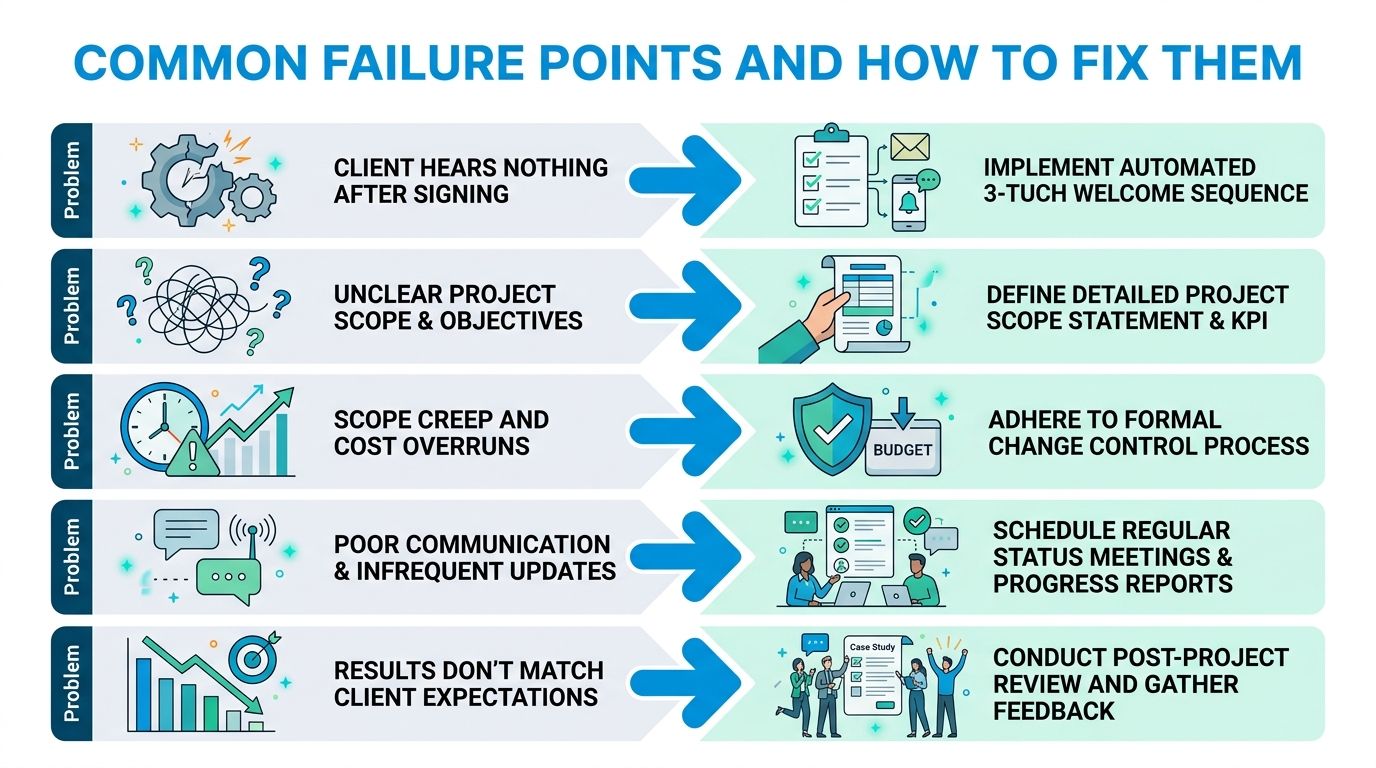
The five failure points show up in almost every consulting onboarding audit. They're predictable, which is good news, because predictable problems are fixable. The challenge is resisting the urge to treat them as isolated mistakes.
The five breakdowns worth fixing first
Post-signature silence happens when the client hears nothing useful after signing. Fix it with a same-day next-step message and an owner who is visibly responsible. Intake bottlenecks happen when the team waits too long to collect the information needed to move forward, so the fix is a single structured request with a deadline and follow-up logic.
Access delays stop collaboration before it begins, so access needs to be requested early and verified before kickoff. Scope ambiguity appears when sales promises and delivery reality drift apart, and the remedy is a written kickoff recap that restates boundaries in plain language. Ownership confusion is the last one, and it usually means the workflow has too many shared responsibilities and too few named decisions.
The diagnostic question I ask is simple. If one client stalled today, could you point to the exact stage where the process broke, or would the team start blaming each other's departments? If it's the second answer, the workflow still needs work.
Starward Navigators builds client acquisition infrastructure for small consulting and advisory firms, and the onboarding gap between signature and kickoff is exactly where that system can help. If your team is tired of manual handoffs, inconsistent follow-up, and kickoff delays, visit Starward Navigators to see how a structured setup can turn that transition into a reliable operating process.