Client onboarding is the structured process of transitioning a newly signed client from agreement to active engagement, and it usually should move in days, not weeks. In practice, it covers document collection, kickoff scheduling, expectation setting, and delivery handoff.
What surprises most firms is that onboarding is less a welcome phase than a revenue-risk process. The early window is where speed, clarity, and follow-through decide whether a client becomes operational or starts drifting away.
Table of Contents
- Client Onboarding Defined as a Revenue Process
- The Five Core Stages of Client Onboarding
- Onboarding Metrics That Matter
- Where Onboarding Breaks Down in Practice
- Manual Versus Automated Onboarding Approaches
- The First 90 Days as the Onboarding Window
- Building Your Onboarding Improvement Checklist
Client Onboarding Defined as a Revenue Process
Client onboarding is the first delivery experience a client has with your firm, and it should be treated like a conversion system. In consulting and advisory work, the signed agreement is only the start. The key question is whether your team can turn that signature into coordinated action before confidence erodes.
Independent 2026 benchmark reporting shows why the timing matters. Top-performing firms respond within 4 hours of signing, complete onboarding in 5 days or fewer, and use automated follow-ups, while bottom-performing firms often take 2 to 3 weeks and lose 25 to 35% of clients in the first 90 days. The same benchmark found median response times of 2.4 hours for the top 20% versus 4.2 days for the bottom 20%, and median completion times of 4.8 days versus 23.7 days (benchmark report).
That spread is why onboarding belongs in the same conversation as retention and revenue stability. The first days after signature are when expectations get set, documents get gathered, handoffs get coordinated, and the client either feels progress or feels pressure. If your process is loose, the client notices quickly.
Practical rule: if onboarding depends on memory, inbox searches, and whoever happened to be available that day, it's not a process, it's a risk.
This is also where firms confuse politeness with structure. A warm welcome email is fine. A clear sequence of ownership, deadlines, and client actions is what keeps the relationship moving. For firms that already track referrals and repeat business, onboarding should sit beside those systems, not underneath them. If you're trying to understand how handoff quality affects later growth, see how referral tracking works in practice.
The right definition is simple. Client onboarding is the structured transition from signed agreement to active engagement, measured by how fast and how cleanly a firm gets to first value. Anything less leaves too much to chance.
The Five Core Stages of Client Onboarding
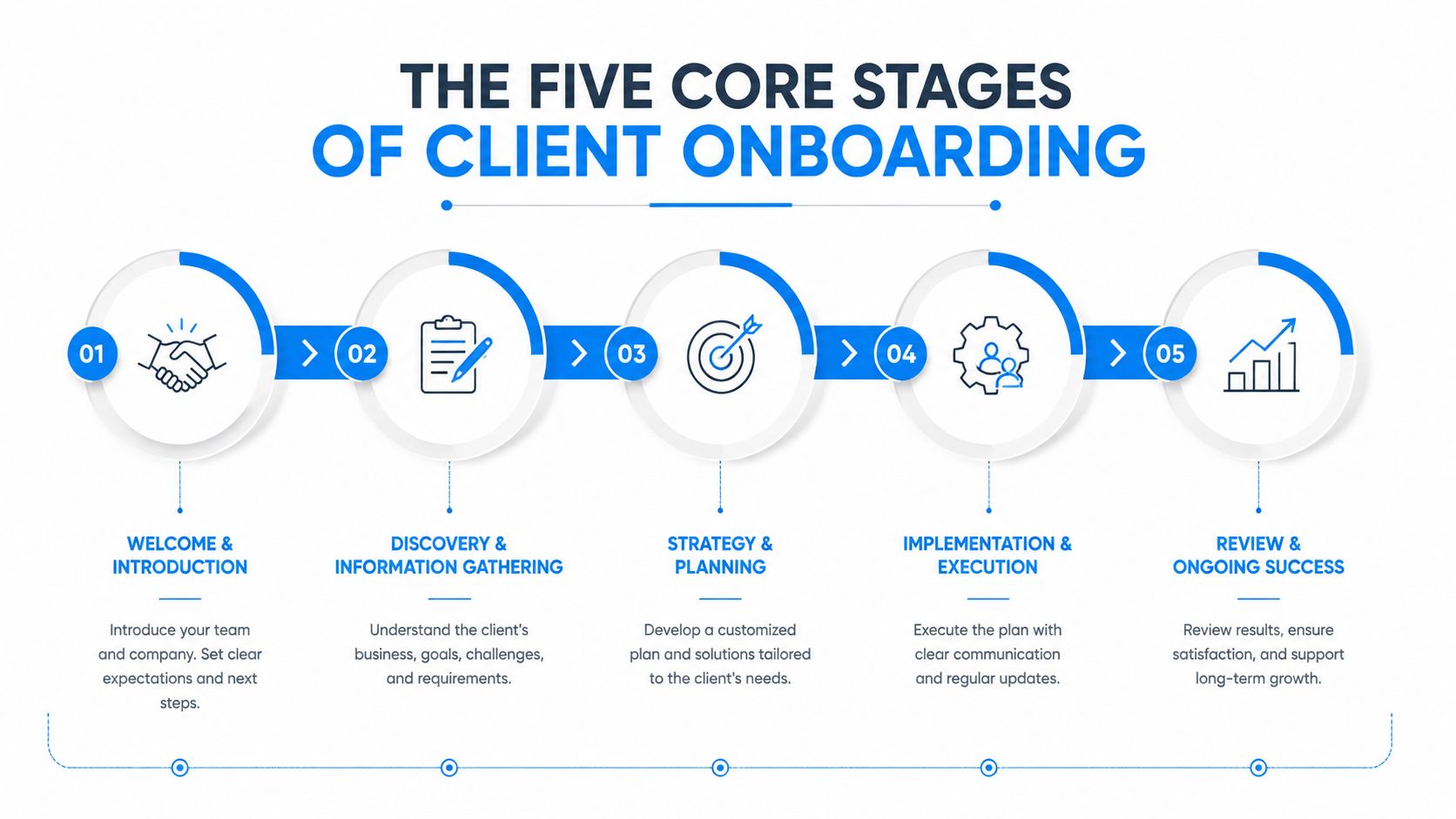
The work usually breaks into five stages, even if a firm doesn't label them that way. Each stage has a different owner, a different failure point, and a different signal that it's done.
1. Intake and document collection
The client provides the materials you need to start. In consulting work, that often means background documents, stakeholders, access details, prior work, or whatever the engagement requires. Completion looks like this, the team has the inputs it needs without chasing the client for basics three days later.
The fastest firms don't treat this as a passive request. They send one clear intake package, explain why each item matters, and set a clean due date. The stronger the first request, the less follow-up you need.
2. Internal handoff and team assignment
Once the deal is signed, someone has to own the transition. That owner isn't always the seller, and it isn't always the delivery lead. It's the person who makes sure the client's context moves from promises into execution.
This stage breaks when nobody wants the messy middle. One person thinks another person sent the files, the project lead thinks the account manager already briefed the team, and the client hears silence. Completion here means internal roles are assigned, context is documented, and the delivery team knows what it's walking into.
3. Kickoff scheduling and expectation setting
The kickoff is where the working relationship becomes visible. The client should leave knowing who's responsible for what, how communication will work, and what happens next. A kickoff that happens late usually signals that the firm is already behind.
The kickoff is not a ceremonial meeting. It's the point where the client decides whether your firm feels coordinated or improvised.
4. Initial delivery activation
This is the first moment the client sees work begin. It might be a plan, an audit, a workflow map, or another visible output. The important thing is that it creates momentum and confirms the team didn't just collect documents and disappear.
5. Early progress confirmation
After the kickoff, the work can't go quiet. A short status update, a draft, or a structured check-in confirms that the client's engagement is live. That early confirmation is often what keeps the relationship from slipping into uncertainty.
The five stages work because they turn onboarding into an operational chain. If one link is weak, the whole client experience feels slower and less trustworthy.
Onboarding Metrics That Matter
If you can't measure onboarding, you can't manage it. The useful metrics are the ones that show whether clients are moving from signed to active without friction, and whether the team is creating time to first value before attention fades.
A 2024 executive metrics guide defines Time to Onboard (TTO) as the total time from purchase to full utilization of a product or service, and notes that onboarding teams also track task completion rate, full-process completion rate, and average onboarding cost per customer (metrics guide). A 2026 state-of-onboarding report adds that 62% of customer-success leaders lack real-time visibility into onboarding progress, only 26% are actively investing in automation, and 70% expect AI to handle half of onboarding tasks by 2027. The same report says best-in-class teams reach Time-to-First Value in under 14 days and achieve onboarding completion rates above 80%.
| Metric | Definition | Target Benchmark | Poor Performance |
|---|---|---|---|
| Time to Onboard | Time from signed agreement to full utilization | As fast as your service model allows, with strong firms finishing in days | Delays that push activation into weeks |
| Task Completion Rate | Share of onboarding tasks completed on time | High and consistent across clients | Frequent misses or partial completion |
| Full-Process Completion Rate | Share of the entire onboarding flow finished without gaps | Clear, repeatable completion | Steps skipped or left unresolved |
| Document Collection Rate on First Request | Share of required documents received on the first ask | 80 to 95% on first request (complete guide) | Repeated chases and fragmented handoffs |
| Time to First Value | Time until the client sees a tangible outcome | Under 14 days for best-in-class teams (state of onboarding report) | A long gap before the client sees progress |
The document collection metric matters more than many firms realize. Service-business guidance says 80 to 95% of onboarding documents should be collected on the first request, because every extra chase adds admin load and delays kickoff (complete guide). That's not just a workflow issue, it's a capacity issue.
For consulting firms, the cleanest scoreboard usually combines speed, completion, and first value. If those three are healthy, the relationship usually feels organized. If one of them is weak, the client starts carrying the cost.
Where Onboarding Breaks Down in Practice
Most onboarding failures don't explode. They erode. The client doesn't usually complain on day one. They just get less confident, less responsive, and less willing to push forward.
The first response is too slow
When a client signs and then hears nothing for days, they start wondering whether the firm is prepared. Benchmark data shows top firms respond within hours, while bottom performers can take days or weeks (benchmark report). That delay is often enough to turn excitement into hesitation.
Ownership is unclear
A common failure is the sales-to-delivery handoff. The salesperson assumes the account lead has everything. The account lead assumes the delivery manager has the context. Meanwhile, the client is repeating information the team already had.
The document trail is scattered
Email threads, loose files, portal logins, and side conversations create a messy start. The client isn't sure what's been received, and your team can't tell what's missing without checking three places. That's where simple requests become extended admin work.
The kickoff happens too late
A late kickoff makes the firm look uncoordinated, even if the work is good. Clients need to see that the team is prepared, aligned, and moving. Waiting too long to schedule that conversation weakens the entire start.
Follow-up disappears when the client goes quiet
Recent onboarding research says 51% of customer engagement leaders see a meaningful share of customers fail to take meaningful action in the first 90 days, with lack of customer guidance and slow response times each cited by 40% of respondents (customer onboarding process). That's the part many explainers skip. The problem isn't just the welcome. It's the absence of structured momentum after the welcome.
A quiet client is not always a satisfied client. Sometimes they're stalled, uncertain, or already disengaging.
The pattern is consistent. The break isn't usually one bad moment, it's a string of small delays that make the firm feel harder to work with than expected. That's why onboarding should be managed like orchestration, not courtesy.
Manual Versus Automated Onboarding Approaches
Manual onboarding works until volume, complexity, or staff turnover exposes the cracks. Then the team spends more time coordinating the process than delivering the service.
What manual onboarding looks like
Manual onboarding usually means email chains, spreadsheet trackers, calendar juggling, and repeated nudges. The upside is flexibility. The downside is inconsistency, and inconsistency is expensive when every client expects the same standard.
What automation changes
IBM topic page says automated customer onboarding replaces repetitive work such as data entry, document collection, scheduling, and compliance checks. The same guidance points to a tighter operating rhythm, with portal or intake materials sent quickly after signature, kickoff started within a few days, and manual follow-up reduced to a minimum. The practical effect is straightforward. Faster first response and structured reminders lower drop-off and shorten time-to-value.
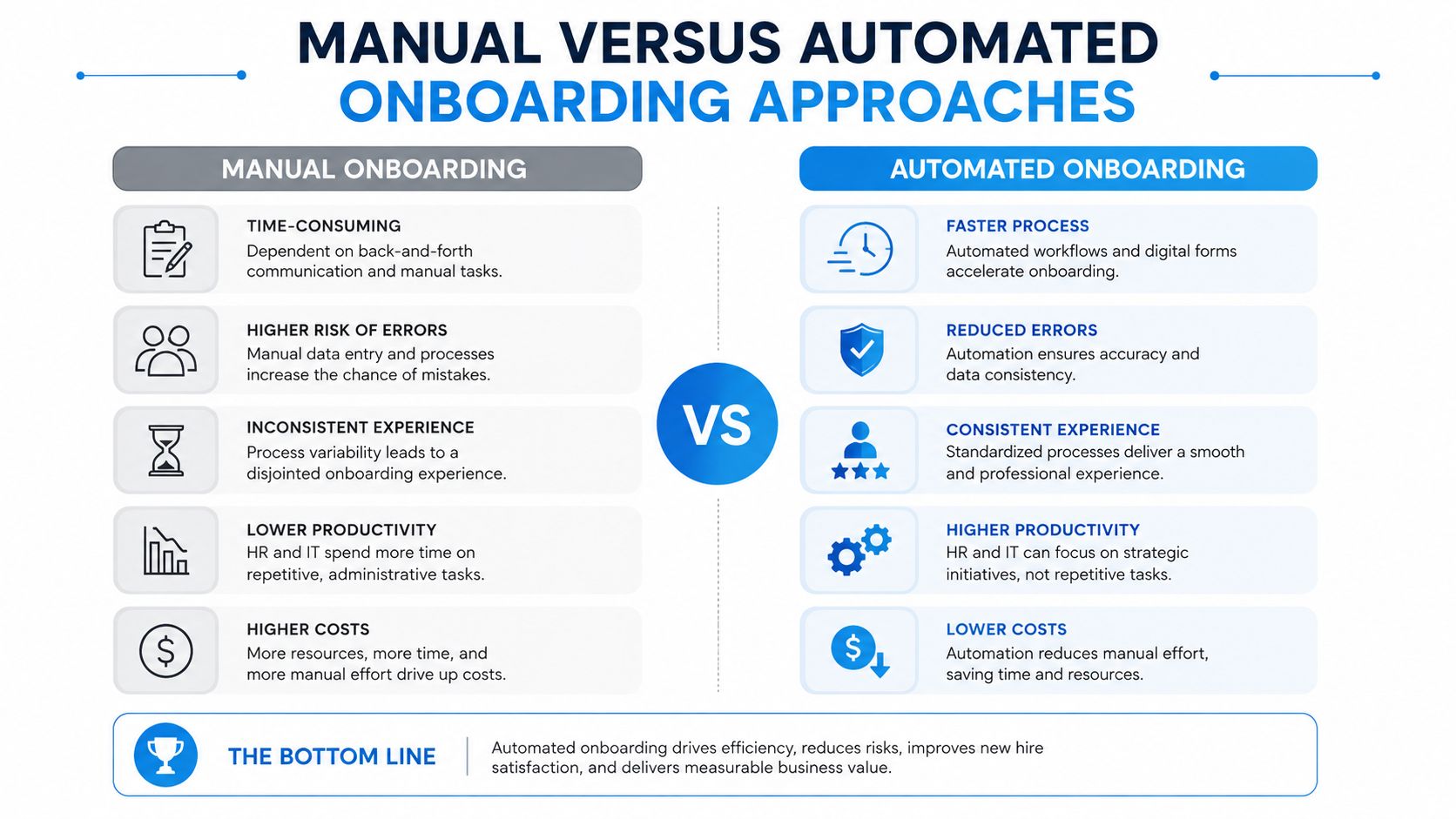
The choice is between consistency and improvisation. Manual onboarding can still work for small volumes or unusually bespoke engagements, but every extra handoff creates another place for details to go missing.
When firms need a system instead of a collection of reminders, tools matter. Follow-up automation is one way consulting teams standardize reminders, routing, and next steps after a client signs. That setup is most useful when the process keeps breaking in the same places.
Automation does not remove judgment. It reduces the amount of judgment wasted on copying the same message into the fifth email thread of the day, so senior staff can focus on coordinated delivery.
The First 90 Days as the Onboarding Window
A signed agreement does not mean the client is onboarded. It means the handoff has started. The risk window runs through the first 90 days, when a client either starts using what was promised or slips into passivity.
The pattern shows up in the research. Analysts at OnRamp found that many customers fail to take meaningful action in that period, with slow response times and weak guidance among the main reasons (customer onboarding process). That is why a definition of onboarding that ends at kickoff misses the failure point.
Too many firms still treat “welcome sent” as the finish line. Clients still need visible ownership, clear next steps, and enough momentum to keep moving. Without that, the work can stall even after everyone has agreed on scope.
The first 90 days are where confidence is earned or lost.
GuideCX's state of onboarding report points to the same operating problem from another angle. Teams often lack real-time visibility into onboarding progress, and friction in that period affects revenue. Early onboarding is therefore both a client-experience issue and a delivery-management issue.
For firms that want to handle it well, a structured cadence matters. The client should know what is happening, who owns the next move, and when they will hear from you again. A practical client onboarding template helps standardize that rhythm without turning every engagement into a rigid script.
The larger point is simple. Onboarding does not end when kickoff ends. It ends when the client is moving, informed, and confident enough that the relationship no longer depends on constant reassurance.
Building Your Onboarding Improvement Checklist
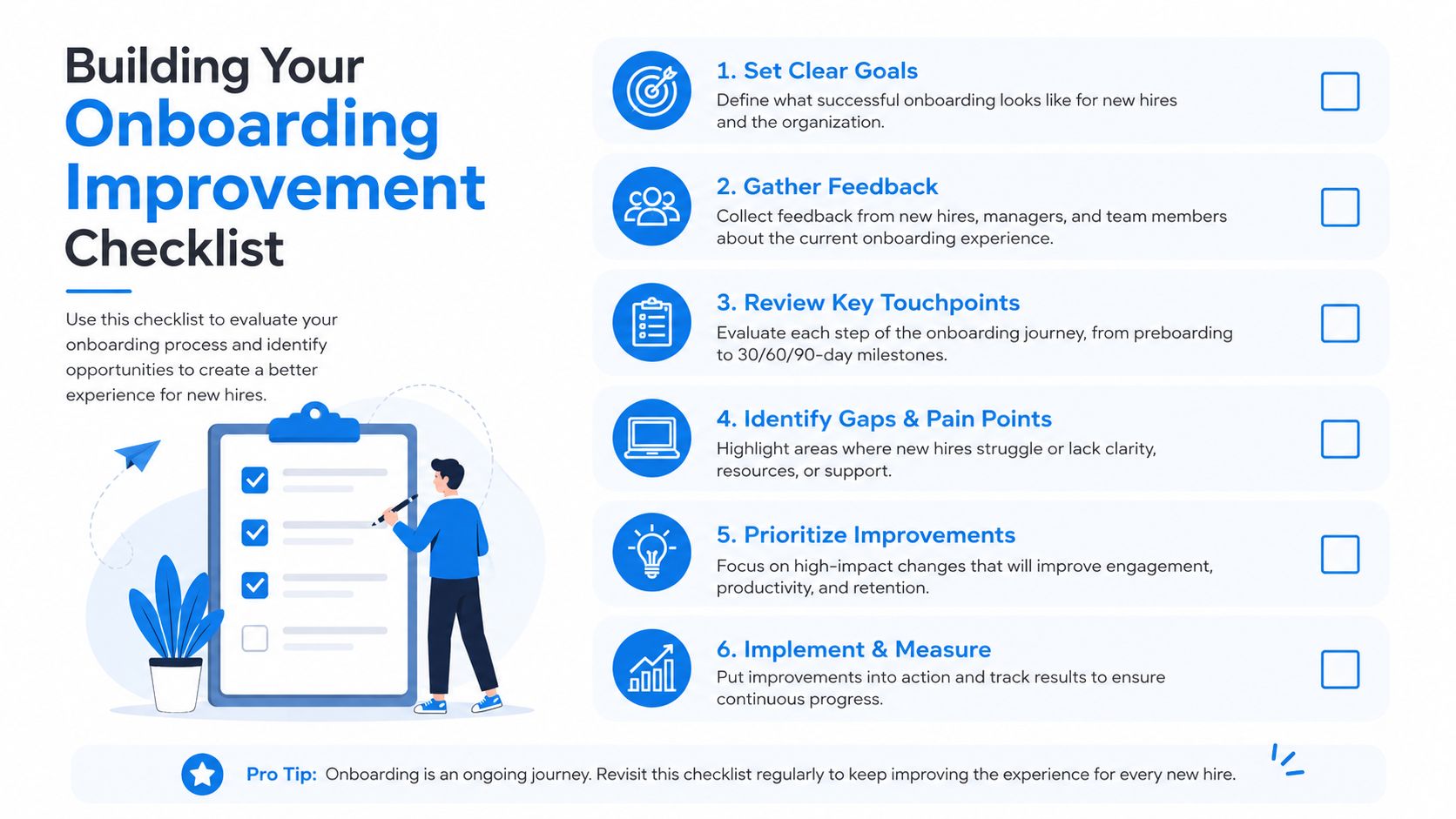
A good checklist doesn't make onboarding bureaucratic. It makes it repeatable. The point is to remove avoidable friction before it reaches the client.
- Check the first response: Verify how long it takes from signature to the first real client communication. The target state is a fast, confident response that confirms ownership and next steps.
- Audit document intake: Confirm whether clients know exactly what to send and where to send it. The target state is a single intake path with minimal chasing.
- Review the internal handoff: Look for one owner who drives the transition from sales to delivery. The target state is no ambiguity about who is responsible.
- Standardize kickoff scheduling: Make sure kickoff happens on a predictable timeline, not whenever someone has space. The target state is a scheduled, prepared meeting with clear expectations.
- Test follow-up automation: Confirm that stalled clients get structured reminders instead of scattered manual nudges. The target state is consistent follow-through without extra effort from senior staff.
- Track the first 90 days: Verify that someone monitors early engagement, not just completion of administrative tasks. The target state is visible momentum after the welcome.
The easiest place to start is with the gaps that create the most drop-off risk. Delayed response, unclear ownership, and silent follow-up usually hurt faster than anything else. Fix those first, then refine the rest.
If your onboarding still lives in inboxes and memory, Starward Navigators can help you standardize the handoff, automate follow-up, and keep the client moving from signed agreement to active delivery. Visit Starward Navigators to see how their client acquisition infrastructure fits consulting and advisory workflows.