
One perfect message won't rescue every lead. A prospect who just submitted a detailed inquiry needs a different response from a buyer who missed a discovery call, a decision-maker reviewing a proposal, or a former opportunity that chose a competitor. Effective follow-up depends on the pipeline moment, the event immediately before the message, the prospect's engagement signals, and the next action you need from them.
That's why a useful lead follow up script isn't a single clever paragraph. It's a set of context-specific prompts connected to ownership, timing, qualification, reminders, and handoffs. The eight examples below move through the operating rhythm of a consulting or advisory firm, from initial contact and qualification to proposals, stalled opportunities, referrals, lost deals, and won-client transitions. Personalize every script before sending it, and never automate a message without defining what happens after the recipient responds, ignores it, or asks to wait.
A platform such as Starward Navigators can support that operating model by capturing leads, triggering follow-up, tracking proposal stages, coordinating appointment reminders, and automating client handoffs. The technology matters, but the decision rule matters more: every message should earn a specific next step.
Table of Contents
- 1. The Initial Contact Follow-Up
- 2. The Discovery Call No-Show Recovery Script
- 3. The Post-Proposal Follow-Up Sequence
- 4. The Stalled Opportunity Re-Engagement Script
- 5. The Referral Thank-You and Next-Opportunity Script
- 6. The Lost Deal Re-Engagement Script
- 7. The Qualification Discovery Call Script
- 8. The Client Handoff and Implementation Kickoff Script
- 8-Point Lead Follow-Up Script Comparison
- Turn Follow-Up Scripts Into Consistent Next Steps
1. The Initial Contact Follow-Up
Speed is useful only when the first message also creates momentum. Research cited by Harvard Business Review and MIT on speed to lead found that responding within 5 minutes makes a company 21 times more likely to qualify a lead than waiting 30 minutes, and 100 times more likely to make contact than responding after that interval. The same source notes that the average B2B lead response time is commonly reported at about 47 hours, so a consulting firm that waits for manual inbox review may lose intent before a person starts the conversation.
Use this message immediately after a website form, referral introduction, or high-intent LinkedIn inquiry:
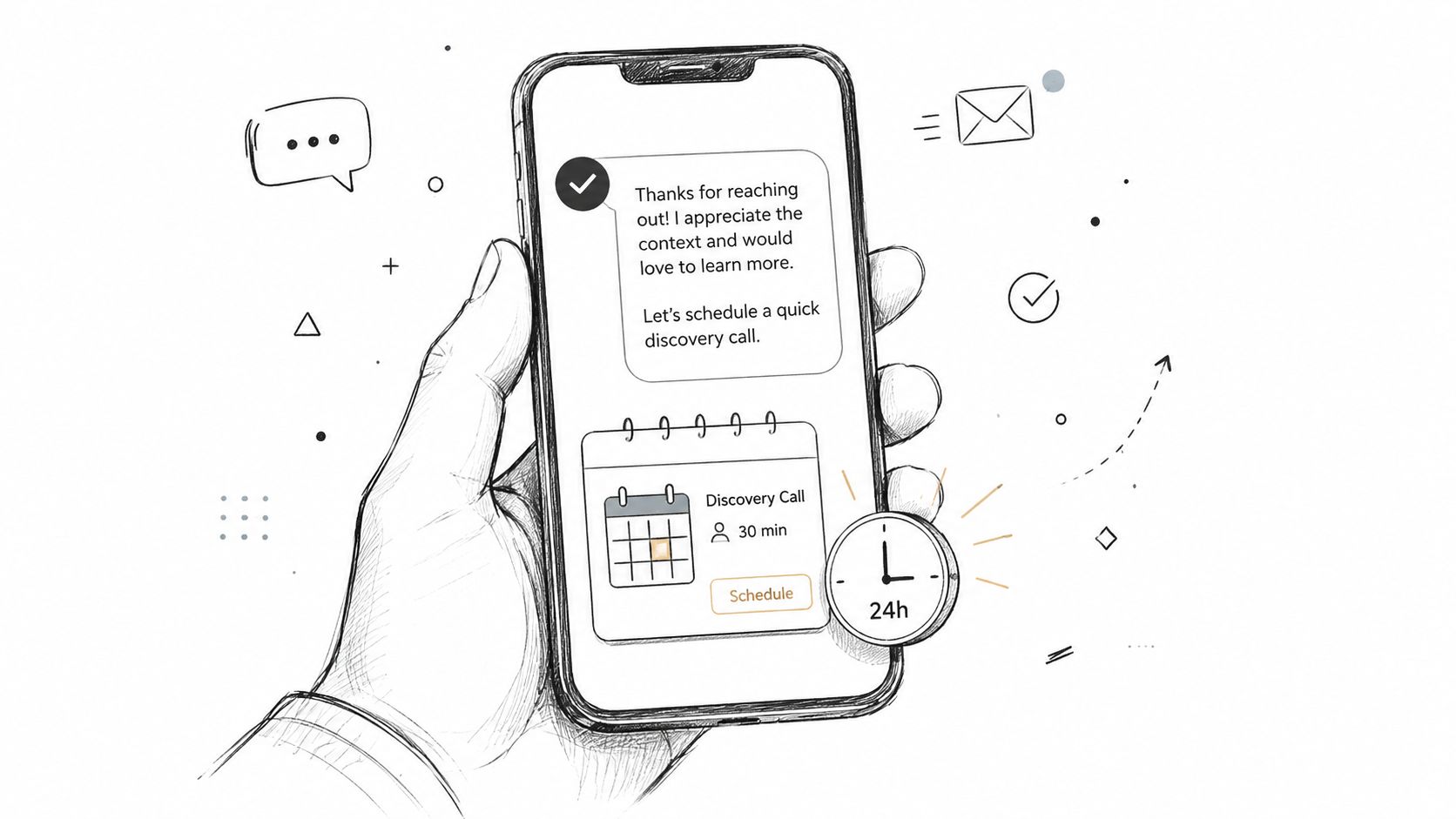
Hi [First name], thanks for reaching out about [specific challenge]. Based on what you shared about [business situation], the first useful step is usually a short conversation to clarify [relevant issue] and determine whether [service or approach] fits. I can offer [time option], [time option], or [time option]. Which works best?
The script acknowledges the inquiry, reflects the prospect's stated problem, and offers a concrete path instead of saying, “We'll get back to you.” For an advisory firm, the value hook might be a review of operating priorities, a discussion of a transition plan, or an initial assessment of a growth constraint. Don't promise an outcome you haven't established.
Trigger, qualification, and handoff
Use dynamic fields for the inquiry topic, company name, and assigned consultant. A lead-routing trigger should create the contact, assign an owner, send the acknowledgment, and alert the business development person to make a manual backup touch. If the lead replies, stop the automated sequence and move the record to qualification. If there's no response, create the next task rather than letting the contact remain in an undefined “new” stage.
Test a specific subject such as “Quick 15-minute discovery call about [challenge]” against a simple acknowledgment, but judge the result by booked and qualified conversations, not opens alone. The first message should be concise. Its job is to confirm relevance and secure a next action, not to deliver a full capabilities presentation.
2. The Discovery Call No-Show Recovery Script
A missed discovery call doesn't automatically mean a prospect has lost interest. Executives get pulled into internal meetings, clients change priorities, and calendar invitations get buried. The wrong response is a disappointed note that makes the prospect defend their absence. The better approach preserves dignity, reduces rescheduling friction, and gives the firm a clear stopping condition.
Send the first message the same day, after allowing enough time for a genuine delay:
Hi [First name], we missed each other for our conversation today. No problem, schedules move quickly. I'd still like to understand what's happening with [stated challenge]. Would [time option] or [time option] work better? You can also choose a time directly on my appointment scheduling page.
If the prospect doesn't respond, send a second, lighter message after 48 hours:
Hi [First name], I wanted to offer one more rescheduling option before I assume the timing isn't right. If [time option] works, I'll hold it for you. If the project has moved down the list, just let me know and I'll pause the reminders.
A final message about a week later should make the exit easy:
I'll close the active scheduling reminders for now. If [challenge] becomes timely again, reply to this message and we'll pick up from where we left off.
Automation and qualification rules
The no-show trigger should record the event, notify the assigned owner, and launch the same-day message. Stop the sequence as soon as the prospect reschedules or replies with a reason. Tag the record with a no-show reason when one is available, such as scheduling conflict, unclear urgency, or internal delay. Those tags help a firm improve qualification and meeting logistics without treating every missed call as a sales failure.
After a third missed meeting, don't keep sending increasingly forceful reminders. Move the contact into a lower-frequency nurture path and set a future review task. The handoff is operationally complete only when the appointment is rescheduled, the owner accepts the nurture task, or the contact receives the pause message.
3. The Post-Proposal Follow-Up Sequence
Proposal silence is rarely solved by “just checking in.” The message needs to connect the proposed work to the business problem, surface uncertainty, and make the decision process easier. A persistent sequence matters because the strongest cadences cluster around 6 to 7 touches over roughly 3 weeks, with touches spaced about 3 to 4 days apart, according to follow-up cadence guidance from Skipcall. That source also reports that 80% of B2B deals close between the 5th and 12th follow-up, while 44% of representatives stop after the first or second attempt. Treat those figures as directional benchmarks, not promises of performance.
Use distinct reasons for contact across the sequence.
Five touches with different jobs
Touch one, proposal delivery
Hi [First name], attached is the proposal for [initiative]. I've structured it around [business problem], with [scope detail] as the first practical step. Please review the assumptions on [scope, timing, or stakeholders], and let's reserve [time option] to discuss questions.
Touch two, early review
I wanted to check whether the proposal reflects the priority you described, especially [specific concern]. Is anything unclear about the recommended approach, responsibilities, or timing?
Touch three, problem reinforcement
You mentioned that [specific consequence] is making [business objective] harder to achieve. I've been thinking about that point and would be glad to walk through how the proposed work addresses it. Would a short review call help?
Touch four, concern handling
Rather than send another summary, I'd prefer to address the main decision concern directly. Is the open question about scope, internal approval, timing, or something else?
Touch five, decision support
Should we plan to move forward with [next step], revise the proposal, or pause this initiative? A clear decision will help us reserve the right resources and give you a useful path either way.
Adapt the spacing to the engagement. An implementation project may require a shorter decision cycle than a strategy engagement. If the prospect views the proposal or replies, stop generic reminders and route the activity to the owner for a personal response. If there's no response by the fifth day, alert the manager or deal owner for intervention.
A structured proposal follow-up workflow should track the stage, owner, last contact, next task, engagement signal, and pause condition. A phone or video touch can be more appropriate than another email when the prospect has already reviewed the document but hasn't raised an objection.
4. The Stalled Opportunity Re-Engagement Script
A stalled opportunity deserves curiosity, not pressure. The prospect may have lost budget, changed leadership, paused the initiative, or lacked the internal capacity to make a decision. If the last meaningful exchange happened weeks ago and no explicit rejection was given, reopen the context before you reopen the pitch.
Hi [First name], we haven't spoken about [initiative] for [time period], so I wanted to check whether circumstances have changed on your end. You originally mentioned [business problem]. Is that still a priority, or has another issue taken its place?
Follow the question with three clear paths:
We can either move forward with the next step, keep the conversation open until the timing improves, or pause and reconnect around [future period]. Which option best reflects where things stand?
This wording gives the prospect permission to tell the truth. It also helps the consultant distinguish an objection from a timing problem. A budget issue may call for revised scope. A team change may require a new stakeholder conversation. A shelved initiative should leave the active pipeline and enter nurture.
Decision rules for a clean pipeline
If the prospect chooses to proceed, confirm the next meeting, participants, decision date, and outstanding information. If they ask to reconnect later, create the calendar task while the timing is fresh and record the reason for the pause. If they say the project is no longer relevant, close the opportunity with a specific loss or disqualification reason rather than leaving it open indefinitely.
Don't send the same proposal again with a new subject line. The re-engagement message should reference the original problem and ask what changed. A short update, a revised diagnostic question, or an offer to reassess scope can add value. Generic “just following up” language usually gives the recipient no reason to answer.
For long-cycle consulting work, a quarterly nurture path can preserve the relationship without pretending the opportunity is active. Each nurture touch should offer a relevant insight, planning prompt, or invitation to revisit the issue, while the CRM keeps the original source, owner, and prior decision context visible.
5. The Referral Thank-You and Next-Opportunity Script
A referral changes the opening context. The referred prospect already has a reason to trust the introduction, while the referrer has taken a reputational risk by making it. Thank both people separately and keep the communication specific.
Send the referrer a prompt acknowledgment:
Thank you for introducing me to [referred contact] at [company]. The connection is valuable because [specific strategic fit or shared problem]. I'll reach out to understand their situation and will update you on how the conversation goes.
The phrase “specific strategic fit” should be replaced with something real. Perhaps the referrer knows the contact's leadership challenge, or perhaps the company is entering a situation where the consultant has relevant experience. Avoid promising confidentiality-breaking details or implying that the referrer will receive information the referred contact hasn't authorized you to share.
After the agreed update period, send a concise status note:
A quick update on [referred contact]. We've [spoken, scheduled a follow-up, decided the timing isn't right, or agreed on a next step]. I appreciate the introduction, and I'll respect the boundaries of what I can share. If another situation comes up where [your service] might help, I'd be glad to speak with them.
Relationship stages and ownership
Track the referrer separately from the referred opportunity. A relationship pipeline can use stages such as Identified, Engaged, Active, and Top Advocate, but each stage needs an owner and a next action. A referred lead may be lost while the referrer remains an important relationship. Don't let one deal outcome determine the value of the broader connection.
Use a referral tracking process to record the source, introduction date, assigned owner, thank-you status, update commitment, and future relationship task. If the referral isn't a fit, report that respectfully without disclosing sensitive details. A quarterly relationship check-in should be separate from deal updates, because a referral partner isn't only valuable when an opportunity is active.
The practical test is simple. After each referral, the referrer should know their introduction was received, handled professionally, and appreciated.
6. The Lost Deal Re-Engagement Script
A lost deal isn't an invitation to argue with the decision. If the prospect chose another provider, cut the budget, or cancelled the project, acknowledge that outcome and leave the relationship intact. Re-engage after the circumstances have had time to change, typically around 4 to 6 months after the loss, while recognizing that the correct timing depends on the buying cycle and reason recorded in the CRM.
Hi [First name], it's been [time period] since we discussed [initiative]. We respected your decision to move forward with [chosen option], and I'm curious whether anything has changed since then. How is the project progressing with that approach?
Then ask focused questions rather than making a replacement pitch:
- Project progress: Is the initiative producing the progress you expected?
- Priority shifts: Have budget, leadership, or business priorities changed?
- Conversation fit: Would a brief catch-up be useful if the issue is active again?
If the prospect says the competitor is performing well, thank them and close the loop. If the project has changed, offer a small, relevant conversation rather than sending a full proposal without qualification. If the budget cycle has reopened, confirm the decision process and stakeholders again. The old opportunity record may no longer represent the current buying environment.
What to record after the message
Mark the outcome as won back, still not interested, changed circumstances, or another defined status. That information helps a consulting firm identify patterns in future deals, including whether the loss came from timing, scope, authority, budget, or competitive positioning. Don't use resurrection messages to punish a former prospect for choosing differently.
If the prospect is receptive, use a light re-engagement sequence with a few useful touches. Keep each message connected to the changed situation. If there's no response, stop the active sequence and retain the record for appropriate nurture. A lost deal should become a learning record and a relationship record, not an endless automated chase.
7. The Qualification Discovery Call Script
A discovery call should do more than create rapport. It should help both sides decide whether the problem, timing, resources, authority, and working approach align. Start by setting the structure so the prospect knows the conversation isn't a disguised product presentation.
Thanks for making time. Here's what I'd like to do in our 20 minutes: understand what's driving your interest, see whether we're a good fit, and agree on a useful next step. Does that work for you?
Ask questions in a natural sequence. Begin with the problem:
What's prompting you to explore [service] now?
What happens if the issue remains unresolved?
Move to timing and consequences:
When would you ideally want to see progress?
Is there an event, deadline, or internal decision shaping that timing?
Then test commercial readiness without turning the call into an interrogation:
Do you have a preliminary budget range in mind?
Who else will be involved in the decision?
What will they need to understand before approving the work?
The budget question isn't only about the amount. It reveals whether the prospect has discussed investment internally. The authority question prevents a consultant from preparing a detailed proposal for someone who can't sponsor or approve it.
The commitment close
End with a specific agreement:
If we decide that a proposal makes sense, can we agree that you'll review it with [stakeholder] by [date]? If that timing won't work, what would be more realistic?
This close tests seriousness without pretending the prospect has already committed to buy. Record the stated challenge, impact, timeline, budget position, decision participants, objections, and agreed next action in the CRM immediately after the call. If the opportunity isn't a fit, explain why and route it to nurture, referral, or closure.
Use the appointment confirmation workflow to send confirmations and reminders, but don't let automation replace preparation. The assigned consultant should review the inquiry, previous messages, referral context, and desired outcome before joining the call.
8. The Client Handoff and Implementation Kickoff Script
Winning the deal creates a new follow-up obligation. Clients should feel continuity between the person who understood their problem and the team responsible for solving it. A handoff message should name the delivery owner, confirm the immediate schedule, summarize what happens next, and invite corrections before implementation begins.
Congratulations on moving forward. [Delivery lead] will contact you by [date] to schedule our kickoff meeting. During the first part of the engagement, we'll focus on [brief sequence or initial outcome]. Your primary contacts will be [names], and we'll confirm the start date, stakeholders, scope assumptions, and immediate information needs during kickoff.
Include the delivery team member's name and, where appropriate, a photo or short introduction. Clients shouldn't have to wonder who has inherited the work or repeat the original business problem. The internal brief should capture:
- Stated challenge: What the client originally needed to solve.
- Selection reason: Why they chose the firm over alternatives.
- Stakeholders: Who owns, influences, uses, or approves the work.
- Concerns: Any risks, reservations, or sensitive points raised.
- Scope assumptions: The boundaries, timing, dependencies, and open questions.
Trigger and delivery acknowledgment
The won-stage trigger should update the client record, start the delivery pipeline, notify the implementation owner, and create the kickoff task. Require the delivery lead to acknowledge the internal brief before the client-facing email sends. That small control prevents a polished message from reaching the client while the delivery team remains unaware.
Schedule the kickoff while the handoff notification is being prepared. Don't make the client start a second scheduling conversation after signing. If scope details remain uncertain, say so directly and list what the kickoff will confirm. Clear uncertainty is safer than implied certainty.
The handoff is complete when the client has a named owner, a scheduled next meeting, and a consistent record shared by business development and delivery. That protects trust at the point when many firms accidentally create silence.
8-Point Lead Follow-Up Script Comparison
| Script | Implementation Complexity (🔄) | Resource Requirements (⚡) | Expected Outcomes (📊⭐) | Ideal Use Cases (💡) | Key Advantages (⭐) |
|---|---|---|---|---|---|
| The Initial Contact Follow-Up (24‑Hour Rule) | Medium 🔄🔄 | CRM + automation + calendar links ⚡⚡ | High open/response (35–45%) 📊 ⭐⭐⭐ | New inbound leads from website/forms/events 💡 | Captures peak interest; signals responsiveness ⭐ |
| The Discovery Call No‑Show Recovery Script | Medium‑High 🔄🔄🔄 | Calendar integration, CRM + BD escalation ⚡⚡⚡ | Recovers 25–40% missed calls 📊 ⭐⭐ | Scheduled discovery calls with qualified prospects 💡 | Recovers conversations; maintains professionalism ⭐ |
| The Post‑Proposal Follow‑Up Sequence (5‑Touch Framework) | High 🔄🔄🔄 | CRM automation, content assets, rep discipline ⚡⚡⚡ | Advances 40–60% stalled proposals; shortens cycle 20–30% 📊 ⭐⭐⭐⭐ | Proposals in active consideration, high‑ticket deals 💡 | Systematic urgency; prevents wishful waiting ⭐ |
| The Stalled Opportunity Re‑Engagement Script | Low‑Medium 🔄🔄 | CRM triggers + light outreach + nurture ⚡⚡ | Recovers 15–25% stalled opportunities 📊 ⭐⭐ | Opportunities dormant for 30+ days; high‑touch sales 💡 | Clarifies status; preserves relationship without pressure ⭐ |
| The Referral Thank‑You & Next‑Opportunity Script | Low 🔄 | Referral tracking + personalized updates ⚡ | Increases repeat referrals (e.g., +25pp) 📊 ⭐⭐⭐ | Inbound referrals from clients/partners; referral‑dependent firms 💡 | Strengthens advocate relationships; drives repeat referrals ⭐ |
| The Lost Deal Re‑Engagement Script (6‑Month Resurrection) | Low‑Medium 🔄🔄 | CRM lost‑deal triggers + empathetic outreach ⚡⚡ | Recovers 8–15% lost opportunities 📊 ⭐ | High‑value lost deals 4–6 months post‑loss 💡 | Low‑effort intel gathering; potential upside if circumstances change ⭐ |
| The Qualification Discovery Call Script | Medium 🔄🔄 | Trained reps + structured script + CRM logging ⚡⚡ | Improves qualification; saves 20–30% pursuit time 📊 ⭐⭐⭐ | Initial discovery calls with inbound interest 💡 | Focuses effort on qualified prospects; collects decisive data ⭐ |
| The Client Handoff & Implementation Kickoff Script | Medium‑High 🔄🔄🔄 | Cross‑team coordination, handoff docs, scheduling ⚡⚡⚡ | Reduces ramp time; fewer restart conversations 📊 ⭐⭐⭐ | Immediately after deal marked "Won", start of delivery 💡 | Preserves momentum; aligns sales and delivery teams ⭐ |
Turn Follow-Up Scripts Into Consistent Next Steps
The eight scripts work best as one operating rhythm, not as isolated templates. Respond quickly to new inquiries, recover missed conversations, qualify before investing in a proposal, manage the proposal-to-decision gap, re-engage stalled and lost opportunities selectively, thank referral sources, and protect momentum after a deal closes. Each moment has a different risk. A new lead risks losing intent. A proposal risks silent drift. A won client risks a confusing handoff.
Start by defining the pipeline stages your firm uses. A small advisory practice might need New Inquiry, Qualified, Discovery Scheduled, Proposal Sent, Decision Pending, Stalled, Won, Lost, and Nurture. The exact labels matter less than the rules attached to them. Every stage should have an owner, an entry trigger, a next task, a response expectation, and a stop condition.
Then assign one script to each operational event. A form submission can trigger immediate acknowledgment and routing. A missed appointment can start recovery messages. A proposal stage can create timed tasks and manager alerts. A referral record can launch a thank-you workflow without confusing the referrer with the referred opportunity. A won stage can create the delivery record and kickoff responsibility.
Make personalization operational
Personalization shouldn't mean rewriting every message from scratch. Define the fields that must be present before a script can send, such as the stated challenge, company, service interest, owner, decision date, and agreed next action. If a required field is blank, route the record to a person instead of sending a generic message.
Add stop and nurture conditions. A reply should stop automated follow-up and create a human task. A booked meeting should suppress scheduling prompts. A clear rejection should close or nurture the opportunity. A request to reconnect later should create a dated task, not an informal note buried in an inbox.
Review outcomes by stage. Look at response quality, qualified conversations, completed discovery calls, proposal decisions, stalled reasons, referral follow-through, and handoff completion. Don't judge a script only by activity volume. A message that generates replies from poor-fit prospects may create more work without improving pipeline quality.
Operating rule: Automation should remove delay and forgotten tasks, not remove judgment from the conversation.
For a consulting or advisory firm that needs prebuilt pipelines, automated follow-up, appointment reminders, proposal tracking, referral workflows, and client handoffs in one acquisition operating system, Starward Navigators is one relevant option. Its infrastructure is designed around business development, client delivery, and relationships and referrals, with lead capture, routing, stage-based workflows, and onboarding actions connected in one system.
The best lead follow up script is the one matched to the prospect's current situation and connected to a clear next action. Write the message for the moment, define what the system should do when the prospect responds or stays quiet, and give a named person responsibility for the next human decision.
Starward Navigators provides consulting and advisory firms with prebuilt acquisition pipelines, automated lead and proposal follow-up, appointment reminders, referral tracking, and client handoff workflows. Visit Starward Navigators to see how those processes can connect from first inquiry through implementation and repeat business.