You've spent days turning discovery notes into a proposal that fits the client's problem, budget, and internal politics. You send it with a polite note, wait for the promised review, and then watch the inbox go quiet. The proposal may be well received, but nobody has converted that interest into a decision, and each unanswered day makes the next message feel more awkward.
That silence usually isn't a verdict on your work. It's a gap between proposal and decision. Buyers need to involve colleagues, confirm priorities, compare alternatives, and resolve objections that weren't visible during discovery. For consultancies, follow-up works when it manages that gap with clear triggers, useful information, and an agreed path forward.
Table of Contents
- Why Proposals Go Quiet After You Hit Send
- When to Follow Up on a Proposal and What Triggers Action
- The Consultancy Follow Up Sequence That Earns Replies
- How to Write Follow Ups That Add Value Instead of Pressure
- Turning Follow Up Into a System So Nothing Slips
- What to Do When Silence Continues and How to Close the Loop
Why Proposals Go Quiet After You Hit Send
A proposal rarely reaches a single person who can read it, approve it, and authorize the work immediately. The person who sponsored the conversation may need input from finance, operations, procurement, legal, or a senior executive. Each additional stakeholder creates another opportunity for the proposal to lose context.
The consultant sees a sent document. The buyer sees a decision process that has just begun.
That distinction matters. Widely cited follow-up data says about 80% of sales require at least five follow-up contacts before closing, while 44% of salespeople stop after one attempt, as summarized by ZoomInfo's sales follow-up statistics. The useful lesson isn't that every consultancy should send five identical emails. It's that a proposal shouldn't be treated as a one-time send-off.
Practical rule: A proposal needs an owner, a next action, and a date for that action before it leaves your hands.
The proposal-to-decision gap
Consider a familiar advisory engagement. The client agrees that the problem is real, likes the proposed approach, and says the document will go to the leadership team. After delivery, the sponsor becomes busy preparing for an internal meeting. A colleague questions the implementation effort. Finance asks whether the work can start in the next planning window. Nobody rejects the proposal, but nobody advances it either.
A generic “Have you had a chance to review?” email doesn't help. It asks the sponsor to reopen the document, remember the discussion, gather the questions, and decide how to respond. The buyer carries all the work.
A structured follow-up reduces that burden. It can point to the section most relevant to the sponsor's concern, offer a short walkthrough, answer a likely objection, or ask which stakeholder still needs information. Each touch should make the next internal conversation easier.
Persistence without pursuit
The trade-off is real. Too little contact allows momentum to decay, while too much contact makes the consultancy appear anxious or inattentive. The answer isn't a perfect script. It's a sequence where the purpose changes each time.
The first message confirms alignment and makes review easy. Later messages add proof, clarify risk, or create a clean decision point. If the buyer remains silent after a reasonable sequence, the opportunity should move into nurture rather than remain an emotionally charged task in someone's inbox.
Around 2% of sales close on the first contact, according to the same follow-up benchmark. For a consultancy, that reinforces a practical operating principle: sending the proposal is the midpoint of the commercial process, not its conclusion.
When to Follow Up on a Proposal and What Triggers Action
A proposal is due for follow-up when the buyer's review process says it is, not when the consultancy feels uneasy. If the client said the leadership team would review it on a specific date, work from that commitment. A message shortly before or on the agreed date respects the process and gives the buyer a clear prompt.
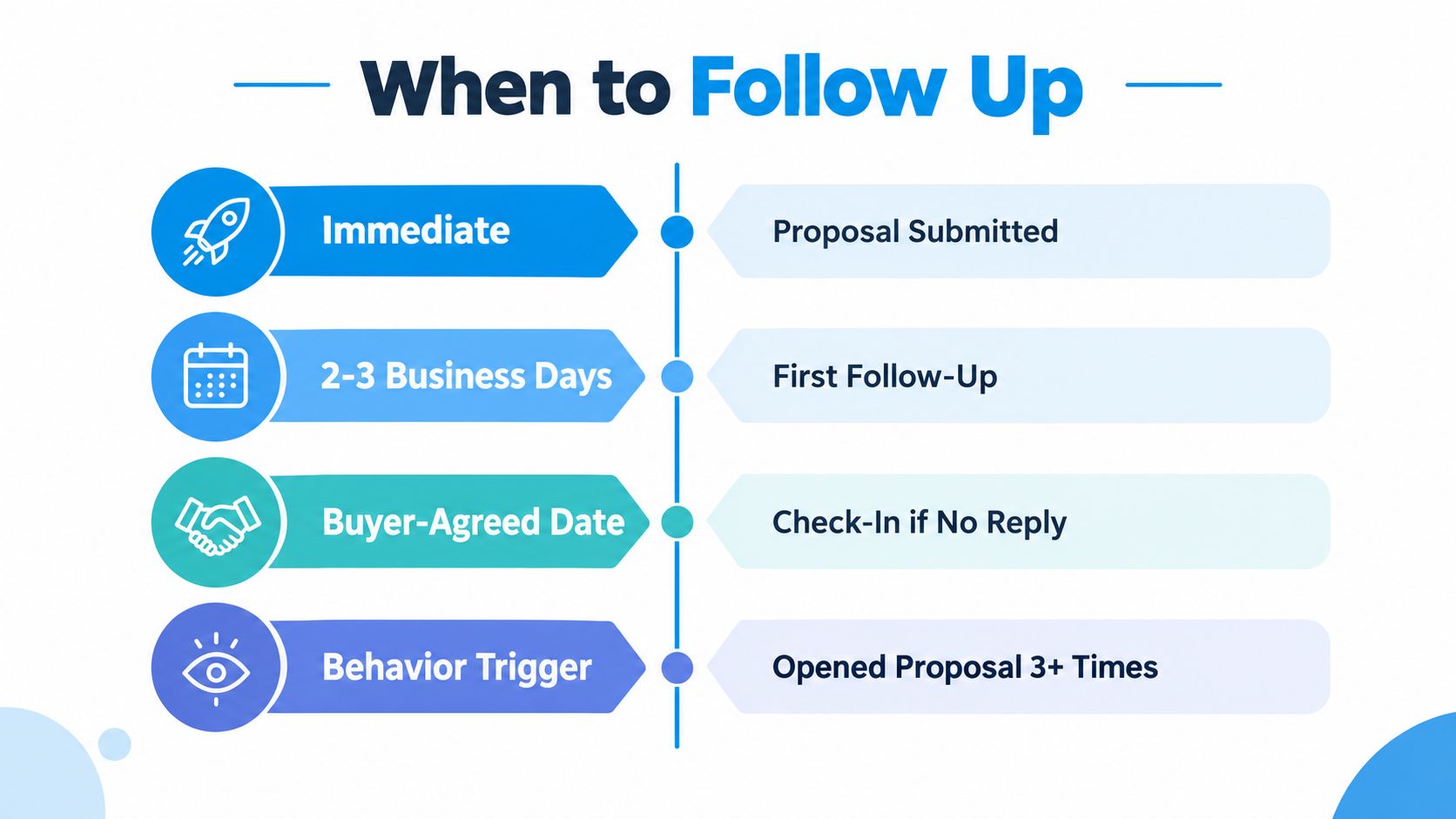
If no date was agreed, send the first follow-up 2 to 3 business days after delivery, consistent with proposal follow-up guidance from Zoomforth. That interval leaves room for an initial review while keeping the proposal connected to the conversation that produced it.
Use a decision hierarchy
Set the timing rules before sending the proposal:
- Buyer-agreed date: Follow up shortly before or on the review date the buyer provided.
- No agreed date: Send the first touch after 2 to 3 business days.
- Engagement signal: If the buyer reopens the proposal after a quiet period, respond to that behavior within 24 hours. Offer clarification on the section they are most likely examining, rather than sending a generic reminder.
- No movement: Space the remaining touches across roughly 2 to 3 weeks. After that, stop active pursuit and move the opportunity into a lower-priority nurture stage.
This creates a managed pipeline gap instead of an open-ended personal task. The trigger determines the next action, while the absence of a trigger keeps the consultancy on the agreed cadence.
Speed still matters, but the lead-response figures from ProfitOutreach's sales follow-up statistics should not be treated as proposal-review evidence. The practical lesson is narrower: speed signals attention. A prompt response to renewed activity shows that the proposal remains actively managed, while unexplained delay gives internal urgency time to fade.
Treat engagement as a trigger, not a verdict
An open confirms access, not approval. It does not show that the buyer understands the pricing, accepts the scope, or has authority to proceed. Use the signal to choose a relevant conversation, never to announce that the prospect is being monitored.
A reopening after silence can trigger a concise note offering to clarify the section under review. Activity from several stakeholders can trigger an invitation to a shared walkthrough. No visible activity should trigger patience and the planned cadence, not invented urgency.
The channel can change when the decision requires it. Email suits a focused clarification, a call helps resolve several linked questions, and a short meeting can bring stakeholders into the same discussion. The proposal follow-up sequence described by Pitchsite uses spaced touches while changing the decision aid and, when appropriate, the channel. Its reported reply-rate benchmarks include 38% for a delivery-confirmation touch within 4 hours, 22% for a day-3 value-add email, 14% for a day-7 check-in, 18% for a day-10 to day-12 channel switch, and 28% for a day-21 close-the-loop email. Treat these figures as benchmarks, not promises. Buyer process, relationship, offer, and market will affect the result.
Connect the proposal stage to a documented client onboarding workflow so an accepted project has a defined handoff and follow-up ownership does not depend on memory.
The Consultancy Follow Up Sequence That Earns Replies
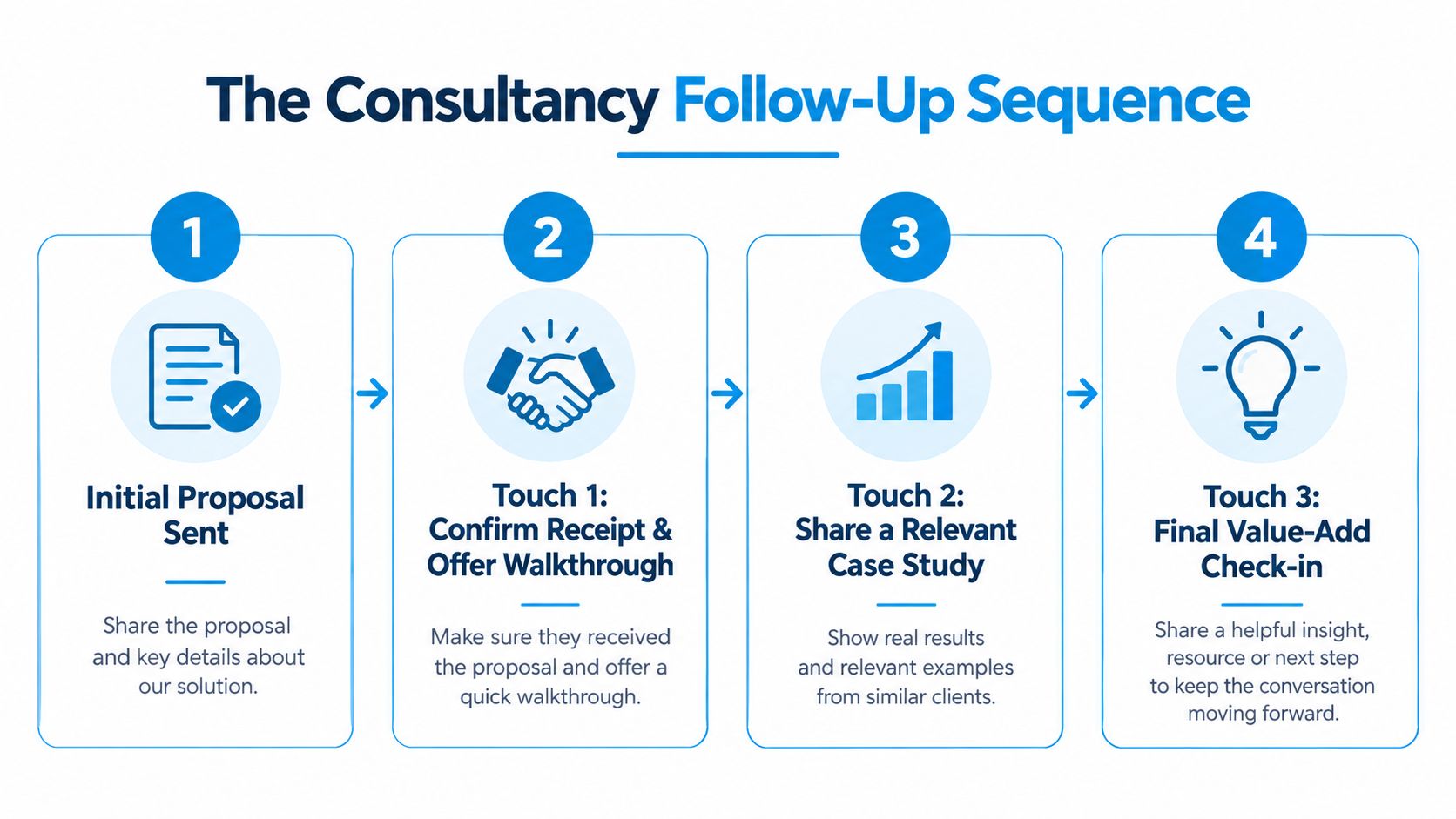
A good sequence doesn't repeat “any thoughts?” with different dates. It gives every touch a distinct job and records the next action in the pipeline. The sequence can run across 3 to 5 touches, with the total active pursuit generally limited to the period in which the buyer's original need remains current.
Touch one confirms receipt and lowers friction
The first message should arrive after the initial review window unless the buyer has set a different date. Don't make receipt the entire point. Confirm that the proposal is available, remind the buyer what it addresses, and offer a walkthrough or an email response.
Subject: A quick walkthrough of the [project name] proposal
Hi [Name],
I wanted to make sure the proposal for [scope] reached you. I've highlighted the sections that connect most closely to your priority around [specific business issue].
Would a short walkthrough help your team review the scope and assumptions? I'm also happy to answer questions by email if that's easier.
What does your review process look like from here?
Best,
[Name]
The final question matters because it reveals whether the proposal is with the right person, waiting for a meeting, or blocked by an internal step.
Touch two adds proof or a decision aid
The next message should give the buyer something useful to share internally. That might be a relevant case study, an explanation of your delivery approach, a brief implementation outline, or an ROI figure that already exists in your approved materials. Don't add a number just to make the message sound more persuasive.
Subject: A relevant example for [business priority]
Hi [Name],
You mentioned that [specific challenge] is the main concern. I'm sharing [case study, framework, or relevant example] because it shows how teams typically approach that issue before implementation begins.
The part most relevant to your proposal is [specific section or lesson]. If your colleagues have questions about scope or delivery, I can address those directly in a short group call.
Is there someone else who should receive this context?
Best,
[Name]
This touch recognizes the multi-stakeholder reality of advisory buying. It also gives the sponsor language they can use without asking them to become the consultant.
Touch three surfaces the likely objection
Silence often hides a question. The buyer may be uncertain about the timeline, internal workload, scope boundaries, commercial terms, or how the engagement fits existing initiatives. Raise one likely concern and answer it plainly.
Subject: One implementation question to clarify
Hi [Name],
A question that often comes up at this stage is how much internal time the engagement requires. In the proposed approach, your team's involvement is concentrated around [specific activity], while we handle [specific responsibility].
If that isn't the issue holding things up, a brief reply with the main concern is enough. I can adjust the explanation or bring the right person into the conversation.
Best,
[Name]
Avoid listing every possible objection. One specific answer feels thoughtful. A catalogue of objections can create concerns the buyer hadn't considered.
Touch four changes channel or creates a clean close
If email hasn't produced movement, use a channel switch only when the relationship supports it. A short LinkedIn message, phone call, or voice note can work because it changes the context, not because it increases pressure. Keep the message tied to the proposal and avoid sending the same paragraph in another medium.
Then send a final close-the-loop note if there's still no response:
Subject: Close out or revisit later
Hi [Name],
I don't want to keep this active if the timing has changed. Should I close the proposal on my side, or would it make sense to revisit it later?
Either answer is useful, and I'm happy to reconnect when the priority returns.
Best,
[Name]
This gives the buyer three acceptable outcomes, yes, no, or later. That clarity often produces a more useful response than another open-ended reminder.
How to Write Follow Ups That Add Value Instead of Pressure
The simplest test is to remove your request from the message and ask what remains. If nothing remains except “I'm following up,” the email has no reason to exist.
Compare the common weak version with a message that advances the buyer's work:
| Instead of writing | Write this |
|---|---|
| “Just checking in on the proposal.” | “You mentioned that implementation effort was the main concern. I've outlined the internal activities required in the attached note.” |
| “Have you made a decision?” | “Is the proposal waiting on finance, another stakeholder, or a change in timing?” |
| “Let me know if you have questions.” | “Would it help to review the scope and assumptions together, or is one section causing uncertainty?” |
| “I wanted to follow up again.” | “I'm sharing one relevant example that may help your team evaluate the proposed approach.” |
Make the message easy to answer
A strong follow-up usually contains four parts:
- Specific context: Refer to the buyer's stated problem, not your internal sales stage.
- New value: Add an insight, proof point, clarification, or useful document.
- Low-friction choice: Offer email or a walkthrough, or ask which stakeholder is involved.
- Defined next step: Suggest a date, identify the decision needed, or offer to close the file.
Keep the email short enough to read on a phone. The proposal contains the detail. The follow-up should direct attention to one decision-relevant point.
Subject lines should also describe the value or decision point. “Question about implementation,” “A relevant example for your team,” and “Scope clarification for [project]” tell the recipient why the message deserves attention. “Following up” says only that you're following up.
Choose the channel based on the relationship
Email works well for documents, summaries, and questions that need to be forwarded internally. Phone is better when the relationship is established and the issue is easier to resolve through conversation. LinkedIn can be appropriate for a lighter re-entry, particularly when the buyer already uses that channel with you.
Don't switch channels to increase the number of touches. Switch when the format solves a problem. A call can clarify a complicated scope question. A short LinkedIn note can reopen a dormant conversation. A recorded walkthrough can help several stakeholders review the same explanation.
A channel switch should change the buyer's experience, not multiply the same request.
Use engagement data carefully. A reopened proposal may justify a timely, relevant message, but it doesn't justify saying, “I saw you looking at the pricing page.” That phrasing can feel invasive. Instead, offer help with pricing assumptions, scope trade-offs, or internal approval.
Finally, match directness to deal stage. A new relationship needs educational follow-up and context. An established client relationship supports more direct questions about stakeholders and approvals. A late-stage opportunity usually needs a focused question about the remaining obstacle, not another general overview.
Turning Follow Up Into a System So Nothing Slips
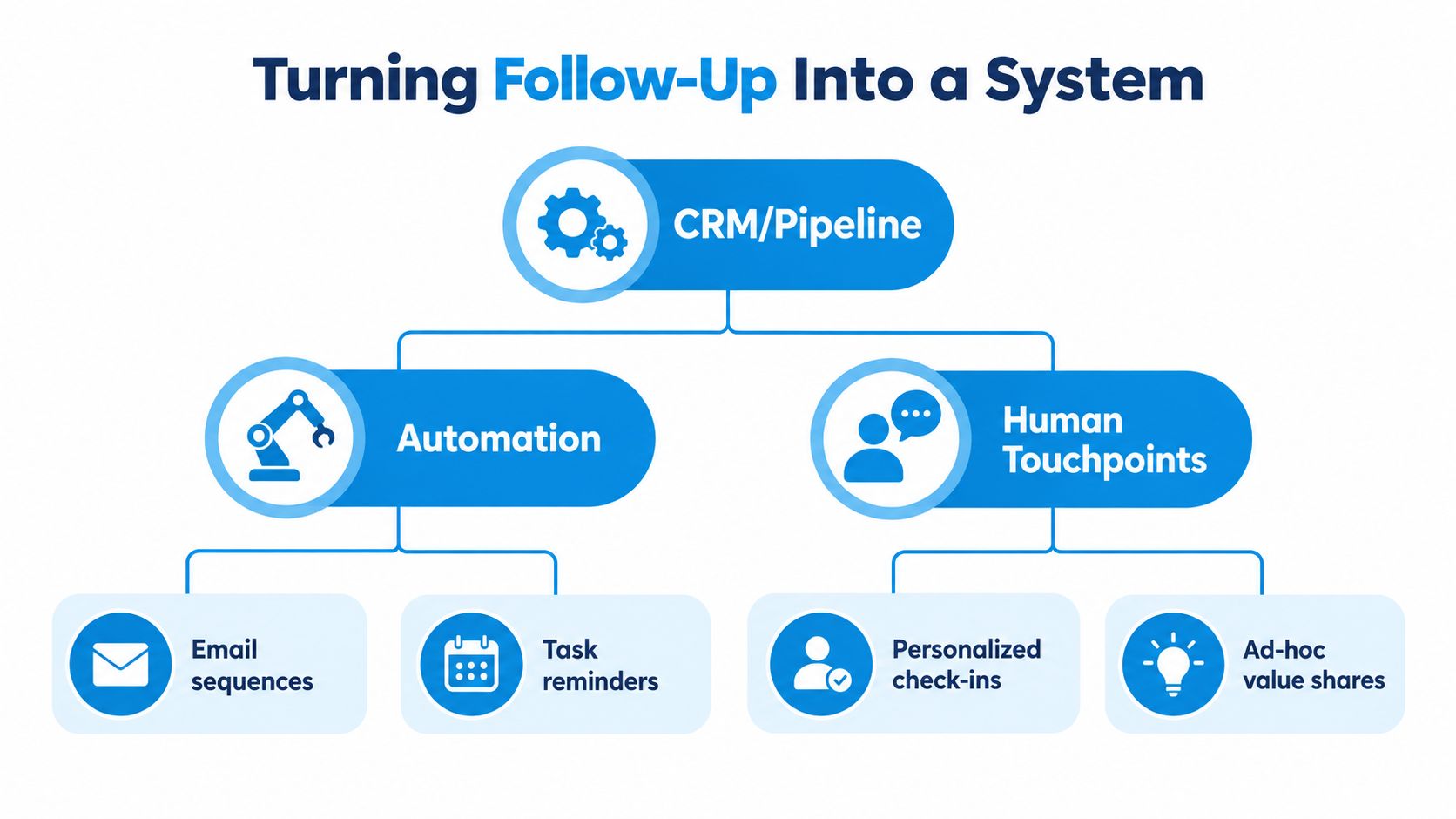
Individual consultants often know exactly what to do, then fail to do it when delivery work, client calls, and new opportunities compete for attention. The fix is to make follow-up a property of the pipeline, not a personal memory test.
A proposal stage should answer five questions:
- Who owns the opportunity?
- When was the proposal sent?
- What did the buyer agree to do next?
- Which follow-up touch is due?
- What happens if the buyer stays silent?
Build triggers around the opportunity stage
A practical pipeline can move from discovery complete to proposal sent, review in progress, decision pending, won, lost, or nurture. When the record enters proposal sent, create the first task and associate the buyer-agreed date. If no date exists, use the standard 2 to 3 business day rule.
Each later stage should enforce a different action:
- Proposal sent: Record delivery and confirm the next review event.
- Review in progress: Prepare a walkthrough, stakeholder summary, or clarification.
- Decision pending: Surface the remaining objection and identify the approver.
- Nurture: Remove the opportunity from active pursuit and schedule a future re-engagement.
- Won: Notify delivery, start onboarding tasks, and schedule kickoff coordination.
Automation handles due dates, reminders, and owner alerts. Humans handle judgment. A workflow can send a receipt confirmation, but a consultant should intervene when a new stakeholder appears, a buyer revisits the proposal after silence, or the client raises a commercial concern.
Keep the operating system connected
Fragmented tools create gaps. A proposal may live in a document platform, the follow-up reminder in a calendar, the buyer's reply in an inbox, and the delivery handoff in a spreadsheet. Each handoff depends on someone copying information correctly.
A consultancy-focused system should capture leads from the website, inbox, LinkedIn, and events, then route them into the same pipeline. It should connect appointment confirmations, proposal tracking, follow-up tasks, client onboarding, and referral nurture so the opportunity doesn't disappear when ownership changes.
For firms that want a configured infrastructure rather than a blank CRM, Starward Navigators' follow-up automation connects proposal stages with reminders, next steps, and handoffs. Other tools can support the same operating principle, including a CRM paired with proposal analytics, scheduled tasks, and carefully reviewed email sequences.
The important design choice is accountability. Every proposal should have one owner, one current stage, one next action, and one exit rule. Templates make execution faster, but they shouldn't replace personalization where the buyer's situation requires judgment.
What to Do When Silence Continues and How to Close the Loop
Silence becomes meaningful after the buyer has had reasonable time, received useful context, and still provided no next step. Treat it as a pipeline signal, not an automatic rejection. The opportunity needs a different status, owner action, and review date.
After 4 to 5 touches without a response, move the proposal to a lower-priority stage and set a 60 to 90 day re-engagement reminder. This protects the relationship while keeping active selling time focused on opportunities with current engagement. Set an escalation rule too: if the buyer has named a decision date, wait for that date; if a new stakeholder appears, switch to the relevant contact or channel.
Use a clear exit message:
“I'm going to close this out for now so I don't keep filling your inbox. If the priority returns, reply here and I'll reopen the conversation. If there's a better time to reconnect, I'm happy to note it.”
If the buyer gives a clear no, respect it. Record any reason they share, ask whether a future timing would be appropriate, and stop active pursuit until then. A professional close preserves referral potential and prevents your team from spending attention on a closed opportunity.
A practical weekly reset
- Audit open proposals: Confirm each has an owner, current stage, and next action.
- Apply the timing rule: Use the buyer's date first, then the standard cadence.
- Review behavior signals: Prioritize genuine re-engagement over routine reminders.
- Change the message job: Shift from receipt confirmation to value, objection handling, or close-out.
- Switch channels carefully: Use a call or another contact only when it can improve the conversation.
- Move silence to nurture: Set a future reminder instead of pursuing indefinitely.
- Prepare the handoff: Transfer context and ownership to delivery when a deal is won.
- Reset onboarding materials: Keep a current client onboarding template ready for the next stage.
If proposals still depend on individual memory, configure these fields and triggers this week. A managed follow-up system gives each opportunity a defined path: pursue, pause, nurture, or close.
Starward Navigators helps small consulting and advisory firms connect proposal tracking, automated follow-up, appointment reminders, and client handoffs in one operating system. Visit Starward Navigators to see how defined next steps can replace quiet proposals and scattered reminders from first contact through delivery.