Most advice about referral tracking software starts with features, then treats every referral motion as if it were the same. It isn't. A consultancy may need to manage trusted referral relationships inside its acquisition workflow, a technology company may need a formal partner relationship management system, and a subscription business may mainly need link, coupon, billing, commission, and payout attribution.
That distinction changes the shortlist. This comparison evaluates each platform by referral and partner workflow depth, attribution, reward or commission handling, integrations, implementation burden, scalability, and suitability for small consulting and advisory firms. It also separates client-acquisition operating systems from PRM and affiliate platforms, because a partner portal can be excellent at deal registration while doing little to chase a proposal or coordinate a client handoff.
Starward Navigators is the benchmark for consultancies that want referral relationships connected to lead capture, proposal follow-up, delivery handoffs, and repeat-business nurture. The other tools are stronger when the central problem is a formal partner ecosystem, affiliate recruitment, or subscription revenue attribution. The right choice depends less on the longest feature list than on where the referral process breaks after someone makes an introduction.
Table of Contents
- 1. Starward Navigators
- 2. Referral Rock
- 3. Kiflo PRM
- 4. PartnerStack
- 5. impact.com
- 6. Everflow
- 7. Tapfiliate
- 8. Rewardful
- 9. FirstPromoter
- 10. Referral Factory
- Top 10 Referral Tracking Software Comparison
- Choose by Workflow, Not Feature Count
1. Starward Navigators
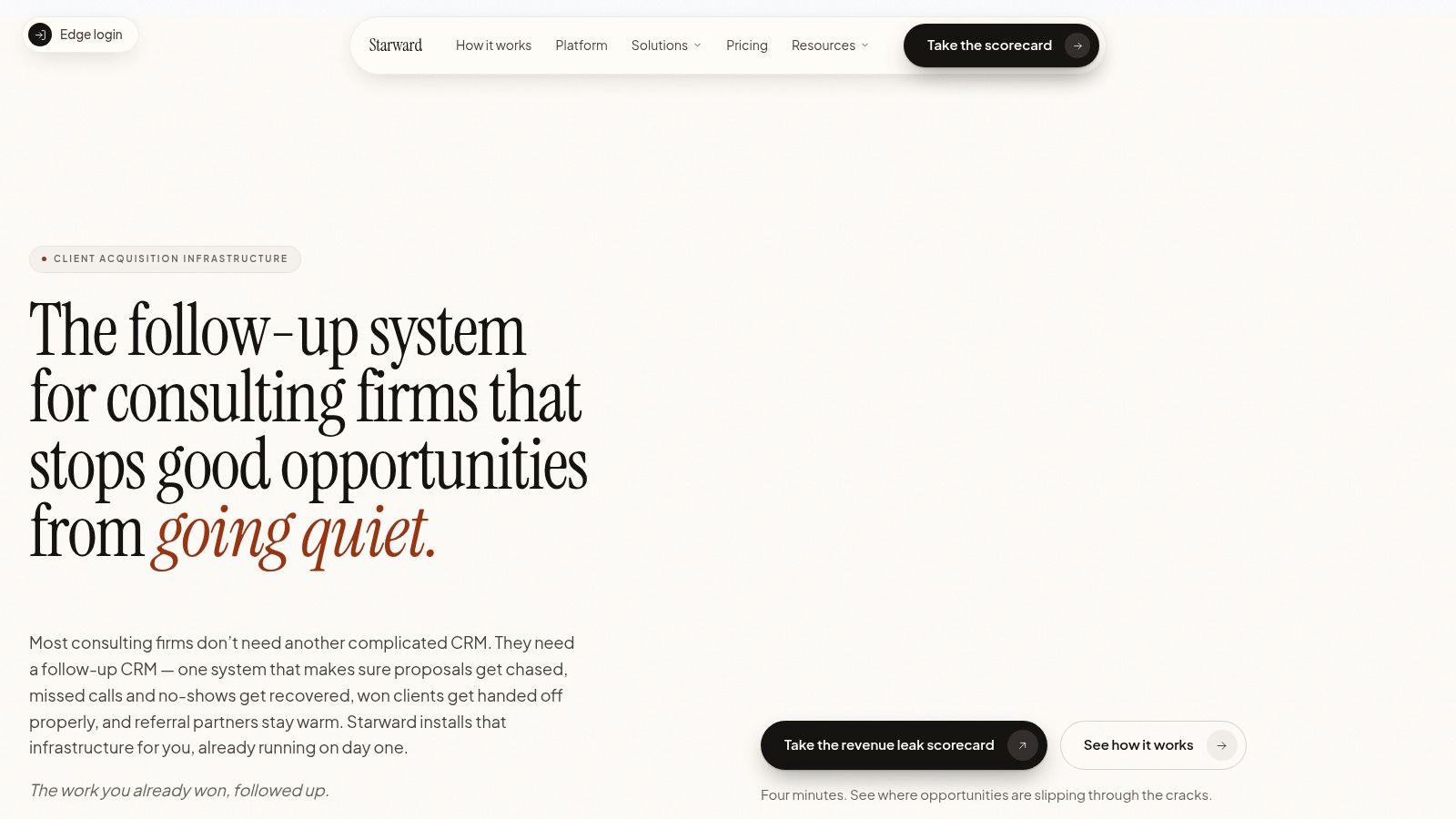
Starward Navigators is the strongest fit here for a small consultancy that sees referrals as part of a broader revenue process, not as an isolated campaign. It's a purpose-built follow-up CRM and client-acquisition operating system for small consulting and advisory firms, typically teams of 2–20 people, with prebuilt pipelines for Business Development, Client Delivery, and Relationships & Referrals.
That starting point matters. A generic CRM gives a firm records and configuration work. Starward begins with workflows around lead intake, discovery, proposals, follow-up, partner nurture, and delivery. It can capture opportunities from a website, inbox, LinkedIn, and events, then keep source attribution, ownership, and activity history in one system.
Why it fits the consultancy workflow
The practical differentiator is what happens after a referral arrives. Starward supports automated partner nurture, referral thank-you workflows, proposal tracking with defined next steps, aging alerts, missed-call and no-show recovery, appointment reminders, and automatic client handoffs when work is won. Those functions address the operational gap between “someone introduced us” and “the engagement was sold, launched, and followed up for repeat business.”
The Relationships & Referrals pipeline is especially relevant for firms whose partners need ongoing attention rather than a one-time payout. You can track the relationship from initial contact through active referral and continued nurture, while the business-development process handles the referred lead.
Practical rule: If your team still has to remember who owes a partner a thank-you, which proposal needs a follow-up, or who starts delivery after a win, you're evaluating an acquisition operating system, not just a referral log.
Trade-offs and implementation
Implementation is a major advantage for a small firm with limited operating capacity. Starward uses a Map, Install, Go Live process, includes contact import, and provides done-for-you setup with a 14-day go-live guarantee. Pricing starts at $97 per month, with four plans ranging from solo consultants to plans supporting unlimited users. The Campaigns, Triggers, and Workflows builder is available on Core Plus and higher plans, so lower-cost tiers may limit advanced automation control.
Claude AI is included on every plan for natural-language questions about stalled proposals, partner activity, and opportunities. The limitation is focus. Larger enterprises needing a highly customizable general-purpose CRM may find the system narrower than a broad enterprise platform.
For a detailed view of the workflow, see Starward's referral management platform. Visit the Starward Navigators website for current plan and implementation details.
2. Referral Rock
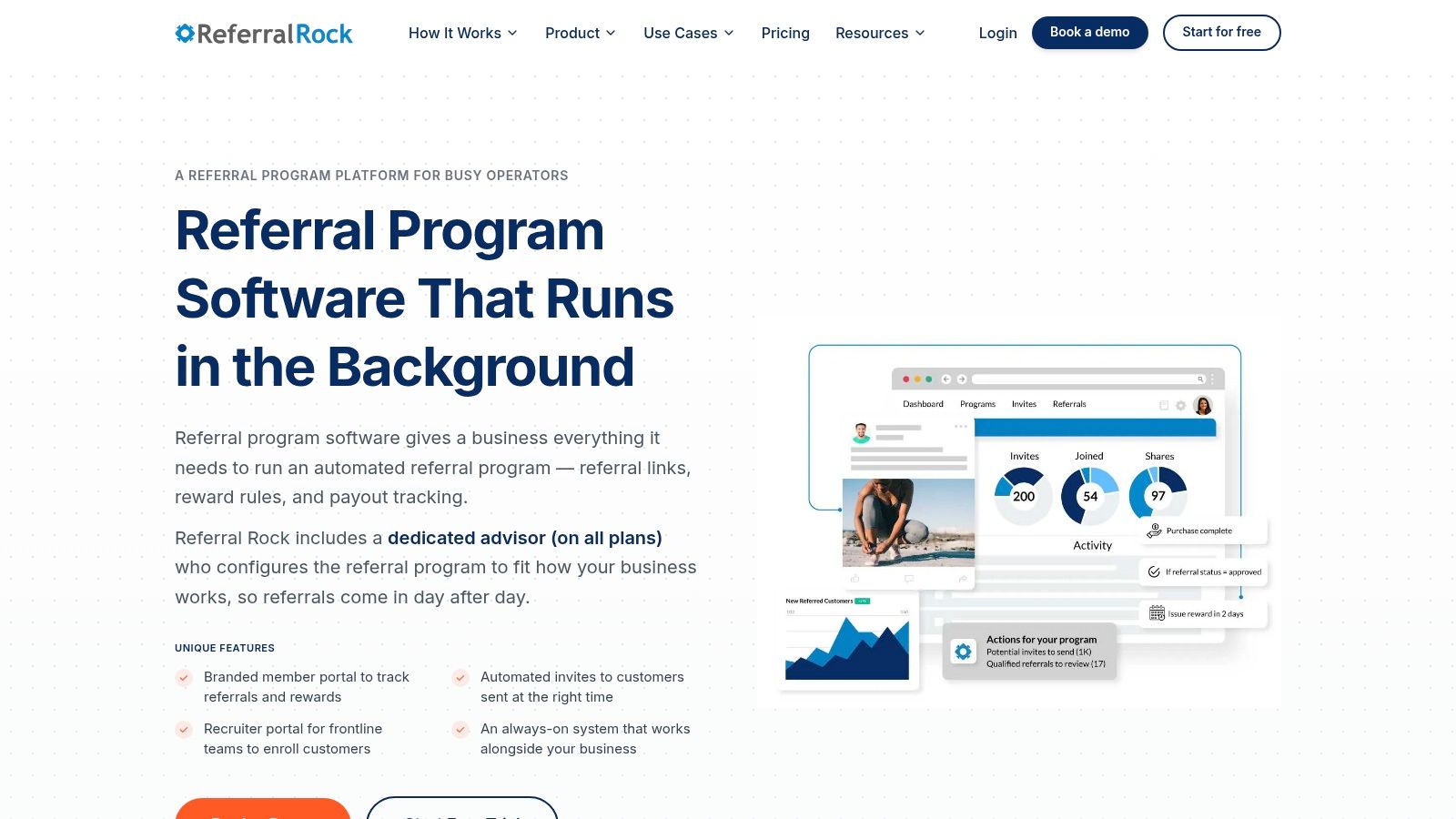
Referral Rock makes sense when the consultancy is building a formal customer, ambassador, partner, or affiliate program and wants the mechanics managed in one place. It combines automated invitations, member onboarding, branded portals, referral activity tracking, rewards, and payouts, which is a different operating model from Starward's lead-to-delivery workflow.
The platform is particularly useful when partners need their own view of activity. A branded member portal can give them tracking visibility, while automated onboarding reduces the manual work involved in inviting and educating participants. Two-sided, tiered, and milestone rewards also support programs where compensation changes according to the result or partner level.
Where it earns its place
Referral Rock supports customer and partner or affiliate programs from the same platform, with broad integrations and advisor-led setup. That support can reduce implementation pressure for a team that knows it wants a referral engine but hasn't yet designed the member journey, incentive rules, or program communications.
The platform takes no cut of rewards, which keeps the economics easier to model than a revenue-share structure. Its controls are also positioned for businesses that need privacy and compliance considerations built into program operations.
For a consultancy, the key question is whether the portal and reward engine are enough. Referral Rock can help automate the referral program, but a firm should verify how referred leads move into proposal stages, how follow-up ownership is assigned, and how a won referral becomes a delivery handoff.
Trade-offs for small advisory firms
The advisor-led approach is a strength, though the flat pricing structure may be heavier than a lightweight internal referral process. There's no permanent free tier, so the program should have a clear operating purpose before purchase.
Use Referral Rock's platform when multiple participant types, branded partner experiences, and automated rewards matter more than consulting-specific proposal and delivery workflows. For implementation planning, consult this guide to how to track referrals, then test whether the platform records the full journey rather than only the initial referral event.
3. Kiflo PRM
Kiflo is a partner relationship management platform, not primarily a consultancy acquisition CRM. That makes it a better fit when partner-led revenue depends on registration, collaboration, account visibility, and commission administration rather than on nurturing a network of individual referral relationships.
Its workflow centers on partner onboarding, branded portals, lead and deal registration, partner collaboration, account mapping, and CRM synchronization. HubSpot and Salesforce sync support a connection to an existing sales system, while Stripe and Chargebee integrations matter for organizations that need the partner process connected to billing.
A PRM for partner complexity
Kiflo's account mapping and overlap detection are important when several partners may approach the same account. A small advisory firm with a handful of trusted introducers might not need that level of structure. A consultancy building a channel with referral partners, resellers, or co-selling organizations may need it to prevent ownership disputes and clarify who registered a deal first.
Pricing scales by active partners rather than contacts. That can suit firms whose partner base is deliberately controlled, but it changes the budget question. You're paying for partner coordination capacity, not just for storing client and prospect records.
A partner portal answers “what has this partner registered?” It doesn't automatically answer “who is chasing the proposal, who owns the next conversation, and who starts delivery after the sale.”
Where it can be too much
Kiflo deploys more quickly than enterprise PRM products, and its lighter structure can be attractive to teams that want partner operations without a large implementation program. Advanced functions such as SSO and custom domains require higher tiers, and a referral-only use case may find the platform broader than necessary.
Choose Kiflo PRM when partner registration, account overlap, CRM sync, and commission automation are central. If your main problem is inconsistent proposal follow-up or weak handoffs from sales into delivery, a consultancy-focused acquisition system is likely to fit the operating reality better.
4. PartnerStack
PartnerStack is built for organizations that manage several partner motions at once, including customer referrals, affiliates, influencers, and co-selling. Its AI-assisted partner workflows, automated commissions, onboarding paths, analytics, and partner marketplace make it more appropriate for a company that treats partner recruitment and enablement as a dedicated growth function.
The marketplace is the strategic differentiator. A consultancy that already knows every referral source it wants to cultivate may not benefit from a discovery network. A SaaS or B2B company trying to recruit new professional partners can see more value in a platform that supports discovery as well as administration.
Strong for multi-program operations
PartnerStack supports different program types within one partner ecosystem, which helps organizations avoid assembling separate systems for affiliates, customer advocates, and co-sell partners. Automated lead submission and commission handling can reduce administrative work once program rules are stable.
The trade-off is implementation depth. Onboarding is typically measured in weeks, and pricing is sales-quoted. That's reasonable for a serious partner operation, but it can be difficult to justify for a small consultancy where the managing partner still owns sales, delivery, and partner communication.
A firm considering PartnerStack should map the handoff into its CRM and delivery process before signing. The platform may solve partner submission and payout administration while leaving proposal progression and client onboarding to another system.
The consultancy test
Ask whether your partners need a structured enablement environment or consistent relationship nurture. If partners need training, registration, co-selling support, and automated commissions, PartnerStack has the right category fit. If the priority is turning a warm introduction into a qualified opportunity and a signed engagement, look at the system that owns that complete acquisition journey.
Review PartnerStack alongside your existing email, CRM, and billing infrastructure. For broader lead-development context, consult this resource on generating leads for email marketing, while keeping partner operations separate from ordinary outbound acquisition.
5. impact.com
impact.com's Partnership Cloud is designed for broad partnership management across affiliate, influencer, and referral programs. It combines partner discovery, contracting, link and promo-code tracking, attribution, reporting, and payouts, making it a strong candidate for organizations with a substantial performance-marketing operation.
Its attribution model is more relevant to businesses with digital conversion events than to a consultancy where a referral may arrive through a conversation, email introduction, event, or private recommendation. Cross-device and event attribution can help connect online interactions, but it doesn't replace a human-owned follow-up process after a lead enters the pipeline.
Where the platform is strongest
impact.com scales from a starter edition toward enterprise marketplace access. Its broad ecommerce and application integrations, performance reports, and higher-tier fraud detection support teams that need governance across many partners and campaigns.
The platform's marketplace can help with partner discovery, but access generally begins at higher tiers. Essentials and Pro tiers may also be difficult for a very small program to justify. That creates a clear trade-off: impact.com is powerful when partnership variety and reporting complexity are real, but excessive when a consultancy has a small group of relationship-based introducers.
Fit for advisory firms
An advisory firm should ask whether it wants partners to generate trackable digital actions or whether its referral motion depends on qualitative context. A link or promo code can identify a source, but it won't by itself capture the partner's role in shaping the opportunity, the proposal conversation, or the eventual handoff.
Choose impact.com when affiliate, influencer, and referral programs need a shared performance infrastructure. For a boutique consultancy, confirm that the platform can accommodate offline introductions, manual qualification, opportunity stages, and relationship nurture before treating it as a complete referral system.
6. Everflow
Everflow suits teams that want detailed control over multiple performance channels. It supports affiliate, influencer, referral, media-buying, and related partner programs, with white-label portals, multi-touch attribution, server-to-server or postback tracking, partner tiers, marketplace discovery, CRM integrations, payment integrations, and reporting.
That breadth gives Everflow a different profile from a consulting acquisition operating system. It's designed to help a performance team understand and govern traffic, conversions, partner activity, and payouts across a more complex channel environment.
Granular control with a learning cost
The white-label portal can provide a controlled partner experience, while multi-channel tracking supports organizations that don't want referral activity isolated from other performance programs. Marketplace discovery adds a recruitment path for teams that need more partners, rather than only better management of existing relationships.
The cost is operational complexity. Pricing is sales-quoted, and the depth of configuration can create a steep learning curve for a small, referral-only team. A consultancy may end up with strong attribution and payout controls but still need another system for proposal chasing, meeting recovery, delivery kickoff, and repeat-business nurture.
Decision filter: If the reporting team will spend more time configuring attribution than the partners spend making referrals, the platform may be correctly built but incorrectly matched.
A better use case
Everflow is compelling for an organization with several partner types and a need for scalable reporting. It's less compelling when one owner needs to maintain a simple referral process alongside client work.
Evaluate Everflow against the complete referral journey. Include offline introductions, manual partner approval, opportunity qualification, proposal follow-up, commission validation, and the transition from closed sale into client delivery.
7. Tapfiliate
Tapfiliate is a flexible affiliate and referral platform for businesses that need multiple tracking methods, recurring or tiered commissions, deep links, coupon attribution, APIs, server-to-server postbacks, webhooks, and connections through Zapier or Make. Its strongest fit is a SaaS or ecommerce business where the conversion event is technically defined and commissions follow a repeatable rule.
For subscription businesses, recurring commissions are a meaningful capability. For a consultancy, however, the question is whether the platform can represent a relationship-led sale that may begin with an email introduction, continue through several conversations, and close after a proposal rather than a tracked online checkout.
Technical flexibility versus operating simplicity
Tapfiliate gives teams control over query, hash, and custom tracking methods, along with cookie-window settings and deep links. That flexibility helps when a company has an unusual technical stack or wants to attribute different digital entry points.
The same flexibility creates work. Advanced white-label and automation functions sit on higher tiers, and pricing details vary by plan and usage limits. A small firm should account for the time required to define tracking rules, connect systems, validate conversions, and maintain commission logic.
Where consultancies should be cautious
Tapfiliate can support a formal partner program if the consultancy has a consistent digital conversion event and clear commission rules. It isn't a substitute for a relationship pipeline that reminds an owner to contact a partner, tracks proposal next steps, or starts delivery when an engagement is won.
See Tapfiliate as an attribution and commission layer. Pair it with a CRM or operating system that owns the human work around qualification, proposals, handoffs, and partner nurture.
8. Rewardful
Rewardful is built around Stripe-centric affiliate and referral programs for recurring-revenue businesses. Its deep connection to Stripe billing events can attribute signups, invoices, upgrades, refunds, and churn, while commission options include recurring, one-time, and limited-payment structures.
That makes Rewardful particularly attractive when billing is the source of truth. A subscription company can connect referral attribution to the financial lifecycle instead of treating a signup as the final conversion event. The fixed-fee model also avoids platform revenue sharing.
The billing fit decides the shortlist
Rewardful's simplicity is valuable for a business already operating on Stripe or Paddle. Coupon tracking, fraud and self-referral detection, and webhook-based billing events help tie commissions to actual account activity.
The limitation is equally clear. If the business uses another billing processor, Rewardful becomes less suitable. Some advanced capabilities may also need configuration support, and the platform is not a full PRM for co-selling, reseller coordination, account mapping, or partner recruitment.
For consultancies, billing integration can be useful when referral compensation depends on collected revenue or recurring retainers. It still won't manage the wider relationship unless another system handles partner stages, lead ownership, proposal follow-up, and delivery.
Best use and poor use
Choose Rewardful when Stripe billing events and recurring commissions define the referral program. Don't choose it just because your firm uses referrals if the core challenge is moving a referred lead through a consultative sales process.
A practical test is to trace one introduction from source capture through qualification, proposal, signed agreement, invoice, commission approval, and partner thank-you. If the process requires substantial manual work outside Rewardful, budget for the companion systems and ownership that will keep the workflow intact.
9. FirstPromoter
FirstPromoter is oriented toward SaaS affiliate and referral programs, with partner dashboards, recurring and lifetime commission logic, Stripe integration, email automation, tax form collection, and subscription lifecycle attribution. It's a practical match for a software company that needs to connect partner performance with sales, upgrades, refunds, cancellations, and recurring revenue.
Its brandable portal and custom-domain option give affiliates a clear place to retrieve links and review activity. The SaaS orientation also makes its commission model more relevant to subscription businesses than to project-based consultancies.
Strong subscription logic, limited PRM depth
FirstPromoter is not a full PRM for co-selling or reseller motions. It's better at classic affiliate and referral administration than at account mapping, joint opportunity planning, partner enablement, or complex channel governance.
That boundary matters for advisory firms. A fractional executive may receive a personal introduction from an operating partner, work through discovery and a proposal, and then coordinate a multi-person delivery team. A portal can record the affiliate relationship, but the firm still needs a system that owns the conversations and internal handoffs.
When to choose it
Choose FirstPromoter if subscription lifecycle attribution and recurring commissions are the center of the program. It's also relevant when a business wants tax forms and email automation inside the affiliate workflow.
For a consultancy, treat FirstPromoter as a specialist layer rather than a complete acquisition system unless the sales process is unusually standardized and the firm already has a separate CRM for relationship and opportunity management.
10. Referral Factory
Referral Factory focuses on branded customer referral programs, campaign design, governance, and white-label experiences. It supports campaigns using links, codes, embedded portals, widgets, and pop-ups, with API and webhook connections to CRM and billing systems such as HubSpot, Salesforce, and Stripe.
That campaign orientation makes it useful for a company that wants several branded referral experiences rather than one internal partner pipeline. Fraud checks, delayed rewards, approval workflows, and a broad reward catalog help teams govern how and when incentives are issued.
A strong program layer
Referral Factory's strength is control over the participant experience. Teams can launch campaigns, manage branded pages and portals, and apply approval rules before rewards are released. Higher-tier options include white-label, SSO, and enterprise data-hosting capabilities.
The platform can scale participant access and campaign operations, but the implementation burden increases with governance. Pro and enterprise features require higher-tier engagement, so a small consultancy should separate the need for brand control from the need for actual workflow automation.
A consultancy may use Referral Factory effectively for a defined client advocacy campaign or a structured introducer program. It should still confirm how campaign activity becomes a sales record, who owns follow-up, and whether a completed referral can move through proposal and delivery stages without re-keying.
The right operating boundary
Select Referral Factory when branded campaigns, reward governance, fraud checks, and multiple referral experiences are the main requirements. If the firm primarily needs a relationship pipeline with proposal follow-up and client handoffs, a campaign platform may leave the most important operational work elsewhere.
Top 10 Referral Tracking Software Comparison
| Solution | Core features / Capabilities ✨ | UX / Quality ★ | Price & Value 💰 | Target audience 👥 | Unique selling point 🏆 |
|---|---|---|---|---|---|
| Starward Navigators 🏆 | ✨ Prebuilt BD/Delivery/Referrals pipelines, proposal tracking, automated follow‑ups, onboarding | ★★★★☆ | 💰 From $97/mo, strong ROI for consultancies | 👥 Small consulting & advisory firms (2–20) | 🏆 Purpose-built follow-up OS + 14‑day go‑live; AI (Claude) insights |
| Referral Rock | ✨ Branded portals, automated invites/onboarding, reward automation, 50+ integrations | ★★★★ | 💰 Mid–high; no permanent free tier | 👥 B2B services, SaaS, multi-location businesses | ✨ Turnkey referral engine with advisor-led setup |
| Kiflo PRM | ✨ Partner portals, deal/lead registration, account mapping, CRM sync | ★★★★ | 💰 Scales by active partners (partner‑based pricing) | 👥 Teams needing lightweight PRM without enterprise bloat | ✨ Fast deploy; focused PRM features + HubSpot/SF sync |
| PartnerStack | ✨ Multi-program PRM, partner marketplace, automated payouts, analytics | ★★★★ | 💰 Sales‑quoted, can be costly for small teams | 👥 SaaS & companies focused on partner recruitment at scale | ✨ Built‑in marketplace + AI-assisted partner discovery |
| impact.com (Partnership Cloud) | ✨ Link/promo tracking, partner marketplace, advanced attribution, reporting | ★★★★ | 💰 Tiered; marketplace & advanced features on higher tiers | 👥 Mid-market → Enterprise brands | ✨ Extensive attribution & performance reporting |
| Everflow | ✨ White‑label portals, multi-channel tracking, S2S/postbacks, marketplace | ★★★★ | 💰 Sales‑quoted; scalable for growth teams | 👥 Performance marketing & partner teams needing granularity | ✨ White‑label + multi-touch attribution and granular reporting |
| Tapfiliate | ✨ Multiple tracking methods, deep links, recurring & tiered commissions | ★★★☆ | 💰 Mid; plan/usage dependent | 👥 SaaS & e‑commerce needing flexible tracking | ✨ Very versatile tracking (deep links, coupons, S2S) |
| Rewardful | ✨ Stripe‑native attribution, recurring commission support, fraud checks | ★★★★ | 💰 Fixed‑fee (no revenue share), good for Stripe stacks | 👥 Stripe‑based subscription businesses | ✨ Precise Stripe event attribution for recurring payouts |
| FirstPromoter | ✨ Brandable partner portal, recurring/lifetime commissions, tax forms | ★★★★ | 💰 Tiers by affiliate revenue (SaaS‑friendly) | 👥 SaaS teams with subscription lifecycles | ✨ Strong Stripe integration + built‑in tax/form support |
| Referral Factory | ✨ Unlimited campaigns, branded pages/portals, 200+ reward types, fraud checks | ★★★★ | 💰 Mid–high; Pro for white‑label/enterprise features | 👥 Teams prioritizing brand control across referral campaigns | ✨ Deep program governance & extensive reward catalog |
Choose by Workflow, Not Feature Count
The economics explain why referral tracking has become a serious operating category. Referred customers can cost about $40 on average, compared with roughly $150 for paid ads, and industry compilations report average referral-program ROI of 5.7x. Mature programs are reported to reach 8–12x within three years of launch, with a median payback period of 6 months, according to industry referral program benchmarks. Those figures don't prove that every consultancy will achieve the same outcome. They do show why firms need trustworthy source capture, ownership, conversion rules, and follow-up instead of a spreadsheet that records names after the fact.
The market has also moved beyond informal contact management. A 2016 business-customer referral program study reported an average of 5,850 customers enrolled per program, with 2,106 actively making referrals, as documented in the Amplifinity business customer referral program study. That scale helps explain the category split. A consultancy with a small, high-trust partner network needs relationship nurture and sales execution. A larger partner organization needs registration, enablement, co-selling, account coordination, and commissions. A SaaS or ecommerce business needs reliable attribution tied to digital and billing events.
Use Starward Navigators when a small consultancy needs referral relationships connected to lead capture, proposal follow-up, ownership, delivery handoffs, and ongoing partner nurture. Its prebuilt consulting workflows reduce the design burden for teams that don't have an operations department, while the Relationships & Referrals pipeline keeps partner activity connected to acquisition rather than isolating it in a rewards portal.
Choose a PRM such as Kiflo or PartnerStack when partner registration, co-selling, reseller coordination, account mapping, partner enablement, or partner recruitment is central. Choose impact.com or Everflow when several performance channels require advanced attribution, reporting, discovery, and payout control. Choose affiliate-focused software such as Tapfiliate, Rewardful, or FirstPromoter when links, coupons, subscription billing, recurring commissions, and payout rules define the program. Referral Rock and Referral Factory sit between these categories, with strong program, participant, reward, and campaign capabilities.
Before committing, document the operating rules:
- Referral source fields: Record who introduced the lead, the partner type, the introduction date, the channel, and the person responsible for the next action.
- Partner stages: Define stages such as relationship development, active introducer, referred opportunity, inactive, and nurture.
- Follow-up ownership: Assign responsibility for the first response, qualification, proposal follow-up, partner update, and thank-you.
- Attribution rules: Decide whether attribution is based on a submitted lead, accepted opportunity, signed engagement, collected payment, or another defined milestone.
- Reward or commission logic: Specify approval, eligibility, timing, refunds, recurring payments, and exceptions before partners expect payment.
- Integrations: Map the CRM, forms, email, calendar, billing, payment, proposal, and delivery systems that must exchange data.
- Reporting requirements: Decide which views matter, including partner activity, referred opportunities, proposal status, conversion, revenue, commissions, and repeat business.
- System ownership: Name the person who will configure, audit, and maintain the workflow after launch.
Test one complete referral journey before buying. Start with the introduction, then follow it through qualified opportunity, proposal, decision, client handoff, commission or reward validation, partner thank-you, and repeat-business nurture. The best platform is the one that keeps that journey visible and owned, not the one with the most features in a product tour.
Starward Navigators gives small consulting and advisory firms a prebuilt operating system for referral relationships, lead capture, proposal follow-up, appointment reminders, and client handoffs. Visit Starward Navigators to see how a consultancy-focused workflow can replace scattered referral notes with an accountable process from first introduction through repeat business.