
Most advice about pipeline consulting services starts in the wrong place. It assumes the answer is either a bigger CRM deployment or a broad RevOps retainer. That's backwards. A pipeline usually breaks at one specific point first: lead response, proposal follow-up, stage discipline, forecasting, CRM implementation, demand creation, or the handoff between selling and delivery.
That distinction matters because the operating model you buy should match the leak you're trying to stop. If your team responds slowly, a strategy workshop won't fix it. If your stages mean different things to different reps, more lead volume only hides the problem. And if your sales motion already works but your CRM is unreliable, an outsourced SDR program solves the wrong issue.
This is especially important in consulting, where the broader market is large but defined inconsistently. Estimates for global consulting range from about $120 billion to nearly $280 billion depending on what gets counted, which is a useful reminder that “consulting” includes very different business models and sales motions (market sizing comparison).
The better comparison is simpler. Judge each provider by the revenue problem it solves, the implementation burden it puts on your team, its CRM specialization, its demand-generation role, its pricing transparency, and the kind of firm it fits best.
Table of Contents
- 1. Starward Navigators
- 2. RevPartners
- 3. Go Nimbly
- 4. Winning by Design
- 5. EBQ
- 6. Coastal
- 7. New Breed
- Top 7 Pipeline Consulting Firms Comparison
- Choose the Service That Matches the Bottleneck
1. Starward Navigators
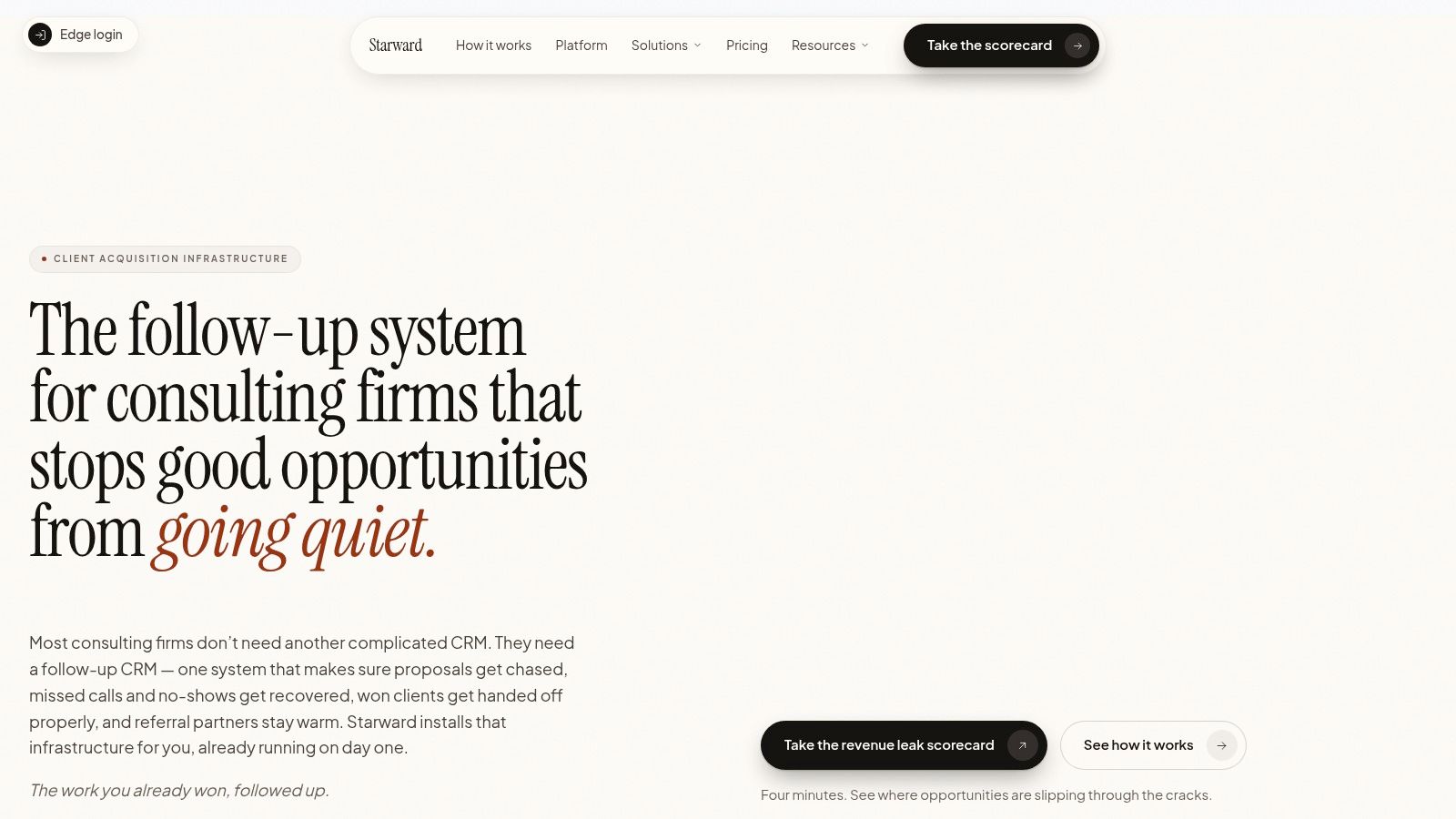
Starward Navigators fits a narrower and often more urgent revenue problem than a typical pipeline consulting engagement. It is built for firms that already generate interest but lose momentum between inquiry, meeting scheduling, proposal follow-up, onboarding, and referral management. For that buyer, a prebuilt operating model can be more rational than a broader advisory project or a custom CRM implementation.
The distinction is practical. Starward does not lead with open-ended process design. It installs predefined pipelines for Business Development, Client Delivery, and Relationships & Referrals, then configures them around the firm's current sales motion. That reduces interpretation work for small consulting and advisory teams that do not have internal RevOps capacity.
This matters most when the bottleneck is consistency.
A common failure pattern in consulting is not lead volume but poor follow-through: inquiries arrive through different channels, ownership is unclear, appointment requests sit in inboxes, proposals go quiet, and post-sale handoffs depend on memory. Earlier lead-response benchmarks show how quickly response delays reduce conversion. In that context, Starward's value is less about CRM depth and more about enforcing fast capture, assignment, and follow-up.
Where the model is strongest
Starward is a better fit for firms that want an installed system with consulting-specific defaults, not a methodology engagement that leaves implementation to the client. Its Map, Install, Go Live structure points to a vendor-led delivery model. The company handles setup, contact import, and automation configuration rather than stopping at recommendations.
That approach changes the implementation burden. A boutique consultancy or solo advisory practice can get a working pipeline without first translating generic CRM objects into a consulting workflow. The trade-off is flexibility. Teams with complex territory rules, multi-brand reporting needs, or heavy integration requirements may find a prebuilt model faster at the start but less adaptable later.
Methodology, implementation, and CRM specialization
Compared with providers that focus on RevOps strategy or CRM architecture, Starward is more productized. The methodology is embedded in the system design itself: how leads are captured, how meetings progress, how proposals are tracked, and how client relationships are maintained after the sale. That makes adoption easier when the team needs operating discipline more than strategic redesign.
Its CRM specialization is also narrow by design. Starward is oriented toward consulting and advisory firms rather than broad cross-industry CRM transformation. Buyers should read that as a constraint as well as an advantage. If your firm wants a consulting-specific pipeline with minimal setup decisions, specialization helps. If you need enterprise-grade customization across a larger GTM stack, it may limit you.
Demand generation role and pricing transparency
Starward is not primarily a demand-generation partner. It does not solve low market awareness, weak positioning, or an empty top of funnel in the same way an outsourced SDR program or growth agency might. It helps firms convert existing attention into booked conversations, proposals, signed work, and retained relationships with fewer operational misses.
Pricing is more transparent than in much of this category. Public plans start around $97 per month and scale by users and contacts. Higher tiers include campaign, trigger, and workflow builders. The company also states that setup is done for you and that firms typically go live in about two weeks, with a 14-day go-live guarantee. That level of specificity makes comparison easier for smaller buyers who need cost clarity before entering a sales process.
- Best for: Solo consultants, small advisory firms, and boutique service teams that need a working client-acquisition system quickly.
- Primary service: Prebuilt CRM and pipeline operating model for consulting businesses.
- Why hire it: Your revenue leak sits in speed, handoffs, proposal follow-up, or referral management rather than CRM selection or top-of-funnel creation.
- Main limitation: Firms with more complex integration, reporting, or governance requirements may outgrow the predefined structure.
One caution remains. The site presents a clear offer and implementation path, but it shows less public proof in the form of named testimonials or external certifications than some larger providers. For buyers who value speed, pricing clarity, and low implementation overhead, that may be an acceptable trade-off.
Visit Starward Navigators.
2. RevPartners
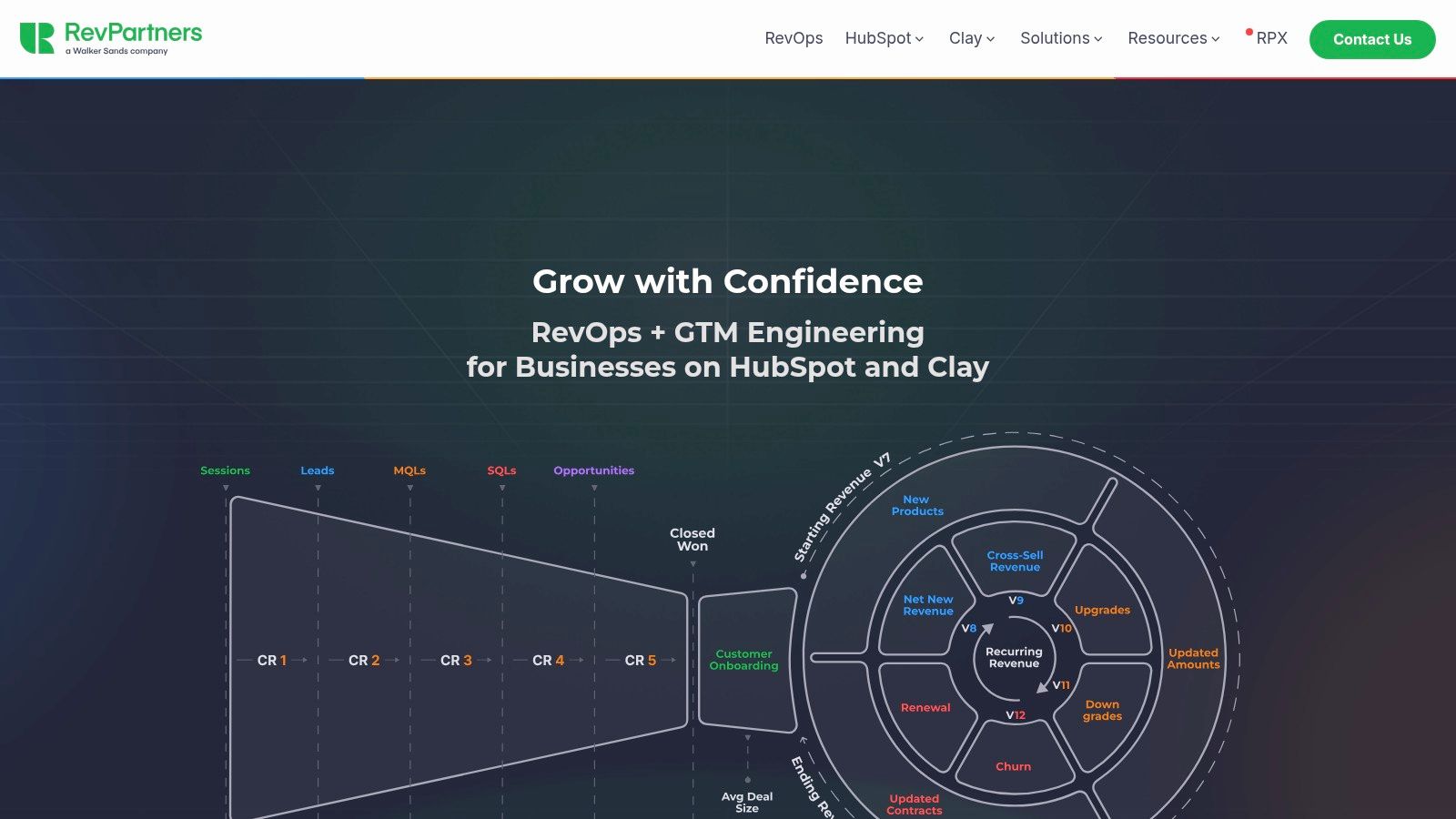
RevPartners is a stronger choice when your bottleneck sits inside HubSpot and spans marketing, sales, and service. This isn't the option for a solo consultant who just needs proposal follow-up. It's for teams that want a HubSpot-centered RevOps function with clearer packaging and faster implementation than a custom advisory engagement usually offers.
Its offer combines RevOps-as-a-Service retainers with fixed-scope HubSpot implementations. That makes it useful for buyers who want both architecture and execution: stage definitions, forecasting visibility, automations, integrations, and reporting.
Why the model makes sense
RevPartners publishes pricing structure and onboarding terms more transparently than many service firms in this category. That matters because many pipeline consulting services create friction before the work even starts. If you can't estimate the engagement shape before a sales call, it's harder to compare options rationally.
The trade-off is specialization. RevPartners is optimized for HubSpot. If your systems are already standardized elsewhere, that strength becomes a constraint.
Faster time-to-value matters most when your team already agrees on process and just needs the system implemented cleanly.
Its in-house reporting product, BLUF, also signals a specific philosophy. RevPartners isn't just installing fields and workflows. It's trying to make pipeline velocity and KPI visibility part of the operating model.
- Best for: Small to mid-market teams committed to HubSpot.
- Primary service: RevOps retainers plus fixed-scope HubSpot implementation.
- Demand generation role: Adjacent, but not the core reason to hire them.
- Main limitation: Less attractive if you need a CRM-agnostic partner or only have a narrow project.
For firms still clarifying how inbound gets turned into actual pipeline, it helps to understand the mechanics behind generating leads for email marketing, because implementation quality won't compensate for weak capture logic.
Visit RevPartners.
3. Go Nimbly

More pipeline does not fix a pipeline you cannot trust.
Go Nimbly makes sense when the revenue problem is operational inconsistency. Teams usually arrive here after adding tools, reports, and handoffs that never resolved the underlying issue. Sales uses one stage definition, finance uses another, customer success inherits incomplete data, and leadership ends up debating forecast inputs instead of making decisions from them.
That points to a different buying logic than the firms above. Go Nimbly is not primarily a prebuilt system vendor, a pure CRM implementer, or an outsourced demand generation shop. It sits closer to a RevOps operating partner with technical depth, especially for companies running Salesforce plus adjacent billing, quoting, support, and success systems.
The practical value is in governance design. Required fields, validation rules, lifecycle definitions, attribution logic, handoff criteria, and forecasting structure are tedious to build, but they determine whether pipeline reporting reflects actual deal progress or just rep optimism.
Insight Partners recently argued that pipeline generation is being reshaped by AI, channel shifts, and a stronger requirement for source traceability and auditability in growth programs (pipeline generation and traceability trends). Go Nimbly aligns with that requirement. Its model is better suited to executives who want an auditable revenue system than to smaller teams that need more meetings booked.
A simpler way to evaluate fit is by failure mode:
- If you need net-new pipeline creation, hire a demand generation or outsourced SDR provider.
- If the process is already clear and the main task is configuring HubSpot or Salesforce correctly, a narrower implementation partner is usually cheaper.
- If the issue is cross-functional revenue operations, disputed forecasts, or quote-to-cash complexity, Go Nimbly is the stronger candidate.
- If post-sale execution breaks because sales and delivery record different milestones, the answer may start with client onboarding workflow design before you revise opportunity stages again.
The trade-off is weight. This type of engagement tends to be more rational for mid-market and enterprise teams than for small firms with one CRM, one sales motion, and limited process variance. Pricing is not public either, which makes early comparison less efficient than with firms that disclose package structure upfront.
Visit Go Nimbly.
4. Winning by Design
A larger CRM stack does not fix a sales team that uses the same stages in different ways. Winning by Design is better understood as an operating model engagement, not a software project. It fits companies whose pipeline problem starts with inconsistent qualification, weak manager inspection, or a gap between the sales motion and the customer lifecycle that follows.
That distinction matters in this comparison. RevOps firms improve system design. Implementation partners configure Salesforce or HubSpot. Outsourced providers add pipeline production capacity. Winning by Design sits in a different category. It standardizes how revenue teams define progress, inspect deals, and connect pre-sale activity to retention and expansion.
Its core appeal is methodological discipline. Frameworks such as SPICED and the bowtie model give leadership teams a shared way to evaluate deal quality, customer handoffs, and post-sale growth. For firms with complex service delivery or account expansion goals, that can be more useful than adding another dashboard.
A practical test is simple. If the CRM already captures the right fields but forecast calls still devolve into opinion, the bottleneck is usually execution consistency rather than data architecture.
Where it tends to outperform CRM-first consulting
Winning by Design is strongest when leaders need adoption and behavior change, not just a cleaner instance. A CRM specialist can build stage requirements. A methodology-led firm is more likely to address whether managers inspect those requirements consistently, whether reps know how to advance a deal, and whether customer success inherits accounts with a clear success plan.
That creates a trade-off. The engagement can improve pipeline judgment and operating cadence, but it may still leave technical work on the table. If your problem is primarily field mapping, automation logic, attribution setup, or integration debt, a narrower implementation partner will usually be the more efficient buy.
For teams still debating whether the issue is poor stage design or weak stage discipline, this consulting-specific sales pipeline structure for service firms is a useful reference point.
Use Winning by Design when:
- The revenue team lacks a common qualification and forecasting language
- Frontline managers need a repeatable inspection cadence
- Sales, success, and expansion motions operate as separate systems
- The company wants methodology adoption first, then CRM refinement second
Look elsewhere first when:
- You mainly need Salesforce or HubSpot implementation
- The immediate goal is more outbound volume or booked meetings
- Budget approval depends on upfront package pricing, since pricing is not public
Visit Winning by Design.
5. EBQ
A lot of pipeline problems are not consulting problems. They are production problems.
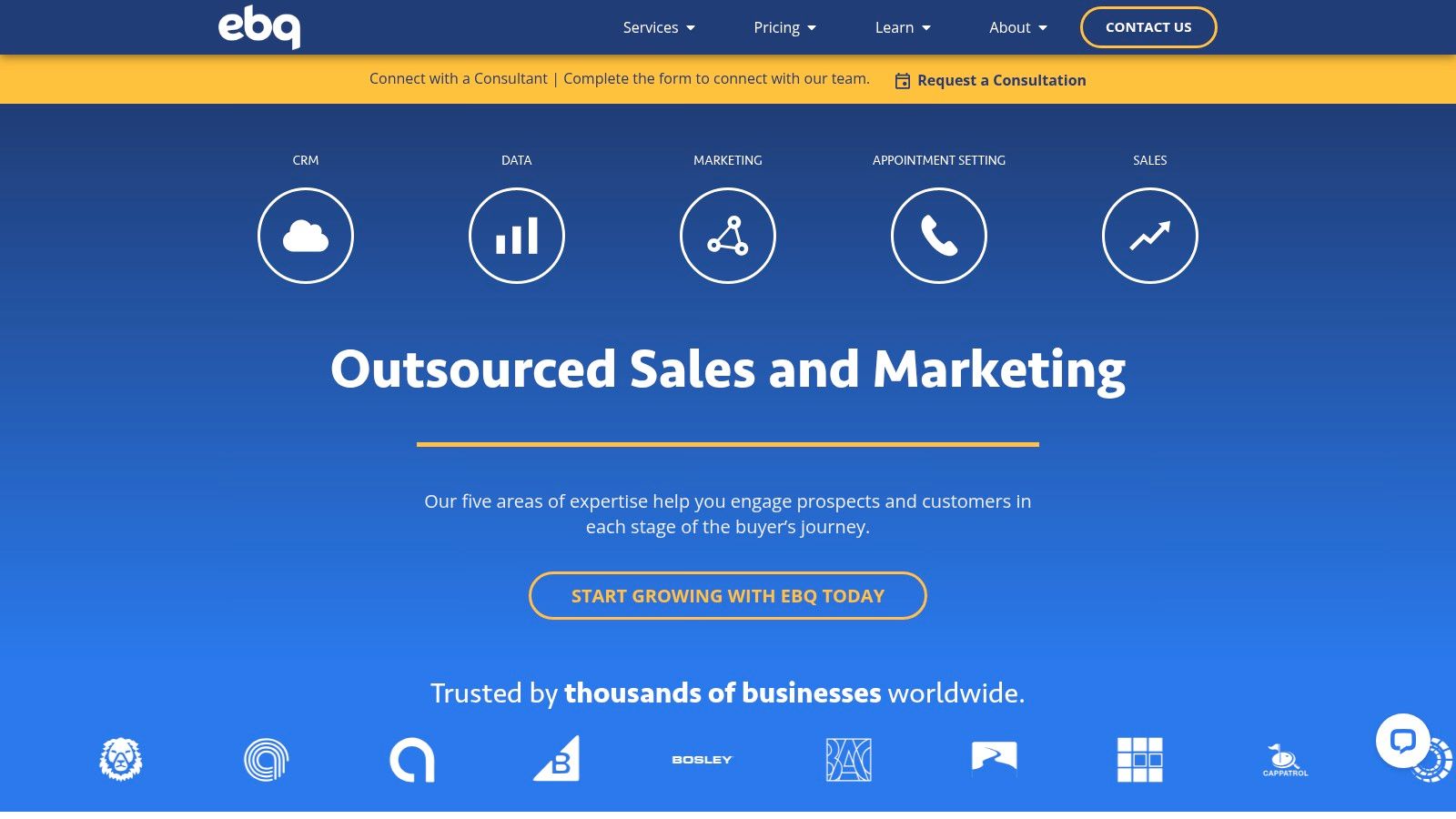
EBQ fits companies that already know who they sell to, have a workable sales motion, and need more conversations entering the funnel than the current team can produce. In that case, an outsourced pipeline program can be a more rational buy than a methodology engagement or a CRM rebuild. You are purchasing managed execution capacity, with process support around it, rather than asking a firm to redesign revenue operations from first principles.
That distinction matters because EBQ sits in a different category from firms earlier in this list. Winning by Design addresses pipeline quality through methodology and manager behavior. Coastal addresses pipeline reliability through Salesforce design and process enforcement. EBQ addresses pipeline volume through outsourced prospecting, appointment setting, and related support in CRM and marketing operations.
The upside is speed and operating simplicity. A headcount-based model is easier to budget than open-ended advisory scoping, and it gives teams a clearer picture of what they are buying: people, management, and output expectations. The downside is just as clear. Outsourced demand generation only works when the underlying message, target account definition, qualification rules, and handoff process are already reasonably stable.
A useful way to evaluate EBQ is to ask where your bottleneck appears after a meeting gets booked. If discovery quality is weak, follow-up is inconsistent, or pipeline stages are poorly defined, added top-of-funnel activity can expose those weaknesses faster than it solves them. If the sales team converts well once meetings happen, the economics look very different.
EBQ is usually a better fit when:
- The company needs pipeline creation more than process redesign
- Internal leadership wants outsourced SDR or BDR capacity without building a team from scratch
- Budget approval favors clearer staffing-based pricing over custom consulting scopes
- CRM and reporting support are helpful, but not the main reason for the engagement
EBQ is usually a weaker fit when:
- The core problem is low win rates, poor forecast accuracy, or inconsistent sales execution
- The offer and ideal customer profile are still being tested
- The handoff from booked meeting to active opportunity is unreliable
- The business needs deep CRM architecture work more than outbound production
Visit EBQ.
6. Coastal
A pipeline problem inside Salesforce usually is not a strategy problem first. It is often a systems design problem with revenue consequences.
Coastal fits that situation better than a methodology-led consultancy. If deal stages, approvals, quote logic, service handoffs, or forecast categories are misconfigured, more coaching or more lead volume will not fix the reporting noise. A Salesforce specialist is useful because the bottleneck sits in platform design and process enforcement, not in generic sales advice.
That difference matters in buying decisions. Firms such as Winning by Design are stronger when the company needs a sales method. Coastal is stronger when leadership already knows the motion it wants but cannot get Salesforce to reflect it consistently across sales, finance, and post-sale teams.
A practical test helps separate those cases:
- If reps are creating opportunities but forecast calls still turn into spreadsheet cleanup, the problem is likely CRM implementation.
- If CPQ, pricing rules, approvals, or renewal workflows distort pipeline visibility, the problem is likely Salesforce architecture.
- If the team cannot agree on qualification, stage exit criteria, or manager coaching, the problem is probably upstream of the CRM.
Coastal's value is highest in the first two cases. Its service model centers on Salesforce consulting and managed services, with depth in Sales Cloud and Revenue Cloud rather than broad demand generation support. That specialization creates a trade-off. You get stronger platform fluency and better alignment between process design and system constraints, but you are not buying an outsourced pipeline engine or a CRM-agnostic RevOps partner.
Pricing is typically custom, which is common for implementation-heavy work and less transparent than staffing-based models. For some buyers, that is acceptable because the risk of a poor Salesforce setup is expensive over time. Stage definitions, dashboard logic, quote configuration, and approval paths affect forecast trust long after the project ends.
Coastal is usually a rational choice for companies standardized on Salesforce that need cleaner execution inside the system they already run. It is a weaker fit for teams that need net-new demand creation, want a prebuilt go-to-market playbook, or expect one partner to cover HubSpot, sales methodology, and outbound production in the same engagement.
Visit Coastal.
7. New Breed
More vendors do not always produce a better pipeline. In many companies, they produce cleaner handoffs on paper and weaker accountability in practice. New Breed is built for that specific failure mode.
The firm sits in a different category from a pure CRM implementer or a sales methodology consultancy. Its value comes from combining RevOps, HubSpot execution, and demand generation in one operating model. That matters when the core problem is not a broken field mapping or a missing playbook, but a disconnect between pipeline creation and pipeline management.
A useful way to assess New Breed is to ask where revenue friction lives. If the team already has demand but cannot route, qualify, score, or report on it consistently, a narrower RevOps partner may be enough. If the company has a functioning process but needs net-new meetings, an outsourced pipeline program such as EBQ can be the cleaner buy. New Breed fits the middle case. Growth is constrained because acquisition, handoff, lifecycle design, and reporting are being run by separate partners with different incentives.
That integrated model has trade-offs.
It can reduce coordination loss because one team owns campaign execution, HubSpot configuration, and funnel reporting. It can also increase commitment. Buyers are not purchasing a quick implementation or a limited advisory sprint. They are usually choosing a partner that will influence both how demand enters the system and how sales works it through the funnel.
This makes New Breed more suitable for companies that want an operating partner than for teams shopping for a one-time fix. Pricing is custom, which is common in blended service models but less transparent than packaged implementation firms. The practical implication is simple. Buyers need a sharper internal brief before procurement starts, including channel scope, CRM stack assumptions, handoff ownership, and the metrics leadership expects the engagement to change.
Use New Breed if the bottleneck is cross-functional and recurring. Skip it if the requirement is narrow, such as a standalone HubSpot cleanup, a sales methodology reset, or a single-channel outbound engine.
Visit New Breed.
Top 7 Pipeline Consulting Firms Comparison
| Solution | Implementation Complexity 🔄 | Resource Requirements ⚡ | Expected Outcomes 📊 | Ideal Use Cases 💡 | Key Advantages ⭐ |
|---|---|---|---|---|---|
| Starward Navigators | Low, vendor-led Map → Install → Go Live (≈2 weeks, 14‑day guarantee) | Low internal effort; subscription-based (starts ≈$97/mo); built-in AI | Fewer lost proposals, standardized handoffs, reduced manual re-keying | Small consulting/advisory firms, solo consultants, boutique teams | Prebuilt consulting pipelines, done‑for‑you setup, referral + follow‑up automations |
| RevPartners | Medium, packaged HubSpot implementations and ongoing RevOps retainers (14–30 days fast‑track) | Medium, retainer or implementation fee; HubSpot-centric tooling | Faster forecasting, clearer pipeline velocity, faster time‑to‑value | SMBs choosing HubSpot who want packaged RevOps + implementation | Transparent pricing, BLUF reporting, deep HubSpot implementation experience |
| Go Nimbly | Medium–High, process redesign, governance and tooling across complex stacks | High, senior RevOps expertise and consulting time; flexible engagement models | Strong pipeline governance, rigorous forecasting and validation rules | Mid‑market to enterprise B2B with complex sales/quote‑to‑cash needs | Senior subject‑matter experts, end‑to‑end process redesign capability |
| Winning by Design | Medium, methodology-driven sprints and training (SPICED, bowtie) | Medium, time for training and adoption; may need systems integrator for automation | Standardized GTM language, improved manager cadence and repeatable motions | Teams needing sales enablement, playbooks, and behavioral change | Proven methodology, focus on habits and manager enablement |
| EBQ | Low–Medium, outsourced SDR/BDR programs with CRM ops layer | Medium, headcount‑based pricing (half/full‑time model) and alignment overhead | Immediate pipeline creation and appointment setting with ops support | Organizations needing quick outbound capacity without hiring | Rapid capacity add, clear headcount pricing, integrated management layer |
| Coastal | High, Salesforce‑centric implementations, CPQ and revenue cloud work | High, Salesforce licenses, technical configuration, ongoing managed services | Robust quote‑to‑cash alignment, real‑time forecasting and pipeline visibility | Firms standardized on Salesforce seeking durable pipeline governance | Deep Salesforce/Revenue Cloud specialization, CPQ and managed services |
| New Breed | Medium–High, HubSpot‑native RevOps plus demand programs and enablement | Medium, HubSpot commitment, integrated retainer/project model | Improved pipeline creation, conversion rates, and unified reporting | Teams all‑in on HubSpot wanting combined ops + demand delivery | “One‑team” delivery across RevOps and demand gen, strong HubSpot partnership |
Choose the Service That Matches the Bottleneck
The market for pipeline consulting services is broad because the problems are broad. Some firms need a working follow-up system. Others need stage governance, CRM implementation, manager enablement, outsourced top-of-funnel creation, or a full HubSpot or Salesforce operating layer. Comparing all of those providers as if they sell the same thing leads to expensive mismatches.
Starward Navigators is the best fit when a small consulting or advisory firm needs a ready-to-run acquisition and follow-up operating system. It's built for the firm that loses deals in ordinary but costly places: slow response, loose scheduling, silent proposals, messy handoffs, and neglected referral relationships. The advantage isn't abstract strategy. It's a prebuilt system that runs quickly with vendor-led setup.
RevPartners and New Breed make more sense when HubSpot is central to your stack and the issue is broader RevOps execution. RevPartners is the cleaner choice for transparent packaging and implementation-led work. New Breed is stronger when you also want demand generation under the same umbrella.
Coastal is the specialized pick for Salesforce and Revenue Cloud alignment. Go Nimbly is the governance-heavy option for complex forecasting, process design, and system discipline. Winning by Design is the right hire when your biggest issue is methodology, management cadence, and consistent execution across people. EBQ is the practical choice when you need outsourced pipeline creation now and can support it with strong internal qualification and handoff rules.
Before you request proposals, document five things: your current pipeline stages, your CRM and adjacent tools, your actual sales motion, the integrations you can't live without, and the budget model you prefer. Then compare providers on implementation ownership, ongoing support, measurable deliverables, pricing transparency, and internal workload. That last factor gets ignored too often. A “cheaper” engagement that requires months of in-house design can cost more than a prebuilt system that goes live fast.
If your firm's pipeline problem looks more like follow-up leakage than platform shortage, Starward Navigators is worth a close look. It gives small consulting and advisory teams a prebuilt system for lead capture, proposal tracking, client handoffs, and referral management, with done-for-you implementation instead of a blank CRM. See how it works at Starward Navigators.