
A referral partner is a third party who introduces qualified prospects to a vendor and is paid only when a deal closes, without owning the sale. For a consulting firm, that distinction determines who qualifies the opportunity, who follows up, who receives attribution, and who carries the responsibility for turning a warm introduction into revenue.
You may recognize the situation. A former client sends a generous email introducing a peer who has exactly the problem your firm solves. The message lands in a shared inbox, someone marks it for follow-up, and the opportunity disappears beneath proposal work, delivery issues, and calendar noise. The referrer checks in once, hears nothing useful, and internally decides not to risk another introduction.
That failure isn't a problem with referrals themselves. It's a problem with treating a referral partner as a friendly contact instead of as a managed pipeline source. In a small advisory firm, every handoff needs an owner, a qualification standard, a response expectation, and a way to report what happened next.
Table of Contents
- The Warm Intro That Disappeared
- What a Referral Partner Actually Does
- Why Referrals Outperform Other Channels
- Four Types of Referral Relationships
- How to Qualify the Right Partners
- A Referral Workflow That Actually Closes
- Common Misconceptions That Undermine Results
- Turning Referral Partners Into a System
The Warm Intro That Disappeared
The email looked ideal. A former client introduced the managing director of a growing business, described a commercial problem your advisory team handled regularly, and mentioned that the prospect wanted to talk soon. The former client had already done the difficult trust-building work. The prospect knew who you were, why the introduction mattered, and who had recommended the conversation.
Then the message entered the firm's general inbox.
One partner assumed a business development colleague would respond. The colleague assumed the partner wanted to handle it personally. Nobody recorded the source in the CRM, nobody assigned a next action, and nobody defined how quickly the prospect should receive a response. By the time someone searched for the email, the prospect had stopped replying.
Operational rule: A warm introduction still needs a workflow. Trust opens the door, but ownership and follow-up determine whether anyone walks through it.
The firm lost more than one possible engagement. It also damaged the referrer's confidence. That former client had put personal credibility behind the recommendation. A silent inbox made the partner look careless, even though the underlying failure belonged to the receiving firm.
This is why a referral partner deserves a sharper definition than “someone who sends us business.” The partner needs a clear submission route, a named internal owner, agreed qualification criteria, and visibility into referral status. The firm also needs attribution rules that distinguish an introduction from an accepted opportunity and a closed deal.
The client onboarding process matters after the sale, but the referral handoff needs structure before discovery even begins. If the firm can't capture and route the opportunity reliably, the partner relationship will deteriorate no matter how strong the original relationship was.
What a Referral Partner Actually Does
A referral partner is an individual or organization that introduces a qualified prospect to a vendor and is generally compensated only when the deal closes. The partner identifies a relevant need, makes the connection, and gives the vendor enough context to begin its own sales process.
The boundary is important. A referral partner usually:
- Introduces the prospect: They connect the buyer with the consulting firm and explain why the conversation may be relevant.
- Provides context: They may share the business issue, urgency, or decision environment they already understand.
- Steps out of the sale: The vendor takes responsibility for discovery, qualification, pricing, negotiation, proposal, and delivery.
A referral partner generally doesn't sell, quote, or implement the offering. The ZINFI definition of a partner referral describes the model as an introduction that allows the vendor's team to take the opportunity forward. Think of the partner as a scout who spots promising talent and points the team in the right direction. The scout doesn't coach the team, negotiate the contract, or play the match.
That separation distinguishes referral partners from adjacent models:
| Dimension | Referral Partner | Reseller | Affiliate |
|---|---|---|---|
| Primary action | Introduces a qualified prospect | Sells the vendor's offering | Promotes an offer or tracked destination |
| Sales ownership | Vendor owns the sales cycle | Reseller owns much of the sale | Vendor usually owns conversion after the promotion |
| Commercial basis | Usually paid when the deal closes | Earns resale margin or agreed revenue | Often paid for a tracked conversion |
| Delivery role | Usually none | May support or implement | Usually none |
| Best fit | High-trust, relationship-led services | Products or services the partner can sell directly | Broad awareness and traffic generation |
A reseller may scope the solution, handle pricing, and support the customer. An affiliate may drive attention through content or links without knowing whether the prospect is a genuine fit. A referral partner sits between those models, with relationship access but limited sales-cycle ownership.
Why Referrals Outperform Other Channels
Referral performance has a structural advantage in B2B consulting. The buyer isn't meeting your firm as a completely unknown provider. Someone they trust has already transferred part of the credibility required to start a serious conversation.
That trust transfer matters because advisory work is difficult to evaluate before delivery. A prospect buying a fixed-fee diagnostic, transformation program, or fractional executive service is not merely comparing product features. They're judging expertise, judgment, discretion, and the likelihood that the engagement will produce a useful result.
A 2024 B2B buying study cited in industry summaries found that 73% of B2B marketing executives rank word of mouth and peer recommendations as the most influential factor when deciding which vendors to consider, while another cited source reports that 91% of B2B purchasers' buying decisions are influenced by word of mouth. These figures are reported in the B2B referral marketing statistics compilation.
Trust reduces early friction
A referred prospect typically arrives with a reason to listen. The consulting firm still has to prove fit, but it doesn't need to spend the entire first conversation establishing that it is credible enough to be considered.
That can make discovery more direct. The prospect may disclose the underlying issue sooner, explain the internal stakes more openly, and involve the appropriate decision-maker earlier. The partner's introduction doesn't remove qualification work. It improves the starting conditions for that work.
Intent improves seller efficiency
Referral partners filter through their own reputation before making an introduction. They're less likely to connect a prospect who has no relevant need, no interest in change, or no plausible path to engagement. This doesn't mean every referral is qualified, so the firm still needs acceptance criteria.
The economic effect is meaningful for a small firm. Referred B2B leads have been reported to convert 30% to 70% better than leads from other channels, and referred customers are reported as 4.2 times more likely to make repeat purchases than non-referral customers, as documented in the same industry compilation. A principal can spend less time persuading low-intent contacts and more time on discovery, proposals, and delivery.
Conversion quality changes acquisition economics
A referral commission is a cost, but so is unpaid marketing time, repeated qualification, and lengthy trust-building. The relevant question isn't whether the referral carries compensation. It's whether the total effort required to win and retain the client compares favorably with other acquisition sources.
For consulting firms, the advantage is therefore not sentimental. It comes from better context, stronger initial credibility, and a prospect who has already crossed part of the distance between awareness and active consideration.
Four Types of Referral Relationships
Small advisory firms rarely have just one referral pattern. The same firm may manage formal partners, personal contacts, alliances, and client advocates. The operating mistake is treating all four as if they have identical expectations.
A formal referral partner signs an agreement, understands the firm's ideal client profile, and submits opportunities through a defined process. The firm owns qualification and closing. Compensation may be a commission or agreed fee, but payment conditions must be explicit. The relationship needs enablement, status updates, and a service-level expectation for acknowledging new submissions.
An informal network partner may be a former colleague, peer consultant, or founder connection. The introduction can be valuable, but the arrangement often lives in memory rather than documentation. That informality creates disputes about whether the contact was referred, when the introduction occurred, and whether a fee applies.
A strategic alliance partner is usually a non-competing provider serving the same buyer. An accounting firm may identify a client who needs operating-model advice, while an advisory firm may identify a client who needs tax or legal support. The firms may exchange referrals, coordinate positioning, or co-deliver work. The relationship depends less on a single commission and more on reliable boundaries and reciprocal value.
A client-as-partner relationship begins with a satisfied buyer introducing a peer. The client may not want a formal program, but the referral still needs prompt acknowledgement, accurate attribution, and respectful communication. The client shouldn't be pulled into the active sale unless they choose to participate.
| Type | Owns the Sale | Typical Commission | Handoff Discipline | Best Use |
|---|---|---|---|---|
| Formal referral partner | Consulting firm | Written fee or commission terms | Defined submission and response process | Repeatable partner channel |
| Informal network partner | Consulting firm | Agreed case by case | Email introduction plus internal logging | Trusted relationships with occasional opportunities |
| Strategic alliance | Each firm owns its own offer, with shared coordination where needed | Commission, reciprocal referrals, or shared commercial terms | Joint rules for scope and client communication | Complementary services for the same buyers |
| Client as partner | Consulting firm | Thank-you, referral reward, or reciprocal value where appropriate | Simple, personal, and carefully tracked | Advocacy from satisfied clients |
The distinction isn't about assigning a more impressive label. It's about matching the relationship to the right amount of structure. Every type still needs one answer to the same question: who owns the next commercial action after the introduction?
How to Qualify the Right Partners
A productive referral partner has more than a large network. The partner needs access to the right buyers, a reason to make introductions, and enough confidence in your work to protect their own reputation.
Use four filters before adding someone to a formal partner list.
Fit. Does the person or organization serve the same buyer your firm is built to help? Look for overlap in industry, company situation, decision-maker, and problem type. A simple check is: “Can this person describe a real client situation where our offer is relevant without forcing the connection?” If the answer is no, keep the relationship in a general network category.
Value. Does the partner offer a complementary service rather than a competing one? A fractional CFO, implementation agency, specialist law firm, or leadership adviser may see needs your team doesn't address. Ask: “Can we explain the mutual value in one clear sentence?” If the answer requires a long product explanation, the partnership may be too difficult to activate.
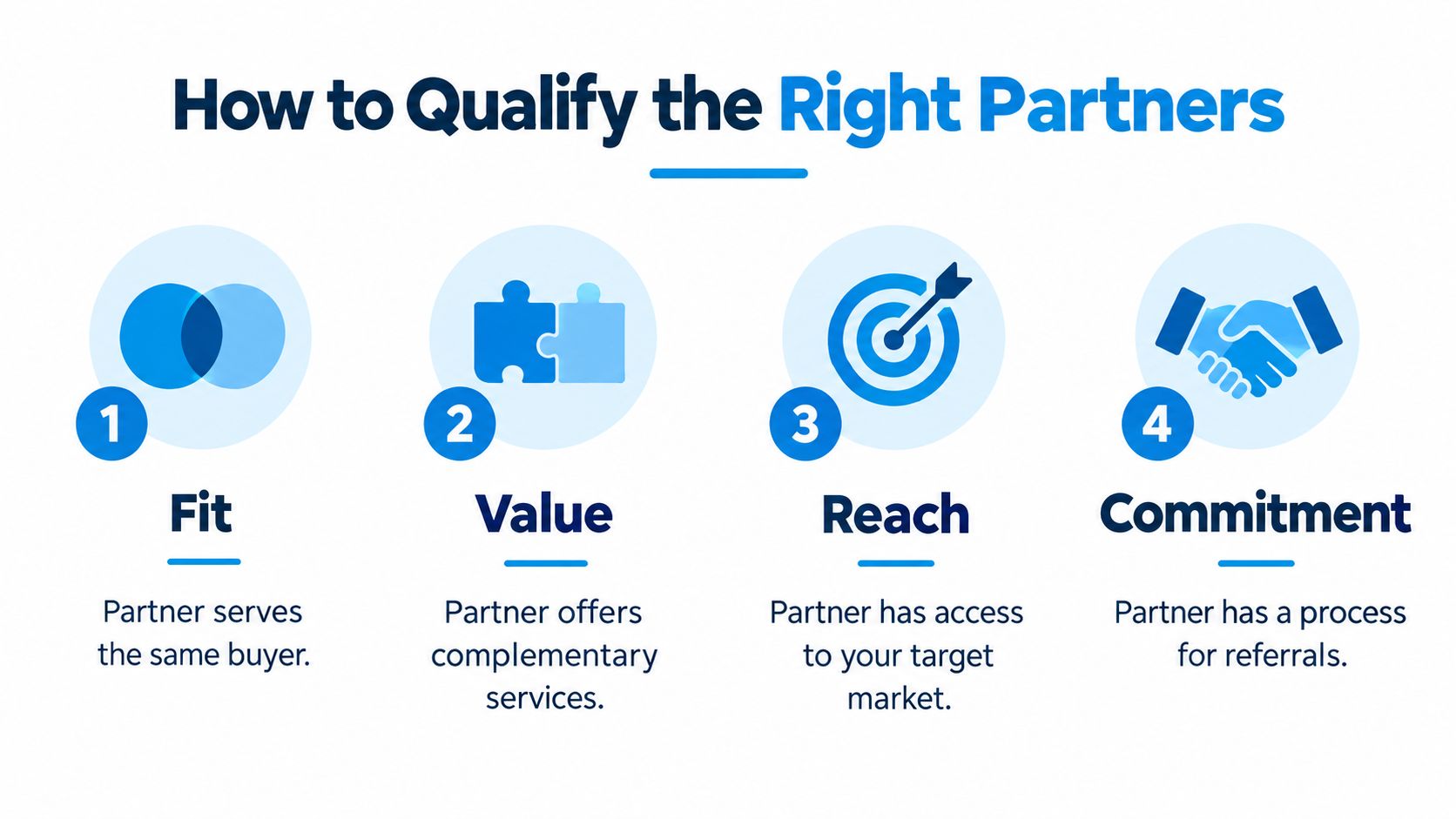
Reach. Measure relevant access, not social visibility. Does the partner regularly speak with people who match your target profile? Ask: “Can they name the context in which a referral conversation would naturally occur?” A partner with a smaller but credible network may be more useful than a prominent contact whose audience doesn't buy your service.
Commitment. Will the partner take a defined action, or are they agreeing politely? Ask whether they'll use a referral form, make a direct email introduction, attend a joint briefing, or review a short partner guide. If there's no agreed behavior, don't forecast referrals from the relationship.
Keep the review practical. Record the answers on a simple sheet, rate the relationship as exploratory, active, or ready for formal terms, and revisit the rating after actual referrals. Qualification should protect the firm from promoting every friendly contact into partner status.
A Referral Workflow That Actually Closes
A referral workflow should make the next action obvious to both sides. Consider a partner introducing a prospect who needs a clear operating model and wants an advisory conversation.
Stage one, introduction. The partner sends a direct email naming the prospect, the business need, and the timing. A vague message such as “You two should connect” creates work for everyone. The receiving firm should acknowledge the introduction, record the partner source, and assign an owner immediately.
Stage two, qualification. The firm confirms whether the prospect fits its service, buyer, urgency, and commercial criteria. A practical response window is 24 to 72 hours, as specified in the workflow plan for this article. The partner doesn't need a full sales report, but they should know that the referral was received and whether the firm accepted it for follow-up.
Stage three, handoff meeting. The consultant meets the prospect directly. The partner can join when their context adds value, but the consulting firm should take control of discovery rather than making the partner carry the conversation. The referral tracking process should show whether the referral was received, accepted, qualified, and advanced.
Stage four, proposal and delivery. The firm owns scoping, pricing, negotiation, and delivery. The partner should receive appropriate status updates, not a stream of internal sales messages or confidential client details. A written rule can specify which milestones trigger communication, such as proposal issued, decision made, or engagement won.
Stage five, commission and feedback. When the deal closes and meets the agreement's payment conditions, the firm records the outcome and pays promptly. The partner should receive a concise outcome update and a thank-you. If the referral did not proceed, communicate that respectfully without exposing information the prospect hasn't authorized you to share.
Most breakdowns happen at the seams. The introduction lacks context, qualification waits too long, the partner is left guessing after the meeting, or payment terms surface only after the sale. Stage definitions and response expectations prevent those failures without forcing the partner into a sales role.
Common Misconceptions That Undermine Results
Referral programs fail when firms confuse goodwill with operating capacity. The first misconception is that referral channels are free. They require partner enablement, intake design, CRM maintenance, attribution, communication, and compensation administration. Even an informal network consumes time when someone has to reconstruct what happened from email threads.
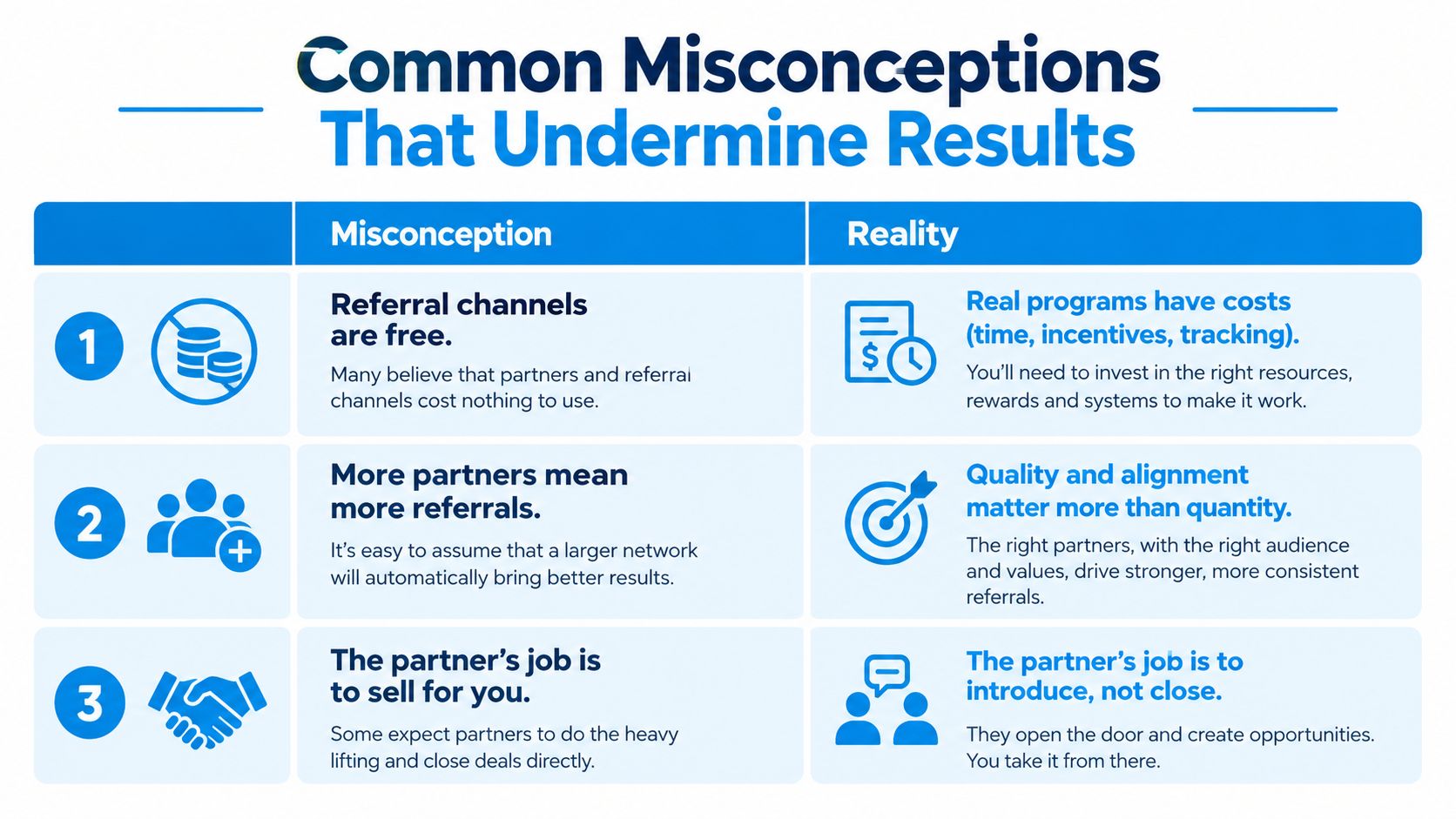
The second misconception is that commission alone sustains the relationship. A financial reward may encourage an introduction, but partners also need confidence that the firm responds well, treats their contacts professionally, and acknowledges their contribution. Reciprocal introductions, useful updates, co-marketing, and access to a named relationship owner can matter just as much in professional services.
The third misconception is that one trusted partner can replace a pipeline. A strong referrer may send valuable opportunities, but referrals tend to arrive episodically. A firm that depends on one relationship remains exposed to changes in that person's priorities, client base, or availability.
The fourth misconception is that every warm introduction is a qualified referral. A prospect may be friendly, curious, or loosely interested without having a defined problem or a realistic buying path. If the firm doesn't define a referral lead, partners may send noise while believing they're being helpful.
A healthy partner channel protects both reputations. The partner protects the introduction by sending a relevant contact. The firm protects the relationship by responding quickly and managing the opportunity professionally.
This short video provides another practical view of referral-program misconceptions and operating expectations:
The answer isn't to reject informal referrals. It's to classify them correctly, apply proportionate process, and avoid promising partner-level treatment where no partner agreement exists.
Turning Referral Partners Into a System
A referral partner becomes a dependable channel when the firm makes a small set of operating decisions explicit. You don't need a complicated partner department. You do need a consistent definition of who qualifies, what happens after an introduction, and how the firm will recognize contribution.
Start with a written partner profile. State the buyer, problem, service boundary, and situations that make an introduction timely. Add a short qualification checklist that a partner can understand without sales training.
Next, create a one-page referral agreement. Cover submission method, lead ownership, attribution, payment conditions, treatment of duplicate introductions, confidentiality, and what happens when an opportunity closes after a delay. A short agreement prevents the most avoidable disputes.
Assign one internal owner. That person doesn't have to close every referred opportunity, but they should monitor intake, route referrals, maintain partner communication, and ensure the CRM record stays accurate. Without an owner, partner management becomes everyone's responsibility and therefore nobody's priority.
Track the opportunity from introduction through outcome. Useful stages include proposed partner, active partner, referral submitted, accepted, qualified, won, lost, and nurture. Review source, response time, acceptance, progression, closed revenue, and partner activity together. The point isn't to reward volume blindly. It's to identify which relationships produce relevant opportunities and where the handoff loses momentum.
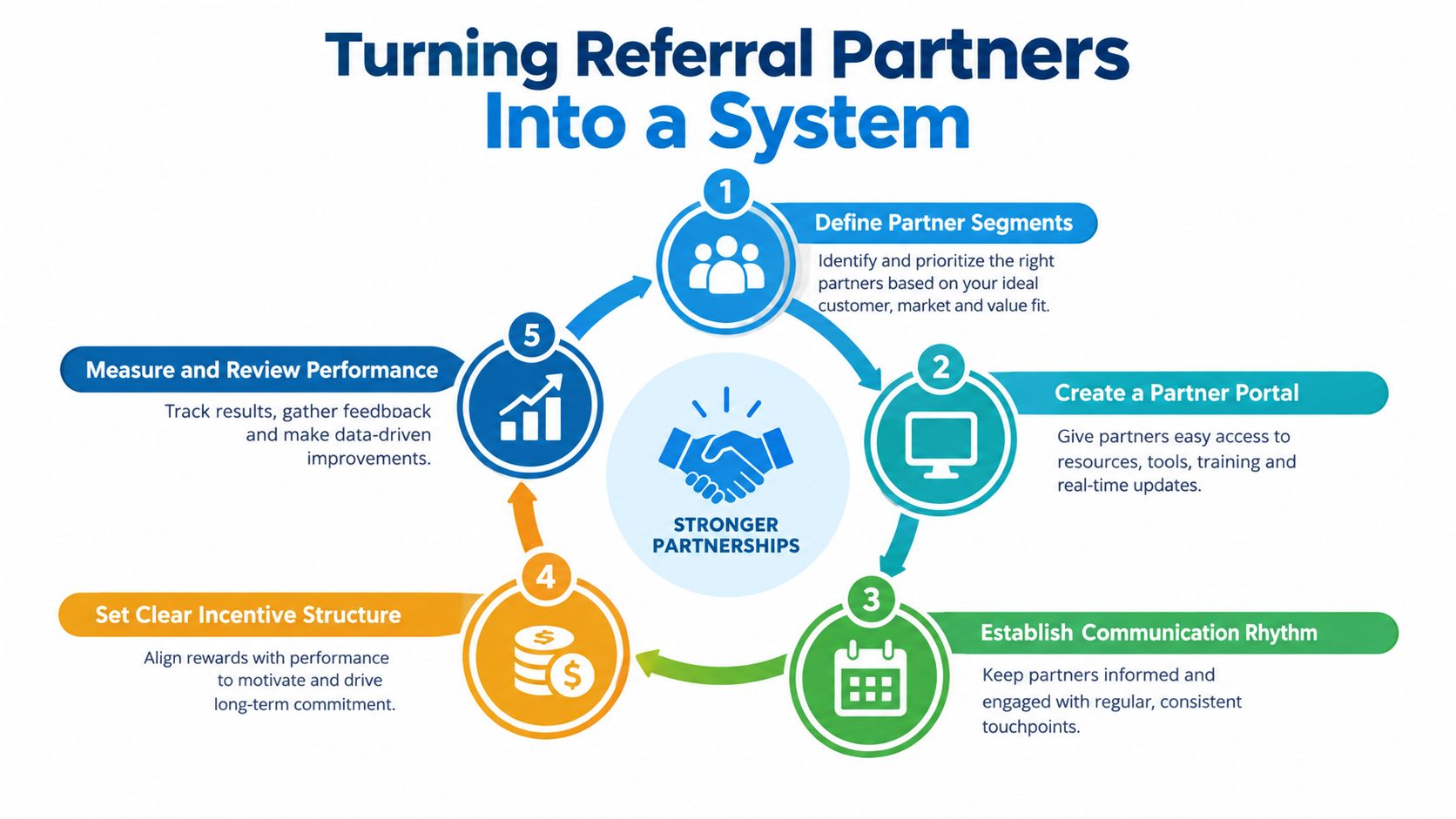
A firm can manage these records in a CRM, a partner portal, or a purpose-built workflow. Starward Navigators provides a Relationships & Referrals pipeline that tracks partner relationships, referral attribution, activity, and nurture alongside the firm's broader acquisition and delivery processes. Its referral management capability is one option for firms that want partner activity separated from active sales opportunities while still connecting introductions to revenue outcomes.
Treat the channel as a pipeline stage with an SLA, owner, health signals, and regular review. That operating discipline turns a warm favor into a repeatable commercial process without stripping the relationship of its human character.
If warm introductions are entering shared inboxes, start by defining your referral stages, assigning an owner, and recording every partner-sourced opportunity from introduction to outcome. Starward Navigators helps small consulting and advisory firms structure referral management, follow-up, attribution, and handoffs in one operating system. Visit Starward Navigators to explore how the platform can support a more dependable referral pipeline.