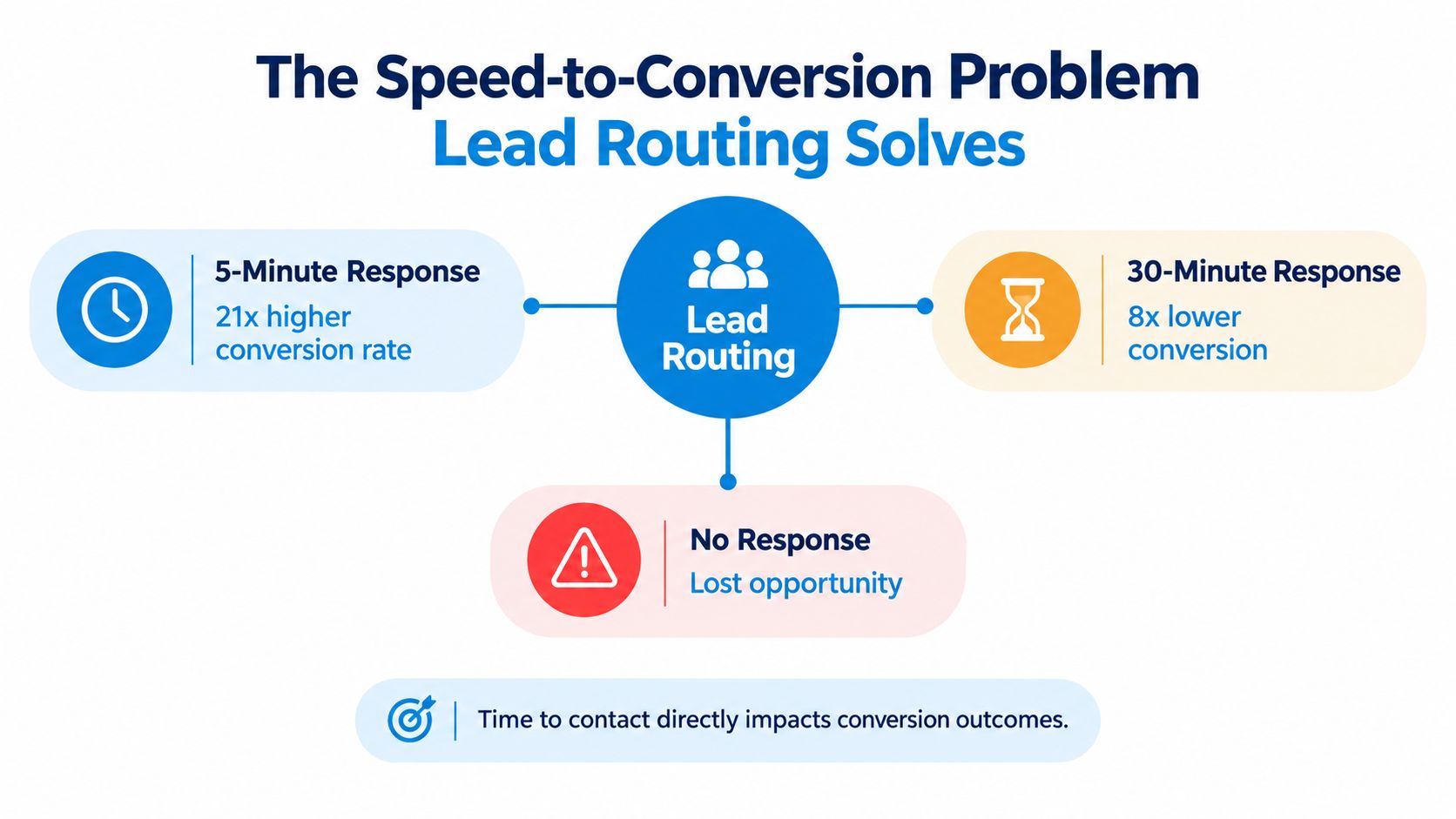
Lead routing is the automated, rule-based process that assigns inbound leads to the right owner immediately. It exists to solve a measurable problem: most leads sit unanswered for hours when they should be contacted within minutes, and contacted leads convert at about 21% within five minutes versus 2.3% with next-day replies (Perspective's benchmark summary).
A prospect submits a form on Monday morning, sends a direct email that afternoon, or mentions your firm in a LinkedIn message. Nobody owns the inquiry, so it waits in a shared inbox until someone notices it. By the time a consultant replies, the buyer has either chosen another advisor or stopped caring about the problem.
That pattern isn't a motivation problem. It's a workflow failure. For a small advisory firm, lead routing is the control layer that connects capture, ownership, response speed, follow-up, and accountability. It determines whether an opportunity moves toward a discovery call or vanishes without a trace.
Table of Contents
- Why Good Consultants Lose Good Leads
- The Speed-to-Conversion Problem Lead Routing Solves
- Manual Assignment, Round Robin, and AI-Assisted Routing Compared
- Building a Routing Engine With Rules, SLAs, and Escalations
- Routing Flows That Fit Small Consultancies
- The Hidden Tradeoff Between Speed and Routing Accuracy
- Common Routing Failures and How to Avoid Them
Why Good Consultants Lose Good Leads
A founder at a boutique strategy firm receives an inquiry from a company that fits the firm's ideal client profile. The form includes a clear business challenge, a credible budget signal, and a request to speak. The founder is in a client workshop, the operations lead assumes the founder will handle it, and the associate sees the notification but doesn't know whether they're allowed to respond.
Three days later, the founder opens the form dashboard. The prospect has already hired another advisor.
This is how good firms lose good leads. The team has expertise, a strong reputation, and a service that solves a real problem. What it lacks is a reliable answer to three operational questions:
- Who receives the lead?
- When does assignment happen?
- Which rule made the decision?
Lead routing answers all three. In plain language, it's the rule-based process that assigns an eligible lead to an owner or queue within a defined time boundary. The rules might consider account ownership, territory, service line, product interest, source, or the availability of a specific specialist. The system records the decision instead of leaving the team to reconstruct it from inboxes and memory.
Practical rule: If nobody can identify the lead owner and the next action without asking around, the firm doesn't have a routing process. It has a hope-based handoff.
Routing first became an operational discipline because assignment quality alone wasn't enough. B2B response research found that more than 99% of 114 companies failed to respond within five minutes, while another benchmark covering 1,247 companies and 253,817 inbound leads reported a median first response of about 42 hours (Workato's lead response study). The problem is familiar even in much smaller firms: a captured inquiry becomes nobody's immediate responsibility.
A proper routing layer turns scattered entry points into one controlled intake. Website forms, email inquiries, event conversations, referrals, and other inbound sources enter the same process. The system applies the relevant rule, assigns a named owner, starts the response clock, and creates a visible trail of what happened.
That makes lead routing more than CRM housekeeping. It protects the narrow period when a buyer is actively looking for help, while giving the firm a defensible process for deciding who should respond.
The Speed-to-Conversion Problem Lead Routing Solves
A consulting inquiry can represent weeks of billable work, yet a slow handoff can leave that opportunity unworked while the prospect compares alternatives. The cost is not just a missed reply. It is lost pipeline value, partner time spent checking inboxes, and weaker visibility into which channels produce qualified demand.
Response speed matters because advisory buyers often arrive with a live problem, a defined decision window, and several firms under consideration. Perspective's benchmarks also report that contacted-lead close rates decline when the first conversation slips beyond the initial response window (Perspective's lead response benchmarks). The practical recommendation is straightforward: route the inquiry immediately, then give the assigned consultant enough context to respond intelligently.
Four components of a working route
Capture brings every meaningful entry point into one operating process. A website form, shared inbox, referral record, event scan, or manually entered inquiry should create a structured record with enough detail for an initial decision.
Assignment logic evaluates that record against practical rules. A finance transformation inquiry may go to the fractional CFO practice, an existing client contact to the account owner, and an unclear request to a monitored intake queue. Keep the first rule set visible and easy to change. A maze of exceptions slows decisions and makes accountability difficult.
SLA enforcement starts the response clock at assignment. The firm should be able to see when the lead arrived, who owns it, what action is due, and whether that action happened. Without those fields, a promise to respond remains difficult to manage.
Follow-up sequencing keeps the opportunity progressing after the first reply. Booking a discovery call, confirming attendance, sending a proposal, checking a decision, or escalating an idle lead should each have a defined next action. A documented lead management workflow makes ownership and due points visible to the whole team.
Together, these components create the control layer between inquiry and opportunity. Capture without assignment creates a queue. Assignment without an SLA creates passive ownership. Fast routing without relevant follow-up creates activity, not conversion.
Manual Assignment, Round Robin, and AI-Assisted Routing Compared
There isn't one universally correct routing method. The right choice depends on lead volume, service specialization, account relationships, and how much judgment each inquiry requires.
| Routing approach | What it optimizes | Main risk | Best fit |
|---|---|---|---|
| Manual assignment | Context and discretion | Delay and inconsistent coverage | Low-volume, strategically important inquiries |
| Round robin | Fair distribution and simplicity | Poor fit when expertise differs | Similar leads handled by a shared team |
| Territory or segment routing | Specialized ownership | Dependence on clean classification | Distinct markets, regions, or practices |
| AI-assisted routing | Multi-signal matching | Opaque or overcomplicated decisions | Larger, data-rich teams with mature processes |
Manual assignment
Manual review works when each inquiry is unusual and the volume is manageable. A partner may need to assess an executive referral, check an existing relationship, or decide whether a complex engagement belongs with a particular specialist.
The cost is obvious. Every manual review introduces waiting time, and every unowned queue creates ambiguity. Use manual judgment for exceptions, not as the default for ordinary inbound demand.
Round robin
Round robin sends the next eligible lead to the next available owner in a defined pool. It's a strong starting point for a small team selling similar services to a similar audience. The process is easy to explain, easy to audit, and less likely to create arguments about favoritism.
It becomes weak when one consultant handles operations work, another handles executive coaching, and a third owns a specific account relationship. Equal distribution isn't accurate distribution if the recipients aren't interchangeable.
Territory or segment routing
Territory, industry, company-size, and service-line rules make more sense when expertise or relationship context matters. The system can route a healthcare inquiry to the healthcare advisor, a named account to its relationship owner, or a specific transformation request to the relevant practice lead.
This method depends on reliable intake data. If the form doesn't capture service interest or the CRM contains stale ownership, precise-looking rules will produce confidently wrong assignments.
AI-assisted routing
AI-assisted routing can weigh multiple signals, such as intent, source quality, account context, and prior interactions. It may help when a firm has enough historical data to distinguish patterns that simple rules can't express.
Don't add AI to compensate for unclear ownership or bad data. Start with transparent rules, then add assisted recommendations where human review still matters. Your CRM for consulting firms should make the decision understandable to the team, not turn routing into an unexplained black box.
Building a Routing Engine With Rules, SLAs, and Escalations
A small consultancy doesn't need an enterprise maze. It needs a short, documented chain from inquiry to accountable action.
Define the intake rules
Start by listing every channel that can create a business opportunity: forms, email, events, referrals, LinkedIn conversations, and direct introductions. Normalize them into one record structure so the routing engine can evaluate the same core fields regardless of source.
Then define the fields that affect ownership:
- Service need, such as finance, operations, strategy, or revenue leadership.
- Relationship status, including existing client, former client, named account, partner referral, or new prospect.
- Source and context, including event, referral, website, or campaign.
- Priority indicators, such as an explicit request for a call or a time-sensitive business issue.
Don't create a rule for every imaginable scenario. A smaller set of visible rules will outperform a complex system that nobody can explain.
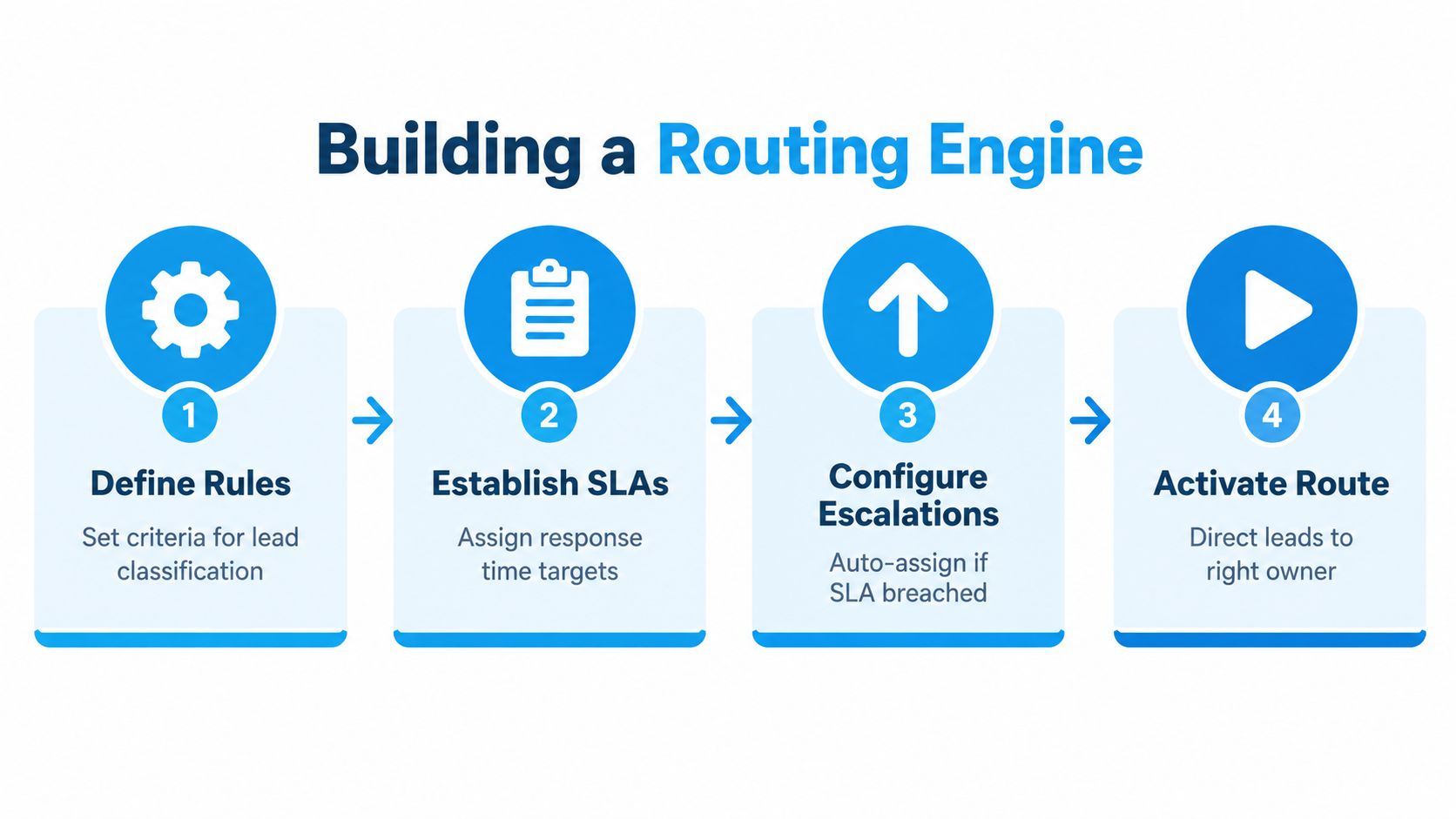
Attach an SLA to each route
The assignment should start a timer. Set the response target according to the lead type, then record whether the owner replied, attempted contact, booked a meeting, or changed the status. The exact target matters less than making it explicit and measurable.
Use alerts before a breach, not only after one. The owner should receive the assignment and context immediately. A manager or backup owner should receive an escalation when the required action hasn't happened.
Create a fallback path
Every route needs a safe destination when information is incomplete, the owner is unavailable, or the rule fails. Use a monitored queue or designated operations owner, then alert someone who can correct the record and assign it.
A fallback isn't a sign that the system failed. It's the guardrail that prevents one missing field from becoming a lost opportunity.
Define the full handoff
Routing shouldn't stop at first contact. Define what happens after a reply, a discovery call, a proposal, a pause, or a rejection. A clear sequence prevents the common situation where the lead is technically owned but nobody knows what should happen next.
The routing-engine walkthrough video can support implementation discussions, but your own workflow must reflect the firm's services, owners, and decision stages.
Routing Flows That Fit Small Consultancies
A solo advisor doesn't need the same route as a boutique team, but both need the same basic discipline: capture the inquiry, assign responsibility, trigger a response, and preserve context.

The solo consultant
A solo fractional COO receives a website inquiry describing an operational bottleneck. The form creates a contact record, identifies the source as website inbound, assigns the lead to the consultant, and creates a first-response task. An immediate confirmation tells the prospect the inquiry was received and offers a scheduling path.
The consultant still decides whether the problem fits the practice. Automation handles capture, acknowledgement, reminders, and status visibility. It doesn't replace the judgment needed to assess scope, urgency, or fit.
If the prospect books a call, the system moves the opportunity into discovery and creates the relevant preparation task. If the prospect doesn't respond, a follow-up sequence keeps the conversation visible rather than relying on memory.
The boutique advisory team
A four-person advisory firm receives a partner referral for a client entering a new market. The referral record identifies the partner, the requested service, and any existing account relationship. Account ownership takes priority, unless the request clearly belongs to a specialist practice.
The assigned advisor receives the context and the partner relationship remains attached to the opportunity. If the owner doesn't act within the firm's defined response window, the operations lead receives an escalation and can reassign the inquiry without starting the investigation from scratch.
Event leads follow a different branch. They enter a shared pool, receive a source tag, and route to an advisor familiar with the event topic. The team can then track discovery outcomes, proposal movement, and partner follow-up in one place.
The operational payoff isn't complexity. It's a consistent operating rhythm that works even when the founder is in delivery, an advisor is travelling, or a referral arrives outside normal working patterns.
The Hidden Tradeoff Between Speed and Routing Accuracy
Fast assignment is valuable, but fast misassignment is still a bad customer experience. An advisory buyer who reaches the wrong specialist may need to repeat the problem, wait for an internal handoff, or accept a generic response that signals the firm didn't understand the request.
The better standard is immediate ownership with enough context to protect fit. Route the lead quickly to the most likely appropriate owner, then preserve a controlled exception path for cases that need expert review.
The fastest response is not the fastest generic reply. It's the fastest relevant response from someone who can move the conversation forward.
For a firm with distinct practices, use layered logic:
- Known accounts go to the existing relationship owner.
- Clear service requests go to the relevant specialist pool.
- Unclear inquiries go to a monitored generalist or triage owner.
- Strategic or unusual opportunities receive an immediate acknowledgement and a human review step.
That balance matters because routing guidance increasingly treats the process as more than initial assignment. Collection, distribution, follow-up, and reassignment all affect the eventual quality of the opportunity, while overly prescriptive logic can become counterproductive (LeadSquared's lead routing guide).
Don't judge routing only by whether a lead was assigned quickly. Review whether the first conversation was relevant, whether the discovery call happened, whether the proposal progressed, and whether stalled opportunities were reassigned. Speed is the entry condition. Fit and follow-through determine the commercial outcome.
Common Routing Failures and How to Avoid Them
Most routing failures are ordinary process gaps, not dramatic technical incidents. A shared inbox has no named owner. A discovery call happens without a reminder. A proposal goes quiet because nobody owns the next contact. A referral is logged in a spreadsheet and never receives a proper thank-you or follow-up.
Fix each failure at the workflow level:
- Inconsistent response: Assign every inbound record to a person or monitored queue, then attach an SLA and escalation.
- Misrouted leads: Keep service, relationship, and segment fields standardized, and review the rules when the firm changes its practices or account ownership.
- Overloaded owners: Use availability, practice area, and workload signals before sending every inquiry to the same partner.
- Untracked discovery calls: Create confirmations, reminders, preparation tasks, and a clear post-call status.
- Quiet proposals: Require a next step and date before an opportunity can leave the proposal stage.
- Broken handoffs: Trigger the delivery pipeline, notify the new owner, and preserve the commercial context when a prospect becomes a client.
- Unmanaged referrals: Record the referring relationship, create the promised follow-up, and keep the partner informed.
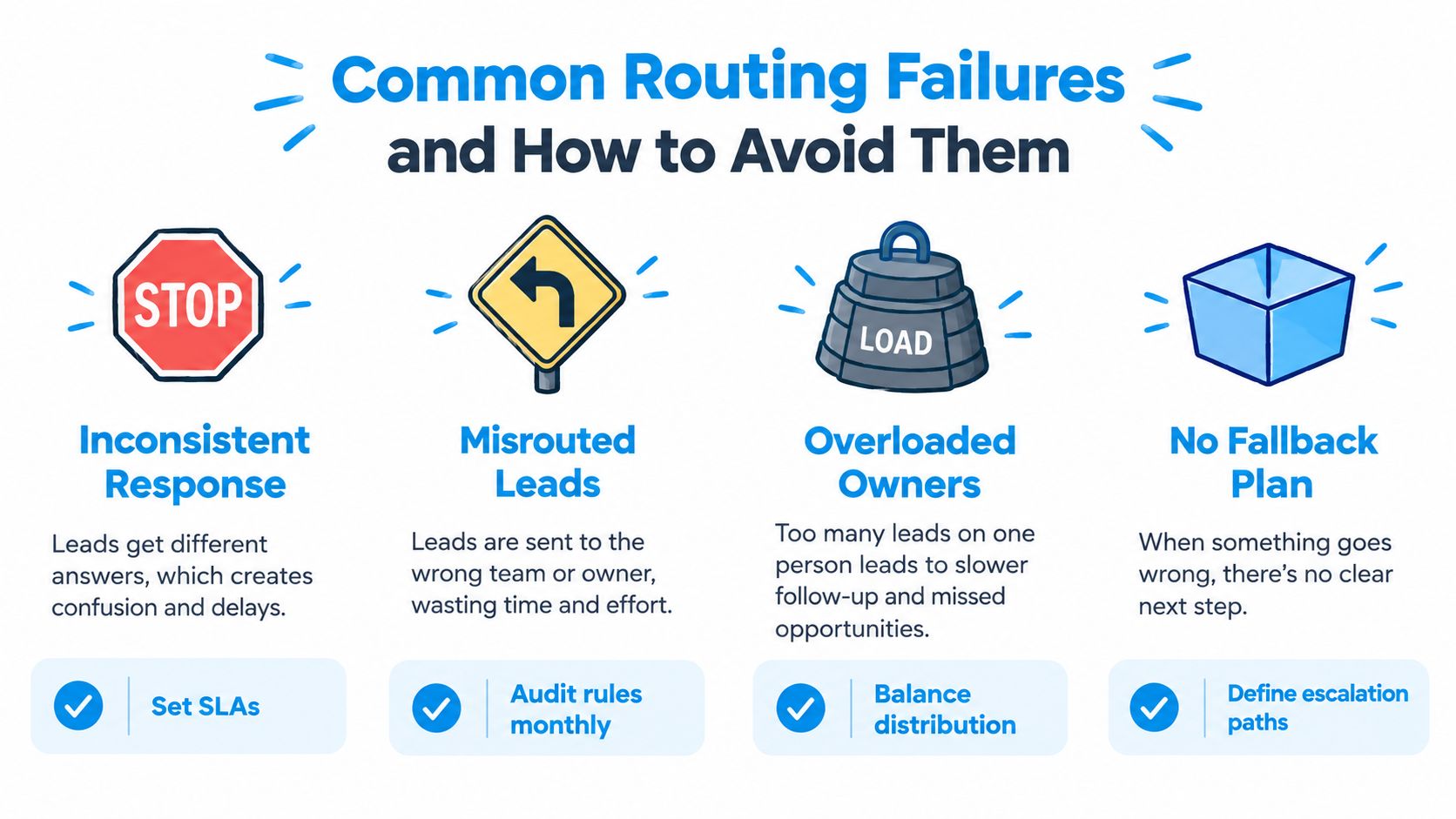
Use follow-up automation to turn those rules into visible actions, but audit the workflow regularly. Check whether leads are reaching the correct owners, whether owners are acting within the agreed window, and whether escalation paths function as intended.
Your final checklist is simple:
- Every lead has an owner.
- Every assignment has a reason.
- Every important route has a response target.
- Every missed target triggers escalation.
- Every stage has a next action.
- Every exception has a fallback.
Lead routing protects more than speed. It protects relevance, accountability, and the trust that makes a buyer willing to continue the conversation.
Starward Navigators gives small consulting and advisory firms a prebuilt operating system for lead capture, routing, follow-up, appointment reminders, proposal tracking, client handoffs, and referral relationships. Visit Starward Navigators to see how you can replace shared-inbox uncertainty with an accountable workflow from first inquiry to decision.