
A firm that finishes onboarding in five to seven days retains more than 92% of new clients at 90 days, while firms that take 14 to 21 days retain only 70% to 80%, according to the 2026 client onboarding benchmark. That gap isn't created by a better welcome email. It comes from how quickly a consulting firm collects usable information, assigns ownership, schedules the first working session, and delivers an early result.
The operational bottleneck is usually data collection, not kickoff design. If requirements arrive through scattered email threads, spreadsheets, and repeated reminders, delivery can't start with confidence. Portal-based intake, explicit document requests, and automated handoffs turn onboarding from a welcome sequence into a measurable retention system.
Table of Contents
- Why Client Onboarding Determines Your First 90 Days
- Designing Intake and Document Collection That Moves Fast
- Automating the Handoff From Sales to Delivery
- Structuring Kickoff Sequencing and Template Workflows
- Measuring Onboarding With the Right Leading Indicators
- Turning Onboarding Best Practices Into Repeatable Systems
Why Client Onboarding Determines Your First 90 Days
Between 40% and 60% of cancellations occur during the first 90 days, largely because of onboarding friction rather than service failure, according to this client onboarding process guide. For a consulting firm, that makes onboarding an operating process with a direct retention consequence. The question is whether the client understands the engagement, supplies usable information, and sees credible progress before uncertainty takes hold.
A common advisory engagement exposes the problem quickly. Sales closes the proposal, but the delivery lead does not receive the final scope. The client receives a generic request for “documents,” sends a partial attachment, and waits for clarification. The kickoff is then scheduled without the access credentials or baseline data needed to make the meeting productive.
Everyone is occupied, yet the client experiences silence and administrative friction.
That sequence damages confidence before substantive work begins. The buyer cannot distinguish internal disorganization from a controlled delivery process, while the firm spends time explaining delays instead of demonstrating value. A practical explanation of client onboarding helps frame the process as the controlled transition from signed agreement to productive delivery rather than a ceremonial welcome.
The first week is an operational deadline
The benchmark cited earlier reports that top-performing firms respond within 4 hours of signing, collect intake information through portals instead of email, complete onboarding in 5 days or fewer, and automate follow-ups. It also reports that firms completing onboarding in 5 to 7 days retain 92% or more of new clients at 90 days, while firms taking 14 to 21 days retain 70% to 80% at that point. See the 2026 onboarding benchmark findings for the full comparison.
The same report places digitally onboarded completion at about 4 hours, compared with 7 days for traditional methods. This does not mean every consulting engagement can be completed in an afternoon. It shows that the administrative path to readiness can shrink sharply when a portal collects structured data, identifies missing inputs, and sends complete information to delivery without repeated manual intervention.
The operational bottleneck is usually data collection. Email threads, spreadsheets, and reminders create delays because people must interpret requests, check files, and decide what happens next. A portal-based intake process turns those actions into visible stages and gives the delivery team usable context sooner.
Practical rule: Treat the first week after signature as the highest-impact period for reducing ambiguity, reaching first value, and protecting early retention.
Diagnose friction before adding automation
Automation will not repair a confusing process. Map every step from proposal acceptance through kickoff, then identify pauses caused by email interpretation, file reconciliation, missing ownership, or unclear approval rules. Automate only after the handoffs are explicit.
For most small advisory firms, the first improvements are practical:
- Create one source of truth: Keep the client record, scope, required inputs, owners, and status in one operating system.
- Name the first value milestone: Define the first tangible output the client should see, such as a diagnostic readout, prioritized opportunity list, or agreed delivery roadmap.
- Separate client work from internal work: The client may upload data while the delivery owner validates it and the coordinator schedules kickoff.
- Set an escalation path: Missing information should trigger a reminder and an internal alert, not an invisible pause.
The firms that retain early clients do not necessarily build the most elaborate onboarding programs. They make progress visible, keep requests structured, and prevent a signed agreement from disappearing into an unmanaged handoff. That discipline compresses time-to-first-value from weeks toward hours where the underlying work permits it.
Designing Intake and Document Collection That Moves Fast
Intake slows down when firms request every possible input before explaining what matters first. Clients receive a long form, unclear attachment instructions, and follow-ups from several people. The firm may collect a large volume of material, yet still lack information that is complete, consistent, and ready for delivery.
Design intake around the first value milestone. If the initial deliverable depends on a current organizational chart, financial extract, system access, and a description of the decision the client needs to make, request those items first. Defer background material that will not affect the first piece of work. The goal is to move usable information into the delivery process quickly, not to complete an oversized questionnaire.
Build the portal around decisions
A portal should do more than replace an email attachment. It should explain what the client must provide, why each item matters, who owns the task, and what happens after submission. That structure turns data collection into a managed workflow rather than a series of reminders.
Use a short sequence:
- Confirm engagement details: Show the agreed scope, primary contact, delivery owner, and immediate next milestone.
- Collect structured context: Ask for the business objective, current situation, constraints, stakeholders, and definition of success.
- Request named files: Use labels such as “latest sales pipeline export” or “current operating plan,” rather than “supporting documents.”
- Confirm receipt and gaps: Notify the client immediately when an item is submitted, then identify missing, outdated, or unreadable material.
- Route internal review: Send the submission to the responsible delivery owner with a specific validation task and deadline.
- Schedule the next event: Offer kickoff times once the minimum information for a useful meeting is available.
The client onboarding template should follow this sequence instead of presenting one large questionnaire. A useful template gives the client a visible path to completion and gives the firm a reliable status signal. It also makes exceptions easier to manage because the team can see which item is blocking progress.
Remove fields that create work without improving delivery
Review each field with one question: will the answer change the first action the team takes? If not, remove it from initial intake or make it optional. If the information already appears in the proposal, CRM, or signed agreement, do not ask the client to enter it again.
Retain fields that establish delivery context:
- Engagement objective: What decision or outcome prompted the purchase?
- Success criteria: How will the client recognize meaningful progress?
- People and permissions: Who approves, contributes, and needs access?
- Current-state evidence: Which reports, systems, or documents establish the baseline?
- Constraints: What timing, compliance, technology, or capacity limits affect delivery?
Use conditional questions where possible. A fractional finance engagement may require financial system access, while an operations advisory project may depend on process documentation and team availability. Showing only relevant requests reduces cognitive load and improves information quality.
Sequence easy tasks before difficult ones
Clients are more likely to begin when the first actions are obvious and quick. Ask them to confirm contacts and objectives before requesting a complex export or multi-party approval. Early completion creates momentum and lets the team validate the engagement while harder tasks remain in progress.
The OnboardMap 2026 benchmark reports that portal-based intake is completed 2.3 times faster than email-based intake. It also reports that leading firms finish onboarding in 5 days or less, as shown in the client onboarding benchmark report. The operational advantage extends beyond speed. A portal preserves field structure, attaches files to the correct record, exposes incomplete tasks, and provides reliable inputs for automated handoffs.
Email still has a role in relationship-building and exceptional circumstances. It should not serve as the system of record for required inputs. When a client sends a document by email, someone must identify it, rename it, store it, update the status, and decide whether it satisfies the request. That reconciliation work is where small firms lose days. A portal makes missing information visible early, allowing delivery staff to spend time validating evidence instead of reconstructing the intake trail.
Automating the Handoff From Sales to Delivery
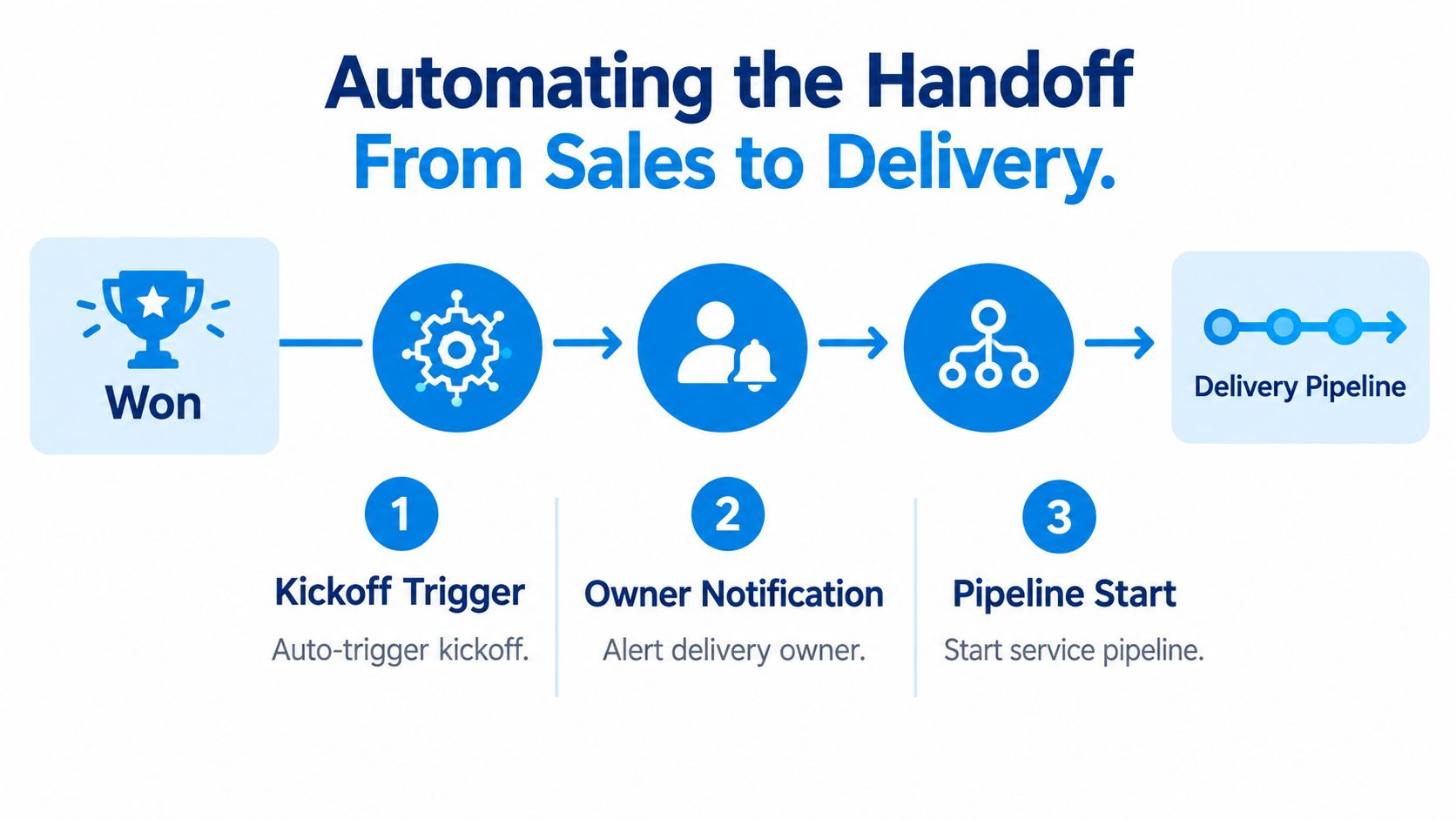
Treat the sales-to-delivery handoff as an event-driven transition. A handoff that depends on someone remembering to send a message will fail when the pipeline is busiest. Once an opportunity reaches the won stage or the agreement is confirmed, the system should create delivery work, assign owners, notify the right people, and start the client-facing sequence.
The 4-hour response standard cited earlier is achievable only when a trigger fires without waiting for a salesperson to write an internal note. That trigger also needs clean operational data. If the portal has captured the client's objectives, contacts, scope, documents, and access requirements in structured fields, delivery can act immediately instead of reconstructing the engagement from email threads.
Define the trigger precisely
“Deal won” works only when the stage has a clear meaning. Decide whether the trigger occurs after proposal acceptance, contract signature, payment receipt, or completion of all required conditions. Different engagement types may need different gates. Define those rules explicitly so delivery staff do not have to interpret sales stages manually.
A dependable handoff includes:
- A confirmed client record: The legal entity, contacts, scope, start conditions, and communication preferences are present.
- A delivery owner: One person is accountable for readiness, even when several specialists contribute.
- A linked delivery record: The delivery pipeline inherits relevant proposal details, collected inputs, and agreed outcomes.
- A client notification: The client receives confirmation, the next action, and a named contact.
- A scheduling action: Kickoff options are sent automatically or assigned immediately to a coordinator.
The handoff should also preserve exceptions. If a required document is missing, a field conflicts with the signed scope, or payment has not cleared, the workflow should pause and route the issue to a named owner. Automatic progression without validation moves bad data downstream faster.
Sequence notifications around action
Internal alerts should specify the next task rather than announce that a deal closed. The delivery owner needs scope and intake status. The coordinator needs a scheduling task. The salesperson needs confirmation that the handoff completed and visibility into exceptions.
Notification timing matters. The first client message should acknowledge the decision and establish confidence. An internal delivery alert can follow with operational details. A reminder should fire when the client has not completed a required action, and an escalation should reach the owner when the process exceeds its defined window.
A handoff is complete when the next owner can act without reopening the sales history or asking the client to repeat information.
Measure the gap from signature to kickoff
Track timestamps for agreement confirmation, first response, intake completion, owner assignment, and kickoff scheduling. A stage history and a small exception report can reveal whether delays come from missing data, unclear ownership, scheduling friction, or a trigger that never fired.
CRM workflow builders can automate these transitions. For small consulting and advisory firms, Starward Navigators is one example of an operating system that updates the client record at the won stage, starts a delivery pipeline, sends an onboarding email, notifies the owner, and triggers kickoff scheduling. The platform matters less than the design. Each transition should create the next task, retain the collected data, and make its owner visible.
Structuring Kickoff Sequencing and Template Workflows
A kickoff meeting can't rescue an unprepared engagement. The client should arrive knowing the purpose, the decisions required, the participants, and the immediate output. The delivery team should already have the information needed to spend the meeting on interpretation and alignment rather than basic collection.

A practical sequence has seven phases: welcome, discovery, documents, access, kickoff, handoff, and review. The phases aren't a reason to force every engagement into identical meetings. They're a control structure that helps the team identify what must happen, who owns it, and when the client should see evidence of progress.
Turn the sequence into operating rules
The welcome phase confirms the relationship and establishes the next step. Discovery captures the client's objective, decision context, stakeholders, and constraints. Documents and access gather the evidence and permissions required for delivery. Kickoff aligns the working team around scope and success criteria. Handoff moves the engagement into its recurring delivery rhythm, while review checks whether the onboarding promise has been met and whether any risk remains.
Use templates for repeatable work, but don't confuse standardization with rigidity. A strategy consultancy may need a senior stakeholder workshop, while a fractional CFO may need a secure data review before the first working session. The template should define the control points and required outputs. It shouldn't dictate every sentence or meeting format.
A strong kickoff template includes:
- Purpose and desired decisions: State what the meeting must resolve.
- Success criteria: Connect the engagement to a result the client can recognize.
- Roles and working norms: Define who approves, contributes, attends, and receives updates.
- Current-state summary: Bring forward validated intake information rather than asking the client to restate it.
- Immediate deliverable: Confirm what the team will produce next and how the client will use it.
- Open risks: Identify missing access, unclear scope, dependencies, or timing constraints.
IBM's guidance recommends defining goals such as time to first value, activation, and early retention, removing unnecessary registration friction, and mapping the complete customer journey before adding automation or AI. The IBM guidance on accelerating customer onboarding supports a useful order of operations: understand the journey first, simplify it second, then automate the stable parts.
The client onboarding workflow should therefore be treated as a living delivery map. If a kickoff repeatedly exposes the same missing input, change the intake request. If clients leave without knowing the next milestone, change the meeting template. If owners still rely on memory, add a stage trigger or task assignment.
A short walkthrough can help teams align on the intended sequence and the handoffs that support it.
The best kickoff feels like momentum because the administrative work has already been absorbed by the workflow. The client leaves with a clear decision, a named next action, and a credible view of what happens next. That experience is more valuable than a polished agenda sent into an otherwise unmanaged process.
Measuring Onboarding With the Right Leading Indicators
A completed checklist does not prove that onboarding worked. It can conceal slow data collection, unresolved quality problems, or a kickoff that produced no usable result. Track the operational signals that show whether information moved from the client to delivery quickly enough.
Use four indicators together:
| Indicator | What it reveals | How to instrument it |
|---|---|---|
| Onboarding completion rate | Whether clients finish the required sequence | Mark a phase complete only when its defined output exists |
| Time to first value | How quickly the client reaches a meaningful result | Record when required inputs arrive and when the first accepted value milestone is reached |
| Day-30 CSAT | Whether the early experience met expectations | Request feedback after the client has experienced the initial delivery |
| Early-stage churn | Whether onboarding risk is appearing early in the relationship | Connect cancellation or disengagement records to the onboarding cohort |
A customer onboarding metrics benchmark reports a median onboarding completion rate of 19.2% across SaaS onboarding flows, customer retention of 46.9% at one month, and 1.4 support tickets per user per month during onboarding. These figures come from a SaaS context, so consulting firms should not copy them as targets. Their value is diagnostic: completion, value, satisfaction, and support burden are separate outcomes, not one “onboarded” status.
Make time to first value the primary outcome
For advisory work, first value may be a validated baseline, a decision-ready diagnosis, a prioritized action plan, or a first deliverable that changes the client's next move. Define that milestone before onboarding starts. Record when the required inputs became available, when the team began analysis, and when the client accepted the result.
This measure exposes trade-offs that completion alone misses. A shorter intake can raise completion while leaving delivery without enough context. A longer request can improve information quality while delaying the first result. Time to first value shows which information must be collected immediately and which can wait until the work is underway.
Read the indicators as a system
Review results by cohort and engagement type. A completion problem points to form design, request order, or reminder timing. High completion combined with a long time to first value suggests that the workflow closes before delivery begins, or that internal capacity is holding the work. Low day-30 CSAT can indicate unclear expectations, weak communication, or a first deliverable that does not match the client's definition of success.
Support volume reveals friction that completion rates miss. If clients repeatedly ask where to upload a file, who owns the next step, or what a request means, the workflow is forcing them to seek answers manually. Each question identifies a missing label, unclear instruction, or missing owner in the intake design. This is the measurement counterpart to the field-removal test from the intake section: repeated client questions mark fields and steps that survived without earning their place.
Measurement discipline: Do not optimize the percentage of clients marked complete. Optimize the time and confidence required to reach the first meaningful result.
Run a weekly review of the phase with the greatest delay or abandonment. Inspect the exact request and handoff, change one part of the workflow, preserve the baseline, and record the intervention. Then watch whether time to value, satisfaction, and early churn move together. If they do not, the process may be reducing visible completion without improving the client's actual path to value.
Turning Onboarding Best Practices Into Repeatable Systems
Client onboarding best practices work when they operate as one system. Portal-based intake supplies structured information. Automated handoffs assign the work. A seven-phase sequence gives the client and team a shared path. Leading indicators show whether the process reaches value quickly and protects the relationship afterward.
Small firms don't need to automate every exception before improving the core path. Start with the engagement types that repeat most often, define the minimum information required for the first deliverable, and assign one owner from signed agreement through kickoff. Then automate the predictable events, including confirmation, document reminders, owner alerts, scheduling, and stage progression.
The strongest operating model also preserves human judgment where it matters. A consultant should interpret a client's situation, resolve ambiguity, and adapt the work. The system should prevent avoidable omissions, duplicate requests, forgotten follow-ups, and invisible waiting.
Audit your current process by reviewing the last few completed onboardings. Note where information was requested twice, where a client waited without an update, where an owner had to reconstruct the sales context, and where the first deliverable could have started earlier. Fix the highest-friction handoff first, then measure the result through completion, time to first value, day-30 CSAT, and early-stage churn.
Starward Navigators provides prebuilt pipelines for business development, client delivery, and relationships, with automated follow-up, proposal tracking, client record updates, owner notifications, and kickoff scheduling for consulting and advisory workflows. Visit Starward Navigators to see how its onboarding automation can replace fragmented handoffs with a repeatable path from signed engagement to delivery.