A hot inquiry arrives on Monday morning. By Thursday, nobody has spoken to the buyer, the assigned consultant is still checking email threads, and the proposal sent on Friday sits untouched in a shared folder. The firm doesn't have a lead problem. It has a follow up sale operating problem.
For a small consulting or advisory firm, follow-up isn't a final courtesy after the “real” sales work. It is the operating system that connects inbound interest, discovery, proposal decisions, delivery, repeat engagements, and referrals. The strongest approach treats those moments as three distinct plays: respond quickly to new demand, manage stakeholders while a proposal is being evaluated, and create deliberate reasons for former clients to buy or refer again.
Table of Contents
- Why Most Follow Ups Fail in Small Consulting Firms
- Designing the First Touch Around Speed of Response
- The Six-Touch Cadence That Outlasts a Stalled Proposal
- Managing Multiple Stakeholders Without Losing the Champion
- Reactivating Silence Without Damaging the Relationship
- Turning a Closed Deal Into a Repeat Sale and Referrals
- Building Your Follow Up Operating System
Why Most Follow Ups Fail in Small Consulting Firms
At a six-person consultancy, the week often starts with good intentions. A referral arrives through LinkedIn, a website form lands in the inbox, and someone promises to enter both into the CRM after the morning client call. By Tuesday, the referral is waiting for a partner's opinion, the form has no owner, and the team is debating who should send the first message. By Friday, the proposal that looked promising has become “one to revisit.”
The visible symptom is usually simple:
“Our proposals just go dark.”
The underlying failure is rarely a lack of effort. It is a missing operating decision. Nobody defined who owns the inquiry, how quickly that person must act, what information belongs on the record, or what happens after the buyer receives a proposal.
The leaks are operational, not motivational
Four breakdowns appear repeatedly in boutique firms:
- Unassigned inquiries: A lead enters through a form, inbox, event list, or referral, but no named owner receives a task. Shared ownership becomes no ownership.
- Manual routing: A partner forwards an email, waits for a reply, and assumes someone else has started the conversation. Every handoff adds delay and context loss.
- Generic nurture: The buyer receives “just checking in” messages that don't reflect the problem discussed, the decision process, or the next event.
- Proposal-stage ambiguity: The team sends a document but doesn't record who reviewed it, which objection remains open, or when a decision should occur.
Persistence matters, but persistence without context becomes noise. Historical sales benchmarks often cited from the National Sales Executive Association state that 80% of sales require at least five follow-up contacts, while 44% of salespeople stop after one follow-up. Those figures should be treated as industry benchmarks, not universal laws, but they support a practical conclusion: silence after one message isn't proof that the opportunity is dead. See the historical follow-up benchmark and its limitations.
The remedy isn't to add more reminders to an already chaotic calendar. It is to install ownership, timestamps, decision stages, useful messages, and explicit stopping rules. The next three plays provide that structure.
Designing the First Touch Around Speed of Response
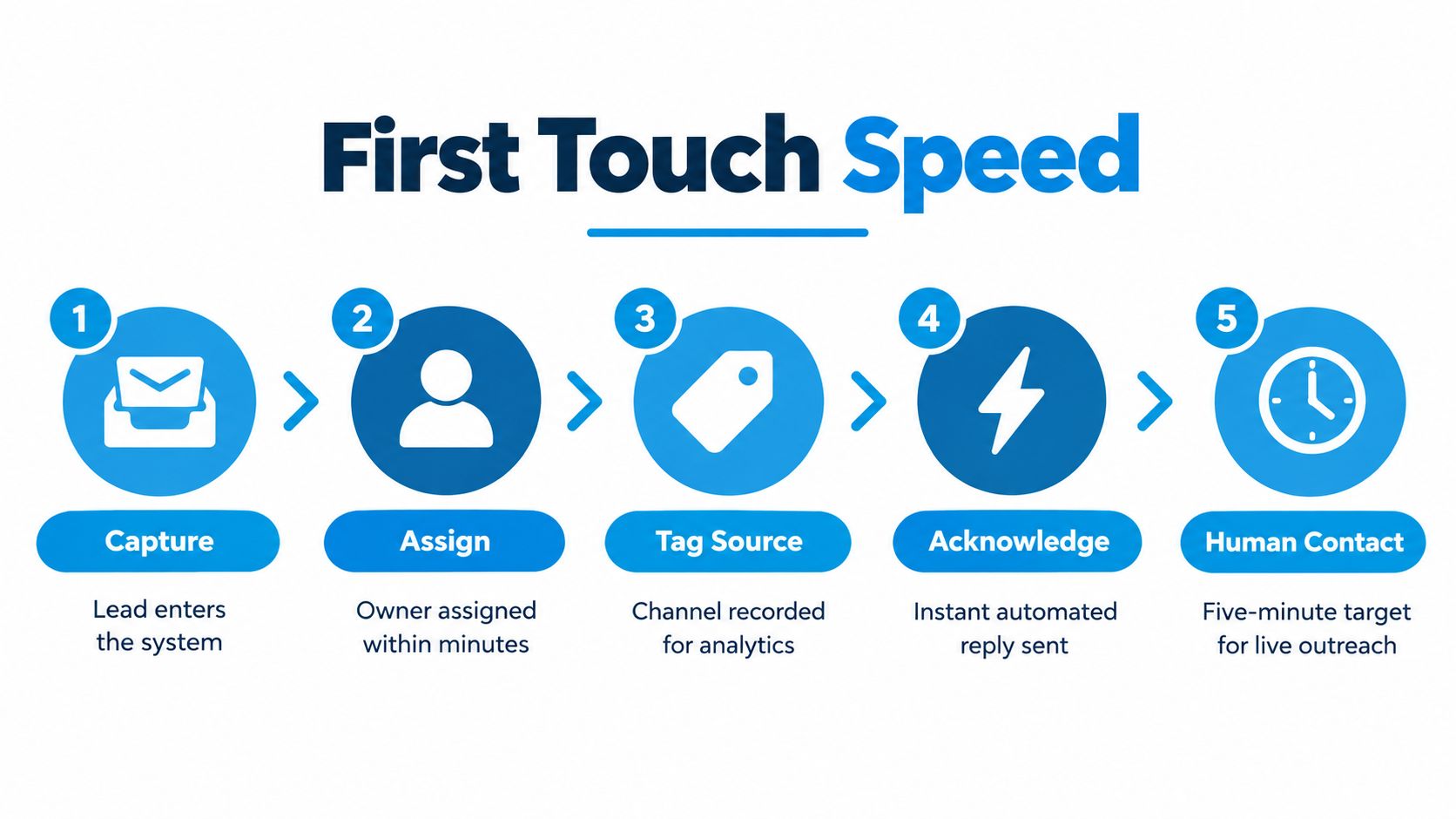
A prospect submits a form during a busy afternoon. By the time a consultant sees it, assigns it, and finds an opening, the buyer may have shifted attention to another problem or provider. The first-touch workflow must protect that narrow window by capturing the inquiry, assigning an owner, recording its source and timestamp, and triggering an immediate acknowledgment.
The operational benchmark is demanding. A lead-response study associated with MIT researchers and InsideSales analyzed more than 15,000 leads and found that contacting a new inquiry within 5 minutes, rather than waiting 30 minutes, produced odds of contact approximately 100 times higher and odds of qualification about 21 times higher, according to the published lead-response analysis. Moving from a five-minute response to a ten-minute response also reduced the odds of dialing to qualification by roughly 4 times.
These figures do not guarantee conversion for every consulting lead. They provide a clear operating signal: respond while the buyer still remembers the problem that prompted the inquiry. Manual assignment and an inconvenient calendar opening create avoidable leakage, whether the lead arrived through a form, referral, or event conversation.
Build the trigger, not a heroics culture
For an inbound form, the workflow should create the contact, store the form source and timestamp, assign a named owner, send an acknowledgment, and create a live-contact task. A referral record should retain the referrer and introduction message, notify the responsible consultant, and prompt a personal reply that recognizes the connection. An event lead needs the event and topic tagged, relevant notes attached, and ownership assigned to the person who handled the conversation.
The first human message should stay short:
- Confirm that the inquiry arrived.
- Restate the business problem you understood.
- Offer two concrete meeting times.
- Give the buyer an easy reply path, such as “Reply with A, B, or another time.”
An automated acknowledgment confirms receipt only. The metric that matters is time-to-first-human-touch, measured from lead creation to a live conversation. Track the median and worst-case response time as well. A healthy average can conceal an inquiry that remained unassigned for days.
Practical rule: Every new lead needs one owner, one timestamp, one next action, and one escalation path.
A small firm can support this process with a centralized inbox, connected forms, routing rules, task creation, and coverage hours that define when the five-minute human-contact target applies. If no consultant can respond immediately, the system should create an escalation task. The acknowledgment records activity, while the live contact starts the sale.
The Six-Touch Cadence That Outlasts a Stalled Proposal
A proposal can be accurate, well priced, and still stall because every follow-up asks the buyer to do the same work: decide. “Just checking in” adds no context, resolves no uncertainty, and gives internal stakeholders nothing they can use.
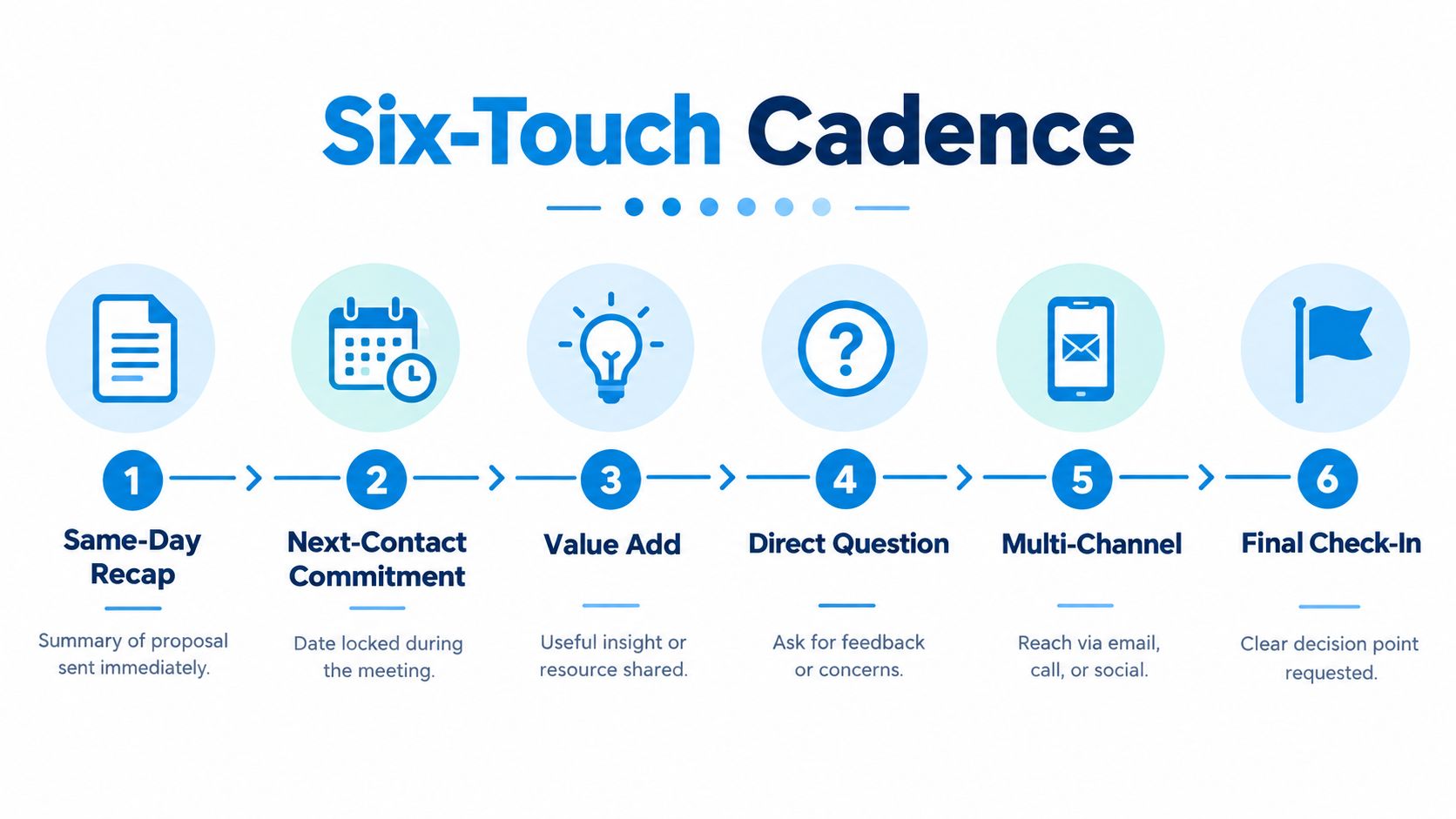
Start the sequence at the end of discovery. Record the decision criteria, stakeholders, commercial risk, agreed next step, and date. Send a same-day recap, then secure the next conversation before the meeting ends whenever possible. A practical proposal cadence uses approximately six touches over three weeks, often three to four days apart, with useful email content alternating with direct calls. These benchmarks appear in sales follow-up research from Cirrus Insight.
The six touches work best as decision support rather than six reminders:
- Touch one, same-day recap: Confirm the business problem, scope, decision criteria, and next event. Attach or link the proposal, while keeping the conversation active.
- Touch two, focused clarification: Ask which proposal element requires discussion. “Which assumption should we review?” produces more useful information than “Any thoughts?”
- Touch three, role-specific value: Send one concise decision aid, such as an implementation-risk note, assumptions summary, or commercial clarification.
- Touch four, live outreach: Call the primary contact and leave a brief voicemail when appropriate. Name the decision point, not merely the fact that you called.
- Touch five, stakeholder support: Offer an executive summary or a conversation with the person responsible for the unresolved issue.
- Touch six, explicit decision point: Ask whether the opportunity should proceed, be revisited on a defined date, or be closed for now.
Use the channel that matches the task. Email carries assumptions and summaries; a call exposes hesitation and missing context. After every interaction, record the event that controls the next action. If finance needs to review assumptions, the next task belongs to that review, not to an arbitrary reminder three days later.
The proposal record should show the last meaningful conversation, remaining objection, stakeholders involved, proposal date, decision milestone, and next owner action. Add an expiry or review point. Without a decision milestone, the proposal becomes an open loop that consultants repeatedly restart.
Use this proposal follow-up workflow to structure those stages, while keeping the process tool-independent. A spreadsheet can capture the fields, and a CRM can automate reminders. Neither can compensate for messages that add no decision value.
Set a clear ceiling for persistence. The benchmark analysis reports that roughly 93% of leads that eventually convert are reached by the sixth call attempt, while opportunities requiring seven or more calls are about 45% less likely to convert. Treat those figures as a persistence guide, not a closing guarantee. After the sequence, recycle the opportunity, move it to nurture, or close it according to the buyer's stated position.
Managing Multiple Stakeholders Without Losing the Champion
A proposal can stall even when its original contact remains interested. Finance may question the assumptions, operations may worry about implementation, and an executive sponsor may need a shorter explanation of the outcome. Continuing to email one person leaves those concerns unresolved and can make the champion carry the entire internal sale.
B2B buyers commonly use an average of 2.5 contact channels, and 88% want to hear from vendors while researching and evaluating options, according to B2B buyer research from Sopro. The implication is to send the right decision asset through the channel each stakeholder can use, rather than increasing message volume.
Start with the buying group
Before the next follow-up, update the proposal record with four fields:
- Who has reviewed the proposal?
- Which objection remains open?
- Which channel does each stakeholder prefer?
- What decision event appears on the buyer's calendar?
The primary contact is the champion, not a gate to bypass. Ask how the internal review works, what each stakeholder needs, and whether the champion wants you to join a discussion. Contacting colleagues directly without context can make the champion appear uninformed. It can also turn useful multi-threading into internal friction.
| Buyer Role | Decision Concern | Follow-Up Asset That Helps | Preferred Channel |
|---|---|---|---|
| Sponsor | Strategic outcome and visible business impact | Executive summary tied to the agreed priority | Short email or sponsor conversation |
| Technical evaluator | Feasibility, method, dependencies, and implementation risk | Delivery plan, assumptions, and risk clarification | Working session or detailed email |
| Financial approver | Commercial logic, scope boundaries, and confidence in the investment | Cost assumptions, options, and decision summary | Structured email or finance review |
| Procurement | Terms, process, timing, and required documentation | Procurement pack, terms, and decision timeline | Email with a defined checklist |
Use the table as a working reference, not a script. “The buyer” may be several people, each with a different definition of a safe decision. A technical memo sent to the sponsor can create work instead of confidence. A broad vision statement sent to finance may leave the approval question unanswered.
The champion should never have to translate your proposal from scratch for the rest of the buying group.
Give the champion language they can forward, and ask permission before adding other stakeholders. A one-page summary can cover the problem, recommendation, expected involvement, and decision required. That lets the champion explain the case without rebuilding it from scattered emails.
Channel choice should follow the stakeholder, too. One person may prefer email, another a call, and another a short shared document. Record those preferences in the opportunity and connect each contact to a specific decision task. Role-aware follow-up reduces internal uncertainty, while repeated generic messages only increase activity without resolving the purchase decision.
Reactivating Silence Without Damaging the Relationship
Silence doesn't have one meaning. The buyer may want to proceed later, may be blocked by procurement, may have lost budget, or may have decided against the engagement. Treating every silent opportunity as a generic reminder task makes the consultant sound inattentive and makes forecasting unreliable.
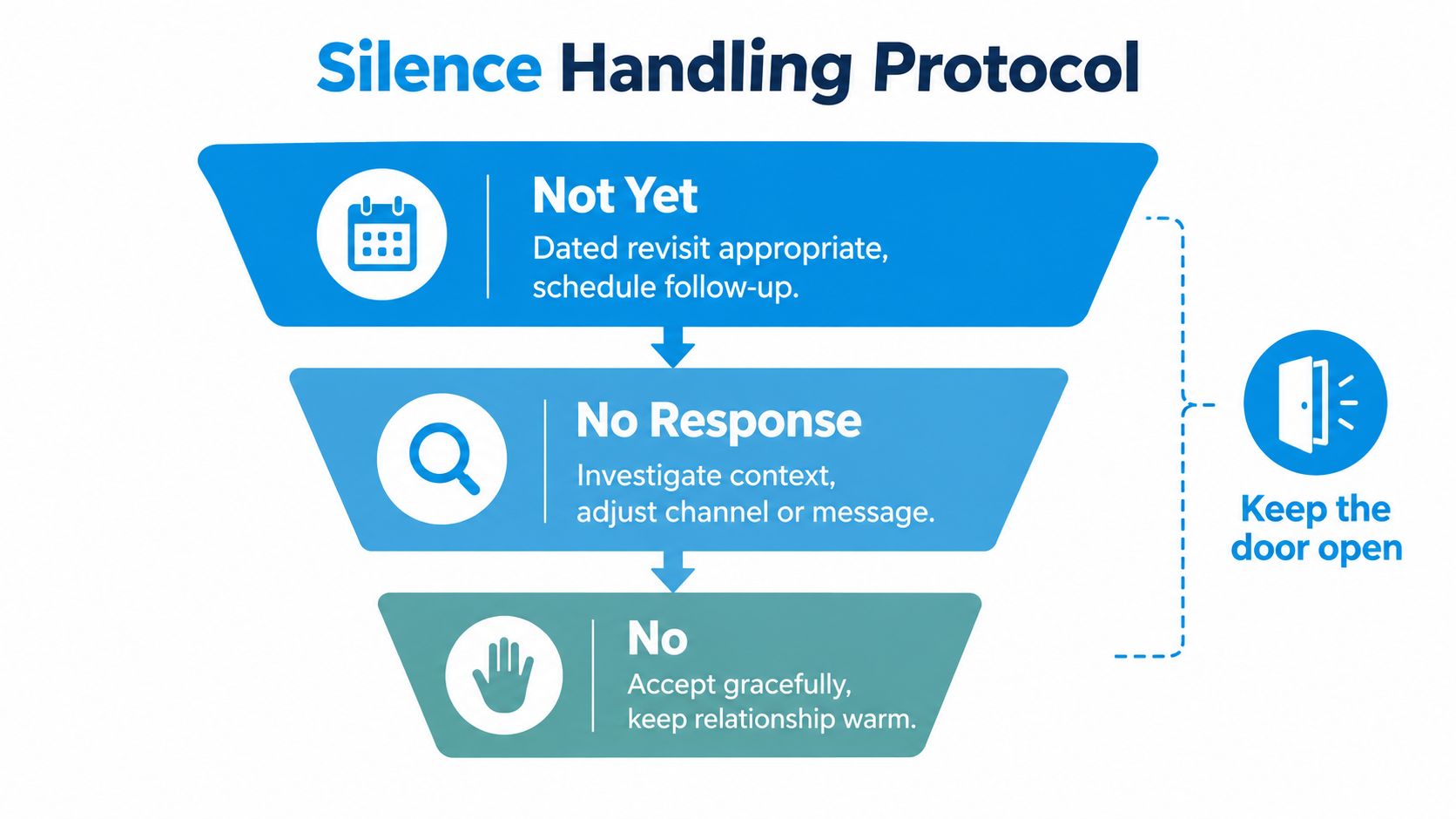
Use three states:
Not yet
The buyer has a real future timing signal, such as a planning cycle, leadership meeting, or budget event. Move the opportunity to a dated revisit stage. The follow-up should name the agreed timing:
“You mentioned revisiting this after the planning meeting. I'll reconnect on the date we recorded. If priorities change before then, reply here and I'll adjust.”
Blocked
The buyer has interest but can't progress because a decision question remains unanswered. Record the blocker and send one useful aid. That might be a procurement document, an implementation outline, clarification of assumptions, or a short response to a risk raised by finance.
“It sounds like the open point is implementation ownership. I've attached a short outline of responsibilities and dependencies. If that resolves the question, we can confirm the next decision step.”
No
The buyer explicitly declines, lacks authority or budget, or remains unresponsive after the defined cadence without a credible next event. Close the active opportunity respectfully. A clear close-the-loop message protects the relationship better than indefinite pursuit:
“I'm closing this active follow-up for now so I don't keep sending reminders that aren't useful. If the priority returns, reply to this thread and we can pick up from the proposal.”
After every touch, capture four things:
- Buyer-stated timing: What date or condition did the buyer name?
- Unresolved decision question: What is preventing progress?
- Next event: Which meeting, approval, or planning action matters?
- Future-contact consent: Did the buyer agree to later contact?
The decision tree is straightforward. Keep the opportunity active when there is a dated next event and an owner. Move it to low-frequency nurture when the need remains plausible but timing is unclear. Recycle or close it when the buyer declines, the stated blocker cannot be resolved, or the cadence ends without evidence of movement.
Benchmark coverage on B2B sales persistence notes that deals may require multiple touchpoints, but broad benchmarks don't establish a universal stopping rule for complex advisory work. Your CRM should. Disciplined disengagement protects consultant attention and makes a later reactivation credible because the buyer isn't returning to an endless stream of identical reminders.
Turning a Closed Deal Into a Repeat Sale and Referrals
The sale isn't complete when the proposal becomes “won.” In advisory work, the handoff determines whether the client experiences a coordinated engagement or has to repeat the original story to the delivery team. Post-sale follow-up should therefore run as its own pipeline, with triggers that create confidence before they create another commercial ask.
Start with the won-stage event. It should update the opportunity, notify the delivery owner, create the client record if needed, launch onboarding, confirm scope, and schedule the kickoff. The client should know who owns the next step, what happens first, and where questions go.
Use delivery moments as expansion signals
A practical sequence includes:
- Kickoff confirmation: Confirm the date, attendees, objectives, preparation, and immediate responsibilities.
- Scope recap: Restate what is included, what isn't, and how changes will be handled.
- Early delivery check-in: Ask whether the work is addressing the agreed problem and whether a new dependency has appeared.
- Mid-engagement review: Surface adjacent needs only when the client has enough experience to assess them.
- Completion review: Document outcomes, remaining risks, and sensible next priorities.
- Future-value check-in: Agree on whether a later review, advisory block, or new engagement makes sense.
The familiar 30, 60, and 90-day labels can help organize check-ins, but the trigger should be the client's delivery milestone rather than an arbitrary calendar message. A strategy project may need a post-implementation review. A fractional executive engagement may need a leadership transition conversation. The useful question is, “What changed, and what decision follows?” not, “Is it time to sell again?”

Referrals need the same restraint. Send a personal thank-you after an introduction, share a useful resource during a relationship check-in, and make a direct referral request only when the client has experienced a clear moment of value. The request should identify the type of situation you can help with, not ask vaguely for “anyone who might need us.”
Track referral sources separately from new-business sources. Record who introduced the opportunity, whether the introduction was accepted, whether a meeting occurred, and whether the relationship remains active. The referral tracking workflow should make gratitude and follow-through visible rather than leaving them in a founder's memory.
Automation triggers can be simple: won-stage update, delivery pipeline start, kickoff completion, milestone review, referral introduction, and thank-you task. The critical design choice is to keep client success, repeat business, and referral activity connected without making every post-sale interaction feel like a disguised pitch.
Building Your Follow Up Operating System
A usable follow-up system fits on one page. It names the trigger, owner, message, next stage, and stopping rule. It doesn't depend on the most organized consultant remembering what the last person promised.
Start with four dashboard measures:
- Time-to-first-human-touch: Measure from lead creation to substantive live outreach, with median and worst-case views.
- Contact rate: Separate attempts from actual conversations so activity doesn't masquerade as progress.
- Proposal-to-decision conversion: Track movement from proposal sent to accepted, declined, recycled, or closed.
- Referral-sourced revenue: Keep introductions and resulting business visible as their own source.
Avoid a single average response time. Averages hide the lead that sat unassigned while the rest of the pipeline looked healthy. Segment by source, business hours, owner, and stage so the dashboard points to an operational fix.
Required CRM fields
Your records should capture:
- Source and timestamp
- Named owner
- Business problem and qualification notes
- Last substantive contact
- Next action and next-action date
- Decision criteria and stakeholders
- Stakeholder role and preferred channel
- Open objection or blocker
- Proposal date and decision milestone
- Silence state, timing, and consent
- Won-stage handoff owner
- Referral source and relationship status
Then configure five trigger families:
- Inbound: Capture, assign, tag, acknowledge, and create human-contact task.
- Proposal: Send recap, schedule touches, log objections, and enforce a decision milestone.
- Silence: Classify not yet, blocked, or no, then move the record to active, nurture, or closed.
- Post-sale: Launch onboarding, notify delivery, and create milestone reviews.
- Referral: Record the introduction, thank the source, monitor progress, and schedule relationship nurture.
An operating system such as Starward Navigators can consolidate these consulting-specific pipelines, automated reminders, proposal tracking, client handoffs, and referral workflows. The platform choice matters less than enforcing the behavior: every opportunity has an owner, every stage has a next step, and every follow-up either advances the decision or changes the opportunity's status.
Starward Navigators provides prebuilt acquisition, delivery, and referral pipelines for small consulting and advisory firms, including automated lead response, proposal follow-up, client handoffs, and relationship nurture. Visit Starward Navigators to replace scattered reminders with a follow-up system your team can install and run consistently.