A strong discovery call, a well-written proposal, and then weeks of silence. Most consultants know the pattern. The expertise was relevant, the document looked professional, and the client still didn't move.
The problem usually isn't the quality of the recommendation. It's that the offer leaves too many decisions unresolved. The buyer still has to decide whether the scope is safe, whether the investment is justified, who needs to approve it, what happens next, and whether the consultant can deliver without creating new operational risk.
These company proposal ideas solve that problem by changing the decision the buyer is being asked to make. A diagnostic sprint asks for approval to learn. A phased engagement asks for approval to advance one stage. A mutual action plan asks both sides to commit to dated steps. Each model fits a different buyer, deal size, and level of trust.
Table of Contents
- 1. Fixed-Fee Diagnostic Sprint Proposal
- 2. Phased Engagement Proposal with Stage Gates
- 3. Value-Based Fee Proposal
- 4. Retainer and Fractional Advisory Proposal
- 5. Paid Pilot or Proof-of-Value Proposal
- 6. Outcome-Based or Performance-Linked Fee Proposal
- 7. Mutual Action Plan Proposal
- 8. Decision-Focused Executive Summary Proposal
- 9. Referral Partnership Proposal
- 10. Strategic Alliance or Co-Delivery Proposal
- Comparison of 10 Proposal Models
- Matching the Proposal Model to Your Next Deal
1. Fixed-Fee Diagnostic Sprint Proposal
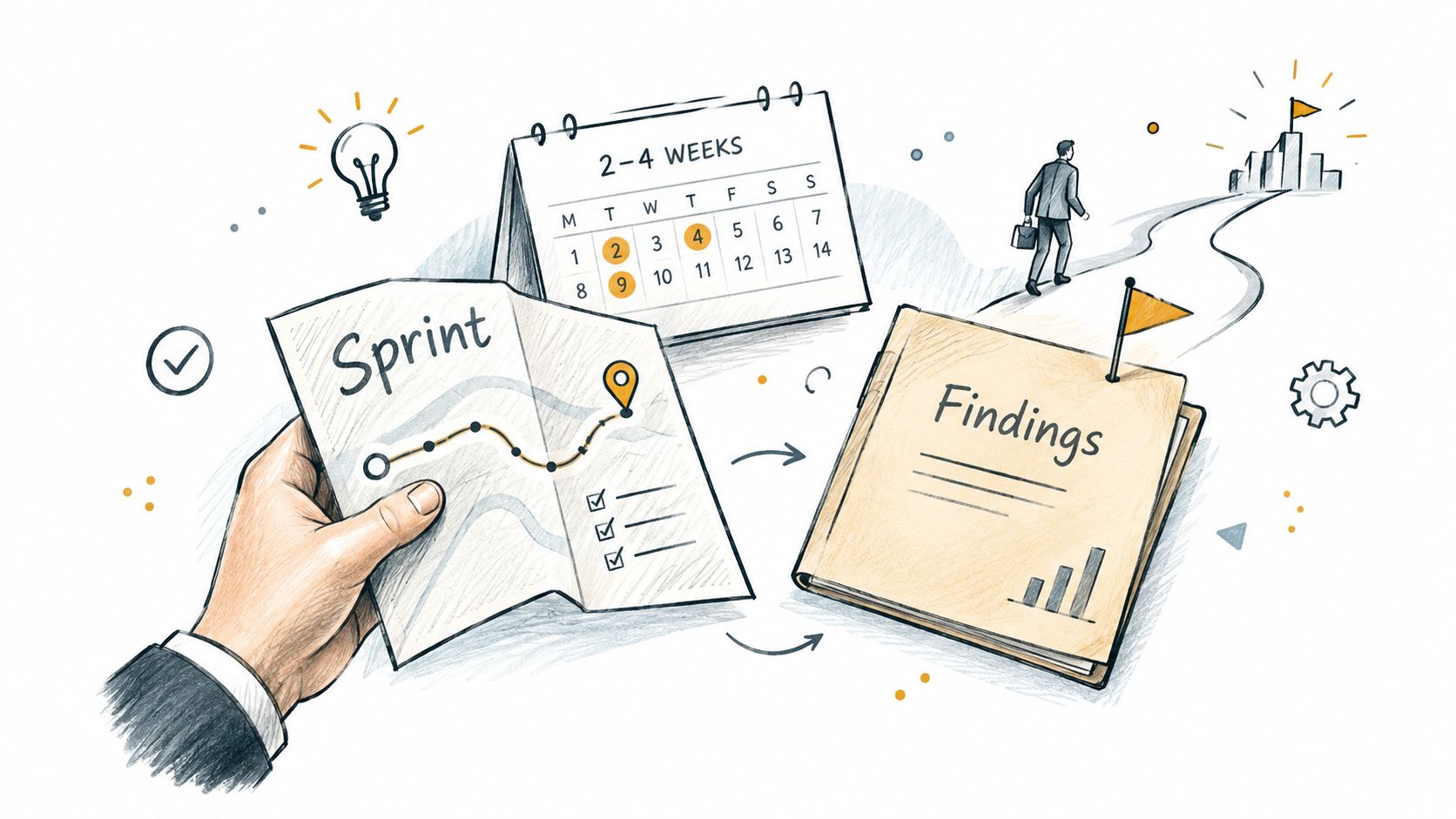
A diagnostic sprint turns an open-ended consulting conversation into a bounded decision. The buyer isn't committing immediately to a large transformation. They're approving a defined assessment with a clear start date, fixed fee, limited scope, and named deliverable.
For an operations consultancy, that might mean reviewing a sales handoff, interviewing key managers, mapping the current workflow, and delivering a prioritized improvement roadmap. For a strategy firm, it could end with a market assessment, investment recommendation, or go/no-go decision. The proposal should state the decision the sprint will inform in its first paragraph.
The format works best when the buyer recognizes a problem but doesn't yet trust the proposed solution enough to authorize a larger engagement. It also gives the consultant paid access to the facts needed for responsible recommendations. The trade-off is that a sprint creates a second buying decision. You must earn the implementation phase rather than assuming it will follow.
Build the decision into the delivery
Name the final output, the people involved, the information required, and the readout date. Schedule the readout before the sprint starts. That meeting becomes the expected point for reviewing findings and deciding whether implementation makes sense.
Add a credit policy if appropriate, applying part of the diagnostic fee to a larger engagement signed within an agreed period. This reduces the buyer's sense that the assessment is a dead end while protecting the value of the initial work.
Practical rule: The sprint proposal should sell clarity, not a disguised implementation project.
In Starward Navigators, create a proposal stage when the readout is scheduled. Trigger a reminder sequence for the readout, assign ownership for the follow-up recommendation, and record whether the next decision is implementation, additional discovery, or closed-lost.
2. Phased Engagement Proposal with Stage Gates
A phased proposal removes the decision to approve the entire project at once. Instead, the buyer approves a sequence such as Discover, Design, Implement, and Sustain, with a separate scope, fee, and approval point for each phase.
This structure suits transformation work, process redesign, technology implementation, and advisory programs where the next phase depends on evidence from the current one. Large consultancies commonly use steering committee gates, while Agile delivery uses recurring reviews to create similar decision points. The principle is simple: don't ask the client to trust an unknown future when you can define the next review clearly.
Write exit criteria for every phase. “Complete discovery” is too vague. A better criterion might require an agreed current-state map, validated priorities, named implementation owners, and an approved design decision. Objective criteria make the gate a business decision rather than a subjective impression of whether the consultant has done enough.
Pre-schedule every approval point
Put gate meetings on the calendar before the engagement starts. Include who attends, what evidence they'll review, what decision they must make, and what happens if they pause or reject the next phase.
The trade-off is administrative overhead. Stage gates require disciplined documentation and client availability. They also expose weak delivery earlier, which is precisely why serious buyers value them.
Use Starward's client onboarding workflow to connect the won opportunity to delivery ownership, kickoff scheduling, and phase-specific handoffs. In the pipeline, treat each gate as a distinct next step instead of leaving the entire engagement as one open deal.
3. Value-Based Fee Proposal
A value-based fee proposal removes the debate over hours and replaces it with a discussion about economic significance. The consultant prices the engagement around the outcome the client cares about, such as revenue retained, cost avoided, capacity released, or risk reduced.
Start discovery by asking what the problem costs the organization and how the client will recognize improvement. Don't quote a value-based fee if the buyer can't define the outcome or if the consultant can't influence it. A fractional commercial advisor might tie the engagement to a clearly agreed revenue or margin objective. An operations advisor might focus on avoidable rework, delayed decisions, or management capacity.
The proposal must distinguish client value from consultant effort. Explain the business problem, the relevant value metric, the assumptions behind it, the work required, and the review point where both parties will assess progress. This makes the commercial logic easier to defend internally.
Make the value testable
Record the agreed value metric in the proposal and repeat it at the close. If the client says the priority is faster decision-making, define how the team will observe that improvement. If the priority is cost control, document the baseline, the scope of influence, and the limits of the recommendation.
The trade-off is that value-based pricing requires stronger discovery and creates more scrutiny around assumptions. It can also fail when external factors dominate the result. Don't promise an outcome that depends on decisions, budgets, systems, or market conditions outside your control.
A useful proposal structure is:
- Business consequence: Explain what the unresolved problem affects.
- Value measure: Name the metric the client will use to judge progress.
- Consultant influence: State what your team controls and what it doesn't.
- Review method: Define when the value assumption will be tested.
4. Retainer and Fractional Advisory Proposal
A retainer proposal removes the need to reopen the relationship every time the client needs advice. The buyer purchases defined access, responsibility, or capacity on a recurring basis. The arrangement might support a fractional CFO, COO, CRO, or ongoing strategic advisor.
This model works when the client has a continuing management need but doesn't require a full-time executive or a new project for every issue. The proposal should describe the recurring operating rhythm, not just an allowance of hours. Include leadership meetings, reporting, decision support, escalation access, and the boundaries of the advisor's role.
A retainer becomes difficult to renew when the client can't see what happened during the period. Pair the agreement with a monthly activity summary or quarterly business review. Show decisions supported, priorities advanced, risks surfaced, and unresolved dependencies. Avoid turning the report into a timesheet unless time is the actual value the buyer purchased.
Protect capacity and expectations
State the monthly allowance, response expectations, meeting cadence, and what happens when requests exceed the agreed capacity. Clarify whether unused access expires, rolls forward, or converts into a separate project. Define which work requires a new statement of work.
The trade-off is commitment on both sides. The client gets continuity, but the consultant must maintain availability and demonstrate value consistently. A poorly bounded retainer becomes unlimited support, while an overly rigid one feels like a disguised hourly contract.
Use referral and nurture workflows after a strong business review. A satisfied retainer client often knows other leaders with similar needs, but referrals are more likely when you ask at a specific moment and make the introduction easy.
5. Paid Pilot or Proof-of-Value Proposal
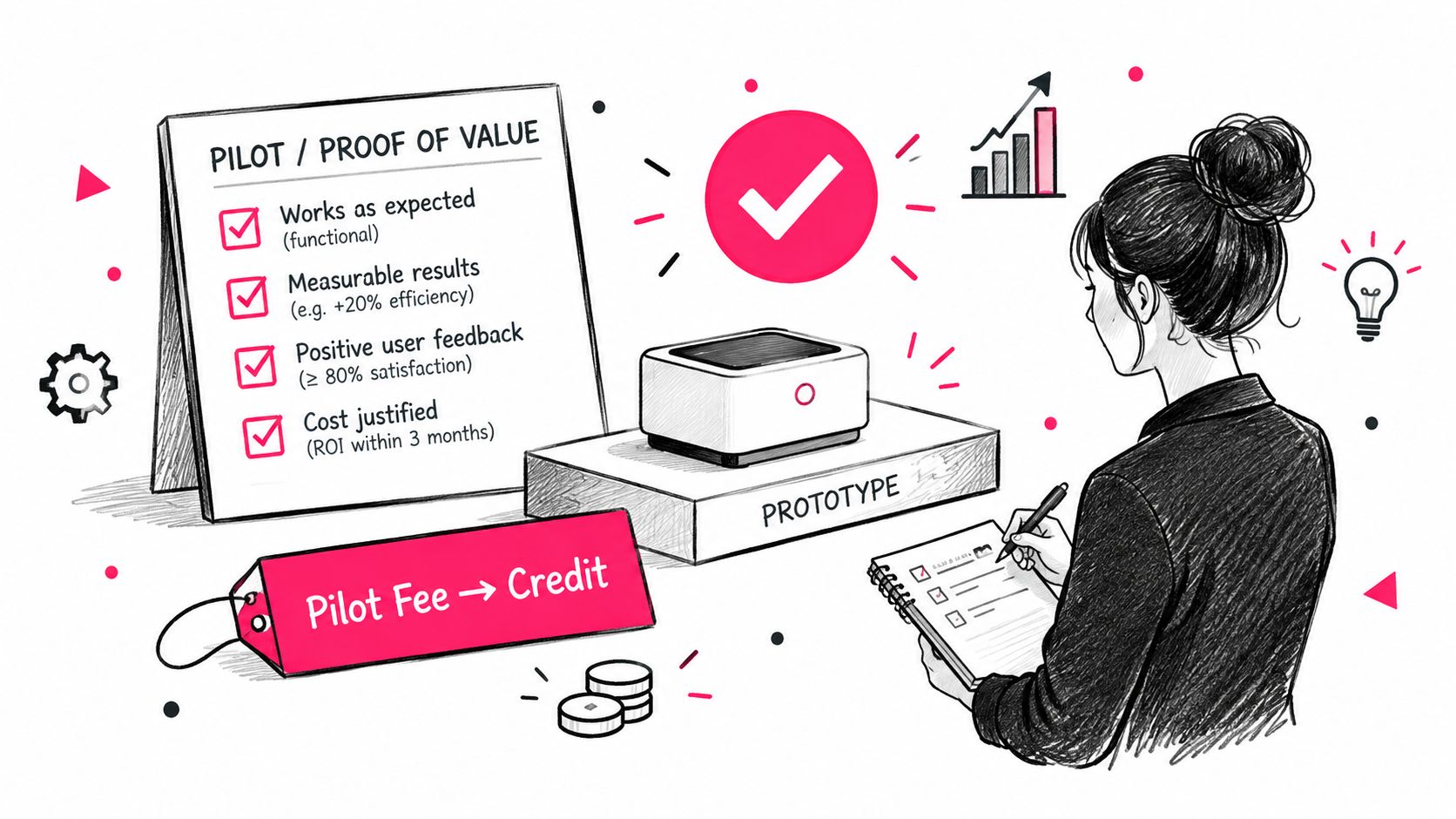
A paid pilot removes the buyer's need to accept a broad recommendation without evidence. The consultant tests the approach in a limited environment, with predefined success criteria and a decision date for expansion, revision, or closure.
A sales consultancy might pilot a qualification process with one team. An operations advisor might redesign one workflow before proposing wider adoption. A technology implementation partner might test one integration or department. The smaller scope lowers exposure, but it must still represent a meaningful use case.
Don't describe success with words such as “better,” “smoother,” or “more efficient.” Define what the client will observe, how it will be measured, who owns the measurement, and what result supports expansion. The pilot fee can be credited toward a larger engagement when the agreed criteria are met, provided the commercial terms are explicit.
Stop pilot drift
Set the decision date in the proposal and schedule the review before work begins. Assign a client owner, define the data needed, and specify what happens if the results are inconclusive. An inconclusive pilot isn't automatically a failure, but it must produce a decision about the next test, the revised scope, or the end of the work.
The trade-off is that pilots can become unpaid consulting if the scope keeps expanding. Limit the variables, document exclusions, and require a new approval for additional departments or processes.
After completion, create a one-page results summary with the original criteria, work performed, findings, and recommendation. That document can support the expansion proposal and become evidence for future opportunities, provided the client permits its use.
6. Outcome-Based or Performance-Linked Fee Proposal
A performance-linked proposal removes part of the buyer's concern that the consultant will be paid regardless of results. The client pays a base fee for the work, while an additional component depends on an agreed business outcome.
This model fits situations where the consultant has meaningful influence over the metric. A growth advisor may affect qualified pipeline creation. A cost transformation consultant may influence an approved savings program. A retention specialist may work within a defined customer segment and intervention plan.
The proposal must separate controllable inputs from shared outcomes. State the baseline, measurement method, reporting source, attribution rules, payment timing, minimum base fee, and cap. If the client changes pricing, staffing, budget, product, or strategy during delivery, explain how that affects the performance calculation.
Choose a metric that won't create conflict
Don't tie compensation to a result the consultant can't materially influence. A marketing advisor shouldn't accept full responsibility for revenue if sales capacity and pricing remain outside the engagement. A finance advisor shouldn't guarantee savings when the client controls implementation decisions.
The upside is strong alignment. The downside is measurement complexity and possible disputes about attribution. A performance component can also make forecasting harder for both parties. Use it when the metric is trusted, visible, and connected to the consultant's work.
Tie the success component to a shared measurement system, not a hopeful forecast.
Include a review schedule and a process for resolving data disagreements. The buyer should know exactly what will be counted, when it will be counted, and who will validate the result.
7. Mutual Action Plan Proposal
A mutual action plan removes the vague next step. It lists what the consultant and client must do, who owns each action, when it is due, and which decision follows. The proposal becomes a shared route from approval to kickoff instead of a document waiting for an answer.
Draft the plan during the proposal discussion. Ask the buyer to identify procurement, legal, finance, security, and executive approval requirements before sending the final document. These steps often sit outside the champion's control, so leaving them out creates false momentum.
Put both sides on the schedule
A useful plan might include proposal review, stakeholder alignment, commercial review, legal submission, signature, kickoff preparation, and the first delivery meeting. Each step needs an owner and a date. If the client can't commit to a date, record the dependency and decide whether the opportunity is active.
The trade-off is visibility. A mutual plan can reveal that the buyer has interest but no internal capacity, authority, or deadline. That may feel uncomfortable, but it prevents weeks of unproductive follow-up.
Use Starward's client onboarding template to connect the signed agreement to delivery tasks, owner notifications, and kickoff scheduling. Map each milestone to a pipeline stage and automated reminder so the plan remains active after the proposal is sent.
8. Decision-Focused Executive Summary Proposal
A decision-focused proposal removes the effort of extracting the recommendation from a long document. The first page states the problem, recommended approach, investment, expected outcomes, material risks, and decision requested. Supporting detail follows for stakeholders who need to validate the choice.
Write the executive summary last. That forces it to reflect the final scope rather than an early assumption from discovery. End with one decision request, such as approval of the first phase by an agreed date. Don't give the client several competing calls to action.
The summary must be useful to people who weren't in the discovery meeting. Include the context they need to understand why the recommendation matters, but don't fill the page with consultant biography or generic claims. A finance reviewer needs commercial logic. An operational owner needs responsibilities and dependencies. An executive sponsor needs the business consequence and strategic fit.
Make forwarding safe
Assume the champion will send the summary to colleagues without adding your verbal explanation. Use plain language, define specialist terms, and state what the client must provide. Add a short section titled “What would change this recommendation?” when assumptions or dependencies could affect the decision.
Track whether the proposal was opened, reviewed, or forwarded when your proposal system supports those signals. A viewed proposal without a meeting should trigger a concise value summary and scheduling prompt. An untouched proposal should create an internal task for the owner rather than an automatic stream of irrelevant messages.
This model has a clear trade-off. A short first page can accelerate review, but oversimplification can hide important conditions. Put the complexity in appendices and link each major assumption to the supporting detail.
9. Referral Partnership Proposal
A referral partnership proposal removes uncertainty from an informal relationship. It defines which clients the partner should introduce, what happens after an introduction, how the referral is acknowledged, and what benefit the partner receives.
Accountants, attorneys, bankers, implementation specialists, and association leaders may encounter your ideal clients before you do. A formal proposal gives them a safe way to refer. Describe your qualification criteria, response process, communication boundaries, privacy expectations, and follow-up responsibilities.
The partner benefit might be a permitted referral fee, a reciprocal introduction, co-marketing, or a useful resource for their clients. Confirm professional and jurisdictional rules before offering compensation. Some industries impose restrictions that make a simple commission inappropriate.
Treat the referrer as a relationship
Send a status update after an introduction, even when the lead isn't qualified. Tell the partner whether you've made contact, whether the need is a fit, and whether further action is required. Don't expose confidential client details or make the referrer chase you for basic confirmation.
The trade-off is that referral channels require consistent care before they produce repeat opportunities. A partner who sends one introduction and receives no acknowledgment won't keep recommending you. Track the relationship separately from the referred opportunity so you can nurture both.
Use Starward's referral tracking guidance to structure partner stages, thank-you messages, qualification updates, and ongoing nurture. Record the original source accurately so you can see which relationships create conversations and which need attention.
10. Strategic Alliance or Co-Delivery Proposal
A co-delivery proposal removes the buyer's concern that one specialist can't cover the full problem. Two complementary firms present one coordinated solution, with clear ownership for each workstream.
A go-to-market advisor might partner with a finance specialist. A technology consultancy might work with an implementation firm. A boutique operations practice might bring in a legal or compliance specialist for a mandate that requires both process expertise and regulatory knowledge.
The proposal must make the joint team feel like one delivery operation. Show who leads the relationship, who owns each deliverable, how decisions are made, how issues are escalated, and how the client receives updates. Explain whether the client receives one invoice or separate invoices, and document the revenue-sharing arrangement between firms.
Agree before you sell together
Settle lead responsibility, decision rights, delivery standards, confidentiality, intellectual property, dispute resolution, and client communication before submitting the proposal. Don't use the client opportunity to discover whether the partners can work together.
The trade-off is expanded capability at the cost of coordination. A second firm can improve the solution, but it also introduces another schedule, quality standard, and commercial relationship. Choose partners whose delivery quality and client expectations match yours.
After the first successful engagement, publish a shared case study only with permission. It should explain the client problem, the combined approach, each firm's contribution, and the decision the work enabled. That gives future buyers a clearer reason to select the alliance.
Comparison of 10 Proposal Models
| Proposal | 🔄 Implementation complexity | ⚡ Resource requirements | 📊 Expected outcomes | 💡 Ideal use cases | ⭐ Key advantages |
|---|---|---|---|---|---|
| Fixed-Fee Diagnostic Sprint Proposal | Low–Medium, defined scope & short timeline; risk of scope creep | Small team, client interviews, data access, scheduled readout | Diagnostic report, prioritized roadmap, go/no‑go recommendation | Solo consultants / boutique firms testing new accounts or hesitant prospects | Low-risk entry for buyers; demonstrates expertise; natural upsell path |
| Phased Engagement Proposal with Stage Gates | Medium–High, sequential phases and formal gates | Cross‑functional team, stakeholder sign‑offs, milestone billing | Phased deliverables, controlled transitions, regular checkpoints | Multi‑month transformations, advisory firms with complex programs | Limits commitment per phase; review points; improves cash flow |
| Value-Based Fee Proposal | Medium, requires rigorous discovery and credible valuation | Deep discovery, financial analysis, measurable outcome metrics | Fee tied to quantified ROI; alignment on business value | Independent advisors with measurable business problems | Higher margins; shifts discussion to return; aligns incentives |
| Retainer and Fractional Advisory Proposal | Low–Medium, ongoing management and relationship discipline | Recurring capacity, reporting, quarterly reviews, escalation terms | Predictable monthly revenue, deeper client insight, ongoing support | Fractional executives, advisors seeking stable recurring revenue | Predictable revenue; easier capacity planning; expansion opportunities |
| Paid Pilot or Proof-of-Value Proposal | Low–Medium, short, tightly scoped test with exit criteria | Small pilot team, client operational involvement, measurement tools | Evidence of value, internal champions, pilot-to-scale path | Risk‑averse or first‑time buyers needing proof before scale | Builds evidence quickly; shortens sales cycle; produces references |
| Outcome-Based / Performance-Linked Fee Proposal | High, needs baselines, measurement, legal clarity | Strong data systems, agreed measurement method, caps/floors | Shared upside; bonus tied to performance; potential premium fees | Experienced advisors confident in influencing metrics | Strong alignment with outcomes; differentiates firm; can justify higher fees |
| Mutual Action Plan Proposal | Low–Medium, joint plan requires upkeep and coordination | Time to map owners, dates, procurement steps; tracking tools | Reduced stalls, visible accountability, clearer approval path | Long or committee‑driven buying cycles; BD leaders | Reduces stalled proposals; exposes hidden stakeholders; clarifies next steps |
| Decision-Focused Executive Summary Proposal | Low, disciplined one‑page decision-first structure | Senior‑level synthesis, appended details, proposal tracking tools | Faster C‑level approvals; clear decision request up front | Sellers targeting C‑level or board decision makers | Speeds decisions; easy to forward internally; reduces misunderstandings |
| Referral Partnership Proposal | Low–Medium, depends on compliance and partner processes | Partner management, tracking & acknowledgement systems, compensation admin | Lower‑cost, higher‑trust leads; repeatable acquisition channel | Advisors with professional networks; independent consultants | Scales through partners; high‑trust leads; cost‑effective acquisition |
| Strategic Alliance / Co‑Delivery Proposal | High, joint governance, revenue split, and IP considerations | Partner coordination, legal agreements, combined delivery teams | Broader solution scope, shared pipeline access, larger bids | Boutique consultancies pursuing larger or multi‑discipline engagements | Wins larger deals; fills capability gaps; shares BD effort |
Matching the Proposal Model to Your Next Deal
Choose the proposal model by asking which decision is blocking the buyer. If the client agrees that a problem exists but doesn't know what to do, use a fixed-fee diagnostic sprint. If the work is complex and the buyer fears committing too early, use a phased engagement with stage gates. If the buyer needs proof in a limited environment, use a paid pilot.
Match the model to the relationship stage. New accounts usually need a smaller first commitment, a clear diagnostic, or a decision-focused summary that helps the champion build internal confidence. Existing clients may be ready for a retainer, fractional leadership role, or performance-linked arrangement because the working relationship already provides context and trust.
Match it to the size and controllability of the problem. Use value-based fees when the economic value is clear and your contribution can be evaluated. Use outcome-linked fees only when the metric, baseline, data source, and attribution rules are trusted by both sides. Don't introduce complicated commercial mechanics just to make a proposal look new.
The proposal itself is only one stage in the buying process. Research cited by 6sense's 2025 buyer study summary reported that 95% of purchases went to a vendor on the buyer's day-one shortlist, compared with 85% the previous year. The same summary said complex B2B buying groups commonly include 10 or more stakeholders, particularly for deals averaging approximately $250,000. That means your proposal needs to reinforce the reputation, discovery, referrals, and stakeholder alignment that came before it.
Proposal production also consumes real delivery capacity. Published benchmark summaries report an average response time of approximately 33 hours, with larger organizations requiring 39 or more hours, while another industry source reported that 41% of APMP members achieve proposal win rates above 50%. Treat these as benchmarks, not guarantees. Qualification, ownership, and follow-up protect the time your team invests.
Start with one model this week. Choose a live opportunity, rewrite the proposal around the decision that remains unresolved, and add a mutual action plan with dated steps, owners, procurement requirements, and a scheduled decision meeting. Then track the opportunity from discovery through proposal delivery, follow-up, and outcome instead of treating “sent” as the end of the process.
Starward Navigators provides client acquisition infrastructure for consulting and advisory firms, including proposal tracking, automated follow-up, appointment reminders, referral workflows, and client handoffs. Visit Starward Navigators to connect your proposal process to the next accountable decision.