
Leads reached within one minute have a 78% contact rate, compared with 48% after 5–30 minutes and 22% after 1–24 hours, according to a referral-conversion benchmark roundup. That reframes the question: how long does a referral take? For a consulting firm, the time needed to win the engagement matters, but so does the time you take to start the conversation.
Those are different clocks. You can respond promptly and still wait months for a commercial decision. You can also deliver excellent work and lose the opportunity before discovery because nobody owned the introduction.
Table of Contents
- The Two Stages of a Referral Timeline
- Why the First Hour Changes Everything
- The Factors That Stretch the Timeline
- Two Referrals Compared
- Nurture Workflows That Keep Warm Referrals Warm
- Tracking Status Instead of Guessing Dates
- The Operating Standard for Referral Speed
- Practical Changes to Make This Week
The Two Stages of a Referral Timeline
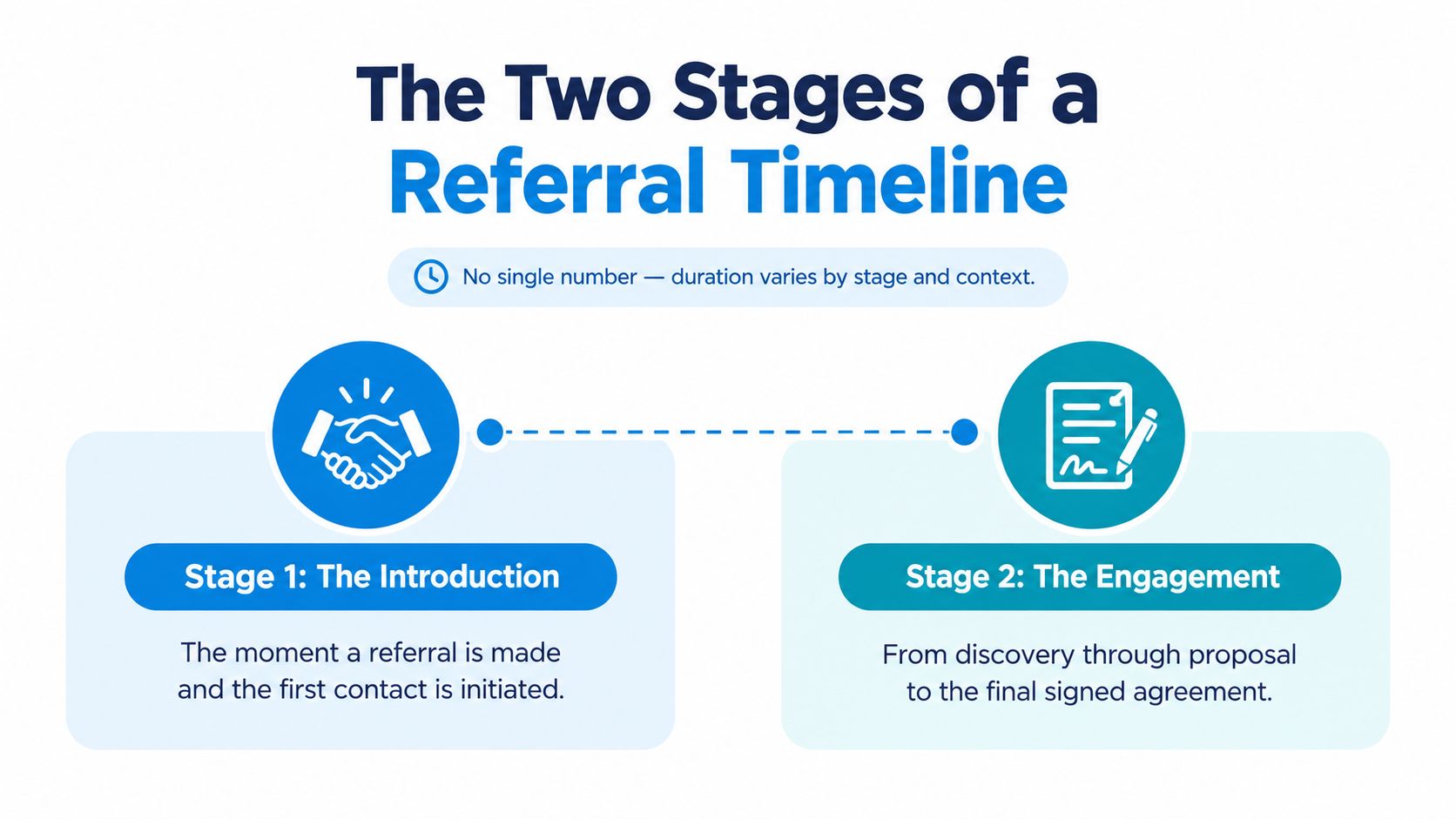
A referral isn't a single event with a predictable completion date. It's an introduction followed by a buying process, and each requires a different operating discipline.
The first-contact window covers receipt, acknowledgment, assignment, and the attempt to arrange a conversation. Your firm controls most of that work. The decision window covers discovery, scope, proposal review, stakeholder agreement, and contracting. You influence that process, but you don't control the buyer's calendar or authority.
The distinction matters because a fast acknowledgment isn't a qualified opportunity, and a qualified opportunity isn't a signed agreement. Reporting them as one measure hides where your team needs to intervene.
Set Expectations Around the Commercial Milestone
A professional-services referral benchmark places consulting and legal sales cycles at approximately 30–180 days, estimates that structured nurturing converts an additional 10–18% of otherwise inactive warm introductions, and reports signing within 90 days at 18–24% for weak digital presence, 38–48% for active presence, and 52–65% for strong digital credibility combined with systematic follow-up.
Treat those figures as directional benchmarks, not a forecast for an individual referral. They distinguish both elapsed time and the conditions surrounding conversion. They don't establish that changing a website alone causes an engagement to close.
For a small advisory firm, the practical implication is to separate response performance from commercial progress. A prompt reply demonstrates attention. Discovery establishes whether there's a problem worth solving. A proposal makes the buying decision concrete.
Practical rule: Before asking when a referral will close, ask which milestone you're measuring and who owns the next action.
That changes the management conversation. Instead of pressing a consultant for an arbitrary closing date, you can ask whether the prospect has confirmed the problem, whether the budget owner is involved, and whether a decision conversation is scheduled.
Why the First Hour Changes Everything
The prospect is often easiest to engage while the introduction is still fresh. They remember why the referrer connected you, have the problem in mind, and may be actively reviewing their options. Delay gives competing priorities room to interrupt.
A speed-to-lead review citing Harvard Business Review research reports that, among 2,241 U.S. companies, firms responding within one hour were nearly seven times more likely to qualify a lead than firms waiting an additional hour; firms waiting 24 hours or longer were more than 60 times less likely to qualify it.
That's evidence about qualification, not signed consulting engagements. Use it to justify urgency at intake, not to promise rapid sales.
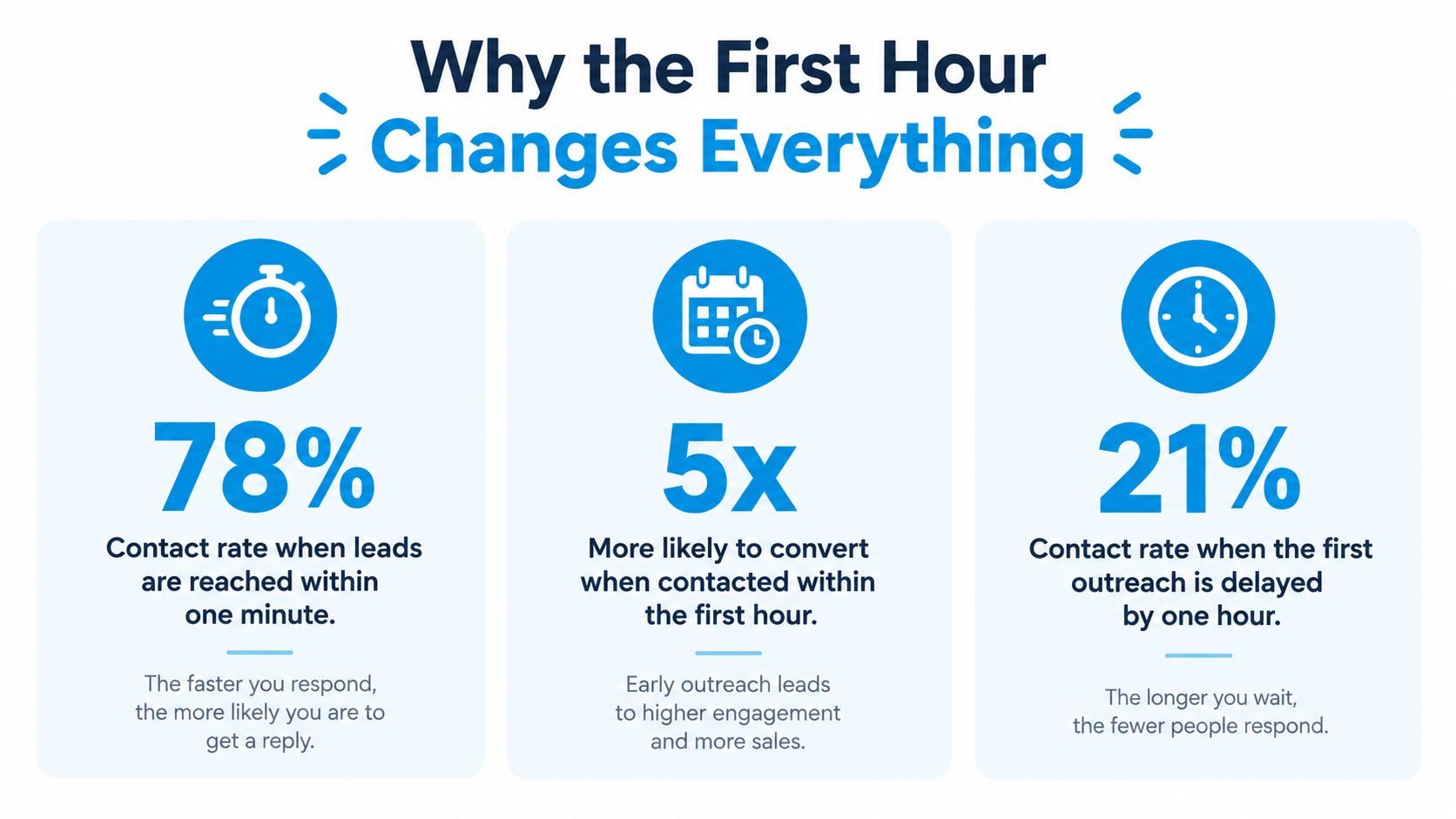
Use the illustration as a reminder about response urgency, not as a statistical reference. The linked benchmarks in the text are the basis for the operating guidance.
Make the Response Useful, Not Merely Fast
- Capture the introduction immediately. Create an opportunity record from the email, website form, or direct message. Preserve the referrer's name and the prospect's stated need, rather than leaving context in a partner's inbox.
- Assign a responsible person. Routing must produce a named owner and a backup. Sending notifications to everyone doesn't establish accountability.
- Acknowledge without overcommitting. Confirm receipt and identify who will respond. Don't promise availability, commercial fit, or specialist expertise before someone checks.
- Offer a concrete next step. The personalized reply should reference the introduction, confirm the relevant problem, and offer a scheduling option. Record what happens if the prospect doesn't answer.
An automated acknowledgment can cover intake while the appropriate consultant is in a client meeting. It can't replace a considered response.
The trade-off isn't speed versus professionalism. It's fast administrative handling versus rushed professional judgment. Automate the former, protect time for the latter, and make sure the prospect can tell someone has taken responsibility.
The Factors That Stretch the Timeline
Once the conversation starts, faster emailing won't resolve every delay. A buyer may need internal approval, a clearer scope, or confidence that your firm can deliver. Diagnose the constraint before deciding that more follow-up is the answer.
Relationship strength affects what the introduction carries. A trusted adviser who understands the prospect's problem can provide useful context. A casual acquaintance may provide little more than permission to make contact. Ask what prompted the referral instead of assuming enthusiasm equals readiness.
Decision complexity changes the work required. A founder considering fractional finance support may make the decision personally. A broader advisory engagement may involve finance, operational leaders, procurement, and legal review. Identify who approves the work and who can block it.
Referral Speed Levers at a Glance
| Factor | What Slows It | Typical Effect | Operational Response |
|---|---|---|---|
| Relationship strength | Referrer hasn't confirmed the need | More context-building before discovery | Clarify the reason for the introduction |
| Decision complexity | Approvers remain unidentified | Repeated conversations without agreement | Map the sponsor, approver, and reviewers |
| Purchasing norms | Buyer requires formal vendor review | Administrative dependencies before contracting | Ask about procurement early |
| Proposal value | Scope or commitment feels difficult to justify | More scrutiny of outcomes and risk | Make deliverables, boundaries, and assumptions explicit |
| Digital credibility | Public information doesn't support the introduction | Prospect needs additional reassurance | Keep service information and practitioner credentials current |
Industry purchasing norms deserve attention during discovery, not after proposal acceptance. Ask whether the buyer needs supplier registration, security review, insurance documentation, or a particular contract format. Treat the answers as dependencies to manage, not objections to overcome.
Proposal value is about commitment as well as price. An engagement that changes responsibilities across the business needs a stronger explanation than a narrowly scoped advisory assignment. Sending a proposal early can backfire if the sponsor can't explain it internally.
Finally, digital credibility supports the trust transferred by the referrer. The conversion bands noted earlier make this worth examining, but the operating response is specific: make your services understandable, show relevant practitioner experience, and remove contradictions between your proposal and public positioning.
When a referral stalls, identify the unresolved decision. Another reminder isn't a substitute for answering it.
Two Referrals Compared
Consider these illustrative scenarios, not reported client cases. Both begin with a trusted adviser introducing a business owner to a fractional CFO firm. The introduction quality is comparable; the firms handle it differently.
At the first firm, the relationship manager acknowledges the connection and assigns a consultant. Before discovery, the consultant reviews the introduction and asks what prompted the search. The owner explains that finance reporting isn't supporting operational decisions.
The consultant explores the problem, identifies who needs to approve the engagement, and checks the purchasing process. The proposal reflects those answers and arrives with a scheduled discussion, not an invitation to get in touch whenever convenient.

Where the Other Referral Loses Direction
At the second firm, the introduction remains in a partner's inbox until someone notices it. A discovery conversation eventually happens, but nobody records the approval process. The consultant sends a proposal and assumes the owner's initial enthusiasm will carry it forward.
When the owner goes quiet, the team can't distinguish internal review from loss of interest. Follow-up asks whether there are any updates, without addressing scope, stakeholder concerns, or the decision itself. The opportunity remains open administratively but has no actionable next step.
| Operating Difference | Better-Controlled Referral | Referral at Risk |
|---|---|---|
| Intake | Named ownership | Informal inbox handling |
| Discovery | Approval path established | Interest mistaken for authority |
| Proposal | Discussion agreed before sending | Document sent without a decision plan |
| Silence | Reason investigated | Repeated generic reminders |
The first scenario doesn't guarantee a win. The buyer can still choose another provider or postpone the project. What the firm gains is visibility: it can distinguish a genuine commercial loss from an opportunity it neglected.
Review your own referrals that way. Find the earliest missed handoff, not just the final unanswered email.
Nurture Workflows That Keep Warm Referrals Warm
Referral nurture should preserve the context of the introduction. A prospect connected by a trusted adviser shouldn't receive the same generic sequence as someone who downloaded a checklist.
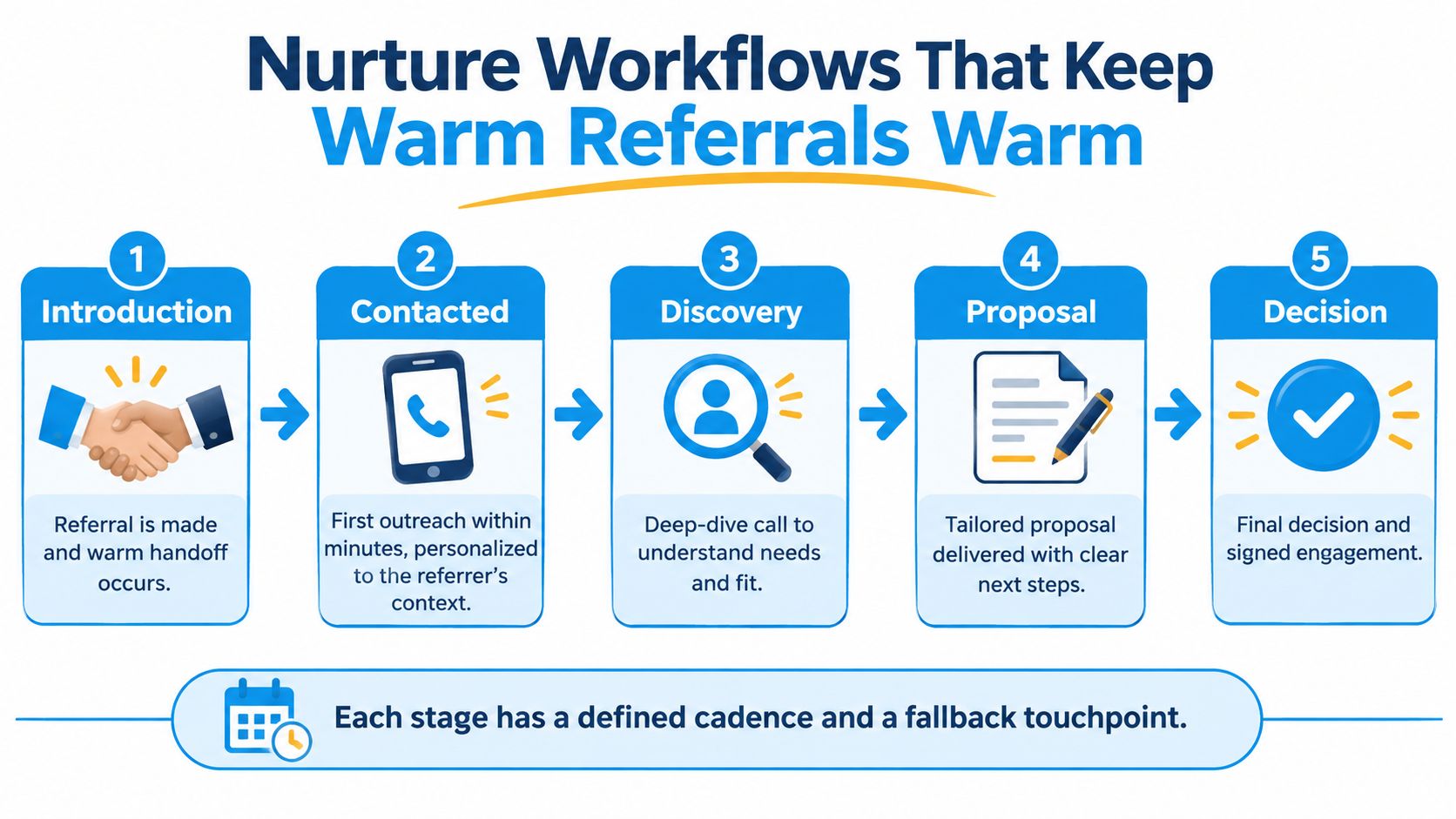
The benchmark discussed earlier gives a reason to invest in the quiet middle of the buying process. The operational task is to stay relevant without turning follow-up into pressure. That requires recorded context, stage-specific messages, and a way to stop automation when a person replies.
Build Around the Buyer's Last Commitment
Use explicit stages: introduction, contacted, discovery, proposal, decision, and won/lost. Advancement should reflect something that happened, not a consultant's optimism. A sent email doesn't prove contact, and a drafted proposal doesn't mean the buyer is evaluating it.
- Record the buying context. Save the problem, the referrer, the prospect's timing, and the last agreed action. The next consultant shouldn't need to reconstruct the conversation.
- Schedule reminders around commitments. If the prospect is waiting for an internal meeting, follow up around that event. When no date exists, create an internal review reminder rather than allowing indefinite silence.
- Send something useful. A scope clarification, implementation outline, or relevant service explanation can help the buyer resolve a question. Don't send content merely to satisfy a sequence.
- Escalate with purpose. Ask a partner to intervene when relationship context or decision authority is missing. Avoid escalation that adds another person asking for an update.
Follow-up automation can support reminders and stage-based sequences. An ordinary CRM with tasks can also work, provided someone owns exceptions and replies stop inappropriate scheduled messages.
Know When to Pause
A prospect who explicitly postpones should move into a timing-based nurture path. A prospect who declines should leave the active sales sequence. Silence deserves investigation, but it doesn't justify endless outreach.
Relationship safeguard: Ask the referrer for context when appropriate, not to pressure the prospect into responding.
Before marking a referral inactive, document the reason and the condition for reopening it. That preserves useful relationship knowledge without inflating the active pipeline.
Tracking Status Instead of Guessing Dates
A date without a milestone can be misleading. Does the prospect want to know when you'll respond, when discovery can happen, or when an engagement can begin? Each question needs a different answer.
Healthcare referral reporting illustrates the distinction without providing a consulting forecast. NHS England's referral-to-treatment report records a median wait of 11.3 weeks and a 92nd-percentile wait of 38.3 weeks at the end of March 2026. Those figures describe a treatment pathway, not merely confirmation that a referral arrived.
For consulting, use the same milestone discipline while keeping the business process distinct.
Give Every Stage an Exit Condition
| Current Status | Evidence Needed to Advance | Default Next Action |
|---|---|---|
| Introduction received | Responsible consultant assigned | Review context and respond |
| Contact established | Prospect agrees to discovery | Arrange the conversation |
| Discovery completed | Fit and purchasing path understood | Resolve gaps before proposing |
| Proposal under review | Buyer confirms decision process | Address questions and coordinate review |
| Decision pending | Acceptance, rejection, or postponement | Record outcome and arrange the appropriate handoff |
Each record also needs an owner, expected window, and next-action date. Set the window from buyer commitments where possible. Internal targets should remain clearly labeled as targets, not promises.
A practical referral-tracking approach makes these distinctions visible instead of burying them in email history. Review stage age alongside the last meaningful interaction, because an old opportunity with an agreed future decision can be healthier than a recent proposal nobody acknowledged.
Status visibility won't shorten a buyer's procurement process. It will help your team identify when waiting is reasonable and when somebody needs to act.
The Operating Standard for Referral Speed
A workable referral standard shouldn't depend on the most conscientious partner remembering everything. It should survive client meetings, leave, and changes in ownership.
Separate service commitments from commercial targets. Your team can commit to intake handling and communication. Discovery availability depends on both calendars, and proposal readiness depends on adequate scoping. A signing date depends on the buyer as well as your firm.
Design for Ordinary Working Conditions
- At intake, use automated capture and routing to support the acknowledgment standard established earlier. Add backup ownership for absences.
- During qualification, require evidence of fit and purchasing authority before investing heavily in a proposal.
- During review, make outstanding questions and agreed actions visible to the person responsible for the opportunity.
- At the outcome, distinguish won, lost, and postponed so delivery handoffs and future nurture don't get mixed together.
These controls can run through a configured CRM and calendar workflow or through dedicated referral-management infrastructure. The choice depends on whether your team can reliably maintain the rules, integrations, and exceptions itself.
Don't confuse a feature-rich tool with a functioning process. A simple system with enforced ownership is preferable to an elaborate pipeline nobody updates.
The operating objective is no unexplained inactivity. A buyer can reasonably need more time. Your firm should still know why it's waiting, what event changes that status, and who checks when that event occurs.
Practical Changes to Make This Week
Start with the gaps your team can observe. Don't redesign the entire acquisition process before fixing introductions that never become assigned opportunities.
- Connect every intake channel. Check website forms, shared inboxes, LinkedIn messages, and event introductions. Measure receipt-to-assignment time to expose routing delays.
- Test the acknowledgment workflow. Submit a referral through each channel and verify that the prospect receives confirmation and the responsible consultant gets the context.
- Require a next action at every stage. Review records that lack an owner, a due date, or a clear buyer commitment. Resolve those omissions before adding more outreach.
- Replace generic nurture messages. Tie follow-up to the prospect's problem, outstanding question, or stated timing. Track substantive replies rather than treating sent emails as progress.
- Examine recent lost referrals. Identify the earliest point where your team stopped managing the process. Separate poor fit, buyer postponement, and competitor selection from missed follow-up.
Choose a corrective action for the most common failure and assign someone to verify that it works. Otherwise, a pipeline review becomes another conversation without a next step.
The useful answer to how long does a referral take isn't an isolated average. It's a clear account of where the referral stands, what remains unresolved, and what your firm will do next.
Starward Navigators provides client acquisition infrastructure for small consulting and advisory firms, including prebuilt pipelines, automated follow-up, appointment reminders, proposal tracking, and referral relationship workflows. Visit Starward Navigators to explore an operating system that connects prompt referral intake with accountable follow-through to the commercial decision.