
A referred CFO lands in one partner's inbox on Friday night. The other partner owns that service line, and neither of them can see the thread. By Monday lunch the prospect has booked a competitor who answered over the weekend.
That is the usual break in a two-to-twenty-person advisory firm. The database is not empty. The decisions are. A CRM record is complete when someone else can act without asking the original owner what happened, who owns the next call, or when the proposal expires.
CRM best practice here is a minimum viable record, enforced at each stage change. Automate the logistics and the accountability. Leave judgment to a named person. Copy one live pipeline into the table below before you buy or reconfigure software.
Table of Contents
- Minimum Records and Response Rules by Stage
- How to Capture and Route Every Inbound Lead
- Stage Gates That Keep the Pipeline Honest
- Automate Logistics and Keep Judgment Human
- How to Track Proposals and Hand Off Clients
- Referral Partners Who Keep Sending Work
- Install One Operating System This Month
Minimum Records and Response Rules by Stage
Use this table as the standard. A stage cannot advance while a required cell is blank. A contact with no next step is not a managed opportunity.
| Stage | Required fields | Owner | Next action that must exist |
|---|---|---|---|
| New lead | Source, service line, contact method | Named seller by service line, territory, or round robin | Human follow-up inside 5 minutes in business hours |
| Discovery | Problem, buying-committee contacts, fit | Discovery owner | Dated next step before the call ends |
| Proposal | Value, decision date, decision makers | Proposal owner | Scheduled follow-up through the decision date |
| Client handoff | Scope, kickoff date, delivery owner | Delivery owner notified at Won | Kickoff booked and delivery pipeline started |
| Referral partner | Last introduction, thank-you status, relationship stage | Relationship owner | Next nurture or thank-you date |
How to read a row
A new lead needs the source, the service line, the contact method, and a named seller. The first human response is due inside five minutes during business hours. Source stays on that row, not in a side sheet, because routing and later reporting both depend on it. In 2024, 45% of global CRM leaders surveyed by SugarCRM said capturing intent data or using lead scoring was a higher priority than five years earlier. Fit and source belong on the lead, where the owner can see them.
A discovery record needs the problem in the client's words, every buying-committee contact, and a fit note. The next step is dated before the call ends. If the call closes with "we'll send something," the stage has not moved.
A proposal needs value, a decision date, and the people who decide. Follow-up is scheduled through that date, under one proposal owner. A PDF in a sent folder, with no date and no owner, is a hope.
A client handoff needs scope, a kickoff date, and a delivery owner who has already been notified. Kickoff is booked and the delivery pipeline has started. Sales does not close the file by messaging delivery in chat.
A referral partner needs the last introduction, whether the thank-you went out, the relationship stage, and the next nurture or thank-you date. One relationship owner holds the row.
Practical rule: If a colleague cannot take the next action from the record alone, the record is not done.
Only decision-critical fields are mandatory. Extra biography creates friction and gets skipped. Open your current pipeline this week and drop every live deal into these rows. Blank cells are the work. Software comes after the blanks are visible.
How to Capture and Route Every Inbound Lead
A lead that arrives at 4:50 p.m. on Friday is not a lead until the record carries a source, a service line, and a named owner. Set that standard for every channel: website form, shared inbox, LinkedIn message, event conversation. The channel changes the capture path. It does not change the minimum viable lead record.
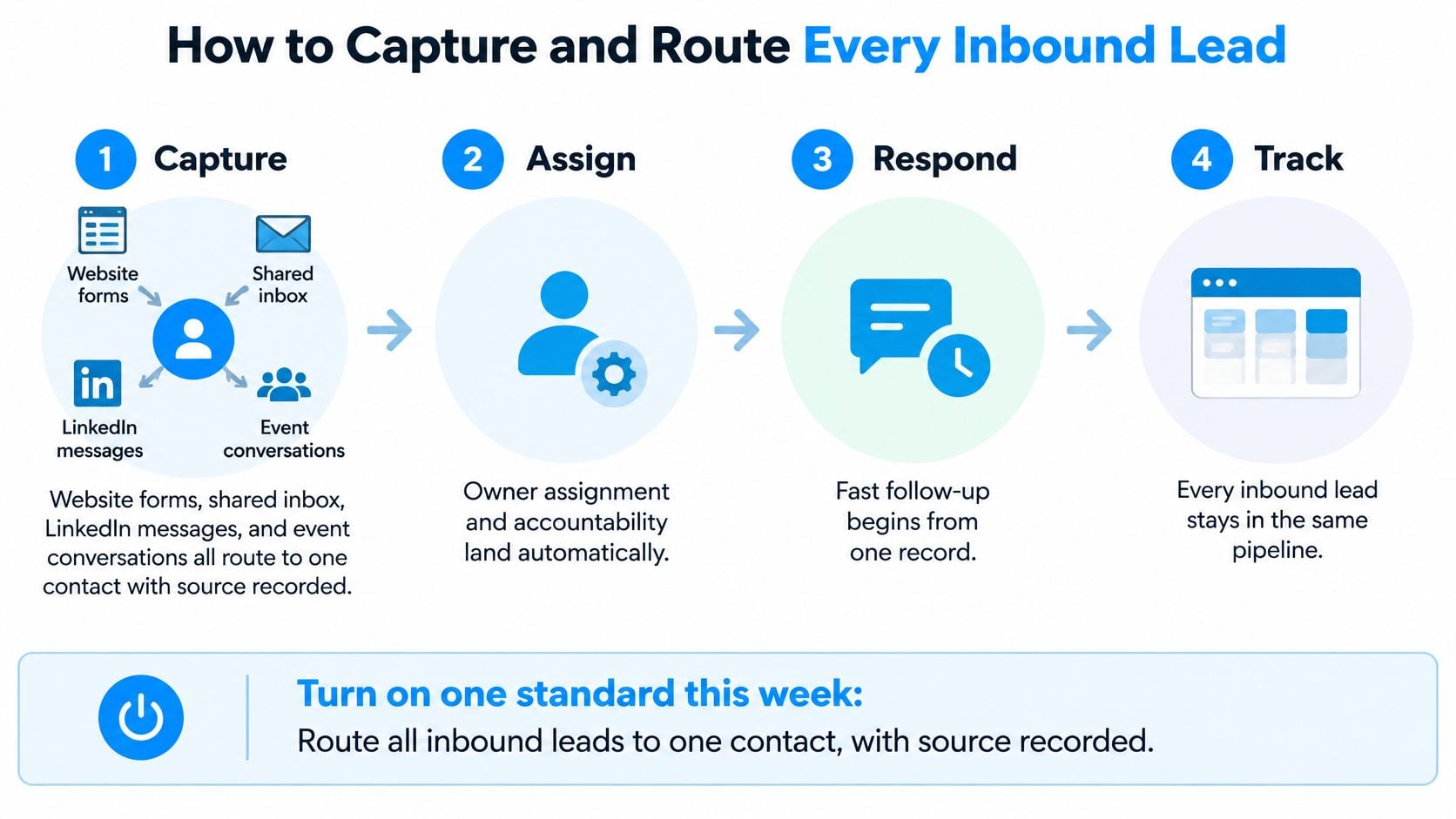
Capture one contact with the first-touch facts. Every inbound path should create or update a single contact. Required fields are narrow: source, the page or person that sent the inquiry, service line, and owner. Forms can connect to the website the firm already runs, or they can be built on the Sites tools included in every plan. If a channel cannot populate those fields, route it to a triage queue rather than to a salesperson.
Assign an owner on arrival. Use service line, territory, or round robin. No record stays unassigned. An unassigned lead has no response clock because no one is accountable for the first move. The routing rule should fail closed: if the owner field is blank, it alerts the operations lead.
Separate the acknowledgement from the human response. Send a short note that a person will follow up. Create the follow-up task on the owner with a due time. Count the automated note as logistics. Count only the human task as the response. A bot that imitates a partner damages trust faster than a slow, honest reply.
Escalate unworked records during business hours. At five minutes, ping the owner. At 30 minutes, ping the owner and a partner. Use business-hours clocks, not elapsed time. A Friday 6 p.m. form is not late at 6:05 p.m. It is late if it is still open at 9:05 a.m. Monday.
Review the queue weekly by exception. Median first-response time, share contacted within five minutes, qualification rate, and conversion by source. Pull the Agent Report, Appointment Report, Attribution Report, and Call Report if you use Starward's reporting. Averages hide the slow tail, and a strong website number can conceal event and LinkedIn leads. Review by source and by owner.
Why the clock is an SLA
Research summarized by Vida, covering about 2,241 U.S. companies, found that only 37% responded to web leads within one hour. Firms that contacted a lead within one hour were nearly seven times more likely to qualify it than firms waiting an additional hour, and more than 60 times more likely than firms waiting at least 24 hours. A separate analysis in that same write-up found conversion more than eight times higher when the first attempt was inside five minutes.
Use those numbers to justify the five-minute and 30-minute escalations. Do not paste them into a slide as a target. Automate routing, the acknowledgement, and the escalation. Keep a named human on the follow-up task, because qualification is a judgment call and a form submission is not a decision.
Traps that hide a slow queue
Median, not average: one fast website reply can mask a two-day LinkedIn message.
Business hours, not elapsed time: the Monday morning queue is the true test of an after-hours form.
Source by source: event and LinkedIn leads often sit behind a healthy website average.
Before a form goes live, run GDPR-first email checks for signup flows so mistyped or non-consenting addresses never enter the contact record. Pair that with a clear source field, then point new subscribers into a lead path built for email rather than a separate list nobody owns.
Run a two-week pilot on one form and one owner. Keep an exception log: unassigned records, automated-only contacts, and after-hours math. Fix the log before adding a second channel.
Stage Gates That Keep the Pipeline Honest
Hygiene is stage design, not a quarterly cleanup day. A boutique advisory firm can run six stages and no more: New lead, Qualified, Discovery, Proposal out, Decision, and Won (handoff). Each gate is one sentence.
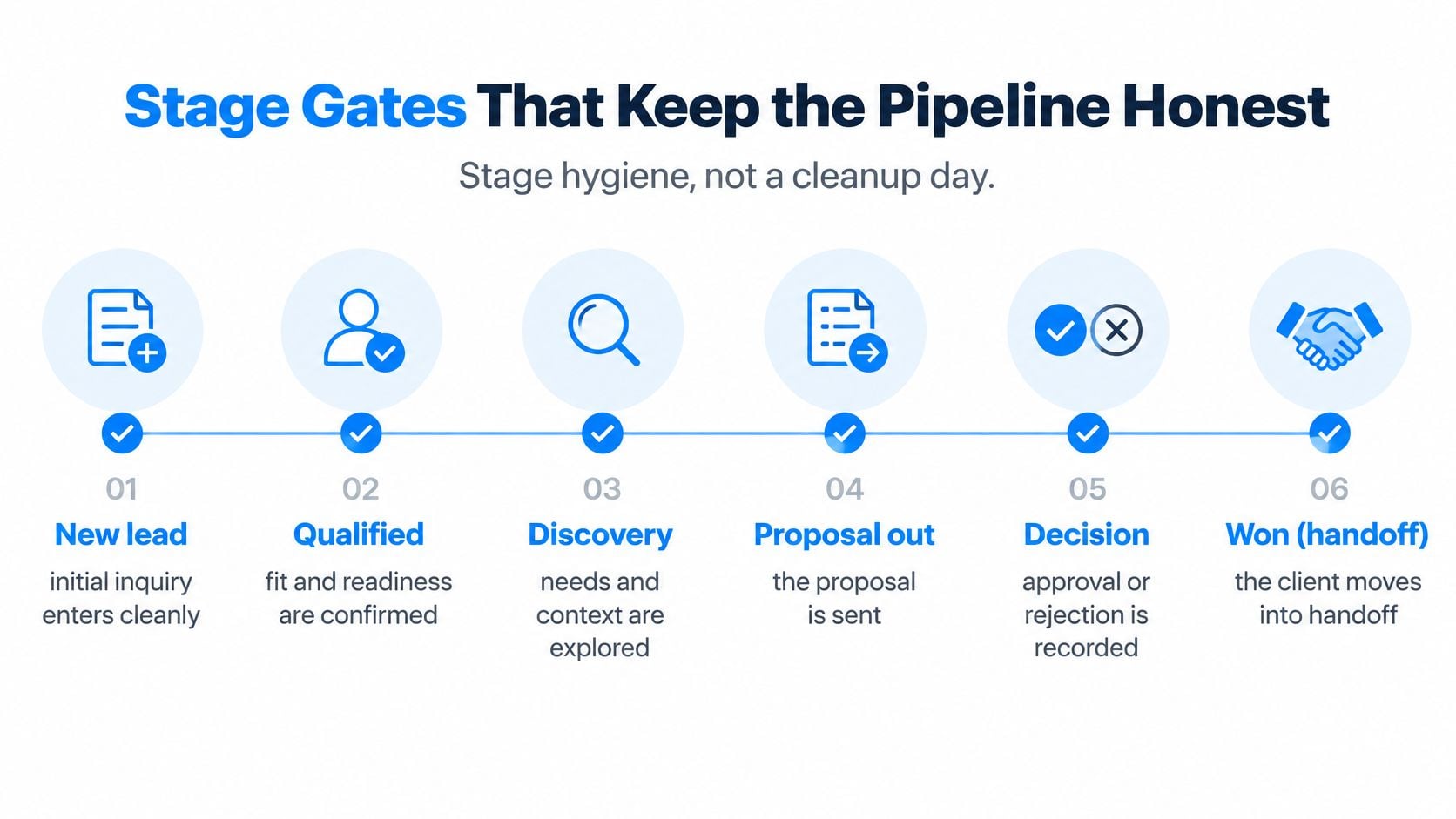
New lead enters only with source, service line, and an owner. Qualified requires a confirmed service line and a budget range. Discovery is complete only when the problem and the buying-committee contacts are on the record. Proposal out requires value, a decision date, and a follow-up owner. Decision is a date, not a mood. Won (handoff) requires scope, a kickoff, and a notified delivery owner.
An opportunity cannot advance until it carries a next step, a next-step date, an owner, an expected value, and a decision timeframe. Free-text stage names are not allowed. Blank fields count as missing data, not as valid answers.
A proposal with no activity for seven days is flagged. On its decision date it must close as won, lost, or no decision. A stalled maybe inflates the forecast and trains the team to ignore the board.
What the import is allowed to do
Map contacts to the standard template. Match on normalized email, domain, phone, and fuzzy name. A merge keeps source history. Throwing away the original campaign, referrer, or event name makes the next routing rule worse than the duplicate it removed.
This is revenue work, even in a small database. In a 2024 survey of 631 CRM users and stakeholders in the United States, United Kingdom, and Australia, published by Validity, 24% of administrators said less than half their customer data was accurate and complete, and 31% believed poor-quality data cost at least 20% of annual revenue.
| Metric | Definition | Cadence | Owner |
|---|---|---|---|
| Completeness | Share of required fields filled on open records | Monthly | Exception-list owner |
| Duplicate rate | Share of contacts or accounts flagged as duplicates | Monthly | Exception-list owner |
| Stale records | Open records with no activity in seven days | Monthly | Exception-list owner |
| Next action coverage | Share of open opportunities with a scheduled next action | Monthly | Exception-list owner |
| Proposals past decision date | Open proposals past their decision date | Monthly | Exception-list owner |
One person owns the exception list and brings it to the monthly review. CRM hygiene for healthier pipelines is worth reading beside that list, because a clean stage name without an owner still produces a pretty, wrong forecast.
Automate Logistics and Keep Judgment Human
A four-email cadence fired at a client who is still deciding whether to trust you will book a meeting and cost the relationship. Advisory buyers pay for judgment, and a sequence cannot supply it. Automate the logistics around the decision and leave the decision itself to a named person.
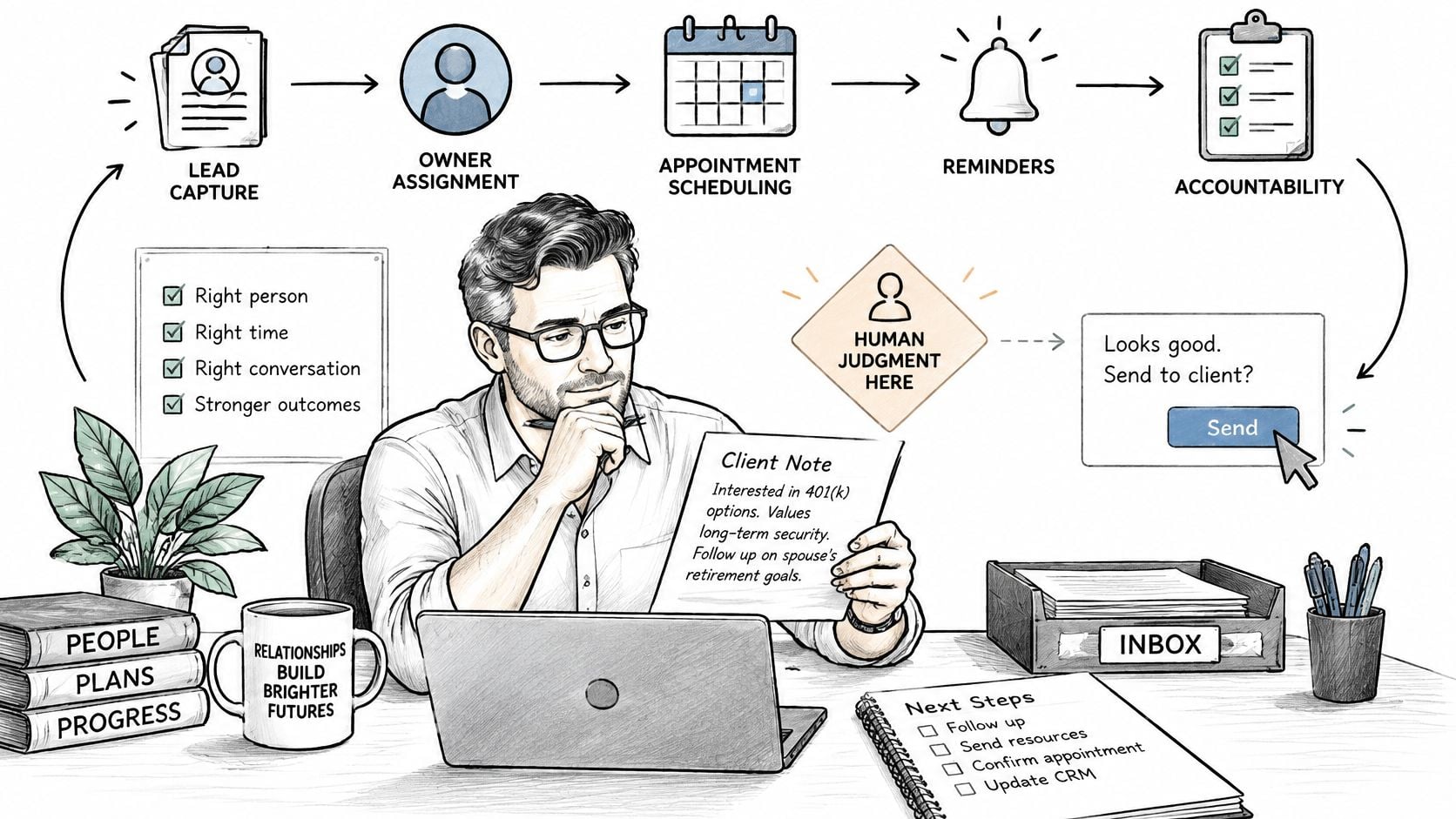
What may run unattended
Unattended sequences earn their place when they move a task or start a clock.
- Lead capture and owner assignment, so the clock starts without a partner opening the inbox.
- Appointment confirmations, reminders, and internal no-show recovery, so a missed call becomes a task rather than a forgotten calendar block.
- A prompt that proposal follow-up is due, sent to the owner. The system does not write a new pitch.
- An internal alert when a deal is won, so delivery hears it from the record.
Every prebuilt automation runs on every plan, and self-serve access to the workflow builder begins at Core Plus, where you edit those sequences yourself. Keep builder access narrow at the start. Partners should sign the list of what runs alone before anyone adds a step, and a second signature should be required before a new step goes live.
What stays with a person
Four moments stay human: interpreting an ambiguous brief, answering a sensitive objection, deciding whether a dormant relationship should be revived, and writing any message that claims to know the client's politics or numbers. Each one needs a name attached, not a queue.
Audit rules the team can check:
- Disclose automated messages.
- Cap cadence, and honor opt-outs the same day.
- Require partner approval before a sequence emails a buying committee.
- Keep a trail of who changed each workflow.
Measure reply quality, meeting show rate, and proposals that reach a real decision. Do not measure emails sent.
Vendors now sell AI capability into every software category, and buyers do respond to it. That demand says nothing about whether automated follow-up strengthens a retained advisory relationship. The 2025 Professional Services Maturity Benchmark flags privacy, transparency, accountability, and ethical dilemmas as significant concerns when AI analyzes client data. Those obligations stay with the firm. The CRM does not supply regulatory or licensing advice.
The short video below is a useful contrast: watch where a sequence replaces a conversation, and mark those moments as blocked for your own list.
End with a one-page allow and block list. Both partners sign it. If a new workflow is not on the allow list, it does not run.
How to Track Proposals and Hand Off Clients
Follow one proposal from send to a recorded outcome, then into delivery. Every open proposal is tracked and followed up on a schedule you set once, so the cadence does not live in a partner's memory.
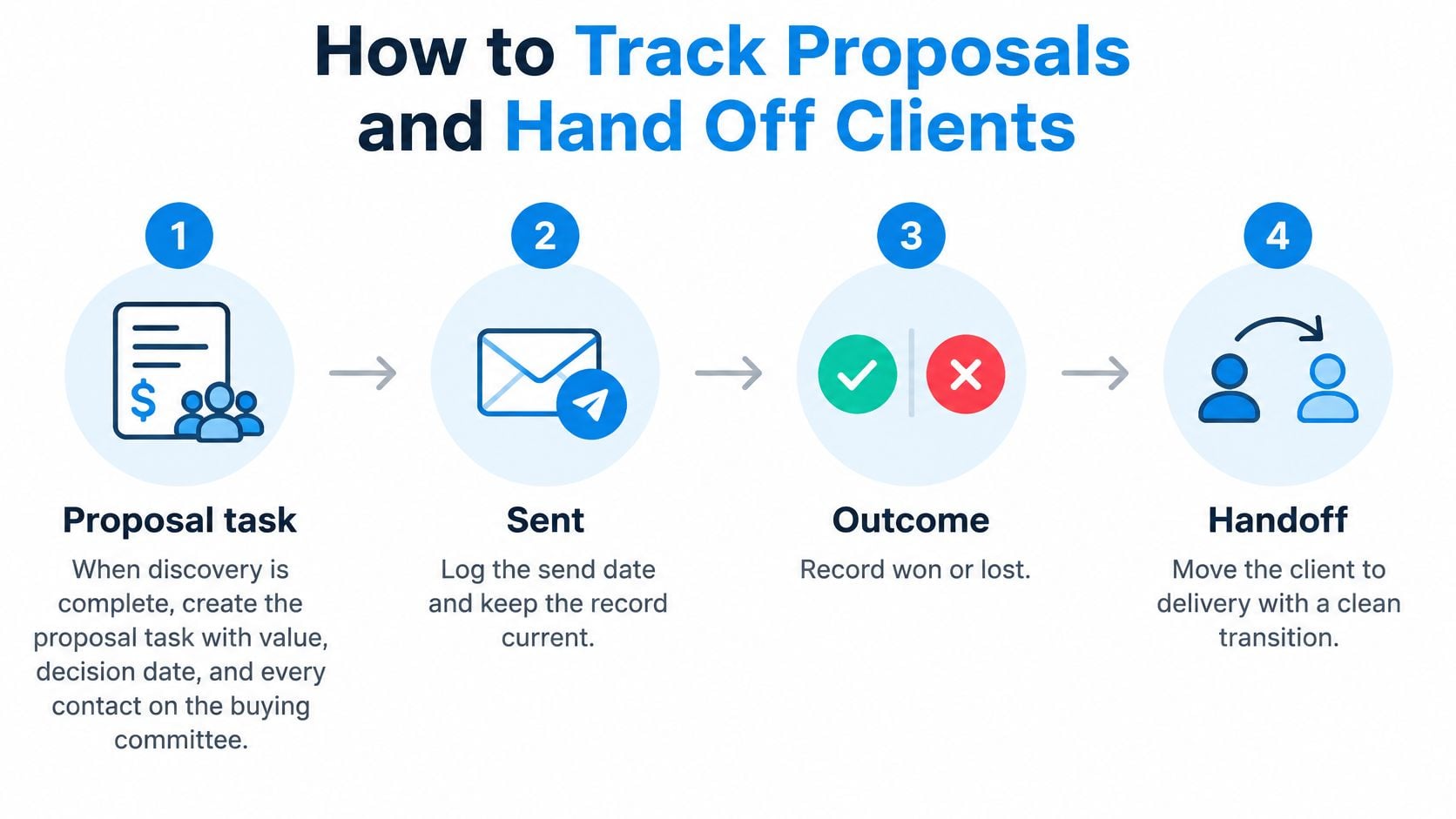
- Create the task when discovery is done. Put value, decision date, and every buying-committee contact on the same opportunity. Activity history is visible to the team, not locked in one mailbox. A champion, a finance lead, and a skeptical operator belong on one record.
- Set the schedule once. A check at day 3, day 7, and day 14 is a workable default, plus a stop if there is no activity for seven days. The same schedule runs for every open proposal.
- Give each touch a human owner. The automation prompts that owner. It does not invent a new commercial position, a discount, or a revised scope.
- Force an outcome on the decision date. Won, lost, or no decision. "Still thinking" is not a stage.
- Hand off at Won without a second project. The opportunity is marked Won, the client record updates, the delivery pipeline starts, the delivery owner is notified, and onboarding and kickoff scheduling begins automatically.
The quiet PDF
Say a fractional COO proposal for a 40-person manufacturer goes quiet after the PDF. The day-7 prompt surfaces it before the champion leaves on travel. The owner calls, learns procurement slipped a week, and moves the decision date. When the answer is yes, the won click creates the kickoff instead of a chat message delivery never sees. That path is the same one in a client onboarding workflow: scope, date, and a delivery owner before anyone starts work.
In 2025, 52% of U.S. consumers surveyed by PwC said they had stopped using or buying from a brand because of a bad product or service experience, while 29% cited poor customer experience specifically. A consulting client feels the same break when the promise in the proposal never reaches the person who delivers the work.
Each month, count proposals still open after their decision date, and handoffs that started without a kickoff. Those two counts tell you whether the schedule and the won click are real.
Referral Partners Who Keep Sending Work
Referrals need their own pipeline, not a tag on old clients. Useful stages are identified, agreed to introduce, introduction made, thank-you sent, and active nurture. Each partner has one relationship owner.
The record stores the last introduction, whether the thank-you went out, and the next touch date. After an introduction, the thank-you is a task with a deadline, not a good intention you will "get to." Between introductions, referral sources receive ongoing nurture touches: a useful note, or a relevant introduction back. Not a newsletter blast sent because the list was handy.
Do not put partners through the new-lead five-minute response standard, and do not score them like inbound demo requests. They are not leads. Treating them that way trains them to stop sending names.
The monthly partner review
Once a month, pull two lists.
- No touch in 90 days. These partners have gone quiet. The relationship owner books one real conversation, or marks the stage accurately.
- Introductions with no thank-you. These are open tasks, same as a proposal with no follow-up. Close them before you ask for another name.
Say an accountant sent two clients last year and then went silent, because nobody logged the second win. The stage and the thank-you task surface that gap in the same review as stalled proposals. You do not need a separate ritual or a second tool. A simple way to track referrals is a stage, an owner, and a date.
List your top ten referral sources this week and place each one in a stage. If you cannot name the last introduction, the record starts at identified, not at active nurture.
Install One Operating System This Month
Turn the standards into a 30-day install. Another tool trial will not fix a blank required field.
Week one, Map. Write how leads, meetings, proposals, clients, and referral partners move today, including the inboxes that bypass the CRM.
Week two, Install. Configure pipelines, reminders, routing, and handoffs around that map. Partners review the stage gates and the minimum-record table before anything goes live. In Install, we configure those pieces around how your firm sells, and you review them rather than building them from an empty board.
Weeks three and four, Go Live. The system takes all new leads. Repetitive follow-up runs in it. The old spreadsheet is closed to new rows.
Match the plan to the team before you pick a tier. Core is $97 per month for a solo consultant or small firm, with 2 users and 2,000 contacts. Core Plus is $197 per month, with hands-on automation, marketing and payment controls, 5 users, and 5,000 contacts. Check seats, contact volume, and whether you need to edit workflows. We can support this Map, Install, and Go Live path for a two-to-20-person consultancy, with scheduling, messaging, proposals, and automation in one place. You still check fit against your own requirements, and you still own your regulatory obligations.
Three dated decisions: book the mapping session this week, name one pipeline owner, and refuse a second system until the five-minute lead standard and the proposal decision date are both live.
Starward Navigators builds the acquisition system small advisory firms run: pipelines, follow-up, proposal tracking, client handoff, and referral care from first contact through repeat work. If your leads, proposals, and partners still live in separate inboxes, start with a mapped operating system instead of another blank CRM. Visit Starward Navigators and book the mapping session.