A next-business-day reply still feels like good service inside a small consultancy. The qualification record says that window is already late. Lead follow up time is an operating variable, not a courtesy preference, and the first hour is where most of the difference shows up.
Table of Contents
- Why Lead Follow Up Time Decides Which Inquiries Qualify
- How Response Odds Decay from Minutes to Days
- Where Most Firms Really Stand on Response Speed
- Setting a Response-Time SLA by Lead Intent
- Designing Follow-Up Cadence After the First Touch
- Comparing Manual, Shared Inbox, and Automated Follow-Up
- Automating Your First Touch and Taking the Next Step
Why Lead Follow Up Time Decides Which Inquiries Qualify
A 2011 Harvard Business Review study of 1.25 million web-generated leads from 29 business-to-consumer and 13 business-to-business companies found that firms contacting a lead within one hour were about seven times more likely to qualify it than firms waiting longer than an hour, and roughly 60 times more likely than firms waiting 24 hours or more, as summarized in Machina's review of that speed-to-lead research. Qualification meant establishing contact with a decision maker.
That definition is the part advisory firms should not skip. A consulting inquiry does not become discovery, a proposal, or a referral conversation until someone reaches the person who can talk. Speed changes the top of the pipeline, not a forecast of booked revenue.
Next business day is not a service level
The common assumption is that a thoughtful reply tomorrow morning is fine, because advisory work is considered and buyers will wait. The study treats delay as a cause of lost qualification, not as a style choice. Hours, not days, are the unit that changes the odds.
For a five-person firm, capture, assignment, and first touch cannot sit on one person's memory of the next business day. If the principal is in a client workshop, the inquiry still needs an owner and a clock.
Teams that treat inbound as a process, including those helping SDR teams qualify inbound leads, separate acknowledgment from the human conversation. The auto note does not qualify anyone. It only keeps the clock honest until a person attempts contact.
Practical rule: Measure first human attempt in minutes during staffed hours. "We replied yesterday" is not a performance number.
What the research measures is contact with a decision maker, not a closed engagement. Use it to justify faster access to a real conversation. Do not use it to promise a win rate.
How Response Odds Decay from Minutes to Days
Think of a new inquiry like a hot pan pulled off the burner. It is usable immediately. Leave it, and the drop is steepest at the start, then it keeps cooling through the afternoon and into the next week.
The first half hour
A 2007 Lead Response Management study of more than 15,000 leads, over 100,000 call attempts, three years of data, and six companies compared a five-minute response with a 30-minute response. The odds of contacting the lead fell by 100 times. The odds of qualifying it fell by 21 times. Moving from five minutes to ten minutes cut qualification odds by about four times. Those comparisons are laid out in LeadSixty's guide to response timing.
The decline does not wait for a missed day. It starts inside the first staffed quarter hour. A "we'll call after this meeting" habit is already on the wrong side of that curve.
What a later, much larger sample adds
A 2021 analysis in the same guide reviewed more than 55 million sales activities and 5.7 million inbound leads across more than 400 companies. Conversion rates dropped by eight times after the first five minutes. Only 0.1% of inbound leads were engaged inside that window. 57.1% of first-call attempts happened after more than a week.
Rapid follow-up is strongly associated with better contact and qualification. Most organizations still do not execute it. That gap is a process failure, not a mystery about buyer psychology.
Tools aimed at faster lead follow-up with Stimulead exist because individual habit does not hold the window. Routing, an immediate acknowledgment, reminders, and owner alerts turn speed into a standard.
| Response window | Reported effect |
|---|---|
| 5 minutes vs 30 minutes | Contact odds about 100 times higher, qualification odds about 21 times higher |
| 5 minutes vs 10 minutes | Qualification odds about 4 times higher at 5 minutes |
| After the first 5 minutes (2021) | Conversion about 8 times lower, with 0.1% engaged in the window |
| First call after more than a week | 57.1% of first-call attempts |
These figures describe contact, qualification, or conversion proxies in the studies above. They are not win rates for a consulting engagement. First-touch design should still assume the steep part of the curve is measured in minutes.
Where Most Firms Really Stand on Response Speed
A partner at a five-person advisory firm finishes a Thursday workshop, opens the shared inbox, and sees a website form from 3:40 p.m. Nobody owns it. Friday is delivery work. The reply goes out Monday morning, written carefully, and already two and a half days late.
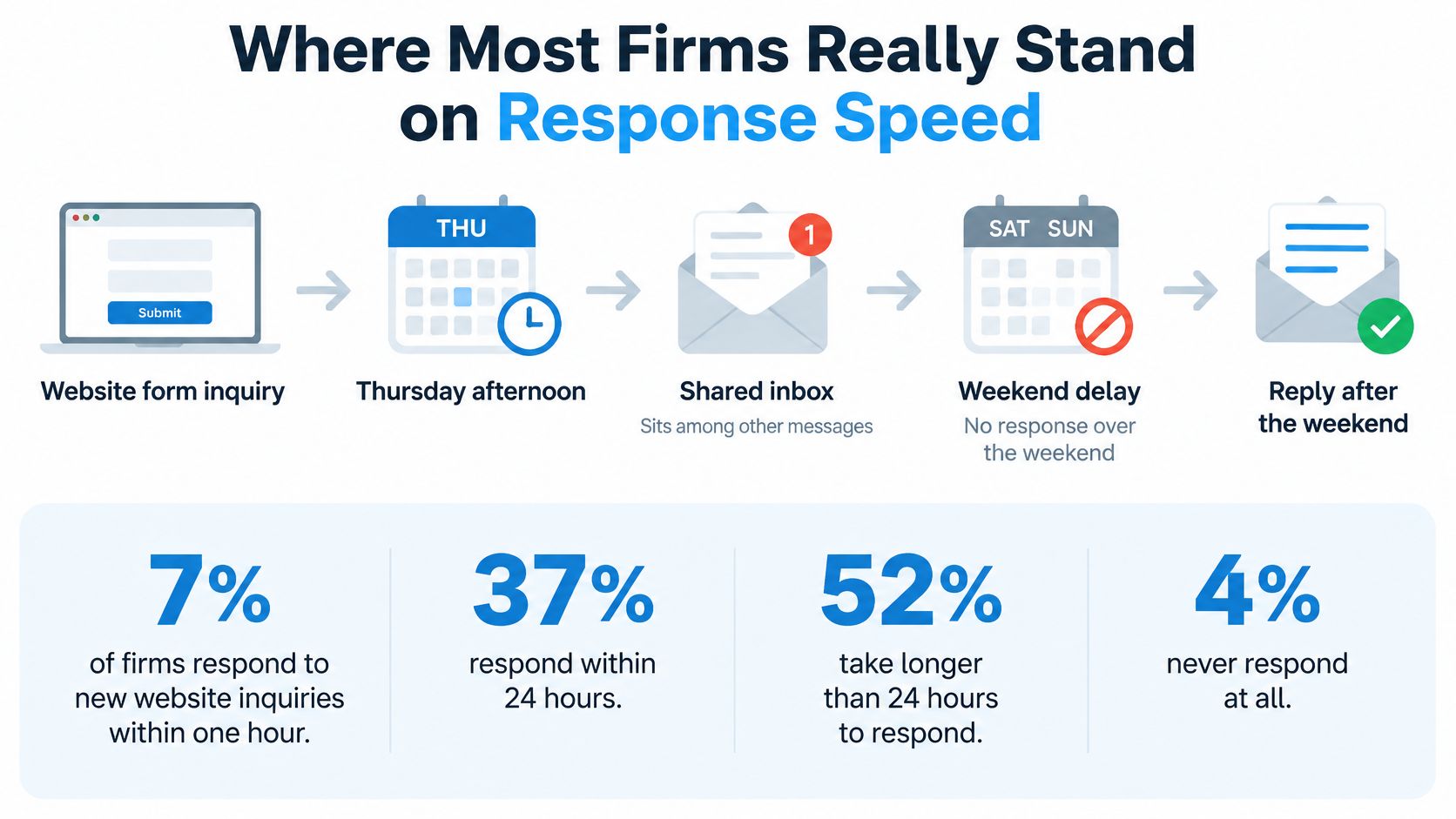
That story is ordinary, not a tale of careless people. A Harvard Business Review audit of 2,241 U.S. companies, reported by Vida, found that only 37% responded to web-generated leads within one hour. Among companies that eventually replied, the average delay was 42 hours. 23% never responded.
The failure is an unowned queue
Most firms miss the hour because the first touch has no owner and no timer. A shared inbox looks like coverage. It is coverage only while someone happens to be watching it. A busy delivery week removes the watcher, and nothing in the inbox escalates.
"Same day" is too blunt for advisory work. Routing, ownership, and the first human attempt should be discussed in minutes. An average that includes a 42-hour reply will hide a Thursday lead that waited through the weekend.
Before you set a target, audit the inbox you already have.
- Who saw it: Name the person who first opened the inquiry, not the shared address.
- When they tried: Record the first call or personal note, not the autoresponder.
- What never moved: Count inquiries with no human attempt at all.
If you cannot name the owner and the minute of the first human attempt, you do not have a response policy. You have a mailbox.
Setting a Response-Time SLA by Lead Intent
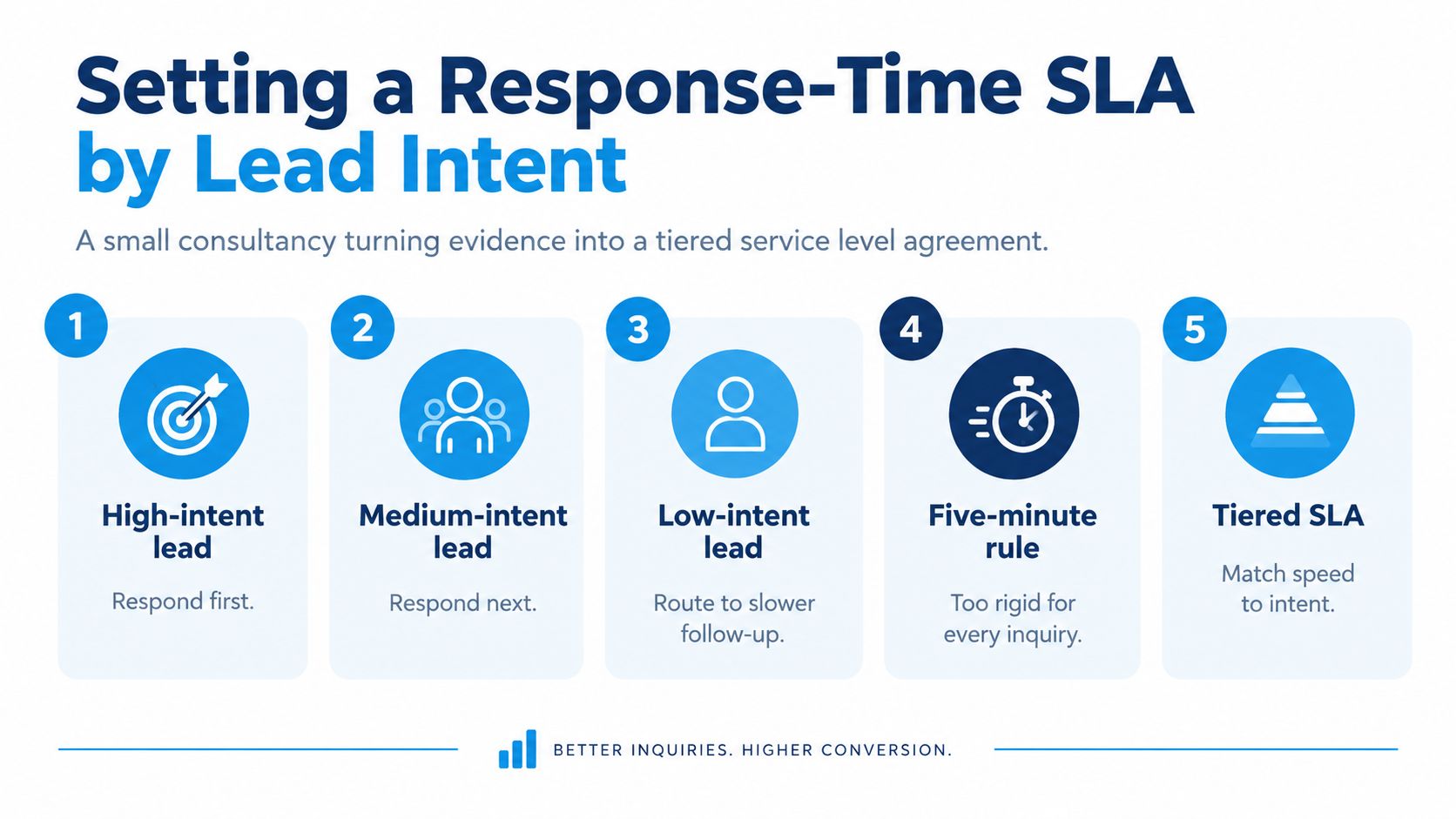
One five-minute rule for every inquiry is too rigid for a consultancy. The strongest public evidence is older, and it comes mainly from U.S. web leads. It does not prove that five minutes is optimal for every market, channel, buying committee, or advisory service. Retell AI's discussion of that evidence also notes that 24% of the audited companies took more than 24 hours to reply, which is a different failure than a ten-minute miss.
Segment the promise. Match speed to intent, to staffed hours, and to whether a specialist has to qualify the question. Keep every inquiry out of an unowned queue, including the slow ones.
Three tiers a five-person firm can run
High intent covers proposal requests, "can we talk this week," and booked discovery. Send an automated acknowledgment at once. During staffed hours, a named person attempts a personal outreach inside five minutes. If that attempt has not happened, escalate to a second person before the window closes.
Medium intent is a specific question about scope, a referral intro, or a form that names a problem. Acknowledge immediately. Aim for a human attempt inside the hour while the office is staffed. The same escalation applies if the owner is in a client session. Referral inquiries deserve the same ownership, which is why a simple way to track referrals belongs in the same system as the inbound form.
Low intent is a newsletter signup or a generic download. Acknowledge it, route it to a slower sequence, and do not pull a principal off a client call to chase it. It still needs an owner so it cannot vanish.
What to report
Report median and 90th-percentile response times separately. An average can look acceptable while a handful of weekend and vacation delays wreck the buyer experience. Review both numbers monthly, by tier, and only count a human attempt.
After-hours mail gets the acknowledgment immediately and a human attempt at the start of the next staffed block, unless the tier is high intent and someone is on duty.
Designing Follow-Up Cadence After the First Touch
The first attempt is not the cadence. Many advisory opportunities stall on attempt two, when the lead does not pick up and nobody has a next step that is not "try again sometime."
The widely cited five-minute rule comes from a separate lead-response study associated with MIT researcher James Oldroyd and InsideSales.com. Martal's summary of that work describes the same early window as a reachability effect. New leads are easier to reach, and more willing to engage, before other priorities, other vendors, or simple loss of intent get in the way. The study measured contact and qualification, not final wins. That limit matters. A fast first call does not close a six-month advisory sale. It only keeps the conversation possible.
A cadence that does not hunt
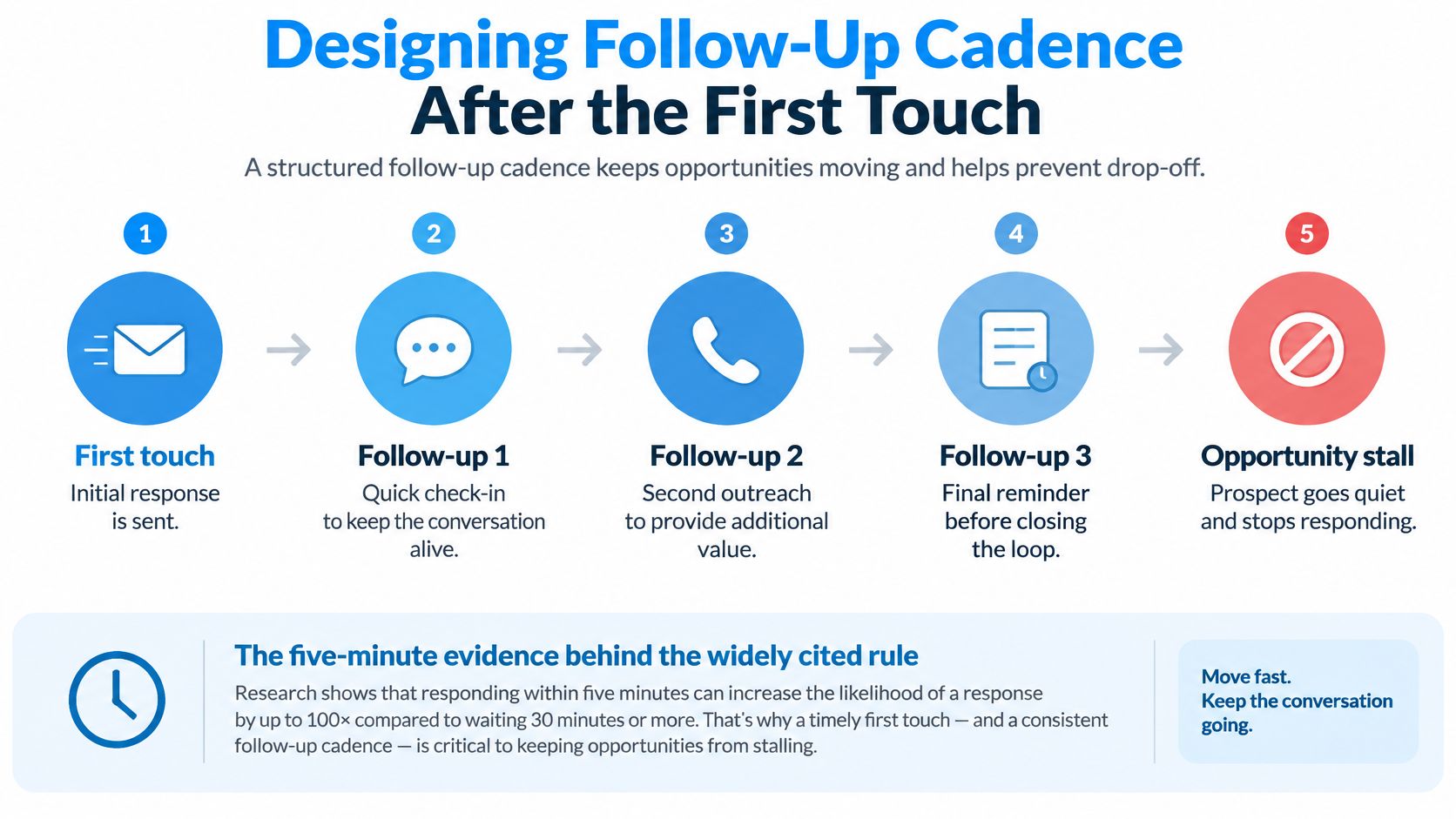
Space attempts across the first few business days. Change the channel when a call goes unanswered. Then stop the active chase and move a quiet lead into a slower nurture with a named owner.
- First touch. Personal call or note inside the tier's window, after the automatic acknowledgment.
- Same-day second try. A different hour, and a short written note that restates what they asked.
- Next business day. One call plus one useful message, not "just checking in."
- Day three. A single attempt with a concrete next step, such as two times you can talk.
- End of the active chase. A closing note that they can reply when ready, then nurture.
Do not stack four calls in one afternoon. The buyer experiences one firm, even if two people touched the record. Stop the sequence the moment they reply.
A short walk-through of how timing and persistence interact is in this video.
Each stage should create the next task on the lead, assigned to one person. If that person does not work the task, it moves. Otherwise yesterday's inquiry loses to today's fresh form every morning.
Comparing Manual, Shared Inbox, and Automated Follow-Up
Three setups show up in almost every boutique firm. They fail in different places.
Manual follow-up lives in one person's head and personal call log. Speed is excellent when that person is free and cares. It collapses on vacation, in a delivery crunch, or when a second advisor does not know the last attempt. Visibility is whatever they remember to write down.
A shared inbox feels like teamwork. Ownership is informal. It holds during a quiet week and breaks when everyone assumes someone else answered the Thursday form. After-hours mail sits until Monday because the inbox does not assign a next-morning owner. Response time is not measured, so the firm cannot see the 42-hour pattern in its own mail.
An automated workflow captures the inquiry, names an owner, sends the acknowledgment, creates the next task, and escalates a missed window. Consistency no longer depends on who is least busy. The cost is setup and a habit of trusting the task list instead of the inbox.
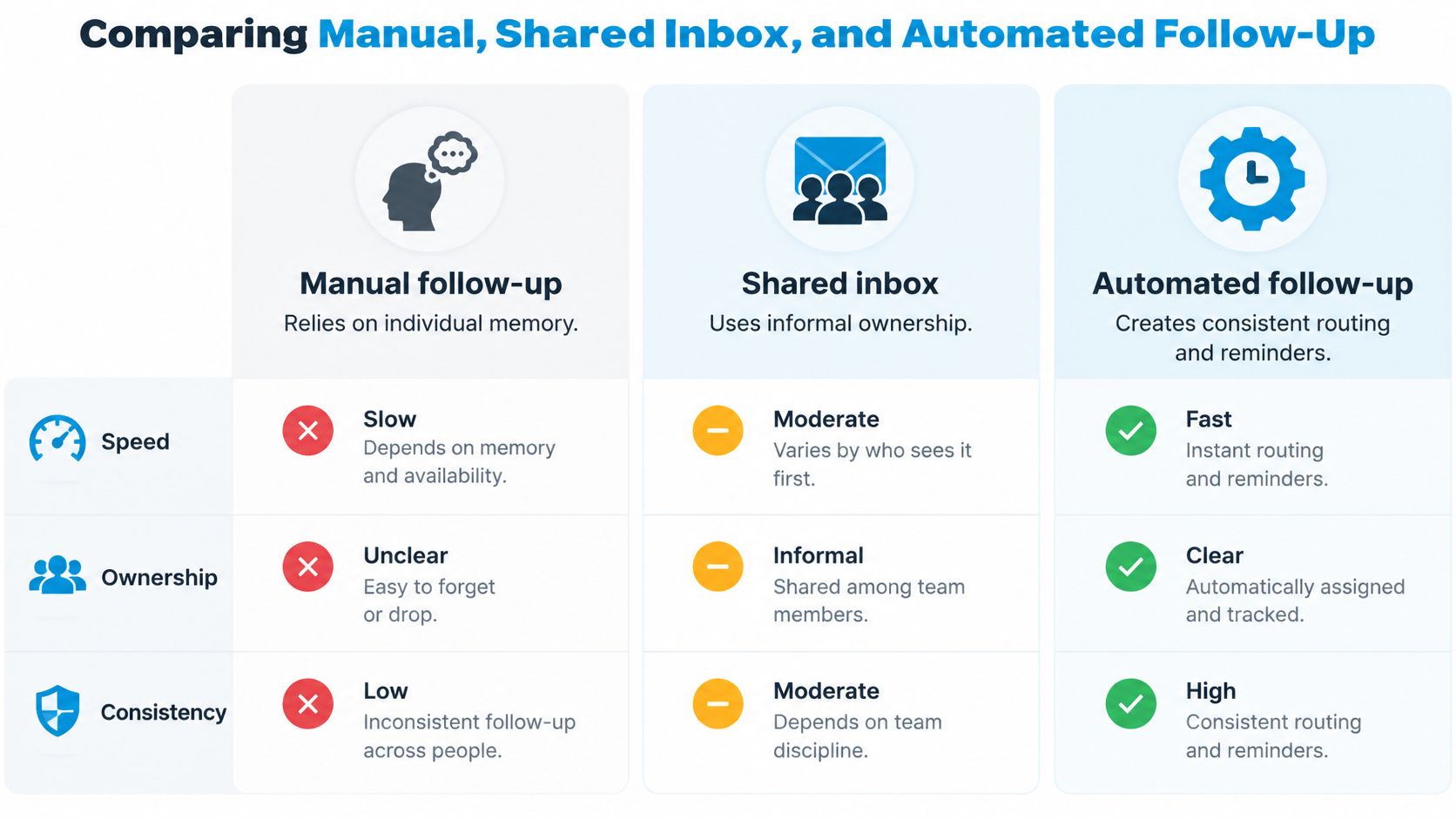
| Criterion | Manual | Shared inbox | Automated workflow |
|---|---|---|---|
| First-touch speed | Fast only if one person is free | Unpredictable | Tied to a timer |
| Consistency | Varies by individual | Varies by who is watching | Same stages for every lead |
| Visibility | Personal memory | Hard to audit | Median and slow outliers |
| After hours | Waits for memory | Waits for Monday | Ack now, owner at open |
| Upkeep | Low until someone is out | Low until a busy week | Upfront build, then lighter |
One option built for this pattern is Starward Navigators, a prebuilt operating system for consulting and advisory firms. It pulls website, inbox, LinkedIn, and event sources into one place, routes leads, runs follow-up sequences, and coordinates reminders, with pipelines already in place rather than a blank CRM. Implementation follows a Map, Install, Go Live sequence with a 14-day go-live guarantee. Campaigns, triggers, and the workflows builder sit on Core Plus and above. The lead management workflows are the piece that replaces the shared inbox as the system of record.
Pick automation when more than one person touches inquiries. Keep manual follow-up only if a solo advisor can prove, from a log, that high-intent leads get a human attempt inside the tier.
Automating Your First Touch and Taking the Next Step
Build the first-touch layer in order. Skipping a step is how firms buy a tool and still lose Thursday's form.
The sequence
Capture. Send website forms, the main inbox, LinkedIn inquiries, and event lists into one system. A lead that lives in four places will be worked in none of them consistently.
Assign. Give every new record an owner at the moment it arrives. Round-robin is fine if the next person is available. A name on the record matters more than a clever rule.
Acknowledge. Send a short, specific note that a person will follow up. Do not count that note as the human attempt.
Alert. Notify the owner inside the tool they already open. An email alert that lands in the same crowded inbox you are trying to escape will be ignored.
Escalate. If no human attempt is logged inside the tier's window, reassign and notify a second person. The clock starts at submission, not when someone happens to see the alert.
Record. Store the timestamp of the first human attempt. Once a month, read median and 90th percentile by tier. Fix the tier that misses, not the average that looks calm.
Test before you trust it
Run five to ten real inquiries through the path before you ask the whole firm to leave the shared inbox. Confirm the acknowledgment, the owner alert, the escalation, and the timestamp. Then turn it on for high intent first.
Appointment logistics sit on the same path once someone agrees to talk. Confirmations and reminders belong with appointment automation, so a booked call does not depend on a calendar reminder someone typed by hand.
This week, export or scroll the last month of inquiries and mark each one against the three tiers. Note owner, first human attempt, and whether a second attempt ever happened. That list is the brief for whatever you install next.
Starward Navigators builds client acquisition infrastructure for small consulting and advisory firms, including capture, routing, and automated follow-up so lead follow up time is a service level instead of a memory test. If your inbox still decides who gets a conversation, start with the Map stage and see how the pipeline is set before anything is installed. Visit Starward Navigators to walk through that step.