You finish a strong discovery call. The prospect has a clear problem, a plausible budget, and a reason to act. Then delivery work takes over. In a familiar hypothetical scenario, you send nothing for four days, and the prospect chooses a competitor who followed through sooner.
The problem isn't a shortage of email templates. It's the missing agreement inside your firm about which message goes out, who owns it, and what happens when the buyer stays silent. A polished email won't fix an opportunity with no next-step date.
For small consultancies, preventing sales leads from falling through means treating follow-up as operating work, not something to squeeze between client meetings. That includes knowing when to stop, when to offer help without requesting a call, and when a personal reply matters more than automation.
The seven templates below run from first response through referral thanks. Each includes timing, subject-line guidance, personalization notes, and automation considerations. Use them as branching paths through the consulting sales cycle, not a sequence every contact must receive.
Working principle: Automate the reminder and the routing. Keep a person responsible for the judgment.
Table of Contents
- 1. Speed-to-Lead First Response Email
- 2. Post-Discovery Call Recap with Mutual Action Plan
- 3. Proposal Follow-Up with Decision-Date Question
- 4. The Breakup Email
- 5. Value-Add Resource Share Nurture Email
- 6. Stalled Opportunity Re-Engagement with New Trigger
- 7. Referral Partner Thank-You and Introduction Request Email
- 7 Sales Lead Follow-Up Email Templates Compared
- Building Your Follow-Up Sequence Before the Next Lead Arrives
1. Speed-to-Lead First Response Email
Trigger: A prospect submits a direct inquiry through your website, inbox, LinkedIn, or an event conversation. Send an acknowledgment immediately, then have the assigned consultant respond personally as soon as possible.
The historical evidence supports urgency. The foundational Harvard Business Review study found that firms contacting prospects within an hour were nearly seven times more likely to qualify the lead than firms waiting an additional hour, as summarized in this review of lead-response research. That finding concerns lead qualification, not a guaranteed consulting sale.
Template and Send Rules
Subject: Your inquiry about [specific service]
Hi [First name],
Thanks for getting in touch about [stated challenge]. You mentioned that [specific objective or constraint], so I'd suggest starting with a short conversation about [relevant decision].
Would [time option with time zone] or [alternative time] work? You can also use [scheduling link].
I'll be your point of contact from here.
[Name]
For example, a boutique HR consultancy receiving a leadership-coaching inquiry could name the requested coaching area rather than send a generic capabilities brochure. Don't make the prospect repeat information already submitted.
- Personalize: Use the actual problem from the inquiry, not an inferred need.
- Automate: Trigger acknowledgment and owner assignment together.
- Failure mode: An instant receipt isn't a substantive response. Don't mistake successful delivery for meaningful follow-through.
Keep this sales lead follow up email template connected to your intake process. When generating leads for email marketing, distinguish a direct service inquiry from a content subscription. They shouldn't automatically receive the same sales invitation.
2. Post-Discovery Call Recap with Mutual Action Plan
A good discovery recap should be useful enough for the prospect to forward internally. It records the problem, the constraints, and the agreed route toward a decision, without requiring another meeting to interpret it.
Trigger: Discovery is complete. Draft the recap while your notes are fresh and send it promptly, preferably the same day. Treat that as an operating recommendation, not a universal performance benchmark.
Subject: [Company] discovery recap and agreed next steps
Hi [First name],
Thanks for explaining how [specific problem] is affecting [business process]. My understanding is that you want [desired outcome], while working within [constraint].
Here's the action plan we discussed:
- Our responsibility: [Deliverable], owned by [name], by [date].
- Your team's responsibility: [Input or internal review], owned by [name], by [date].
- Decision checkpoint: [Agreed review or decision event] on [date].
Please correct anything I've misunderstood. You can forward this summary to [relevant stakeholder] so they have the same context.
[Name]
Keep Agreement Separate from Assumption
For a logistics consultancy speaking with a COO, the recap might distinguish operational bottlenecks from approval requirements. The consultant can own the proposed scope while the COO confirms who must review it.
Don't invent mutual agreement. If the prospect hasn't accepted a deadline, label it as proposed. Use their wording where your notes support it, but don't manufacture a quotation to make the email sound attentive.
A discovery-complete stage change can create the draft and assign a review task. The consultant should approve the substance before sending, especially the business diagnosis and ownership commitments.
A recap isn't a transcript. Keep what the buyer needs to validate the problem and take the next agreed action.
3. Proposal Follow-Up with Decision-Date Question
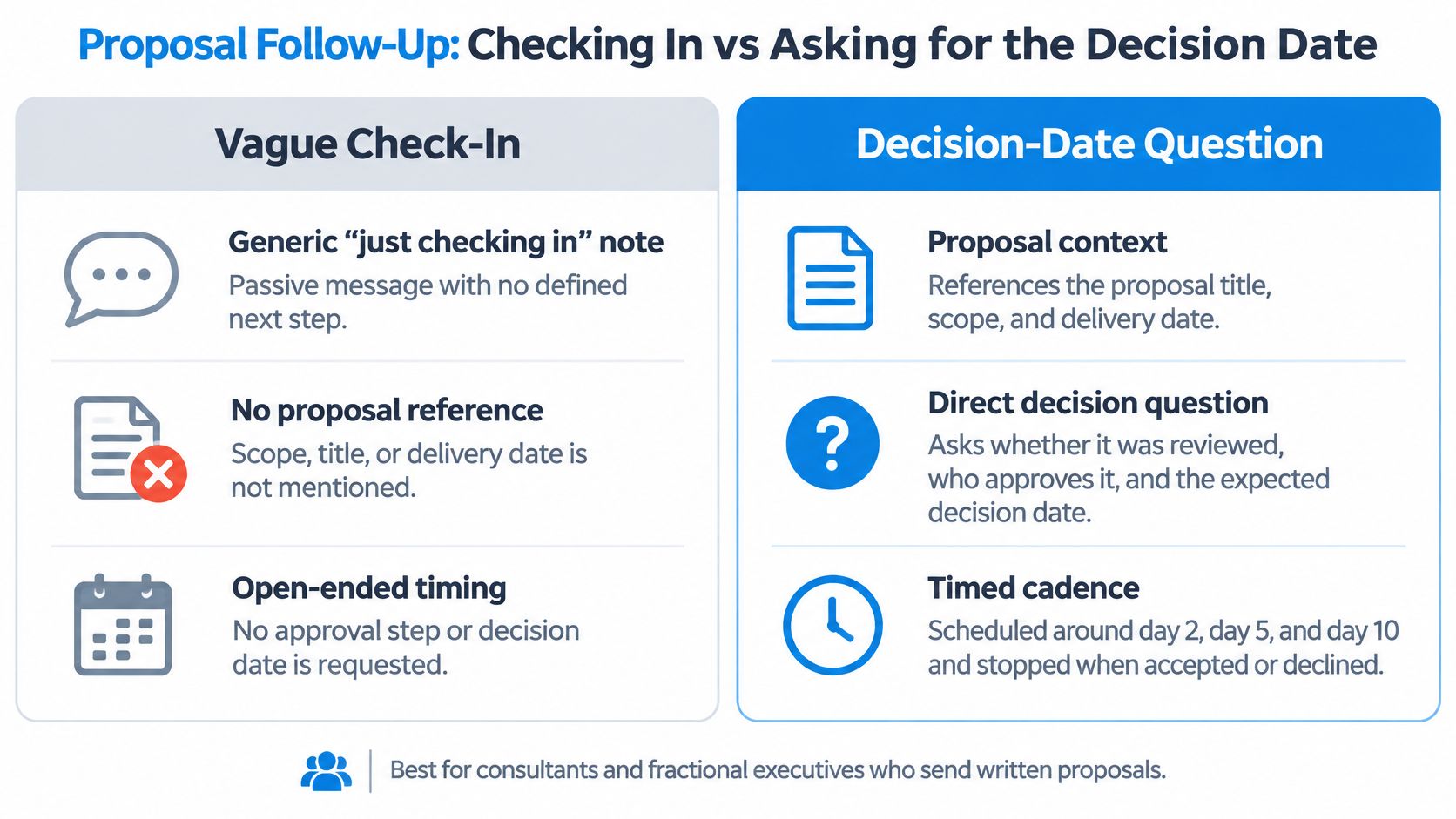
“Any thoughts?” asks the buyer to decide what your next step should be. A decision-date question is more specific: it asks how the proposal will move through their organization.
Timing should follow the review date you agreed, not an arbitrary delay. The practical conclusion from this discussion of differing follow-up timing recommendations is that inbound inquiries, silent proposals, and deferred opportunities need different treatment.
Subject: Decision timing for [project]
Hi [First name],
I'm following up on the proposal for [specific scope], which addresses [agreed priority].
What date is your team working toward for a decision?
If [known constraint] is still unresolved, I can outline a phased start for review. There's no need to schedule another call unless a conversation would help.
[Name]
Automate the Date, Review the Offer
For example, a fractional COO might discover that a proposal is waiting for an internal budget review. That calls for a revised next-step date, not repeated invitations to discuss the same document.
- Personalize: Refer to the actual scope and a constraint the buyer raised.
- Automate: Schedule from the agreed review date, with suppression when the buyer replies, accepts, or declines.
- Failure mode: Don't offer a discount or smaller scope before understanding the obstacle.
A structured proposal follow-up process should record the decision owner and next action alongside the email. Otherwise, even a useful reply can disappear into an inbox without changing the opportunity record.
4. The Breakup Email
Use this as the final message in an unanswered active sequence. It should end unnecessary pursuit, not create artificial urgency.
Trigger: The prospect hasn't responded to relevant follow-ups, and there's no known approval delay or agreed future contact date. Review the history before sending.
Subject: Closing the loop on [project]
Hi [First name],
I haven't heard back about [project], so I'll stop following up on it for now.
If the timing has changed, you're welcome to reply with a better point to reconnect. Otherwise, no action is needed.
Thanks for the conversation, and you can reach me here if the priority returns.
[Name]
Close the Sequence, Not the Relationship
Consider a solo advisor whose prospect previously mentioned a budget freeze. If the buyer already gave a future review period, a breakup email ignores useful information. Set a reminder for that period instead.
The failure mode is emotional pressure disguised as administration. Avoid suggesting that the prospect owes you a reply, or claiming you're withdrawing an offer when you aren't.
Stopping rule: If you say you'll stop following up, stop the active sequence. Don't send another automated reminder behind it.
Automation can handle this message when the record is complete and no recent conversation exists elsewhere. Require manual review for opportunities involving several stakeholders or informal exchanges outside email.
Keep the contact record and its history. Future nurture should reflect the relationship and the person's communication preferences, not restart the same sales sequence under a different subject line.
5. Value-Add Resource Share Nurture Email
A prospect who isn't ready for another meeting may still need help making a decision. Send something they can use independently, not a brochure followed by a disguised calendar request.
Research summarized in Sopro's B2B buyer insights reports that 88% of B2B buyers want vendor contact while researching and evaluating options. That doesn't mean every contact should ask for a call.
Send Something They Can Use
Subject: A resource for [specific decision]
Hi [First name],
You mentioned that [specific challenge] is making it difficult to decide between [approaches].
I thought [resource title or resource link] would be useful. The section on [relevant issue] can help your team assess [decision] before committing to a scope.
No meeting needed. If you'd like the editable version for your internal review, just reply and I'll send it.
[Name]
For example, a revenue operations consultant could share a forecast-review worksheet with a prospect who described inconsistent pipeline definitions. The resource should help them examine that problem, whether or not they hire the consultant.
- Trigger and timing: Send when it supports a known decision, or at an agreed nurture point.
- Personalize: Explain which part matters and why. A bare resource link leaves the buyer to work that out.
- Automate: Organize approved resources by problem and buying stage, then review the match before enrollment.
- Failure mode: Don't label promotional material as neutral guidance.
This template has a different job from proposal follow-up. It helps a buyer progress asynchronously. If you need a decision on an active proposal, ask for that directly rather than hiding the request beneath an article.
6. Stalled Opportunity Re-Engagement with New Trigger
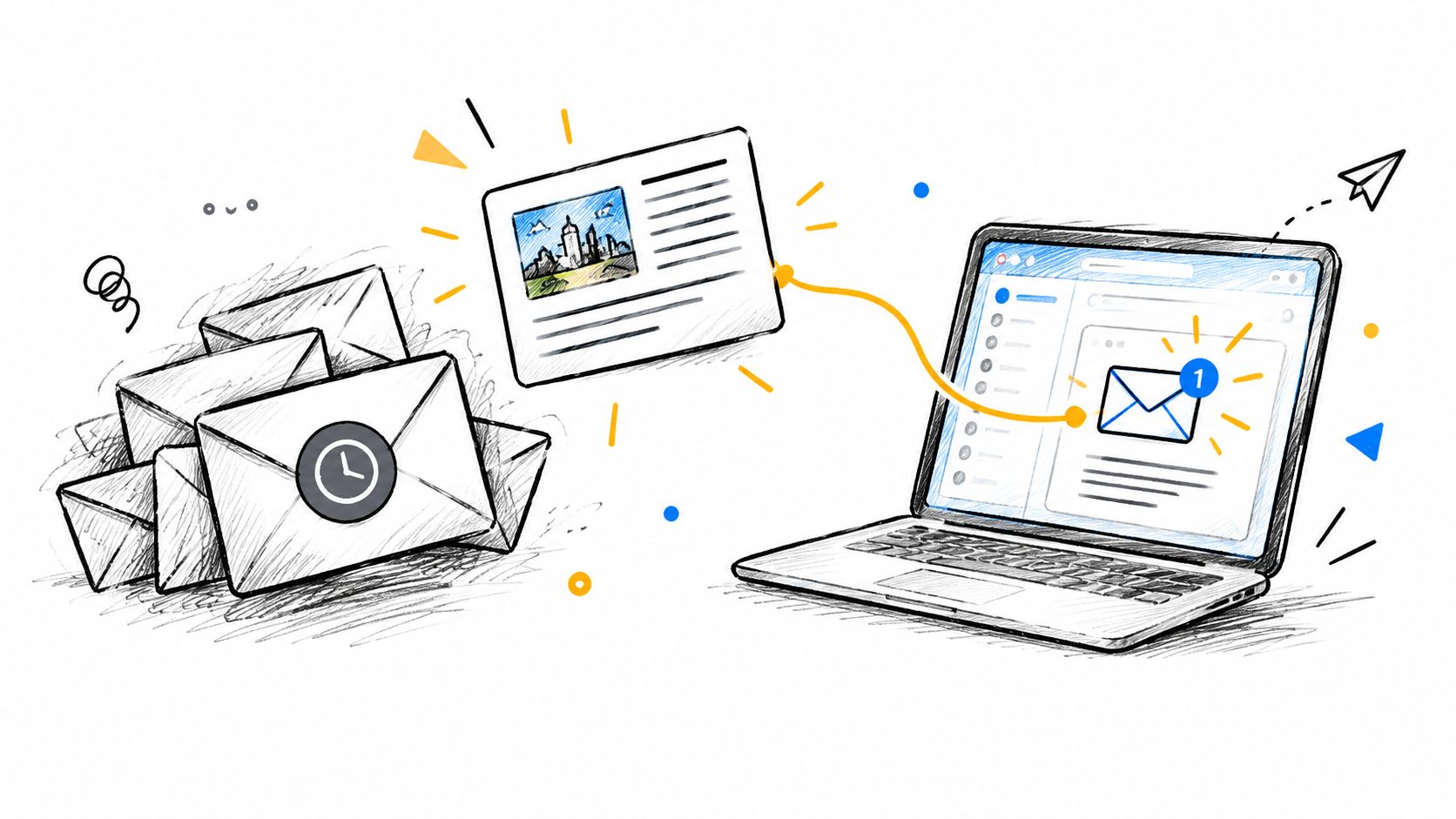
A quiet opportunity isn't, by itself, a reason to email. A relevant change can be.
Possible triggers include a verified leadership announcement, a new initiative, or a planning date the prospect previously mentioned. Check the information before using it, and distinguish what you know from what you suspect.
Subject: [Verified change] and [earlier priority]
Hi [First name],
I saw [verified announcement or previously agreed milestone]. When we last spoke, you were considering [project] but needed [condition] to change.
That may make [specific part of the earlier scope] worth revisiting, although I don't want to assume your priorities are unchanged.
Is [business problem] back on the agenda, or should I leave it paused?
[Name]
Use Automation to Request a Review
Suppose a finance-process consultant sees that a former prospect has appointed a new CFO. That's a reason to review the opportunity, not proof that the new executive wants the old proposal.
The consultant should verify the announcement and inspect the earlier notes. A relevant email might connect the leadership transition to a previously discussed reporting problem, without claiming to know the new CFO's priorities.
Automate the internal task, not the interpretation. An inactivity rule can prompt the owner to investigate, but shouldn't automatically manufacture a timely reason to reconnect.
The failure mode is superficial relevance. Congratulations followed by an unrelated pitch is still an unrelated pitch. If there's no credible connection between the trigger and the earlier business problem, leave the opportunity paused until you have something useful to say.
7. Referral Partner Thank-You and Introduction Request Email
Thank the partner for the introduction before asking them to make another. Their willingness to introduce you deserves acknowledgment regardless of whether the opportunity becomes a client.
Trigger: A partner makes an introduction. Send the thank-you promptly, then share a later outcome only within the boundaries of confidentiality.
Make the Next Introduction Easier
Subject: Thank you for introducing [Name]
Hi [First name],
Thank you for introducing me to [contact]. Your context about [relevant need] helped me prepare for the conversation.
[Brief, permission-appropriate update.]
For future reference, we're especially useful to [ideal client profile] when they're dealing with [recognizable business problem]. If someone asks you for help with that, you're welcome to forward the description below.
[Forwardable description of your work and who it suits.]
Thanks again for thinking of us.
[Name]
For example, a boutique strategy firm could thank an accountant for an introduction and confirm that the conversation took place. It shouldn't share the prospect's budget, internal disagreements, or proposed commercial terms without permission.
- Personalize: Name what the partner contributed, including useful context or a thoughtful fit.
- Automate: Create a thank-you task when an introduction is recorded. Review the message before sending.
- Failure mode: Don't turn every expression of thanks into a demand for more names.
When the relationship supports a direct request, make the client profile recognizable. “An owner considering a leadership transition” is more useful than “any business that needs strategy.”
A clear method for tracking referrals should connect the partner, introduced contact, opportunity owner, and appropriate update. That lets you maintain the relationship without relying on memory or exposing confidential details.
7 Sales Lead Follow-Up Email Templates Compared
| Email Play | Timing / Trigger | Core Move | Value Proposition | Best Audience | Starward Fit |
|---|---|---|---|---|---|
| Speed-to-Lead First Response | Within minutes to 1 hour of a new inquiry | Personal acknowledgment + specific call times | ★★★★★ Captures interest while it's high; 💰 easy to automate | 👥 Small consulting teams handling inbound leads | ✨ Lead capture, routing, and immediate follow-up |
| Post-Discovery Recap + Mutual Action Plan | Within 24 hours of a discovery call | Summarize goals and assign next steps, owners, and dates | ★★★★★ Builds accountability and keeps decisions moving | 👥 Firms with multi-stakeholder sales cycles | 🏆 Supports discovery-stage tracking and proposal handoffs |
| Proposal Follow-Up + Decision-Date Question | 2–3 business days after proposal delivery | Reference the scope and ask about approval steps and timing | ★★★★★ Surfaces objections and prevents quiet proposals | 👥 Consultants and fractional executives sending proposals | ✨ Timed proposal sequences with stage-based triggers |
| The Breakup Email | Final touch after 3–5 unanswered follow-ups | Close the loop while offering an easy way to reconnect | ★★★★☆ Clears stalled leads while preserving goodwill | 👥 Teams with silent leads or proposals | 🏆 Fits stalled-opportunity sequences and long-term nurture |
| Value-Add Resource Share | Mid-sequence or during referral nurture | Share a relevant resource without a hard sell | ★★★★☆ Builds trust over time; 💰 reusable content supports efficient nurture | 👥 Long-cycle prospects not yet ready to buy | ✨ Campaigns and workflows can schedule personalized nurture |
| Stalled Opportunity Re-Engagement | After 30–60 days of inactivity or a relevant business event | Connect a verified new trigger to the prospect's earlier need | ★★★★☆ Reopens relevant conversations instead of sending generic check-ins | 👥 Consultants with quiet opportunities or proposals | 🏆 Supports inactivity triggers and stalled-stage follow-up |
| Referral Partner Thank-You + Introduction Request | Within 2 business days of an introduction; repeat on a nurture cadence | Thank the partner, share an appropriate update, and clarify ideal referrals | ★★★★★ Strengthens referral relationships; 💰 high relationship value at low cost | 👥 Advisors who rely on professional referral partners | ✨ Tracks partner relationships and automates thank-you and nurture workflows |
Building Your Follow-Up Sequence Before the Next Lead Arrives
A sales lead follow up email template is useful only when someone knows when to send it, how to personalize it, and what should stop it. Build those rules around your actual sales stages, not around an undifferentiated list of contacts.
For a starter operating policy, acknowledge inbound requests immediately and aim for a personal response within an hour. Where coverage allows, use the more demanding within-five-minutes target recommended for high-intent inbound leads in this lead-response benchmark summary. Don't apply inbound response findings as promised outcomes for cold outreach.
Use the following as a proposed workflow, not a research-backed universal cadence:
- Discovery completed: Send the recap within 24 hours, with owners and proposed or agreed dates clearly distinguished.
- Proposal delivered: Use days 2 and 5 as provisional check-in points when no review date was agreed.
- Opportunity stalled: Create a review task at 30 days. Send only if there's a relevant reason to reconnect.
- Repeated silence: Consider closing the active sequence after roughly five useful touches, subject to context.
- Referral received: Send the thank-you within two business days, without waiting for a commercial outcome.
Write the first response and discovery recap personally, using the templates as drafting aids. An immediate automated acknowledgment can run alongside that work. Automate timed steps only after you've defined ownership, reply handling, and stopping rules.
Don't force every opportunity through every message. A buyer waiting for approval needs decision support; a buyer who has declined needs the sequence stopped. Resources on client follow-up timing and templates can support drafting, but your recorded agreements should determine the next action.
Review the sequence quarterly against positive replies, booked meetings, proposal movement, and opt-outs, rather than treating opens as the outcome. Read the replies themselves to identify unclear scope, premature meeting requests, and reminders sent after a buyer already answered.
Before adding another template, map your current pipeline stages and assign one template to each follow-up gap.
Starward Navigators provides client acquisition infrastructure for small consulting and advisory firms, including standardized pipelines, automated follow-up, proposal tracking, and referral workflows. Visit Starward Navigators to explore how those components can turn your follow-up templates into an operating process with clear owners and next steps.