A proposal went out last Tuesday. Or was it Wednesday. One founder thinks the other followed up, the client thinks nobody cares, and the notes live in three inboxes and a spreadsheet nobody trusts. That's not a sales problem or a motivation problem. It's what happens when a capable firm tries to organize a business from memory. The work doesn't stall inside stages. It stalls between them, at the handoffs nobody owns.
Table of Contents
- Why Small Consulting Firms Need Real Organization
- Choosing the Right Legal Entity for Your Firm
- Defining Roles and Accountability in a Small Firm
- Building Your Core Operating Workflows
- Structuring Sales and Delivery Pipelines
- Adding Automation Without Losing Judgment
- Practical Tips for Staying Organized as You Grow
Why Small Consulting Firms Need Real Organization
Two consultants start the week delivering client work. By midday they're also chasing an invoice, rescheduling a discovery call, rewriting a proposal, and trying to remember who promised to call a referral partner. Neither person is disorganized by temperament. The firm has no dedicated operations capacity, so the same people sell, deliver, administer, and repair mistakes.
That structure is the norm, not the exception. The U.S. Small Business Administration count of 34,752,434 small businesses in 2023 included 28,477,518 nonemployer firms, or 81.9%, and 6,274,916 firms with paid employees, or 18.1%. A 2 to 20 person advisory firm usually can't afford separate sales operations, client success, and revenue operations roles. It needs repeatable procedures that do some of that coordinating work.
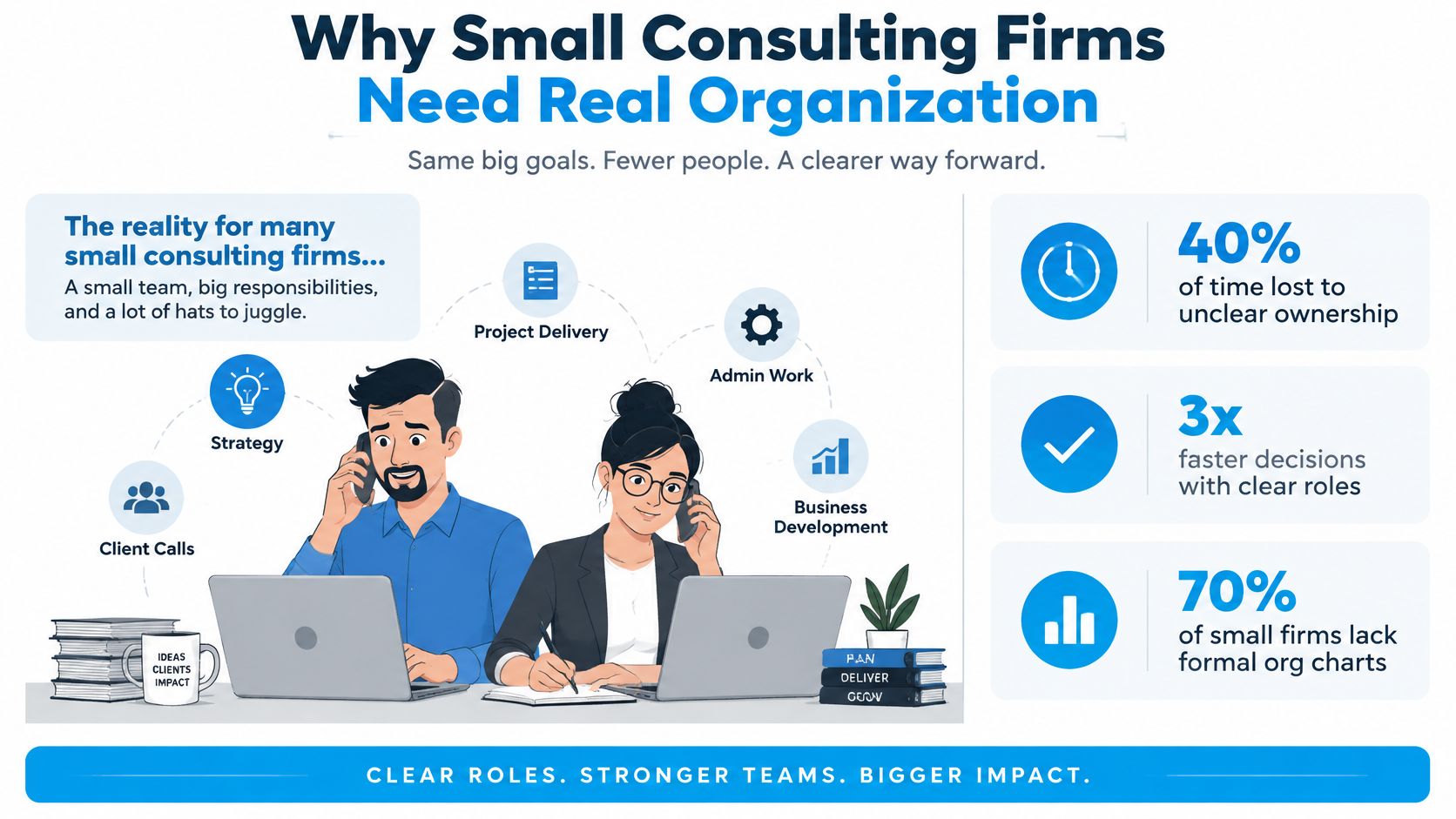
The visual below frames that overload, with the same small team carrying strategy, client calls, and administration at once.
What Organized Actually Means Here
For a small consulting firm, organized doesn't mean color-coded folders or a tidy contact list. It means assigned ownership, standardized recurring work, and a dated next action on every live opportunity. If a founder goes on vacation, another person can open the record and know what happened, what's due, and who owes the next move.
- Ownership is explicit: Every prospect, proposal, and client has one named owner.
- Information is centralized: Forms, email, events, and referrals land in one record.
- Progress is visible: You can see what's stalled without asking around.
Practical test: If the answer to "what happens next with this client" lives only in someone's head, you don't have a system yet. You have a memory with good intentions.
That distinction matters commercially. Clients judge your professionalism partly by how reliably you follow through between conversations. A firm that responds promptly, sends what it promised, and starts delivery without confusion looks larger and safer than it is. Organization, done this way, is a trust signal, not back-office housekeeping.
Choosing the Right Legal Entity for Your Firm
Entity choice feels administrative until you sign your first substantial client contract or bring in a partner. Then questions about personal liability, taxes, and who can bind the firm stop being theoretical. You don't need the most complex structure. You need one that matches your risk, your ownership plans, and your tolerance for paperwork.
The Practical Options
A sole proprietorship is simplest to start, but it offers no separation between you and the business. That can be a poor fit once you're advising clients whose decisions carry financial consequences. An LLC creates a legal separation and flexible ownership, which is why solo consultants and small partnerships often start there. An S corp can change how income is taxed for owners who work in the business, but it adds payroll and formalities. A C corp suits firms planning outside investment or broad equity issuance, which most boutique advisory practices aren't pursuing early.
If you're weighing the two most common paths for a small practice, it's worth taking time to compare LLC and S Corp structures on liability, taxation, and administrative burden before you file. That comparison is more useful than copying whatever structure a peer chose for different income and ownership circumstances.
Registration, Contracts, and Insurance
Once you've chosen, complete the unglamorous basics in one pass. Register the entity, get an employer identification number if needed, open separate business banking, and check local licensing requirements. Put client work under written agreements that name the entity, not you personally.
- Separate the money: Don't mix personal and firm accounts, even informally.
- Document ownership: Two partners need written terms for equity, decisions, and exit.
- Insure the advice: Professional liability coverage belongs in the conversation before a dispute, not after.
Solo consultants with low-risk work can sometimes keep this simple. Firms hiring employees, splitting equity, or serving larger clients shouldn't guess. A short consultation with an attorney and a tax professional costs less than unwinding the wrong structure later.
Defining Roles and Accountability in a Small Firm
Most small firms don't need an org chart. They need an accountability map. An org chart says who holds a title. An accountability map says who owns lead response on Friday afternoon, who chases a quiet proposal, and who tells delivery that a deal has closed.
The image below captures a familiar working session, with sticky notes standing in for decisions that should live in a shared system.

Coordination eats real capacity. German SMEs spend about 7% of working hours on administrative processes, equivalent to roughly 1.5 billion hours annually, while sole traders spend 8.7% of working time on such tasks, according to the administrative burden figures for German SMEs and sole traders. You can't eliminate that work, but unclear ownership makes people redo it, check on it, and apologize for it.
Assign the Transition, Not Just the Task
Break your firm into transitions and give each one an owner, a deadline, and a fallback. Inquiry to discovery needs someone accountable for first contact and scheduling. Discovery to proposal needs an owner for drafting, internal review, and sending. Proposal to decision needs a person who follows up until there's a yes, a no, or an agreed pause. Sale to delivery needs someone who transfers scope, dates, contacts, and promises made during selling.
| Transition | Owner answers for |
|---|---|
| Inquiry to discovery | First response and booked meeting |
| Proposal to decision | Follow-up cadence and next step |
| Sale to delivery | Complete handoff and kickoff date |
In a two-person firm, one person will own several transitions. That's fine. Write it down anyway, and name who covers during absence. In a 20-person firm, split ownership by service line or client segment, but keep one accountable name per transition. Shared ownership usually means nobody checks the exception list.
When two people are both responsible for follow-up, each reasonably assumes the other has handled it.
Avoid designing roles around personalities alone. The person who enjoys networking may be a weak proposal closer. Assign based on the outcome required, review aging work weekly, and move ownership if the evidence says the match isn't working.
Building Your Core Operating Workflows
Workflows should describe state changes, not vague activity. Use a finite-state model for the client lifecycle: New, Contacted, Discovery Complete, Proposal Sent, Decision Pending, Won or Lost, Delivery Active, and Referral Nurture. A record sits in one state, and it can only move when defined conditions are met.
The flow below shows that progression in simplified form, including the loop back when a proposal needs revision.
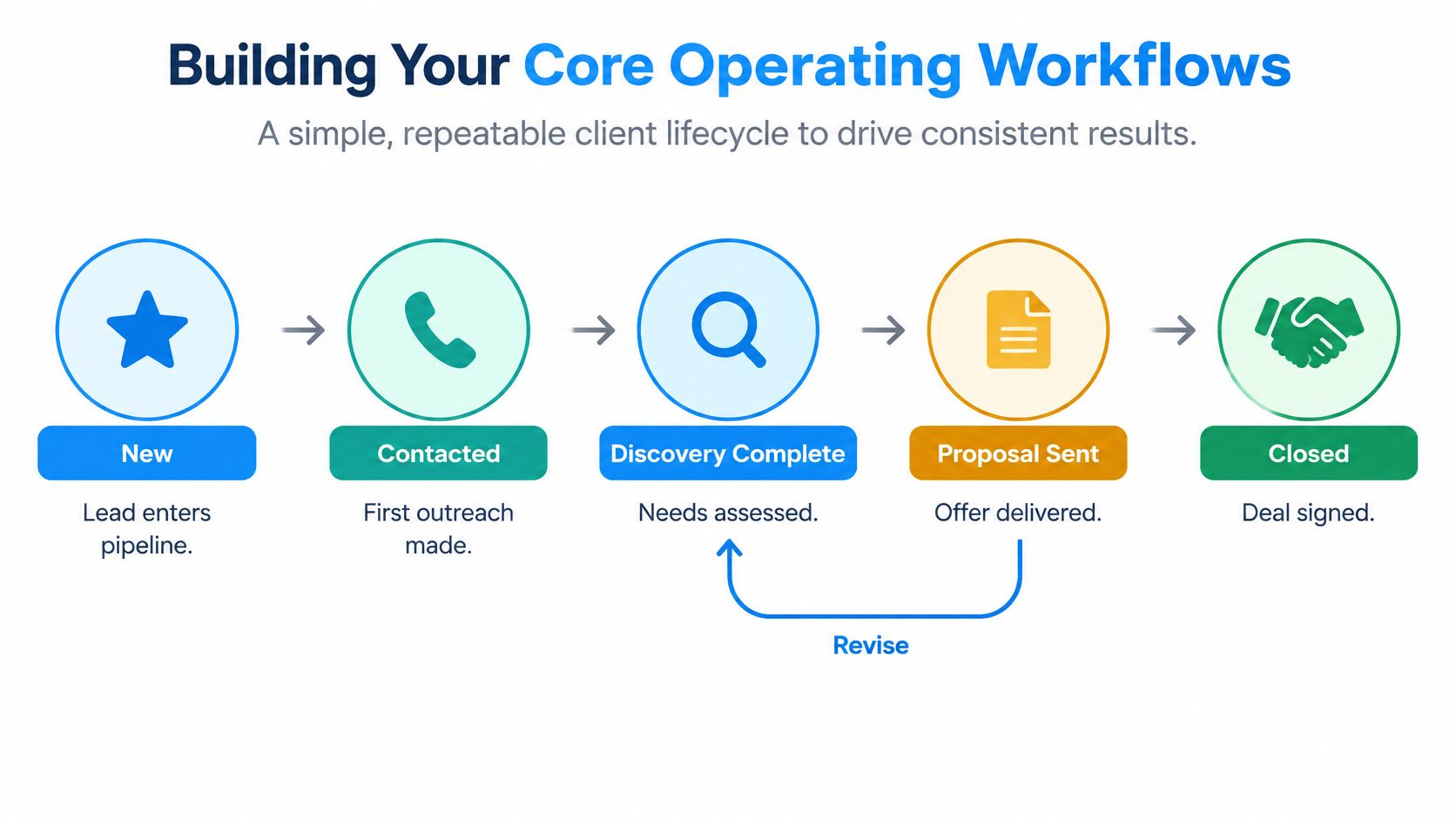
For each state, define the entry condition, required fields, owner, permitted next states, maximum age, and automated action. Proposal Sent, for example, should require proposal value, decision date, service line, and a dated next step. If those fields are empty, the record isn't ready to advance.
Data Rules That Prevent Quiet Decay
This discipline isn't bureaucratic. CRM quality research reports that 76% of users consider less than half of organizational data accurate and complete, while only 3% of businesses meet basic data-quality standards, as summarized in the CRM data quality figures on accuracy and basic standards. Free-text statuses and optional next steps produce exactly that kind of decay.
- Validate core fields: Source, service line, decision date, proposal value, next step, and consent status.
- Block bad movement: Don't let a proposal advance without a dated next action.
- Review exceptions weekly: Missing owners, stale stages, duplicates, and overdue tasks.
The video below is useful background on turning these operating choices into an aligned execution model.
When you're connecting this workflow design to broader firm goals, The OKR Hub's strategy execution alignment guide provides a helpful frame for linking operating model choices to outcomes. For the delivery side specifically, a defined client onboarding workflow turns a won deal into kickoff tasks, owner notifications, and first deliverables without a manual relay.
Some firms build this in a generic CRM such as HubSpot or Pipedrive and configure the states themselves. Others use Starward Navigators, which provides prebuilt pipelines, follow-up sequences, reminders, proposal tracking, and handoff automation configured during setup. Either route works if the state model is clear first. Software can't rescue undefined ownership.
Structuring Sales and Delivery Pipelines
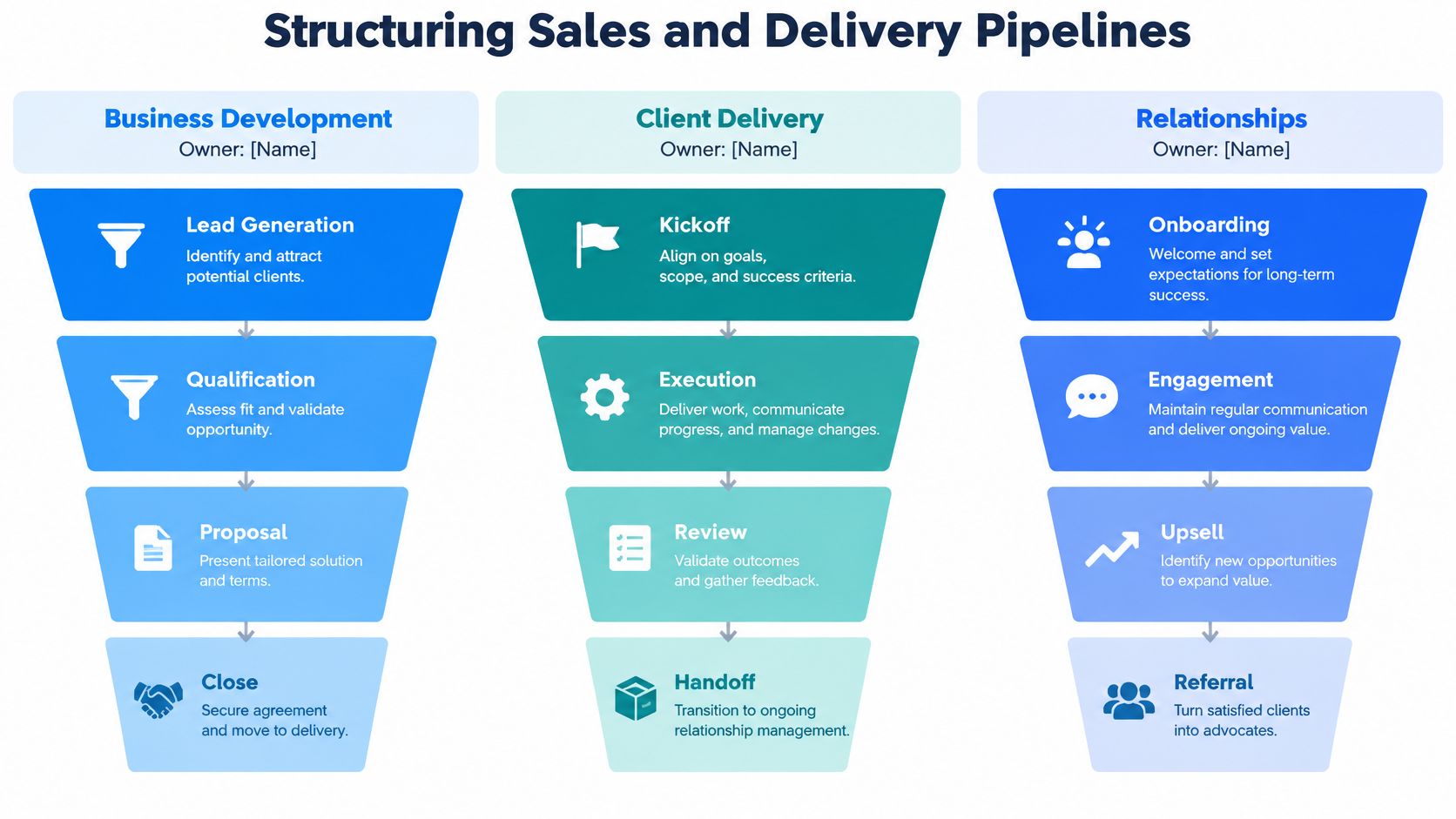
Run three connected pipelines, not one overloaded list. Business Development moves prospects from inquiry to decision. Client Delivery moves signed work from kickoff to completion. Relationships and Referrals keeps past clients and partners active after delivery ends. Each pipeline needs its own stages because the next action and owner differ.
The diagram below shows those three pipelines side by side, with stages and an owner placeholder for each.
Put a Service Level on Lead Response
"Follow up soon" isn't a standard. Capture every inquiry from forms, email, social channels, and events into one record, assign an owner by territory, service line, or round-robin rules, and send an immediate acknowledgement. Then require human action within 5 minutes during staffed hours, with escalation at 5, 15, and 60 minutes for unworked leads.
Speed matters at contact stage. Research analyzing more than 15,000 web leads and over 100,000 call attempts found the odds of contact were about 100 times higher at 5 minutes than at 30 minutes, while qualification odds were about 21 times higher, as reported in the lead response time research on contact and qualification odds. The same source describes a Harvard Business Review audit of 2,241 companies where firms responding within an hour were nearly seven times more likely to qualify a lead, and 23% never responded.
Don't treat those figures as guaranteed close-rate lifts. They measure contact and qualification, not completed sales. Establish your baseline, then run a controlled 30-day comparison by lead source using median first-response time, contact rate, qualification rate, and source-level conversion.
Close the Proposal and Handoff Gaps
The proposal-to-decision stage is where polite silence kills revenue. Every sent proposal needs a decision date, a follow-up sequence, and an owner who is expected to ask for an outcome. Measure stage conversion, median days in stage, and handoff defects, not just lead volume.
When a deal is won, trigger delivery automatically. Create the delivery record, notify the owner, schedule kickoff, and move the relationship into nurture after completion. A disciplined approach to how to track referrals then keeps satisfied clients and partners from becoming names you remember only when pipeline is thin.
Adding Automation Without Losing Judgment
Automate everything is bad advice for an advisory firm. Some work is predictable coordination. Some work is the product clients are paying for. Confusing those categories creates efficient processes that produce weak advice, awkward messages, and commitments nobody approved.
The pressure is real, especially for smaller firms. In a 2025 survey of architecture, engineering, and consulting firms, 58% identified technology integration and data, including AI, as their primary project-delivery challenge during the previous year, and the cited comparison showed the challenge at 40% versus 25% for small and medium firms versus large firms, according to the 2025 survey figures on technology integration as a delivery challenge. The firms that could benefit most from automation may have the least capacity to govern it.
Draw the Human Review Line
Low-risk orchestration is safe to automate: lead capture, routing, reminders, appointment confirmations, internal alerts, thank-you messages, and overdue task notices. These actions move information. They don't interpret it.
High-judgment work requires a person: diagnosing client needs, shaping and pricing a proposal, interpreting sensitive information, negotiating scope, and approving commitments. An AI draft can start a message, but a named person should review anything that carries advice, a price, or a promise.
- Protect sensitive data: Decide what client information should never enter an automated workflow.
- Log corrections: When someone overrides an automation, record why.
- Plan for failure: Alerts should go to a person when a workflow breaks or a record stalls.
- Test edge cases: Duplicate contacts, out-of-hours leads, and changed meeting times expose weak rules.
Operating rule: Automate the reminder, not the recommendation.
A human-in-the-loop model gives you speed without pretending automation equals professional quality. Require explicit approval at commercial and advisory decision points, keep an audit trail, and review automated messages periodically for tone. Clients don't object to efficient firms. They object to feeling processed by a system that wasn't listening.
Practical Tips for Staying Organized as You Grow
Start smaller than you think you should. A two-person firm that maintains eight clear stages will outperform a larger firm with a elaborate system nobody updates. Standardize lead intake and proposal follow-up first, because those transitions affect revenue soonest. Add delivery and referral detail once the basics hold.
Avoid the failure modes that quietly break otherwise good systems.
- Too many stages: Every extra stage creates another place for work to hide.
- Free-text statuses: People invent labels, and reporting becomes meaningless.
- Automation before ownership: A workflow can't escalate to a person who was never assigned.
- Activity counting: Calls made is less useful than stage aging and progression.
Build maintenance into the week. During implementation, import a deduplicated contact file, test representative edge cases, train users on the state model, and audit 20 to 30 records per week for the first month. Keep the weekly exception report after that. It's the cheapest management meeting you'll ever run.
Measure improvement against a baseline you recorded before changing tools. Track median days in stage, rework, and referral reactivation alongside new business. As your top of funnel grows, disciplined generating leads for email marketing only helps if those leads enter the same owned, timed, and measurable process as every referral and event contact.
If your firm is losing momentum between inquiry, proposal, and delivery, Starward Navigators can install the pipelines, follow-up sequences, reminders, and handoffs described here as one operating system for your practice. Visit the site to see how the Map, Install, and Go Live setup works and whether it fits your firm's size and service lines.