A good prospect rarely announces that they're ready to buy. They fill in a form late at night, reply to an old email, or introduce themselves after a talk. What happens next usually decides more than your expertise does. If nobody owns that moment, records it, or follows up on time, the opportunity fades.
Table of Contents
- The Moment a New Inquiry Lands in a Small Advisory Firm
- What a Funnel Actually Is in Plain Language
- The Stages a Consulting or Advisory Funnel Actually Uses
- Why the Funnel Does Not End at the Signed Proposal
- Response Latency as a Funnel Metric You Can Actually Measure
- The Hybrid Funnel Where Self-Service Meets Human Judgment
- How Advisory Firms Wire a Funnel Into One Operating System
- A Quarter of Funnel Decisions You Can Make This Week
The Moment a New Inquiry Lands in a Small Advisory Firm
It's 9.47 p.m. and a website form fires. A finance director has read your article, checked two biographies, and asked for a consultation. The notification goes to a shared inbox that three people monitor and none of them owns.
Three Inquiries and Three Different Outcomes
On Friday afternoon, someone else sends a LinkedIn message to a partner who's travelling. On Monday, a colleague returns from an event with business cards in a jacket pocket. By Wednesday, the firm has three real opportunities and no shared record of who responded, what was promised, or what should happen next.
One prospect gets a thoughtful reply within the hour. Another waits two days because everyone assumes someone else replied. The third gets two replies from different people asking the same opening questions.
A missing funnel doesn't usually look like chaos. It looks like reasonable people improvising, each unaware of what the others have already done.
None of this tells you the firm needs more inquiries. It may already have enough interest to grow, including people who arrived through referrals, events, direct outreach, or readers generating leads for email marketing campaigns. What it lacks is a reliable way to turn scattered interest into a sequence of owned actions.
What Gets Lost Without a Shared Path
- Timing becomes accidental: A prompt response depends on who's awake, available, or checking the right inbox.
- Ownership stays fuzzy: Nobody can say confidently who should book the call, send background material, or chase a quiet proposal.
- History disappears: Notes live in email threads, calendars, memory, and spreadsheets that don't agree with each other.
- Learning never starts: You can't tell whether prospects stall because they're unqualified, badly briefed, waiting too long, or missing a clear next step.
That is the practical answer to what are funnels used for in a small advisory firm. A funnel gives every inquiry the same entry point, a named owner, a defined next action, and a visible place in the firm's work. It protects reputation before it improves marketing. A prospect experiences one coherent firm, not a collection of busy individuals trying to remember what they said last Tuesday.
What a Funnel Actually Is in Plain Language
Think of a restaurant kitchen ticket rail. The server doesn't shout an order into a crowded room and hope the right cook remembers it. The order becomes a ticket, moves along the rail, and passes through stations in sequence. Starters come before mains, allergies stay visible, and nothing leaves the pass until someone checks it.
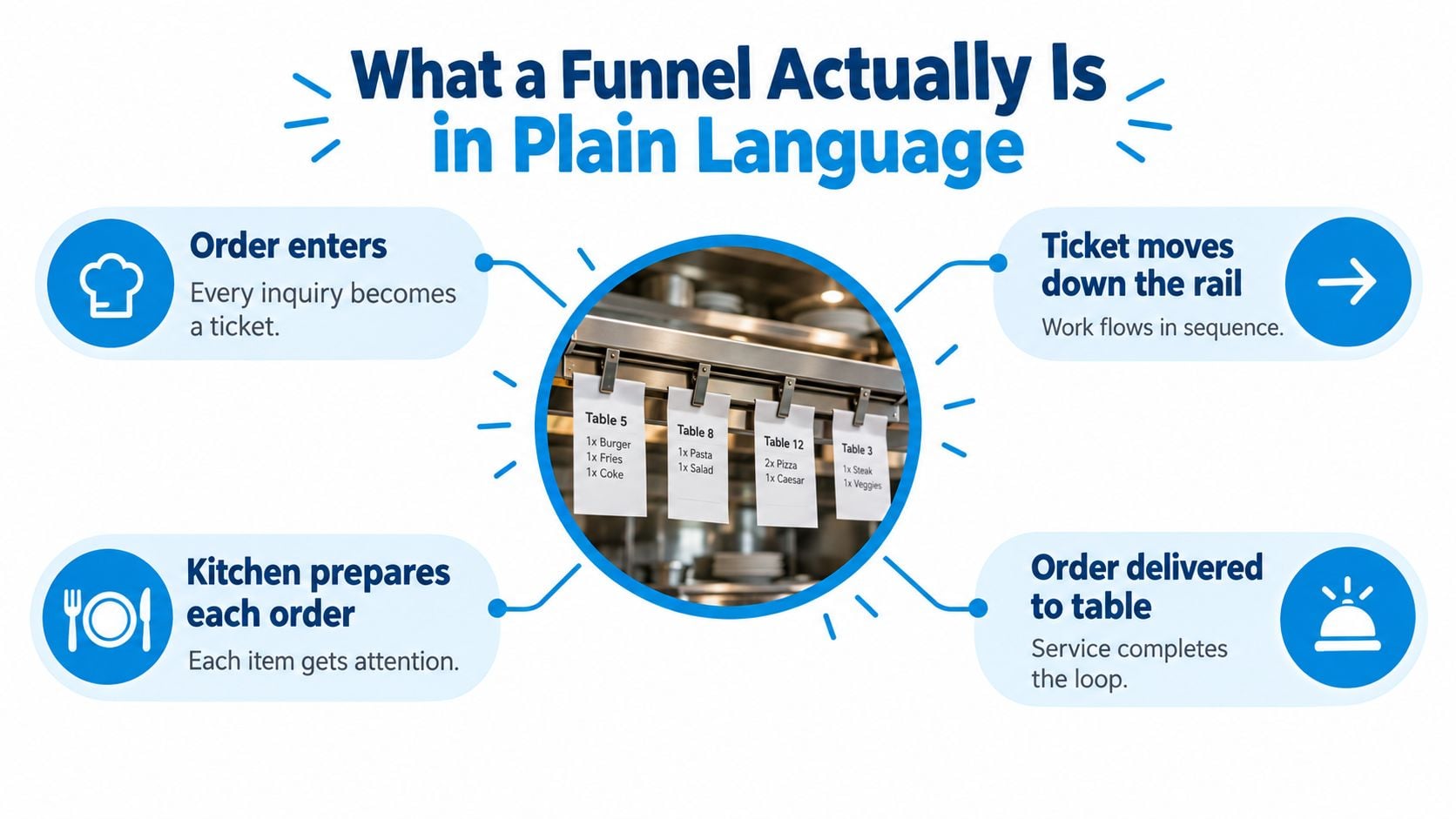
A funnel does the same work for a prospect. Every inquiry becomes a ticket. Each stage has a job, an owner, and a check before the ticket moves on.
Why the Shape Narrows
Many people can become aware of your firm, fewer will make contact, fewer still will be a good fit, and a smaller group will sign. That narrowing isn't failure by itself. It's what lets you stop treating every contact as equally ready to buy and give each person the response that fits their stage.
The historical root is the AIDA model, which stands for Attention, Interest, Desire, and Action. Advertising pioneer Elias St. Elmo Lewis developed it in 1898, and William Townsend associated AIDA with a funnel in 1924, a history traced in the Content Marketing Institute discussion of funnel and lifecycle marketing. The shape captured a simple truth. A large pool enters, and progressively fewer people advance.
Diagram Versus Operating Framework
A diagram on a slide changes nothing. An operating framework changes who does what on Monday morning. It defines stages, assigns ownership, creates follow up, and lets you calculate conversion rates between stages.
Plain test: If a stage has no entry signal, no exit check, and no named owner, it's a label, not a stage.
That distinction matters for forecasting too. If you know how many qualified opportunities typically become proposals, and how many proposals become clients, you can estimate future revenue and work out how much new activity you need. The funnel becomes a management tool, not a poster from a marketing course.
The Stages a Consulting or Advisory Funnel Actually Uses
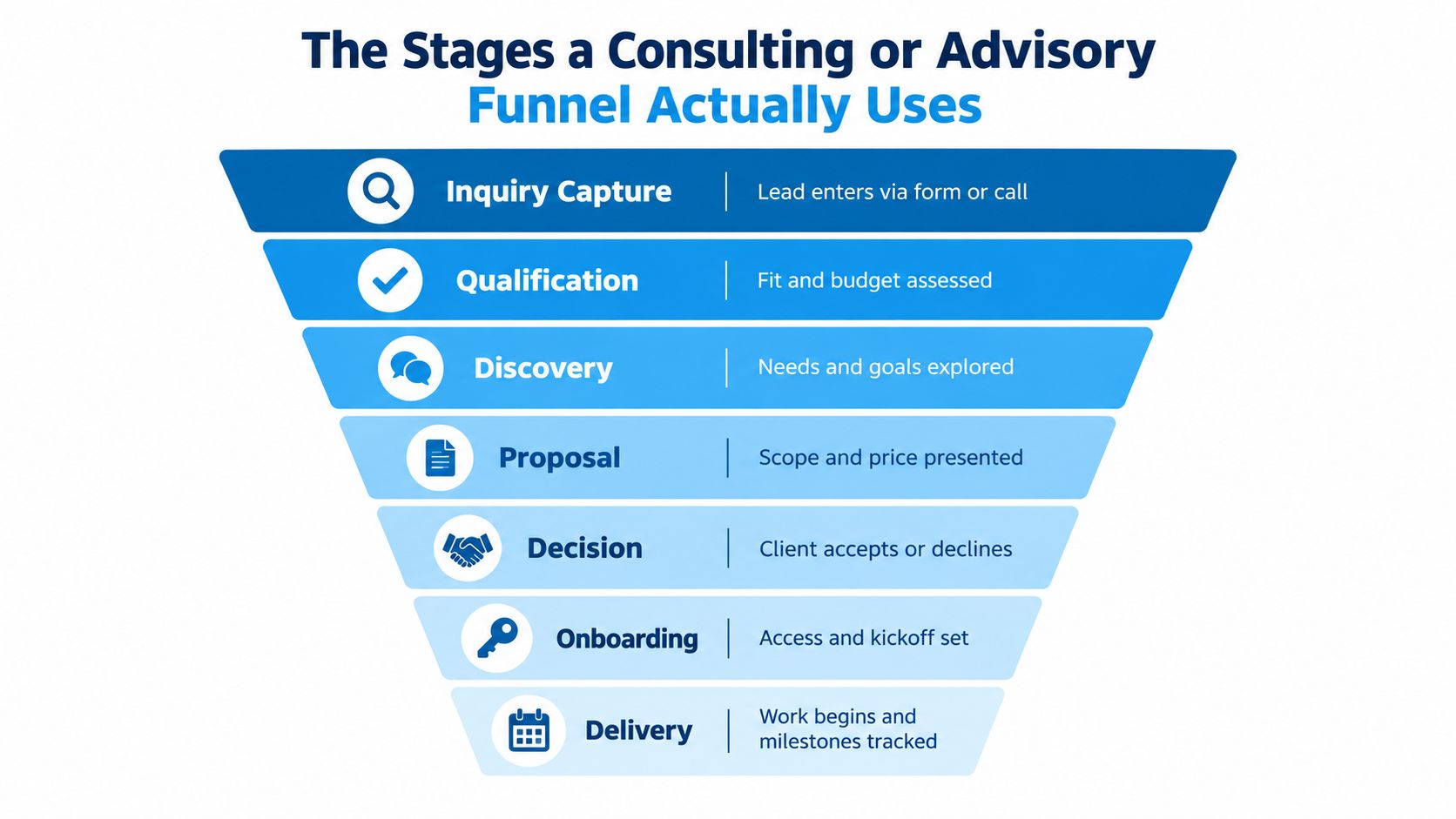
E-commerce funnels focus on carts and checkouts. Consulting buyers make slower, higher risk decisions with several people involved, so your stages need to reflect qualification, diagnosis, and trust. The diagram below sets out the sequence most small advisory firms can adopt without inventing their own language first.
The Seven Working Stages
- Inquiry Capture: A form, call, referral, or message creates a record. Exit means an owner is assigned and first contact is underway. Watch untriaged volume.
- Qualification: You check fit, urgency, decision access, and budget range. Exit means the problem is real and worth exploring. Watch the qualified rate by source.
- Discovery: A consultant explores needs, constraints, stakeholders, and desired outcomes. Exit means you can state the problem back accurately. Watch how many discoveries produce a proposal.
- Proposal: Scope, price, timing, and risks go into a written offer. Exit means the buyer has it and a decision conversation is scheduled. Watch age since sending.
- Decision: The client accepts, declines, or agrees a revised scope. Exit requires a recorded outcome, not silence. Watch proposal win rate.
- Onboarding: Contracts, access, introductions, and kickoff happen. Exit means delivery can start without chasing basics. Watch time to kickoff.
- Referral: A satisfied client or partner is asked and tracked properly, using a consistent approach to how to track referrals rather than relying on memory. Watch referral opportunities created.
This logic matches the classic B2B sequence of prospecting, approach, presentation, objection handling, closing, and follow up described in research on B2B sales funnel stages and metrics. Teams troubleshooting where deals stall after each stage can also compare their follow up cadence with this guide for sales teams on follow-ups, which usefully separates stage completion from simple activity.
The short walkthrough below shows how stage discipline looks when a team reviews live opportunities rather than a static diagram.
If many people reach discovery but few reach proposal, look at qualification quality, decision maker access, or offer positioning first. If proposals pile up without decisions, don't add more top end activity. Fix next steps, ownership, and time based follow up in the stage that's leaking.
Why the Funnel Does Not End at the Signed Proposal
Signing feels like the finish line because it's the moment revenue becomes real. For the client, it's the start of the risk. They've committed money, introduced you to colleagues, and now need proof that choosing you was safe.
Loyalty Cannot Be Assumed
McKinsey built its consumer decision journey work from research involving almost 20,000 consumers across five industries and three continents, and later expanded the database to more than 125,000 consumer decision journeys across 350 brands and 30 industries, as set out in McKinsey's consumer decision journey research. That later analysis found 90% of the categories studied showed no customer loyalty, 58% of customers changed brands between purchase cycles, and nearly 70% of brand choices were made when consumers were first triggered to shop.
Those are consumer markets, not advisory engagements, so don't copy the numbers into your forecast. Take the warning seriously. A past purchase doesn't guarantee the next one, and being remembered at the next trigger moment is work you have to organise.
The Post Signature Stages Do Commercial Work
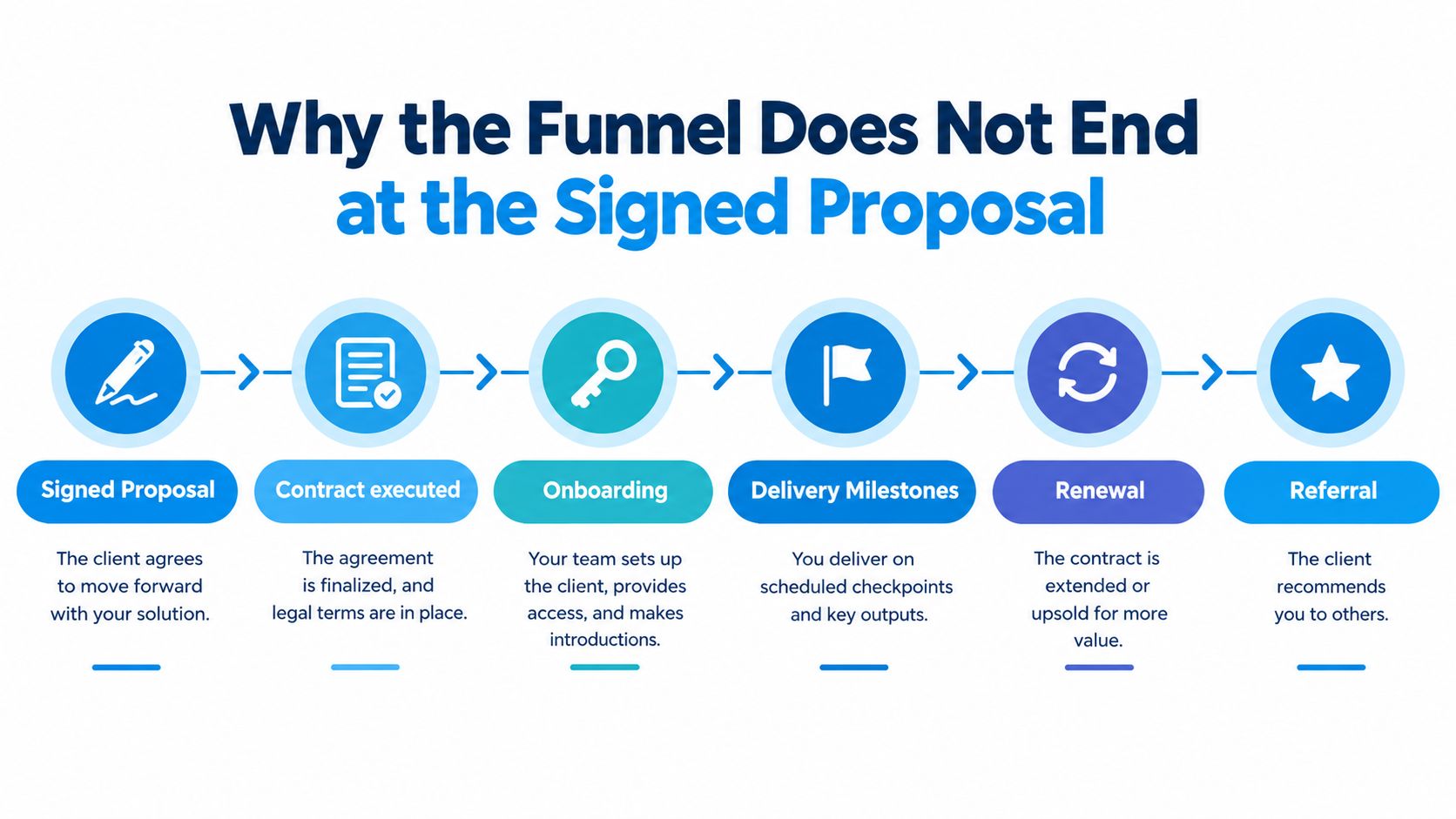
A useful lifecycle funnel keeps checkpoints after conversion. Onboarding confirms access, owners, and kickoff, which is why a clear definition of what is client onboarding helps delivery and business development use the same handoff language. Delivery milestones create natural moments to confirm value, surface problems early, and identify expansion needs. Renewal gets a trigger date rather than a last minute scramble. Referral becomes a stage with an owner after a result, not a hopeful favour asked at random.
Retention and advocacy don't need a separate philosophy. They need the same discipline you used to win the work, entry signals, owners, next actions, and review dates.
Treat the funnel as a measurable lifecycle and you can see the whole commercial relationship. Treat it as a line ending at signature and the most profitable part of that relationship runs on goodwill and memory.
Response Latency as a Funnel Metric You Can Actually Measure
Two firms can receive the same inquiry and create completely different odds by responding at different speeds. An analysis of 2,241 U.S. companies found that firms contacting online leads within one hour were nearly seven times more likely to qualify a lead than firms waiting an additional hour, while waiting 24 hours or longer made qualification dramatically less likely, according to the speed to lead analysis of company response times.
That doesn't mean a consultant should write a rushed diagnosis at midnight. It means the prospect should quickly know they're in the system, who owns them, and when a human will speak with them.
Funnel Latency Timestamps Worth Capturing
| Timestamp | Trigger Event | Owner | Funnel Purpose |
|---|---|---|---|
| Lead Created | Form, call, email, or message received | System | Starts the response clock |
| Owner Assigned | Record routed to a named person | Operations lead | Removes shared inbox ambiguity |
| Acknowledgement Sent | Automated confirmation delivered | System | Confirms receipt and sets expectations |
| First Human Contact | Call, email, or message from a person | Assigned consultant | Measures real responsiveness |
| Meeting Booked | Discovery call enters calendars | Owner | Shows progression beyond contact |
| Next Action Due | Follow up task created after each step | Stage owner | Prevents quiet stalls |
Segment those intervals by source, geography, service line, and owner. Slow replies from one event channel may reveal a data entry problem. Slow replies under one owner may reveal capacity, not lead quality. Without segmentation, you'll argue from anecdotes.
Automate the Clock and Keep the Conversation Human
Automation should capture the inquiry, route it, send confirmation, create the task, remind both sides about the meeting, and escalate a record nobody has touched. The consultant then handles the conversation where judgement matters.
- Set a visible target: Define what prompt means during working hours and what happens outside them.
- Review exceptions weekly: Look at untouched and overdue records before you review total lead volume.
- Measure human contact separately: An instant auto reply shouldn't disguise a three day wait for a person.
That's what makes latency a funnel variable. You're not chasing speed for its own sake. You're reducing avoidable delay at the exact point where intent fades and a competing firm can become the first useful conversation.
The Hybrid Funnel Where Self-Service Meets Human Judgment
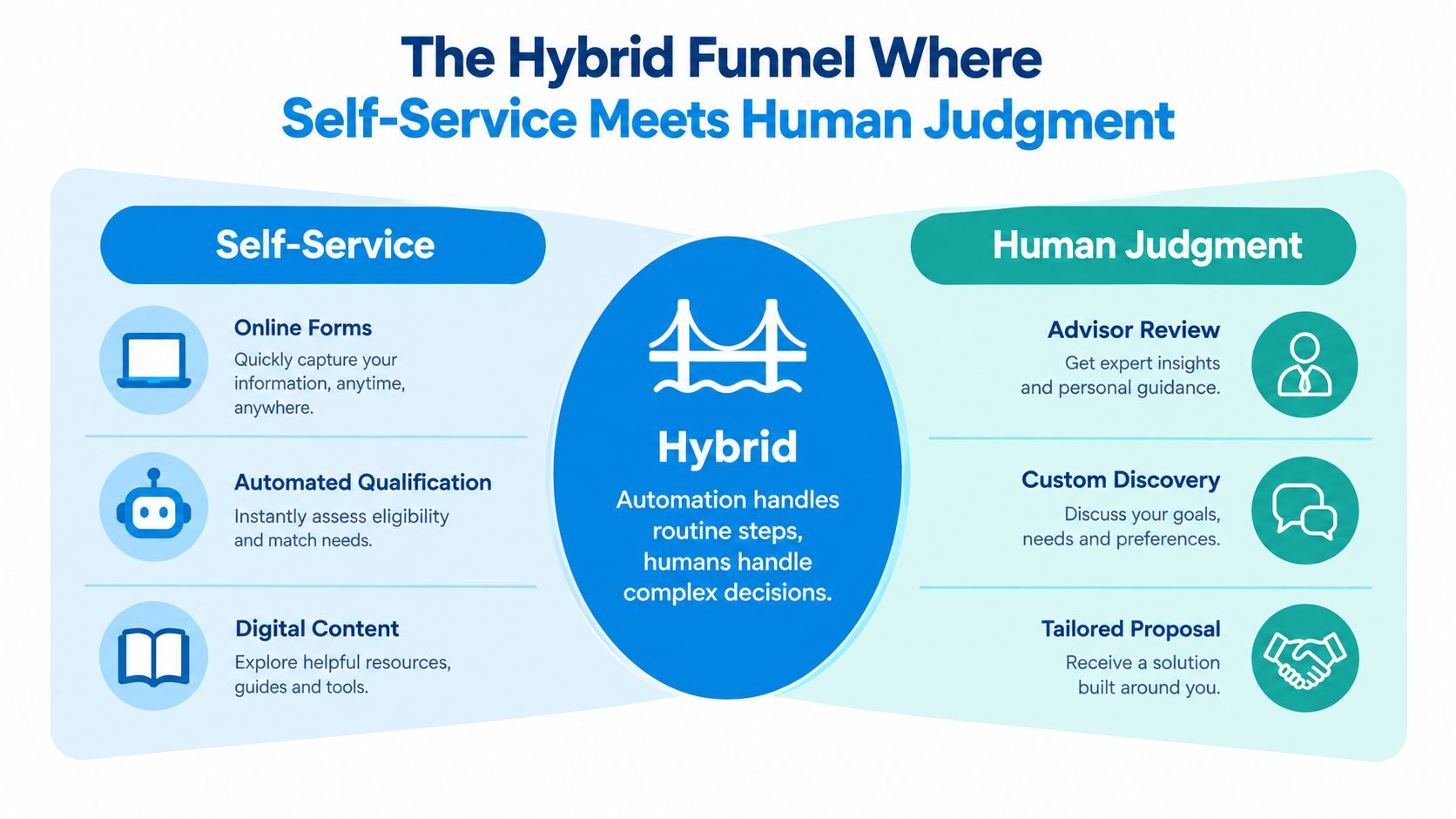
Buyers want two things that sound contradictory. They want to research without being chased, and they want expert help once the decision affects their organisation. A smart funnel doesn't force you to choose between automation and consultants. It routes each question to the mode that fits it.
What Buyers Prefer Depends on the Task
Gartner reported in 2025 that 61% of B2B buyers preferred an overall rep-free buying experience, while buyers still preferred seller input for tasks requiring contextual intelligence, such as judging whether an offering fits their organisation, in its 2025 survey of B2B buyer preferences. The same research found buyers using digital self-service were 1.65 times more likely to regret a purchase, while rep assisted digital paths cut buyer regret by half.
Read that carefully. Removing people everywhere isn't modern. It can push complex judgement onto a buyer who doesn't yet know what to ask, then leave both sides managing a poor fit.
Where Each Mode Belongs
- Self-service handles low context work: Service explanations, typical engagement shapes, preparation guides, qualification questions, scheduling, reminders, and document collection.
- Consultants handle high context work: Diagnosis, stakeholder conflict, scope boundaries, risk, sequencing, commercial trade offs, and whether the firm should decline the work.
- The handoff needs a trigger: A completed diagnostic, a request for pricing, a multi stakeholder problem, or signs of urgency should move the prospect into a named human conversation.
Measure that handoff directly. Track time from trigger to human contact, discovery completion after handoff, and whether proposals from self-service routes need more rescoping than consultant led routes. If rescoping is common, your education content may be promising too much or qualifying too little.
Design rule: Automate information and logistics. Keep people responsible for interpretation, recommendation, and the decision not to proceed.
This is the underserved answer to what are funnels used for in advisory work. They don't just generate leads. They help buyers make decisions at the point where general information stops being enough.
How Advisory Firms Wire a Funnel Into One Operating System
A 12 person firm doesn't need one giant pipeline stretching from first click to final invoice. It needs connected pipelines that hand work over cleanly, because business development, delivery, and relationships move at different speeds and have different owners.
Three Pipelines That Share One Record
Business Development runs from inquiry capture through qualification, discovery, proposal, and decision. Client Delivery begins when a deal is won, then tracks onboarding, kickoff, milestones, and renewal readiness. Relationships and Referrals tracks partners, past clients, introductions, nurture touches, and thank you actions.
The connection matters more than the software category. When a proposal is won, the record should update, the delivery pipeline should start, the delivery owner should be notified, and kickoff scheduling should begin without someone retyping the client's details. When delivery reaches a successful milestone, the relationship pipeline should receive a referral task at a sensible time.
For teams reviewing the capture end of that wiring, SupportGPT's lead capture automation is a useful reference on turning form and chat interest into routed records rather than isolated notifications. The principle is the same in any stack. Capture once, route immediately, and make the next action visible.
Follow Up Sequences Matched to the Stall
- New lead sequence: Confirmation, owner assignment, first human outreach, and escalation if untouched.
- Discovery sequence: Preparation material, calendar confirmation, reminders, and an internal alert after the call for notes and next step.
- Proposal sequence: Scheduled decision conversation, time based follow up, and a clear owner until the outcome is recorded.
- Stalled opportunity sequence: A respectful reactivation prompt tied to the original problem, not generic checking in.
- Referral nurture sequence: Partner updates, useful introductions, and thanks that happen because the stage requires them.
Starward Navigators is one example of a prebuilt operating system for this pattern, with Business Development, Client Delivery, and Relationships and Referrals pipelines, automated follow up, proposal tracking, onboarding handoffs, a Map, Install, Go Live implementation process, and a 14-day go-live guarantee. Whether you buy a system like that or configure tools you already own, judge it by the same test. Can a new consultant open it and see every prospect, owner, deadline, proposal, handoff, and referral without asking around?
A Quarter of Funnel Decisions You Can Make This Week
- Adopt seven stages: Capture, qualification, discovery, proposal, decision, onboarding, referral.
- Set response targets: Define prompt first human contact for every stage.
- Divide the work: Automate logistics, keep diagnosis and recommendations consultant led.
- Review two metrics monthly: Stage conversion and latency to human contact.
- Name pipeline owners: Assign one accountable person per pipeline.
If your inquiries, proposals, onboarding, and referrals still live across inboxes and spreadsheets, Starward Navigators can install the connected pipelines, follow up, reminders, and handoffs described here as one operating system for your advisory firm. Visit the site to see how the Map, Install, Go Live process works and whether it fits the way your team wins and keeps clients.