The most popular business growth advice is to get more leads, close more deals, and hire when the team gets busy. That can leave a consulting firm with a fuller calendar and a weaker business. More sales aren't progress if the owner becomes the bottleneck, delivery costs climb, and clients don't return.
So, what is business growth when you're running an advisory firm? It's an increase in valuable work that your business can win, deliver, and sustain without losing control of its economics.
Table of Contents
- What Business Growth Means Beyond Revenue
- Three Types of Growth and the Stages Behind Them
- Metrics That Show Whether Growth Is Real
- Repeatable Operations and Client Acquisition Handoffs
- Misconceptions That Mislead Growing Firms
- Build Your Growth Scorecard This Quarter
What Business Growth Means Beyond Revenue
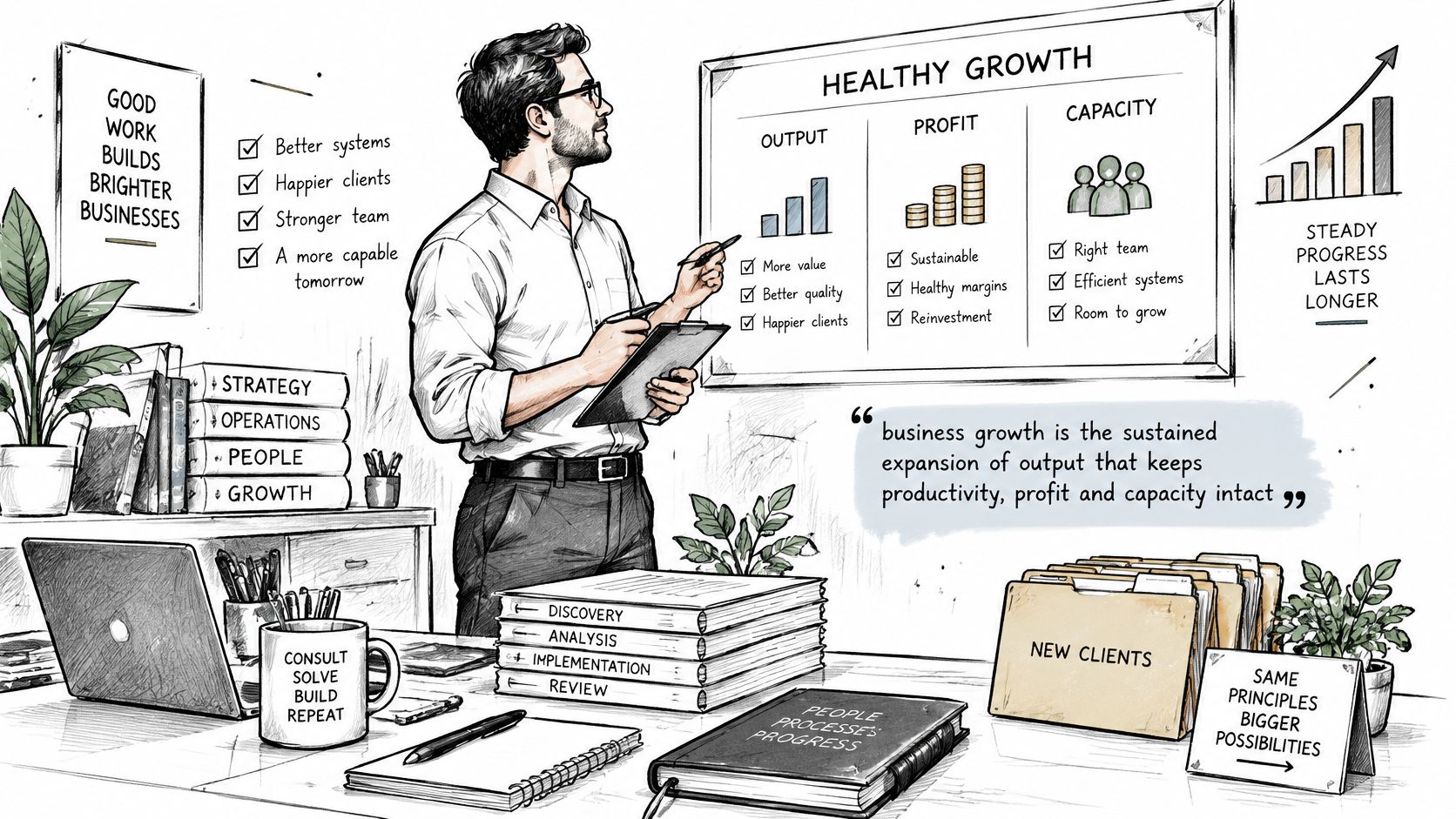
Business growth is the sustained expansion of output while maintaining or improving productivity, profitability, and organizational capacity. Growth that breaks the team isn't healthy growth.
Revenue measures what clients pay you. It doesn't tell you how much effort went into earning that money, how much remains after delivery costs, or whether your team can do it again.
Say a bakery doubles its orders but needs twice the staff and sells its products at a loss. The bakery has increased its size, not its financial health. A consultancy can make the same mistake by accepting every project and relying on unpaid founder overtime to finish the work.
The framework below puts operating health alongside expansion.
Read the whole business, not just sales
Track these measures together:
- Revenue growth: Are clients buying more work?
- Employment growth: How quickly are you adding people relative to output?
- Gross margin: What remains after direct delivery costs?
- Customer retention: Do clients stay when there's a continuing need?
- Cash conversion: How reliably and promptly does completed work become collected cash?
- Labor productivity: How much output does the team produce for its working time?
The OECD defines productivity as the efficiency with which inputs become outputs and identifies it as an engine of sustainable economic growth; its firm-level research found that employment scalers in Finland, Italy, Portugal, and Spain were already 5–15% more productive than comparable firms before entering a high-growth phase, according to its productivity research. Operating discipline can precede expansion rather than emerge automatically afterward.
For a consulting firm, that means converting additional qualified demand into profitable engagements without a proportional increase in administrative labor. A busier inbox isn't the objective.
For an accounting perspective alongside your operational review, Stewart Accounting Services offers a resource on understanding business growth for UK SMEs.
Start with your latest complete annual accounts and staffing records. Write down revenue, margin, and headcount, then compare their movement: if staffing and sales increased but margin deteriorated, identify the delivery costs before celebrating the larger revenue line.
Three Types of Growth and the Stages Behind Them
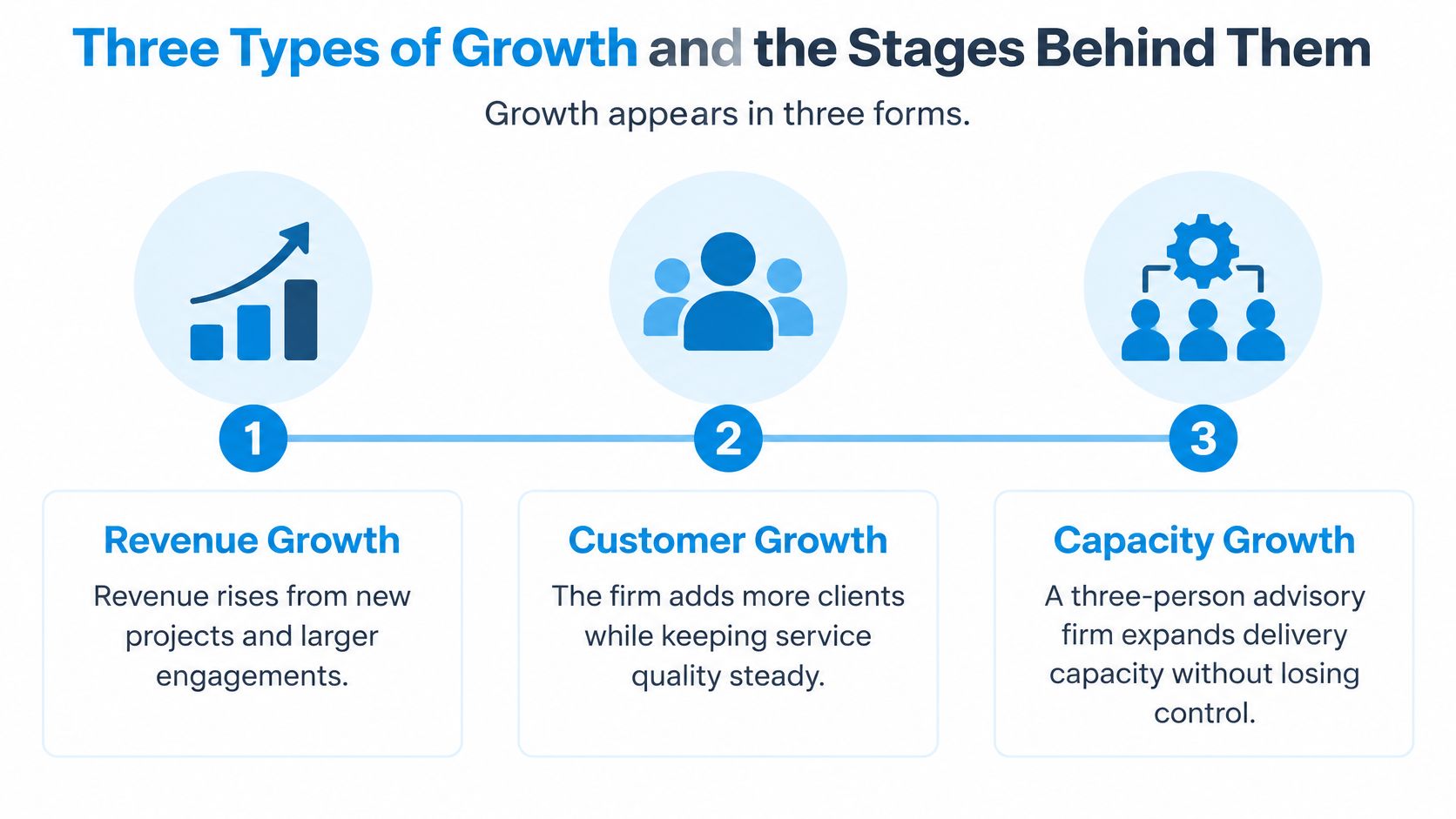
Growth appears in three forms. Consider a small advisory practice: new retainers increase revenue, successful relationships bring additional clients, and reusable delivery methods expand what the existing team can handle.
Those changes are connected, but they aren't interchangeable. Winning another client doesn't necessarily create more delivery capacity.
This diagram separates the forms of growth.
Growth types and what each one signals
| Growth type | What rises | Healthy signal | Warning sign |
|---|---|---|---|
| Revenue growth | Income from new and existing clients | Revenue rises with gross margin stable | Revenue rises while margin falls |
| Customer growth | Active clients and repeat buyers | Retention holds as new clients are added | Churn cancels out each new win |
| Capacity growth | Output per team member | Delivery time holds or falls as volume rises | Overtime and rework rise with volume |
Capacity growth doesn't mean rushing. An advisor who uses an agreed discovery template can spend less time reconstructing client requirements and more time exercising judgment.
Find the stage and its constraint
Use these stages as a diagnostic model, not a compulsory path. A firm may have mature delivery processes while its selling still depends entirely on the founder.
- Founder-led start. The owner sells, scopes, and delivers. Lead response becomes inconsistent whenever client work takes priority.
- Traction. Referrals and repeat clients arrive, but proposal follow-up lives in individual inboxes. The bottleneck is turning interest into a clear decision.
- Systemizing. The team documents pricing, pipeline stages, and responsibilities. Delivery capacity becomes easier to see, including the specialist whose availability limits new work.
- Scaling. New hires deliver through repeatable methods. The pressure shifts toward handoffs, quality control, and making sure sales promises match available capacity.
- Maturing. Leaders concentrate on retention, stronger offers, and client selection. The constraint may be choosing which work deserves scarce senior attention.
A reliable transition from sale to service matters particularly during systemizing and scaling. Understanding what client onboarding involves helps separate a signed agreement from a delivery-ready engagement.
Use this video as an additional perspective on business growth.
Choose the stage that best describes how your firm works, not its age or ambition. Then ask which bottleneck you hit first when another suitable prospect arrives.
Metrics That Show Whether Growth Is Real
Growth metrics, healthy direction and what each reveals
| Metric | What it measures | Healthy direction | What it reveals |
|---|---|---|---|
| ARR | Annual recurring revenue from retainers and subscriptions | Rising, net of churn | How predictable income is |
| LTV | Gross margin a client yields over the relationship | Rising with retention | What each client is worth |
| CAC | Cost to win one new client | Flat or falling as volume grows | What acquisition costs |
| LTV:CAC ratio | LTV divided by CAC | Improving without weaker service or retention | Whether client value supports acquisition spending |
| Gross margin | Revenue minus delivery cost, as a share of revenue | Stable as volume rises | Delivery economics per engagement |
| Proposal-to-win rate | Won proposals divided by proposals sent | Stable or rising | How well the sales process converts |
| Revenue per delivery employee | Revenue divided by delivery headcount | Stable or rising as the team grows | Whether capacity is scaling |
Read these measures as a group. Rising client lifetime value alongside falling acquisition cost is encouraging, provided delivery quality and cash collection remain sound. Rising revenue alongside falling gross margin calls for investigation.
For project-based firms, track repeat or retainer revenue rather than forcing irregular engagements into annual recurring revenue. Label values you don't track as unknown, not zero.
Calculate consistently before comparing
Use these formulas with clearly defined reporting periods:
- Revenue growth rate: Current-period revenue minus prior-period revenue, divided by prior-period revenue, expressed as a percentage.
- CAC: Total sales and marketing spending divided by new clients won during the same period.
- Estimated LTV: Average annual revenue per client multiplied by gross margin percentage and average relationship length in years.
- Proposal-to-win rate: Won proposals divided by proposals sent, using a consistent proposal group and allowing time for decisions.
Jumpstart Partners explains how to compare revenue year over year, a useful starting point for avoiding mismatched periods.
Be careful with acquisition cost when engagements take a long time to close. Spending incurred now may produce clients later, so review acquisition over a period that reflects your sales cycle. Include the cost of founder selling time where practical, or label its exclusion clearly.
LTV is an estimate, not money already earned. Separate established client relationships from new ones so optimistic assumptions about retention don't disguise expensive acquisition.
Watch the constraints behind the numbers
JPMorganChase found that 40% of small businesses surveyed identified labor shortages, retention, or recruiting as significant challenges in its Business Leaders Outlook. Demand alone doesn't establish whether a team can fulfill the work.
Keep qualified pipeline, proposal conversion, engagement margin, available delivery capacity, and repeat or referred revenue visible together. Pipeline should include opportunities that meet your fit criteria, not every person who downloaded a document.
For referred revenue, record the source when the opportunity enters the system. A consistent method for tracking referrals lets you distinguish dependable relationships from occasional introductions.
Diagnostic rule: If the founder must rescue every sale or every delivery, the figures may describe personal effort rather than a business that can expand reliably.
A softer sales period can still reflect a better commercial decision if you're replacing unsuitable work with engagements that use your expertise profitably.
Repeatable Operations and Client Acquisition Handoffs
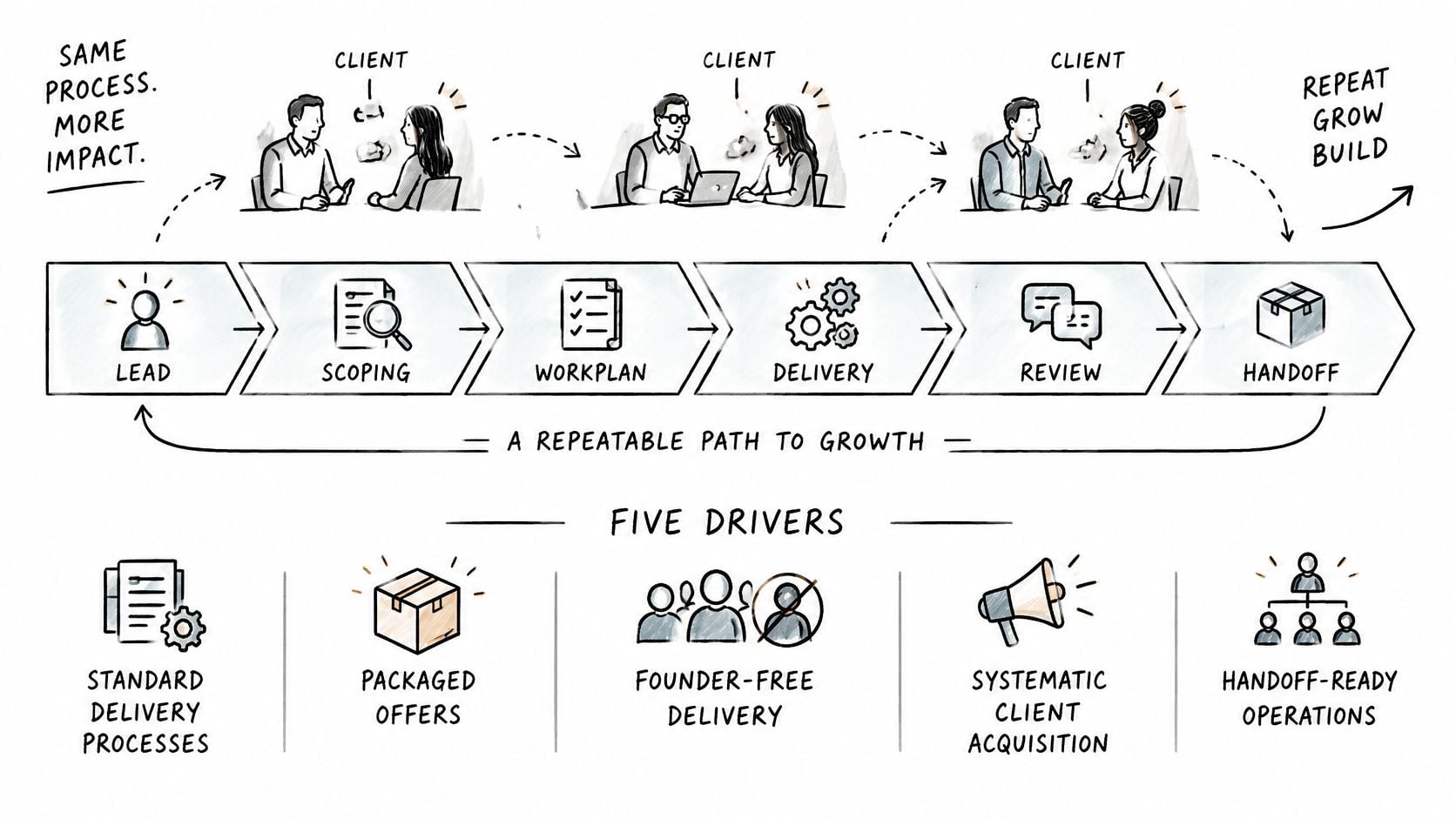
Repeatable growth starts with work that doesn't need to be reinvented each time. Your team needs a shared way to qualify an inquiry, define the engagement, transfer the promises made, and deliver the agreed result.
That doesn't mean treating every client identically. Standardize the routine work so advisors can concentrate on the parts that require judgment.
The OECD's productivity figures for 2024 put average SME labor productivity at approximately 65% of that of large firms across OECD and accession-candidate economies, although medium-sized business-services firms often matched or exceeded large firms, according to the OECD Compendium of Productivity Indicators. Size alone isn't an operating strategy.
The process below connects acquisition to delivery rather than treating them as separate departments.
Standardize delivery and package the right expertise
Standard delivery processes give each engagement a common foundation: an approved scope, a workplan, named responsibilities, review points, and completion criteria. Keep room for exceptions, but require the owner to document what changed and why.
For example, an advisory team can use the same discovery questions to establish the client's objective, decision-maker, available information, and constraints. The proposal writer then works from an agreed record instead of scheduling another internal conversation to reconstruct the call.
Measure rework hours and elapsed proposal preparation time. If documentation improves but advisors still repeat discovery, inspect whether the questions capture what delivery actually needs.
Packaged offers turn recurring client needs into defined engagements. Specify the outcome, included activities, client inputs, exclusions, and how additional work is approved.
Fixed-scope pricing can make buying and staffing clearer, but the firm accepts more estimation risk. A diagnostic package won't remain profitable if advisors include implementation whenever a client asks. Compare estimated and actual delivery effort before expanding the offer.
Make relationships and sales stages accountable
Tracked referral relationships help advisors maintain relationships without depending on memory. Keep the introducer, relevant expertise, last conversation, and next action attached to the relationship.
A useful progression is New Relationship, Connected, Partner, Referral, Active Partner, and Nurture. Don't mistake a friendly conversation for an active referral source, and don't treat partners as a free channel: relationship maintenance still takes time.
Clear sales-stage criteria make each opportunity's position meaningful. Discovery Complete should indicate that the buyer's need, fit, decision process, and likely next action are understood, not merely that a meeting happened.
For every open proposal, record:
- Decision owner: Who can approve the engagement?
- Next action: What will the advisor or buyer do next?
- Expected timing: When should that action happen?
- Unresolved issue: What could prevent a decision?
Track all buying-committee contacts on the same opportunity. Otherwise, an advisor may interpret one enthusiastic contact as organizational agreement while procurement or another executive remains uninvolved.
A CRM for consulting firms should support this shared record. Automating reminders around unclear stages produces more reminders without better decisions.
Plan capacity before accepting the start date
Delivery capacity planning connects proposed work with actual availability. Review booked commitments, likely starts, specialist requirements, leave, and the time needed for reviews and internal work.
Don't aim to fill every available hour. A schedule with no room for client questions or corrections leaves the team unable to absorb normal variation.
Consider a firm that generates more inquiries while its lead advisor is fully committed. Faster qualification can help it decline unsuitable work and offer realistic start dates, rather than promising immediate delivery and transferring the problem to colleagues.
Watch throughput per employee, meaning completed work relative to staffing, alongside utilization and gross profit per engagement. Faster completion is useful only if the team maintains quality and clients receive the agreed outcome.
Treat the handoff as a defined event
At Starward Navigators, we map how leads, meetings, proposals, clients, and referral partners move through a customer's firm before configuring pipelines, follow-up sequences, reminders, routing, and handoffs. The sequence matters: understand the work before automating it.
When a prospect becomes a client, our handoff marks the opportunity Won, updates the client record, starts the delivery pipeline, notifies the owner, and begins onboarding and kickoff scheduling automatically.
The receiving advisor also needs the context: agreed scope, success criteria, stakeholders, promises, exclusions, and outstanding client inputs. A notification without that information still leaves someone searching through email.
A signed proposal should trigger a defined delivery process, not an internal search for who takes over.
This week, inspect lead response time, proposal follow-up coverage, and elapsed time from signature to kickoff. List unanswered inquiries, proposals without a next action, and signed engagements without a delivery owner. Fix the missing ownership before adding another acquisition channel.
Misconceptions That Mislead Growing Firms
Growth means hiring
Hiring can relieve a real capacity constraint. It can also add cost while leaving unclear responsibilities and duplicated work untouched.
Before opening a role, separate specialist work from avoidable administration. If existing advisors spend their time chasing missing information, another advisor may inherit the same problem.
More leads means more growth
More inquiries help only when the team can identify suitable buyers and move them toward a decision. An unqualified inquiry still requires attention, even when it never becomes revenue.
Check lead quality and conversion by source. A channel producing fewer suitable engagements may deserve more attention than one producing a crowded inbox.
Slowing sales always means failure
An owner may deliberately stop selling work that consumes scarce expertise without an adequate return. That isn't the same as losing demand for the firm's strongest offers.
Check why sales slowed. Declining unsuitable projects is a choice; failing to answer suitable prospects is an execution problem.
Adopting AI equals growth
Consultancy.eu reports that more than 80% of management consultants use AI in daily work, while 56% report saving three to four hours per day, in its coverage of management consulting trends. Those are measures of adoption and reported time savings, not proof of profitable firm growth.
An advisor who drafts proposals faster has created available time. The commercial benefit depends on what happens next: more suitable proposals, shorter delivery cycles, deeper analysis, or more internal tasks.
- Price deliberately: Decide whether clients are buying hours, a defined deliverable, or an outcome. Faster work can require a different pricing conversation.
- Prove value: Compare the client's starting position with the agreed result, not the volume of AI-generated material.
- Protect trust: Require accountable human review, protect confidential information, and check factual claims before delivery.
A boutique firm's practical questions are how to price faster delivery, how to demonstrate the value created, and which safeguards preserve quality. Buying access to a tool doesn't answer any of them.
Build Your Growth Scorecard This Quarter
Build a scorecard before choosing another growth initiative. Use accounting records, your opportunity pipeline, and delivery schedules to establish a baseline that someone on the team can update consistently.
Keep the measures visible rather than buried in separate reports.
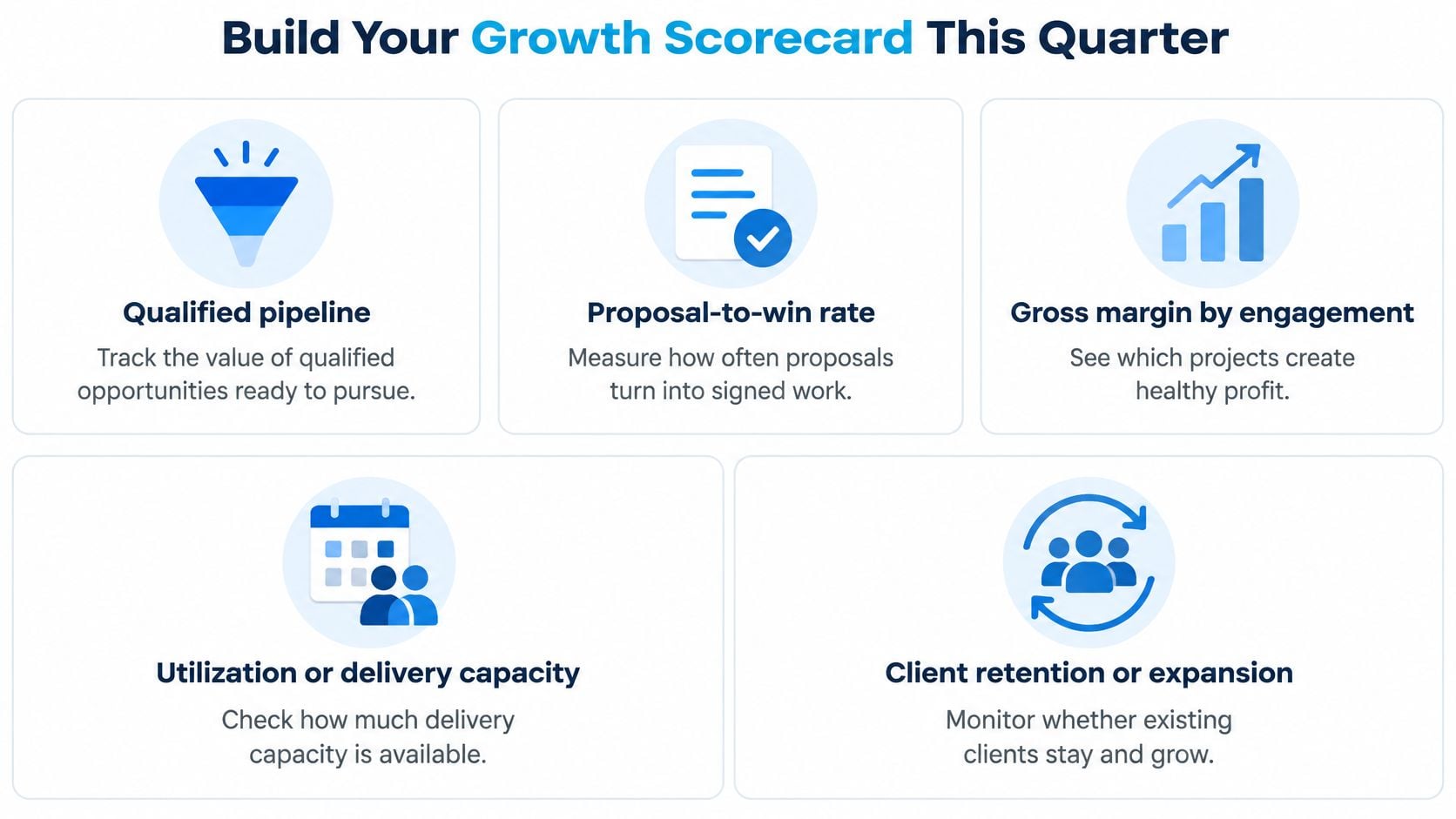
Growth scorecard template for this quarter
| Measure | Healthy direction |
|---|---|
| Qualified pipeline | Rising |
| Proposal-to-win rate | Stable or rising |
| Gross margin by engagement | Stable as volume rises |
| Utilization or delivery capacity | Stable or improving |
| Repeat or referred revenue | Rising |
Turn the baseline into a decision
- Record the baseline. Use the last completed quarter, document definitions, and mark missing values unknown.
- Assign ownership. Name who updates each measure and where the underlying records live.
- Choose the bottleneck. Identify the constraint that prevents suitable work from moving forward.
- Make a focused change. For example, require every sent proposal to have a named owner and scheduled next action.
- Review at quarter end. Compare the measures and inspect whether the change improved the constrained part of the process.
Use a combined verdict rather than an arbitrary pass mark. Revenue rising with margin intact, dependable delivery, and stronger client relationships supports a conclusion of healthy growth. Conflicting signals call for investigation.
Implementation can follow Map, Install, and Go Live: map how leads and clients move, install pipelines and follow-up, then begin using the operating system while repetitive follow-up runs automatically. You can choose the tools, but establish the scorecard first.
Answer this question this week: Will the next client be won, delivered, and referred through a process your firm can repeat?
Starward Navigators builds client acquisition infrastructure for consulting and advisory firms, connecting lead capture, proposal follow-up, client handoffs, and referral relationships. Visit Starward Navigators to explore how a mapped, repeatable acquisition process can support the growth your scorecard is designed to measure.