Companies that contacted an inquiry within an hour were more than 60 times as likely to have a meaningful conversation with a decision-maker as those waiting at least a day, according to the historical Harvard Business Review analysis summarized by Vida's speed-to-lead guide. That's a reason to treat lead assignment as an operating responsibility, not inbox housekeeping. But for a consulting firm, sending an inquiry quickly to the wrong advisor isn't a successful outcome either.
A useful lead routing system answers a harder question: who should own this opportunity when expertise, availability, relationship history and conflicts all matter? It also preserves enough context to establish whether that decision produced a qualified conversation, a proposal or revenue.
Table of Contents
- What a Lead Routing System Does for a Firm
- Routing Methods Compared Side by Side
- How to Build Your Routing Rules
- Response Targets, Escalation and Handoffs
- Common Failure Modes and How to Fix Them
- Measuring Whether Routing Improves Revenue
- Confirm Your Routing Rules Before You Go Live
What a Lead Routing System Does for a Firm
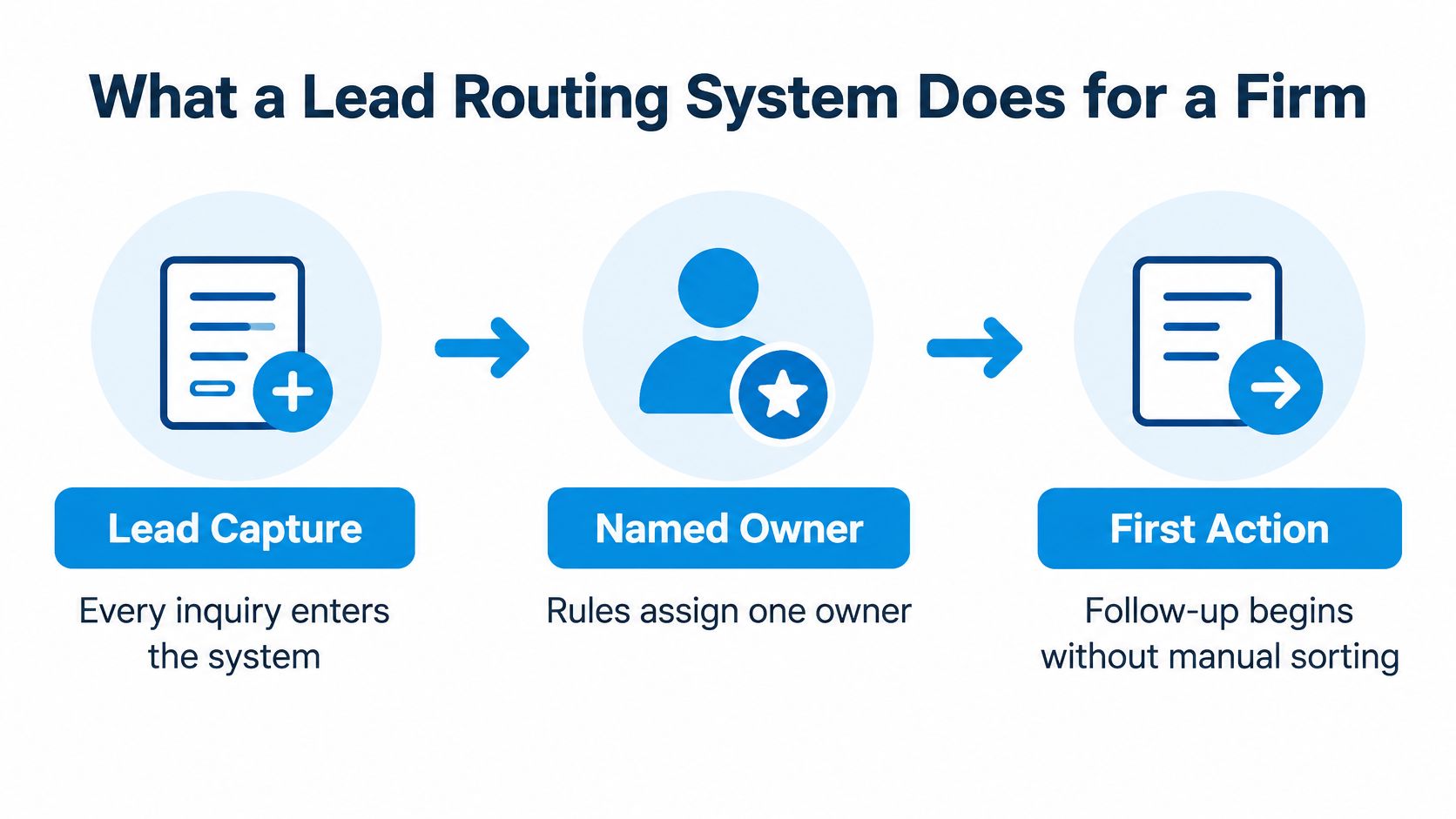
A lead routing system is the set of rules that takes every inquiry from capture to a named owner and a first action without anyone sorting a shared inbox by hand.
Say a finance director submits a website form on Tuesday afternoon asking about a fractional CFO engagement. The form captures the request, but that alone doesn't establish responsibility. Someone still needs to identify the company, check whether there's an existing relationship and decide which advisor can respond appropriately.
The basic operating path should be visible to everyone who handles inquiries.
Follow the inquiry into qualification
The system first creates or updates the finance director's contact record. Website forms, LinkedIn conversations, referral introductions and event contacts should enter the same operating process, even if their capture methods differ.
Before creating another contact, it checks for an existing email address and associated company. An exact email match can update the existing person; a company match should flag the account relationship without merging different employees into one person.
The system then classifies the inquiry by source, service line, firm size and region. For this request, fractional CFO becomes the service line, while an existing-client flag determines whether an account owner needs to stay involved.
Assignment produces a named owner, an automatic acknowledgment and a first-touch task. Those are different events: the prospect's receipt confirmation doesn't prove that an advisor has read the request.
Practical rule: A notification isn't ownership. Ownership means a named person has a next action and a deadline.
Finally, the system records receipt, assignment and outreach timestamps, then moves the opportunity into qualification when the advisor establishes fit. The advisor should see the original request, not just a message saying that a new lead arrived.
Think of the system as a receptionist who knows which partner handles which client and never leaves a call indefinitely on hold. The receptionist doesn't need to solve the engagement, but must get it to someone who can take responsibility.
Start with a source inventory: list every way an inquiry reaches your firm and mark where each currently waits for someone to notice it.
Routing Methods Compared Side by Side
For a small consulting firm with mixed services, weighted assignment is usually a better starting point than simple rotation. It lets you consider suitability and workload together rather than pretending every advisor can handle every inquiry.
Keep the model simple enough that a partner can explain an assignment without opening a workflow builder. If your advisors offer interchangeable services, rotation may be all you need.
Assignment methods and when each fits
| Method | How It Picks an Owner | Best Fit | Main Risk |
|---|---|---|---|
| Round-robin | Next person in rotation | Interchangeable staff with the same services | Ignores expertise and fit |
| Territory or geography | Owner by region or time zone | Firms with clients in several regions | Uneven load when one region spikes |
| Skill or specialty match | Owner by service line or sector | Firms with distinct advisory practices | Stalls when the specialist is booked |
| Relationship owner | Person who holds the referral or account | Referrals and existing clients | Leads wait when the owner is busy |
| Weighted score | Points for fit, value, capacity and availability | Larger small teams with mixed inquiries | Weights need scheduled review |
| Shared queue with claim | Any qualified person claims the lead | Solo advisors and small teams with similar skills | Unclaimed leads age without alerts |
Round-robin distributes opportunities evenly, not necessarily sensibly. A pricing inquiry from a regulated sector shouldn't reach a generalist just because they're next in line.
Territory routing helps when buyers need someone working compatible hours or familiar with a region. Specialty matching protects technical credibility, but neither method resolves absence on its own. You still need an eligible backup.
Relationship ownership preserves trust around referrals and existing accounts. A shared queue offers flexibility, but the queue itself can't be accountable: someone must monitor unclaimed work and intervene.
Combine methods without creating exceptions everywhere
Say an advisory team has sector specialists, a partner who manages introductions and generalists who handle initial qualification. A sector-specific website inquiry goes to an available specialist; if no specialist can respond, an eligible generalist takes responsibility for intake while keeping the specialist attached.
The generalist should confirm the requirement and arrange the right conversation, not improvise technical advice. A referral follows a different path: its relationship owner stays visible even when another advisor handles discovery.
For telephone intake, Voicedial.ai's guide to call routing provides useful context for deciding where callers should go. Distinguish that live-call decision from the longer-term decision about who owns the opportunity.
Your CRM for consulting firms should make both responsibilities visible rather than hiding them inside disconnected inboxes. Choose the method that suits your largest source of inquiries, then write its tie-breaker in plain English.
How to Build Your Routing Rules
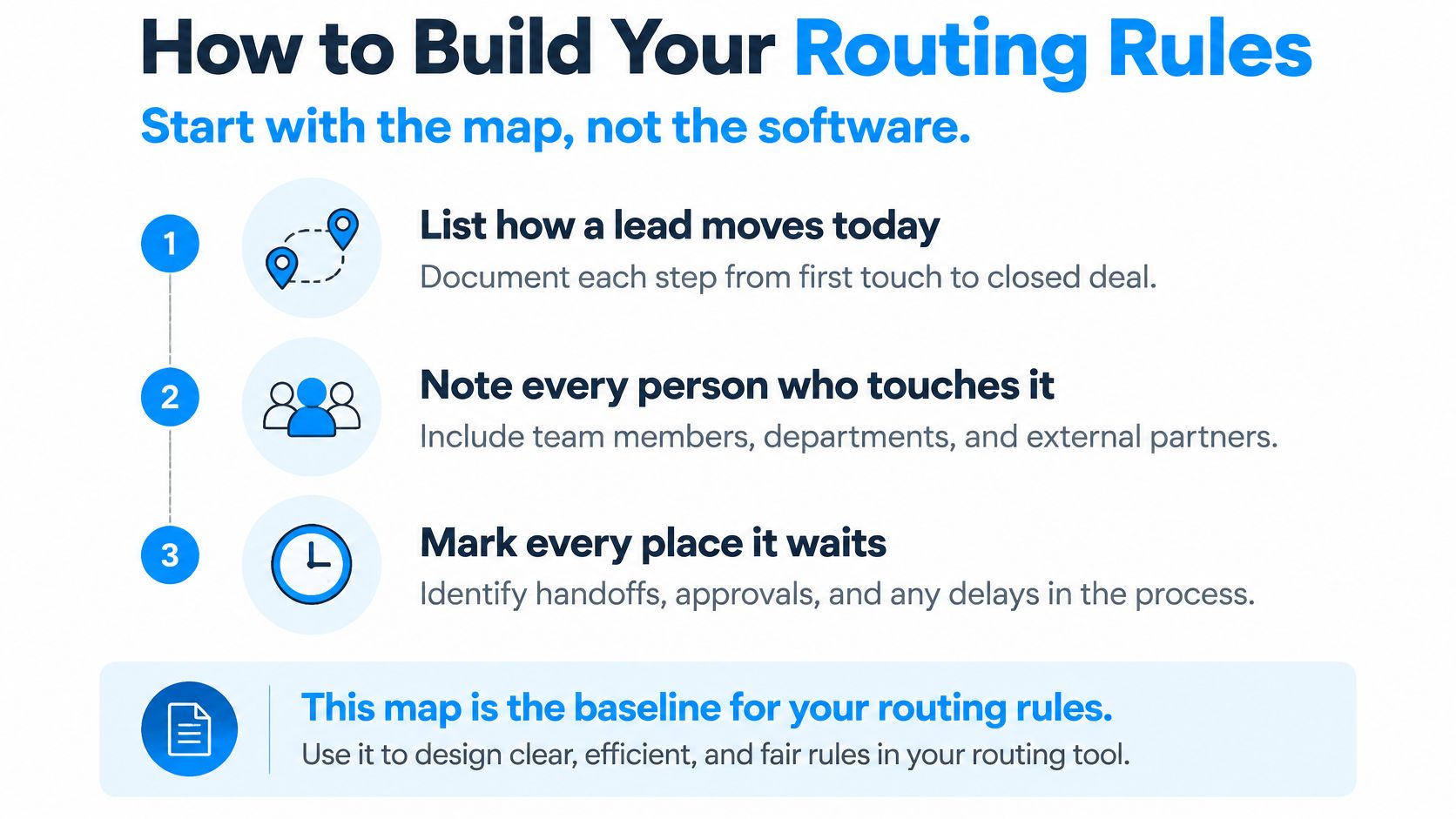
Start with the map, not the software. Automating an unclear process makes unclear decisions happen faster, and leaves the team arguing about exceptions after launch.
Use the current journey as the baseline, including the places where people forward messages or wait for a partner's approval.
Establish eligibility before preference
Map the actual handoffs. Trace an inquiry from arrival to discovery, naming every person who touches it and every place it waits. Include informal steps, such as a partner checking a forwarded email before an assistant can book a call.
Define the fields needed for a decision: source, service line, firm size, region, expected engagement value and existing-client status. Use controlled choices for routing fields, with an unknown option that sends incomplete requests to review rather than leaving them unassigned.
Apply hard exclusions first. Conflicts of interest, unsupported services and regions you don't serve must remove an advisor or practice from eligibility. Don't let a high expected engagement value override a conflict restriction, and don't expose sensitive conflict notes to everyone receiving notifications.
Rank eligible owners using fit, availability and open workload. Give relevant expertise priority over convenience, then distinguish who can take the next action; count active qualification work separately from engagements already in delivery.
Write the tie-breaker. Among equally eligible advisors, prefer the relationship owner when they can respond, then the least-loaded suitable person. Preserve a manual override, but require the person using it to record a reason.
Connect decisions to real events
Make capture event-driven. A submission should update the canonical record, check duplicates, classify the request and trigger assignment without waiting for a batch sync. I'd set a capture-to-assignment target below five minutes, consistent with the operating recommendation in Aloware's intelligent-routing guide, while measuring human outreach separately.
Test representative past inquiries before publishing the workflow. Include a specialist request, an existing client, an unavailable owner, an incomplete form and a possible conflict, then compare the selected owner with the person you would choose manually.
In our setup process, we map how leads, meetings, proposals, clients and referral partners currently move through the firm, then configure the prebuilt pipelines, follow-up, reminders, routing and handoffs around that map. The decisions come before the configuration.
Use a workflow walkthrough to make the sequence easier to review with the people who'll operate it.
Record test outcomes as correct assignment, wrong assignment or manual review required. Don't invent a passing result: document what happened and name the rule responsible for each mismatch.
Change the most consequential rule first. A conflict reaching an ineligible advisor is more urgent than a minor imbalance between otherwise suitable owners.
Response Targets, Escalation and Handoffs
Response targets and escalation by lead type
Treat these as starting operating targets, not promises of conversion. The clock should reflect buyer intent and the coverage your firm can provide.
| Lead Type | First Human Touch Target | Automatic Acknowledgment | Escalate If Unworked After |
|---|---|---|---|
| Website inquiry for a discovery call | Within the five-minute response window during business hours | Immediate | When the short-response escalation timer expires |
| Referral from a partner | Promptly within the staffed response window | Immediate | Before the referral remains unattended through the working session |
| Event or conference contact | Same business day | On import and validation | Before the owner's working day closes |
| LinkedIn reply to outreach | During the current staffed response window | Immediate where the tool allows | When the owner's response window expires |
| Request for a later date | Confirm the requested booking during the next business day | Immediate | If the booking remains unconfirmed at the deadline |
The five-minute website target has a specific historical basis: the MIT/InsideSales.com lead-response study found that the odds of contacting a web-generated lead were 100 times higher when the first call occurred within five minutes rather than thirty minutes.
That comparison concerns web leads and calls, not every consulting inquiry. A partner introduction requires a relevant response; an event contact may need the advisor to establish permission and context before pitching a meeting.
Define what starts and stops the clock
Use business hours in the assigned owner's time zone, with a published coverage calendar. An after-hours acknowledgment should state when a person will respond, rather than implying that someone is already reviewing the inquiry.
If the firm doesn't staff weekends, queue weekend arrivals for the next opening and start the staffed-response timer then. Retain the original receipt time as well, so reports don't conceal how long the prospect waited.
The owner must explicitly acknowledge the assignment. Reading an email notification shouldn't count as acceptance, and accepting a task shouldn't count as contacting the prospect.
Escalation should transfer responsibility, not erase the history of who was expected to act.
When an owner hasn't accepted or worked the inquiry by its deadline, select the next eligible advisor. Keep the original owner, reassignment reason and pending tasks on the record, and cancel obsolete outreach tasks to prevent competing messages.
For a live transfer, the receiving advisor needs the caller's request, what's already been discussed and the action they've agreed to take. Rednea's handoff scripts for escalated calls offer a useful structure for that conversation.
The same discipline applies after sale. Our won handoff marks the opportunity Won, updates the client record, starts the delivery pipeline, notifies the owner and begins onboarding and kickoff scheduling automatically.
Configure follow-up automation around explicit events and stop conditions, including a reply, a booking or a change in ownership. Give every response-table row a named timer and test an escalation before relying on it.
Common Failure Modes and How to Fix Them
Faster isn't always better. An advisor who immediately sends the wrong message can mishandle a valuable introduction more efficiently than someone working manually.
Slow response remains a real concern: an analysis of 939 B2B companies summarized by MergeYourData found an average response time of 47 hours. But lowering elapsed time won't fix a mismatch between the inquiry and the person answering it.
Routing symptoms, likely causes and fixes
| Symptom | Likely Cause | Fix |
|---|---|---|
| Leads sit unassigned overnight | No rule matches the source or region | Add a catch-all queue with recurring staffed-hours alerts |
| Two consultants email the same prospect | Duplicate records from separate channels | Match on email and check the company before assignment |
| Fast replies but no qualified meetings | First responder lacks sector expertise | Add a service-fit score and send specialist work to specialists |
| Referral partner feels ignored | Relationship owner not kept on the record | Preserve the owner and trigger a thank-you when the referral lands |
| One consultant receives most leads | Assignment ignores open workload | Weight assignment by open load and availability |
| Event leads never get routed | Badge lists aren't connected to capture | Connect approved event imports to intake and retain the event source |
| Spam submissions consume owner time | No filter before assignment | Add form validation and a suspect-lead review queue |
An unmatched inquiry needs a temporary accountable owner, not just a new queue name. Confirm the fix by submitting a request with an unmapped region and checking that someone receives an actionable alert.
Duplicate handling requires care. Shared company domains identify related contacts, not necessarily duplicate people; check that a repeated submission updates the right person without merging colleagues.
For expertise mismatches, inspect the content of the first exchange. A booking link sent quickly isn't useful if the prospect asked whether your firm understands a sector-specific issue.
Test the behavior, not just the setting
Say a small consultancy sends a sector-specific referral to a generalist who replies with an irrelevant service pitch. The referring partner objects because the introduction was supposed to reach a specialist.
The appropriate correction is to preserve the relationship owner and attach the relevant specialist before outreach. The confirmation isn't merely that a new rule exists: the next test referral must reach the right people with its introduction intact.
For overloaded consultants, inspect work requiring action, not total records owned. Someone with dormant opportunities shouldn't automatically appear busier than a colleague handling active proposals.
Event imports need an explicit trigger and a source tag. Test an approved import through to an owner's task, and ensure that importing a badge list doesn't automatically enroll every attendee in an inappropriate sequence.
Spam controls should divert suspicious submissions without deleting plausible inquiries. Verify that the review owner can restore a legitimate request and preserve its original arrival time.
Apply straightforward configuration changes in a focused work session, then observe them across a normal operating cycle. Judge the result by qualified meetings, proposal progression and won business, not merely by whether notifications arrived faster.
Measuring Whether Routing Improves Revenue
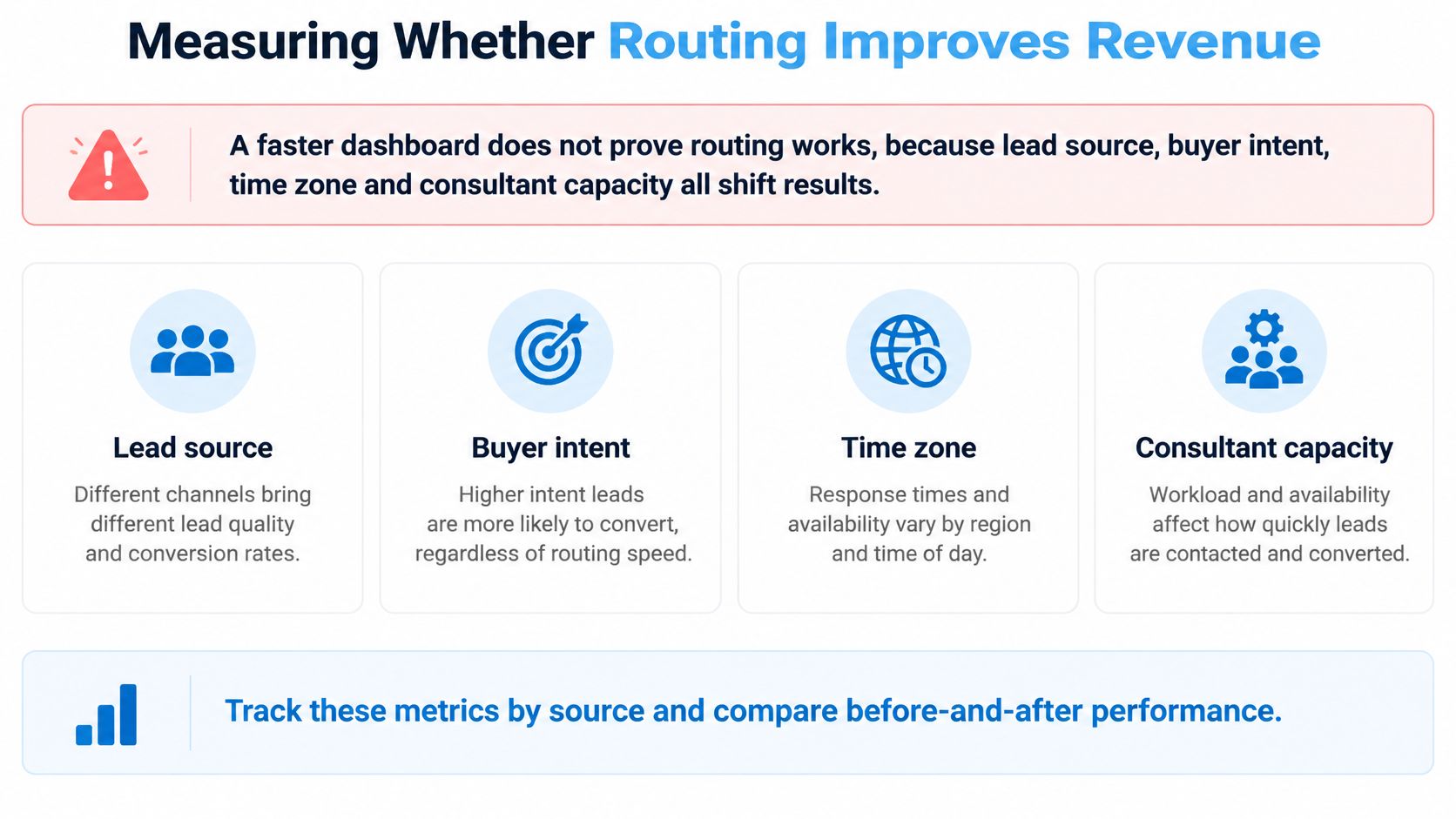
A faster dashboard doesn't prove routing works, because lead source, buyer intent, time zone and consultant capacity all shift results. Comparing an urgent website inquiry with an early-stage event conversation won't isolate the effect of assignment.
Keep these differences visible before interpreting an improvement.
Build a dashboard that separates activity from outcomes
The speed comparisons collected in Bebop's sales follow-up statistics are useful context, but they aren't a universal causal benchmark for your firm. Your operating report should separate:
- Response speed: Median and upper-percentile time to human outreach, grouped by source and region.
- Coverage: Share of legitimate inquiries successfully assigned and share receiving a human response.
- Progression: Qualified-meeting rate, proposal rate and win rate, using consistent stage definitions.
- Commercial value: Revenue per lead, with a clear revenue definition and enough time for opportunities to mature.
Watch the slow end of the response distribution. A healthy median can coexist with neglected inquiries, especially when unmatched requests or after-hours arrivals disappear from the main report.
Define the denominator before calculating rates. Exclude confirmed bots, consolidate duplicate submissions appropriately and separate requests for later contact from inquiries awaiting an immediate response.
Test a change without changing everything
Compare quicker and slower human-follow-up windows only where both are acceptable for the buyer. Keep acknowledgment, source mix, routing eligibility and message quality consistent; don't deliberately delay urgent requests to create a test.
Preserve source, owner, receipt time, assignment time, human-attempt time, consent status and next step through every transfer. For partner-led opportunities, use a consistent approach to tracking referrals so the relationship source remains attributable after reassignment.
A faster workflow is an operational improvement. A better commercial outcome requires evidence further down the pipeline.
If outreach becomes quicker but qualified meetings remain flat, inspect fit criteria, message relevance and booking friction before declaring success. If meetings increase but proposals don't, review qualification quality rather than tightening the timer again.
Review cohorts after they've had a reasonable opportunity to progress. Small volumes and long advisory sales cycles can make short comparisons inconclusive, so retain the uncertainty instead of reporting a performance lift you can't support.
Hold a monthly review by source. Change a rule, record the reason and compare the next eligible cohort without simultaneously rewriting the entire process.
Confirm Your Routing Rules Before You Go Live
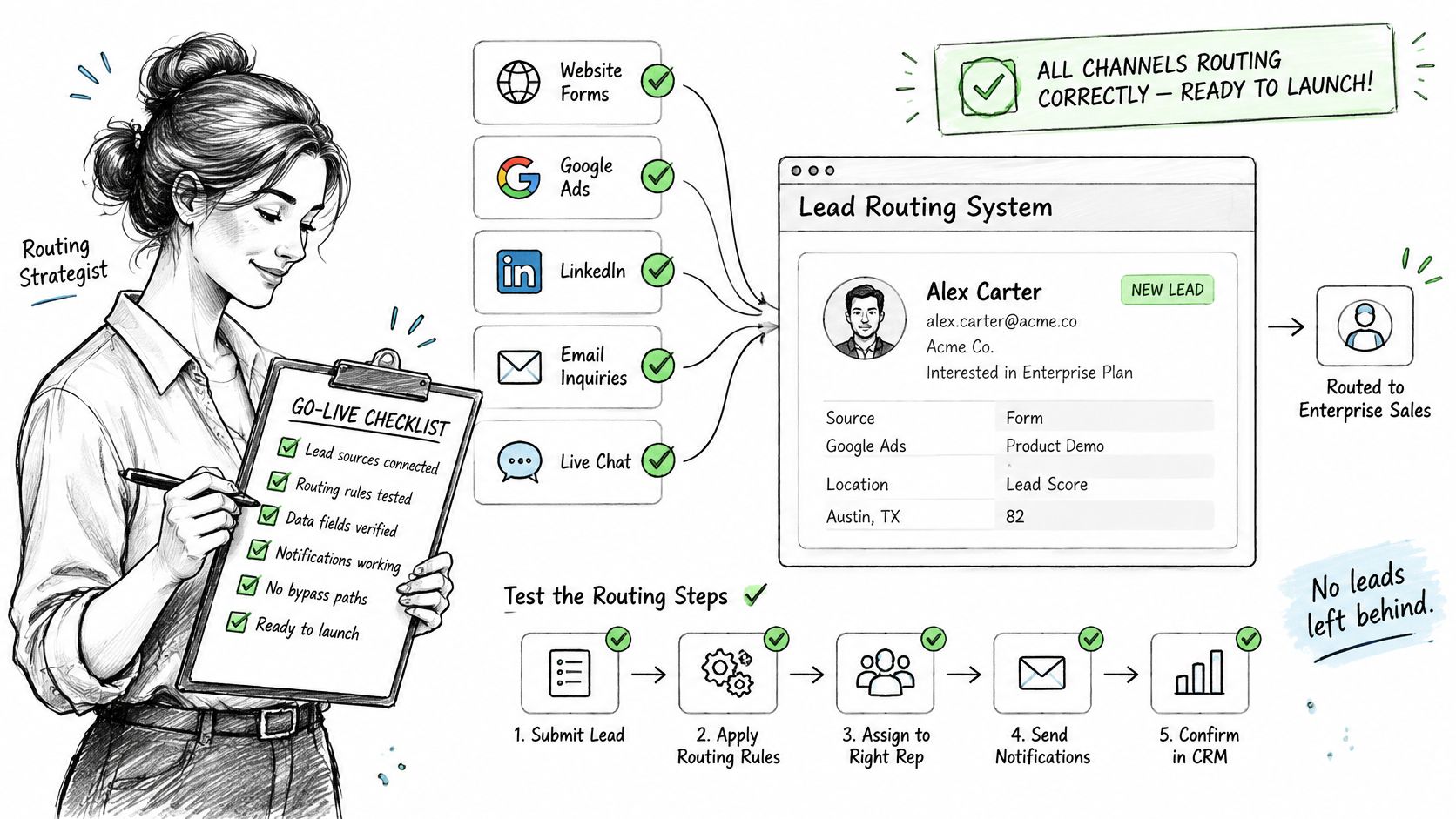
Launch readiness means demonstrating what happens when the normal path fails, not just watching a clean website submission reach a partner.
Use the checklist with the people who'll own intake, sales and delivery.
Require an owner's sign-off
Confirm capture coverage. Submit a test through each inbound channel and verify that the contact and opportunity land in the intended records. Check that an inbox-forwarding habit or event spreadsheet doesn't bypass intake.
Have the responsible advisor approve each routing scenario. Include an unknown service request, a relationship-owned referral, an absent specialist and a conflict requiring restricted review.
Confirm timer coverage and backups. Name the fallback owner for every staffed period and document what happens outside it. An escalation that points to another unavailable person isn't a fallback.
Run a test through the won transition and inspect the resulting delivery responsibilities. Confirm that kickoff scheduling has a clear next action and that essential discovery context remains available.
Book the operating review before launch. Agree which result would trigger a rule change, who can authorize that change and how the team will verify it afterward.
Keep the checklist in a shared document with the rule owner, last-change date and reason for the current setting. Record manual overrides too, because repeated exceptions often identify a missing policy.
Our implementation follows Map, Install and Go Live: Map establishes how leads and clients move through the firm; Install configures the prebuilt pipelines, follow-up, reminders, routing and handoffs; Go Live starts using the operating system while repetitive follow-up runs automatically.
Choose the first rule you'll test this week, assign its reviewer and book the review before switching it on.
Starward Navigators builds client acquisition infrastructure for consulting and advisory firms, connecting lead intake, follow-up, proposals and client handoffs around how your firm works. Visit Starward Navigators to discuss mapping your current process and configuring routing with clear owners, next actions and escalation paths.